Brief summary
Here we have gathered the key thoughts of the hero for those who want to quickly get acquainted with the content. We have posted the video and the full transcript of the interview below.
I came to art consciously, but late — at 28 years old. I believe an artist must constantly change, otherwise their work loses its power. That's precisely why I transitioned to non-objective painting: it's not abstraction, but a new way to express myself.
In independent Uzbekistan, works of art were not created — it's a matter of the market economy.
Even among professors and academics, there are those who reject contemporary art. As soon as you propose something new, you immediately face criticism.
In Uzbekistan, the art market has not developed. Purchasing power is low, collectors choose cheap works without understanding their value. Private galleries remain a hobby for the wealthy, not an independent business.
It is formally impossible to introduce patronage if people are not ready to spend on art of their own free will.
Modern art is met with difficulty here. Many artists fear experimentation, focusing on audience expectations rather than themselves. But any new direction initially faces resistance—otherwise, there is no progress.
Artists used to make a living from their creativity, but if you only manage to sell a couple of paintings, you can't survive on creativity alone.
Art schools are mostly attended by girls, but after graduation they rarely continue their careers: daily life and societal expectations get in the way.
Living with an artist is difficult: they are prone to emotions, their inspiration is unpredictable, and periods of failure affect those close to them.
"A good artist is a hungry artist" is an outdated myth. It all depends on the person: if you believe in your work and know how to sell it, you can live decently.
In Uzbekistan, there is no system for preserving paintings after the death of authors. Relatives do not know what to do with them, and the works are lost. A centralized storage facility is needed; otherwise, the country will lose part of its artistic heritage.
Video version of the interview
This option is for those who prefer to watch and listen (Uzbek language)
Full version
Here we offer the full version of the interview for careful reading.
— Ibrahim Muttalievich, were you interested in drawing from childhood? Did you dream of becoming an artist?
— Every person in childhood is interested in drawing and singing. I also started drawing back in preschool age.
From first grade through tenth grade, I attended the Pioneer House, which existed at that time. In our youth, we were very eager for education. My father was a simple foreman, but I really wanted to go to university. However, there was no one to guide me.
At that time, there was an organization called the Art Fund. Being interested in the local artists working there, observing their work, and improving myself, I often spent time there. In those days, there was a profession of a designer/illustrator, but such positions no longer exist now.
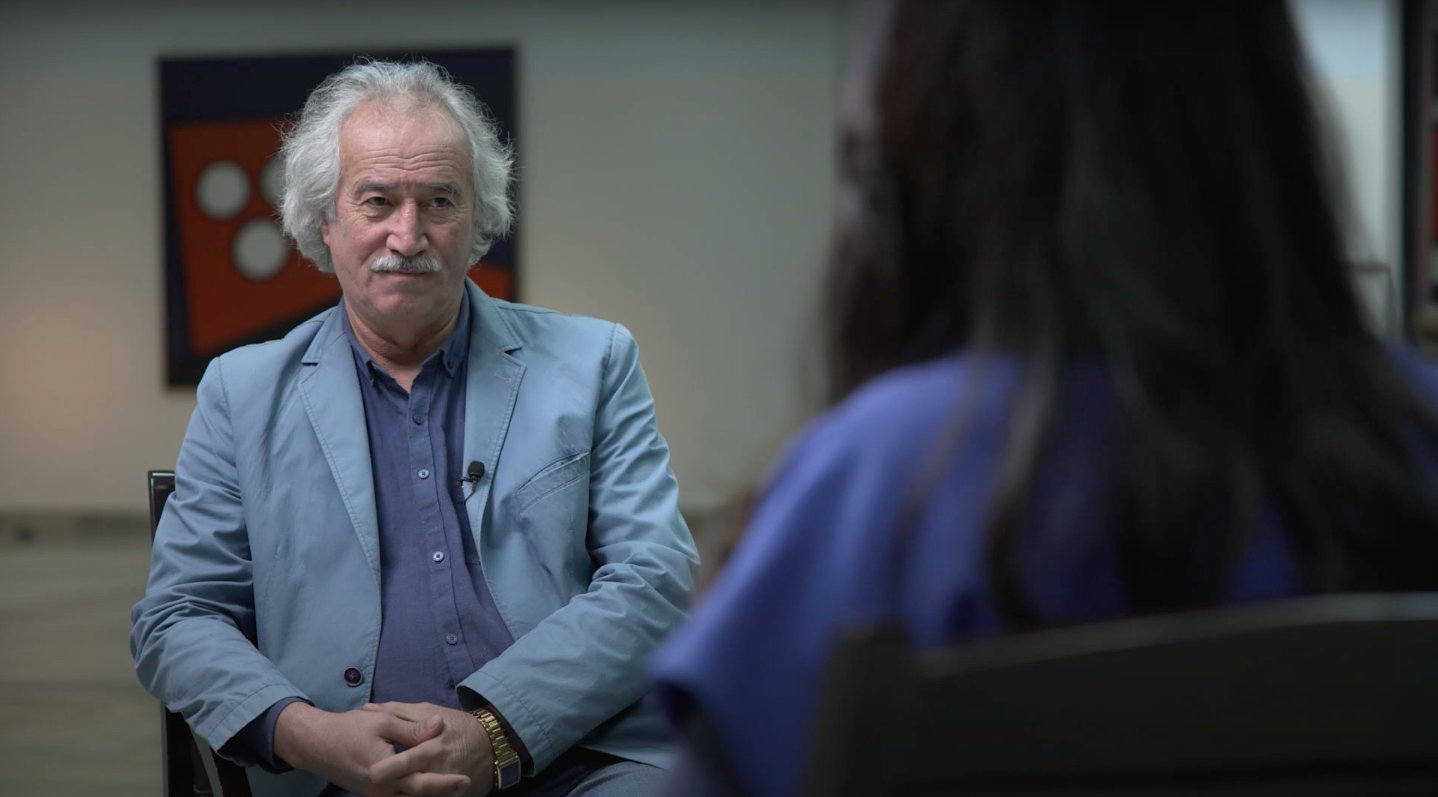
Ibrahim Valikhodzhaev during an interview for HD magazine
Every organization had its own graphic artist. I worked as a graphic artist in such an organization for 10 years. At 28, I submitted my documents to an institute called the Institute of Theatrical Art, and I managed to get admitted there right after school by passing the exams.
My professional interest in visual arts began for me, and since then I have continued to create as an artist.
— After enrolling in the institute, you entered Rakhim Akhmedov's workshop. Tell us, how did he influence your work?
— Interest originates within the person themselves. Before entering university, let's say, even during the 10 years I worked as a decorative artist, I went on plein air trips, painted studies, drew portraits of people from life, looking directly at them. I did a lot of work for myself.
That was a completely different era. There were teahouses with posters of Ural Tansykbayev holding a brush hanging on the walls. Seeing him, thoughts would arise: "I will become an artist just like that."
At that time, magazines dedicated to artists were published. I followed the works of Rakhim Akhmedov. Although he did not know us, I observed his works from my youth and admired them.
Rakhim Akhmedov had portraits that I remember—those of his daughter Nigora Akhmedova. I really liked them and often looked at them. By fate's will, after entering the institute and becoming a student, we ourselves applied to Rakhim Akhmedov's studio, and we had the opportunity to work alongside the master.
— French philosopher Albert Camus said: "Abstraction is the manifestation of a disappointment with reality." Is your work in abstraction a result of having outgrown the figurative style?
— In fact, this cannot even be called an abstraction. It would be more accurate to say that it is an aspiration, not a disappointment. Camus meant to say 'an escape from reality'.
You know, every creator must constantly change. Throughout my creative journey, I have created many works on the themes of bazaars, contemporaries, in the genre of portraiture and other genres. Now, this time, I intended to create a non-objective composition based on my own concept.
Accordingly, the works were created based on this concept, taking into account the dimensions of our hall. A total of 28 works were exhibited because, if you constantly have the same dish, it becomes tiresome.
We created works about our contemporaries, many multi-figure paintings were made, and I developed a desire to create works with one or two colors.
Is it abstraction or a continuation of previous works? In any case, it would be more accurate to say that all the colors used here are a continuation of previous works. Only works created with a different worldview and a different feeling are presented here.
— For an artist, it's very important to attend exhibitions and analyze artistic processes. In your opinion, can they develop far from Tashkent as the center of cultural life?
— We need to look at this from two perspectives. First of all, it's not just Tashkent, not just the capital of the republic—a creative person must see the whole world, then new ideas will start to emerge. You need to be aware of global news.
The Creator is a person who walks ahead of the people, and they must lead others. Therefore, they must always be aware of global events.
On the other hand, you're asking what results can be achieved working, say, outside Tashkent or even away from the center, right? For example, a creative person, even working in a desert area, can express what is in their soul. This can be even more interesting and better.
Paul Gauguin, for example, went to live in Tahiti. As a result, he became world-famous, even while living in a place far from the art world. Life there is different, unlike the familiar one. It is also necessary to create works that are distinct from others in a good way. I think that sometimes being away (from the mainstream) is necessary to find one's own path and unique creativity.
— Has an art market formed in Uzbekistan? What problems do private galleries face?
— I cannot say that the art market is fully formed, because for its formation, first and foremost, there must be a buyer. To become a buyer, a person must not only be fed but also materially satisfied. Only after that can they look at works of art with different eyes.
That's why we haven't developed an art market. Even affluent people who want to decorate their homes look for works on Broadway (the popular name for the pedestrian street Sayilgoh in Tashkent — ed. note), choosing the cheapest ones. A collector's collection should contain the most expensive works. How can one be a collector with cheap works?
Throughout my creative life, I have encountered many similar cases where collectors came to me with a request for work. When they bought 5-6 works, they would ask about the price, and their translator-intermediaries would say:
— Could you suggest a cheaper job?
I agreed, and then the collector said:
— How much does your work cost?
— That much.
— Why are you lowering the price? I don't need cheap work.
There have been such situations. Therefore, it stems from the understanding of our people.
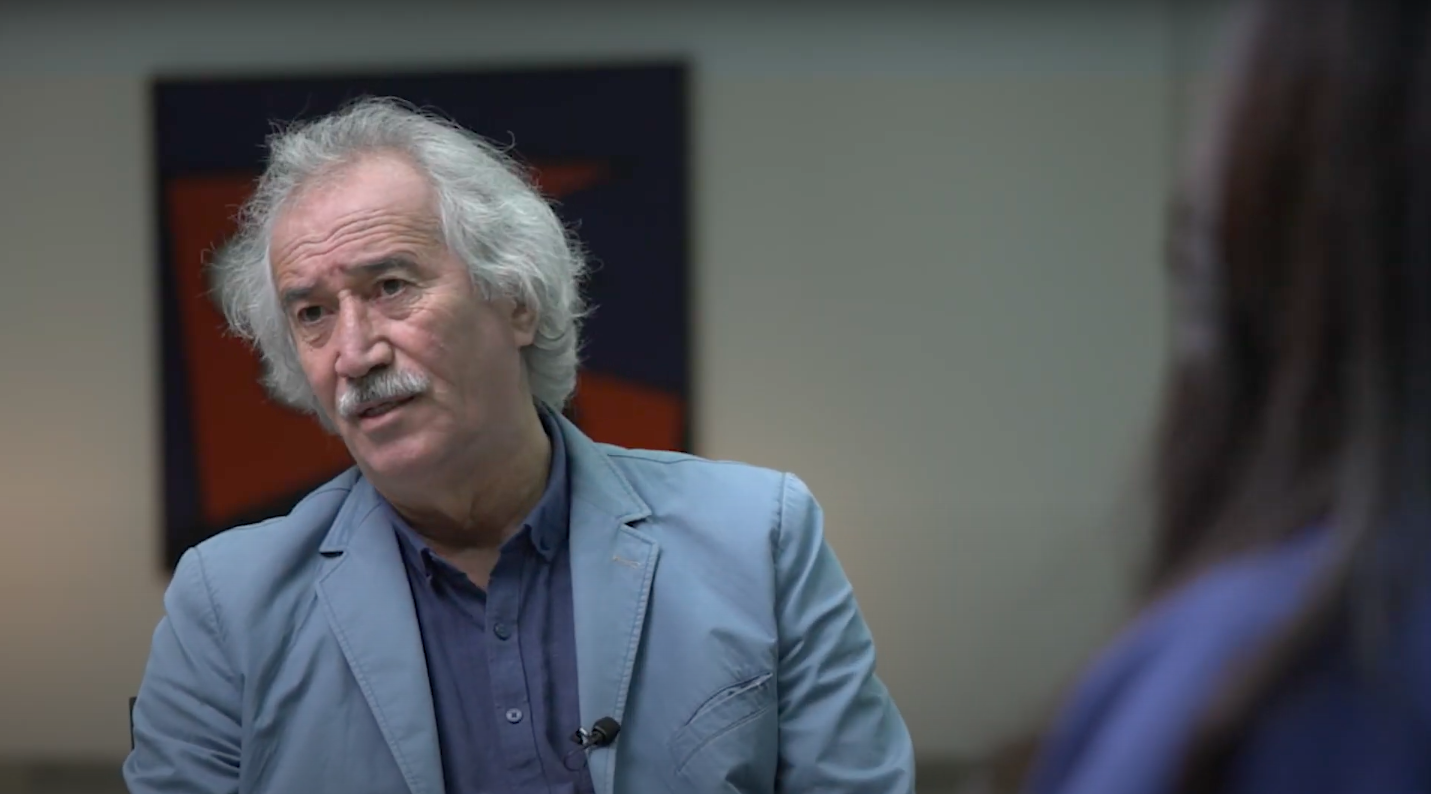
Ibrahim Valikhodzhaev during an interview for HD magazine
On the other hand, your question about galleries is correct. I opened the first private exhibition hall in Uzbekistan. The goal of its opening is that we saw how our youth and our artists were producing good works. Since I am an artist myself, I developed a desire to collect the best works from each exhibition.
Then, having certain capabilities, I began buying works from artists. I collected not only in the field of ceramics but also in applied arts, gathering various works of art for my collection.
However, private galleries do not operate for profit. It's a hobby. It would be more accurate to say it's a hobby of a wealthy person. They derive income from somewhere else and spend it on acquiring beautiful works of art.
Purchasing a collection does not mean having a gallery.
— Can patronage in Uzbekistan and tax incentives for artists similar to artisans become significant support?
— Of course, you cannot forcibly impose on people what they do not have. If a culture of perceiving visual art has not yet been formed, it cannot be forcibly instilled in a person.
Therefore, the state has been paying great attention to this recently: funds are allocated monthly to museums and galleries, works are purchased from artists' studios and exhibition halls, and a special commission has been established to support individual artists.
The thing is, during the period of independence, no works of art were created in our country. To the question "why?" one can answer as follows: it's all about the market economy. People, including the creators themselves, began to pay more attention to the financial side, which is why no paintings glorifying independence appeared.
Therefore, on the president's initiative, works are currently being purchased from artists, which provides tremendous support to creative individuals. It is excellent that they are now receiving state support. However, it is impossible to simply formally introduce patronage if people do not have an intrinsic need for it from the outset.
— In France, entrepreneurs buy artworks for millions of dollars and receive tax benefits. Could this become a more substantial form of support, stimulating interest in art even among those who don't yet feel a particular attraction to it?
— Of course, I believe it's important. If, as you say, we exempt from taxes people who support the arts, that would be very beneficial. Now we need to consider several options in this direction.
— Craftsmen are exempt from taxes. Meanwhile, artists spend much more time than craftsmen on creating a single work. Many artists create only one or two works over five to six years. Besides expenses for paints and other materials, artists also have significant intellectual costs. How do you feel about this? After all, you can't evaluate everything solely on the principle: so much money went into the canvas, so much into the paints.
— That's a good question you asked. Thanks to the attention and significant support being provided, craftsmanship in Uzbekistan is now very developed.
There is an Association of Artisans, a Chamber of Commerce and Industry, there is attention given to artisans, and thanks to the created conditions, their activities are actively developing. Moreover, some craft products are already reaching the level of works of art.
But artists, creative people, exactly lack this kind of support. It's important to consider that a work of art can be expensive, but that doesn't mean at all that "artists sell their works at a high price."
After all, it happens that in a year, in five years, or in ten years, an artist may sell only one painting. And this by no means indicates that they lead a comfortable life.
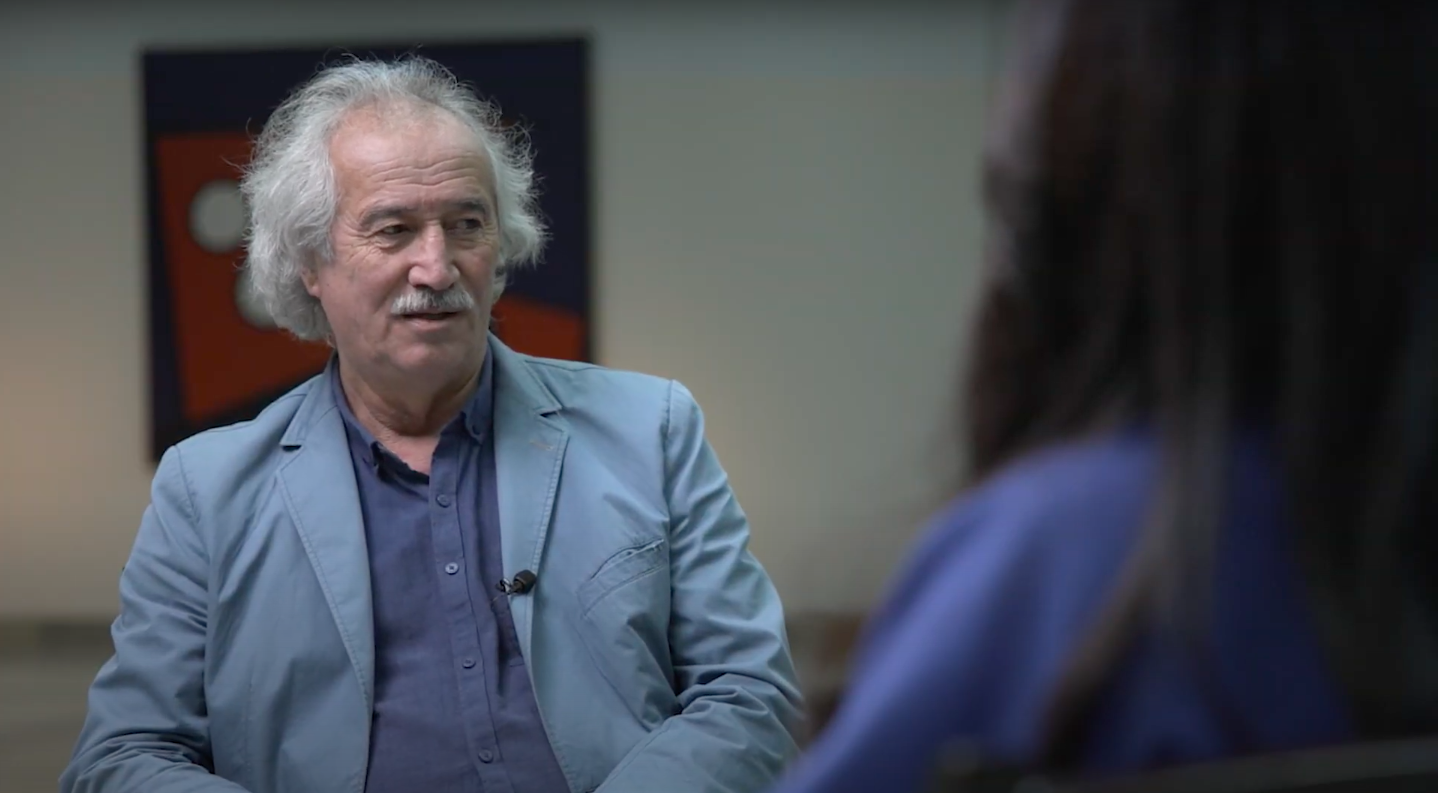
Ibrahim Valikhodzhaev during an interview for HD magazine
Certainly, attention to artists is necessary. There used to be an expression "unearned income." Now, regarding artists, it's more accurate to say "labor without income," as they can work hard, create dozens or hundreds of works in their studio, and in a year sell only one or two paintings.
There are even artists who have sold only two or three works in their entire life. But they still need to keep creating.
Previously, our people preferred to make a living through their creativity rather than, for example, working at an institute or teaching. However, if only a couple of works are sold in a lifetime, one cannot survive on creativity alone.
— Why are contemporary art forms such as installation and performance still not widely accepted in Uzbek society? Is the reason a lack of funding for these types of art, or is it something else?
— This is not about funding, because with the emergence of each new work or new ideas, many questions and debates arise.
Accepting something new is always more difficult: if the very creation of an innovation is already challenging, then its acceptance is even harder. Many of our artists sometimes don't listen to themselves, but wonder: "Will others accept this?" — and in such a state, they create their works.
Therefore, if you don't look back at the market or the opinions of others, but listen to your soul, then, in my view, that is precisely how the path opens to those kinds of art you are talking about.
Whether it's installations, contemporary art, or abstraction — if every artist creates from the voice of their heart, the possibilities for these directions will become even greater.
Even among our professors and academicians, there are those who have turned away from contemporary art and are unable to perceive it. Moreover, there are established trends that have been around for a hundred years, and as soon as you try to propose something new, criticism springs up from all sides.
But one also needs to approach this criticism correctly, one must be able to accept it adequately, and the creator must be prepared for it. In that case, as you said, more and more contemporary works will appear.
— Is criticism for an artist a stimulus to modernize their work or, on the contrary, does it create a fear of trying new directions?
— No, a creator who fears criticism will not be able to create anything.
First and foremost, he must have his own opinion and his own voice. If he only follows the opinions of others, then where will his own soul remain?
That's why it's important for an artist to listen to themselves.
— What is the reason that today there are very few women among artists? Among People's Artists, we practically see no women, although many girls graduate from educational institutions.
— Painting is not a profession; creativity in itself is not a profession.
If someone thinks it's possible to live and earn money solely through creativity, that is a big misconception, since a "profession" is when you engage in an activity on a permanent basis and support yourself with that income.
But creativity is something entirely different: even if no one commissions your work, you still create and continue to produce. Therefore, perhaps this also influences why there aren't as many women among artists.
Because if you look at today's institutions, approximately 90 percent of students are girls, and often they are more talented than young men. However, unfortunately, after graduating from the institute, when they begin adult life, many of them "disappear" into domestic life.
They immerse themselves in family life, and their creative potential no longer develops. After all, women essentially bear greater responsibility for the family, for the household, and they do not have the same freedom as men, who can do whatever they want, whenever they want.
I think this is precisely the main reason.
— The profession of an artist is very unstable, and participation in everyday life is often more of a minus than a plus for the artist themselves. Do you think a greater burden falls on the shoulders of artists' wives?
— Being an artist's wife is a very challenging task. It's hard to call an artist a "normal person." He has periods when inspiration suddenly strikes, and sometimes a single careless word can seem unnecessary, while at other times, on the contrary, it is lacking.
When he is immersed in his creative work, many things displease him, so the artist's wife has a hard time.
During the creative process, an artist can experience a wide range of emotional states. If the work is going as planned, you couldn't find a happier person. But if something doesn't work out, the world feels cramped and uncomfortable. In such moments, they might, without even realizing it, "snap" at their loved ones or children. Therefore, living in a family with an artist is truly very difficult.
— Is the phrase "A good artist is a hungry artist" still relevant today? Is it possible to combine creativity and financial stability?
— Yes, of course. As the saying goes: "Just wish for it—and the Almighty will grant you what you desire."
If we follow the saying "A good artist is a hungry artist," then that might indeed happen. But we should say it differently: "I will live in abundance, I will sell my works, and I will strive." Then everything will work out. I, for example, have lived to this age and don't remember ever being hungry.
My paintings have always found buyers, with over five hundred of my works sold in various countries, and I have never experienced want.
I don't understand when artists complain about constant difficulties, because everything depends on the person themselves.
The main thing is to firmly believe: "I will live well and create wonderful works," and, of course, to work tirelessly. Only in this way can one achieve success.
— Your exhibition recently took place in Dubai. What impressions did you return with?
— I noticed that Dubai appeared relatively recently: just 50 years ago, such a city did not exist. Nevertheless, it is developing so rapidly that today its achievements are recognized worldwide—the progress there is truly colossal.
I was very pleased to organize an exhibition in Dubai because it is precisely in such places, at expositions, that you begin to fully realize the true value of your own works.
If you sell a painting at home for a relatively modest sum, there you can sell it for dozens, or even hundreds of times more. Of course, this is important for any creator, but still, if a work is of no interest to anyone, it won't be taken even for free.
When you exhibit in different countries, you better understand how people value your work and how in demand it is.
From this perspective, I am glad that I was able to visit Dubai.
Today, our country has many artists, including elderly ones. Sometimes it happens that an artist passes away, and their works become unwanted by anyone. Relatives say, "I will sell these paintings if anyone finds them useful," even though the artist highly valued them during their lifetime.
It turns out that they are no longer needed by children or society. We, as the Artists' Union, must take care of preserving such works.
Many masters who have already passed away left entire studios full of paintings. However, there is no place to store them, and their descendants are not interested in them. The question arises: what should be done?
We need to create special facilities for such work and do everything possible to ensure they are passed on to future generations.
Most likely, there is currently no opportunity or means to purchase these works, but in 50–100 years, each of them could literally be worth its weight in gold. This is something we need to think about today. After all, previous generations scattered artistic works all over the world, and almost nothing remains in Uzbekistan: we built the Behzod Museum, but there is not a single authentic work by Behzod there.
Therefore, it is already worth taking care of preserving the art of those who have passed away or are of advanced age.
We need to create a special place for this and put maximum effort into it — now is exactly the right time.
— Do you have the desire to fight?
— For this?
— Yes.
I think to myself: here I have my entire studio filled with works of art. And I ask myself — where to store them? Who will need them after I'm gone? I would like all these works to be preserved in one place, because there are many artists similar to me.
Of course, it doesn't necessarily have to be a museum — it's not about a museum. The main thing is not to let these works of art disappear.
Among them, you may find works of varying levels: good, unsuccessful, and of average quality.
It would be great to create some large database where all these works would be collected, registered, and stored as a collection.
And then, if necessary, one could use them.
— How much time is needed to implement this in Uzbekistan?
— If there are people who become interested in this, it won't take much time: everything can be done in a year or two. The main thing is to have the desire.
Ibrahim Valikhodzhaev during an interview for HD magazine
We cannot solve this on our own; responsible organizations that will think about this are needed. After all, this is an entire wealth—the works that artists created throughout their lives. Our task is to not let this wealth be lost. I believe this is one of the most serious problems.
I speak both as the chairman of the Union of Artists and as an artist: I would not want my works to disappear after my death. Even a momentary pencil sketch I would not give away for free — it too has its own value.
When a work has a price and is properly valued, it becomes property. And allowing property to be lost or plundered is a real crime. This is a major problem for the entire republic.
Take the example of Academician Vladimir Burmakin, who passed away at the age of over 80. He left behind two studios full of paintings. Who needs them now? They could simply be lost.
Workshops are needed, but it turns out no one needs the work. But they have to be stored somewhere.
— Do you have any advice for young artists and creators?
— It is important for young artists not only to create new works, but also to continuously work on themselves.
In every work, one should strive for novelty, revealing unexplored facets of art.
To believe that you have found the only correct path and will follow it forever is a mistake, because in just a year your views may change, and in another year, they may once again find a different direction.
The main thing is to constantly supplement and improve what has already been created, so that in ten years your work will turn into a completely different work of art.
All of this is only possible through constant searching and experimentation. I believe that young creators should continuously try and discover something new for themselves.