Brief Summary
Here we have gathered the key thoughts of the hero for those who want to quickly familiarize themselves with the content. The video and full interview transcript are posted below.
From childhood, he was passionate about drawing, studied at an art school in Gulistan, then enrolled in the Behzod Institute in the design department — he wasn't accepted into painting, and, as he believes, this broadened his perspective on art. After graduation, he started working at the NBU Gallery, where he met artists and began actively participating in exhibitions. In 2008, together with colleagues, he founded the group "5+1"; together they participated in biennales and presented performances in Greece and Australia. One of the vivid images is walking with a lit candle through the streets of Sydney, inspired by Rumi's parable.
Art is not just a technique, but a way to express meaning and inner experiences.
Works with painting, video art, and installation, but believes it's not the technique that defines an artist, but the ability to convey inner meanings. Still in search of self and sees this as their strength.
Family is a support, not an obstacle: there's little time for creativity, but the main thing is the desire to find it. Parents always supported the choice to become an artist, despite the skepticism of older brothers. I believe a true artist doesn't need a large studio—passion and focus are enough.
Art must have meaning and profound content.
The East is capable of offering the world a new word in art, and young artists from Central Asia are already addressing important social themes today. An artist dreams not of fame, but of the opportunity to create something new. There are no bad artists. The main thing is not to stop.
Video version of the interview
We have prepared this option for those who prefer to watch and listen.

Full version
Here we present the full version of the interview for careful reading.
— When and how did you start practicing visual arts?
—I have been interested in drawing since childhood. My first works appeared at an early age and were characterized by naivety. Later, I entered a specialized art school in the city of Gulistan, Syrdarya region, where I began my studies from the fifth grade. It was there, thanks to my teachers, that I studied painting techniques, composition basics, color combinations, textures, and other aspects of art in depth.
In 2004, I applied to the Kamoliddin Behzod National Institute of Arts and Design. Unfortunately, I was not accepted into the painting department, and after reviewing my works and drawings, I was directed to the faculty of design. For four years, I studied in the design faculty and graduated from the institute in 2008.
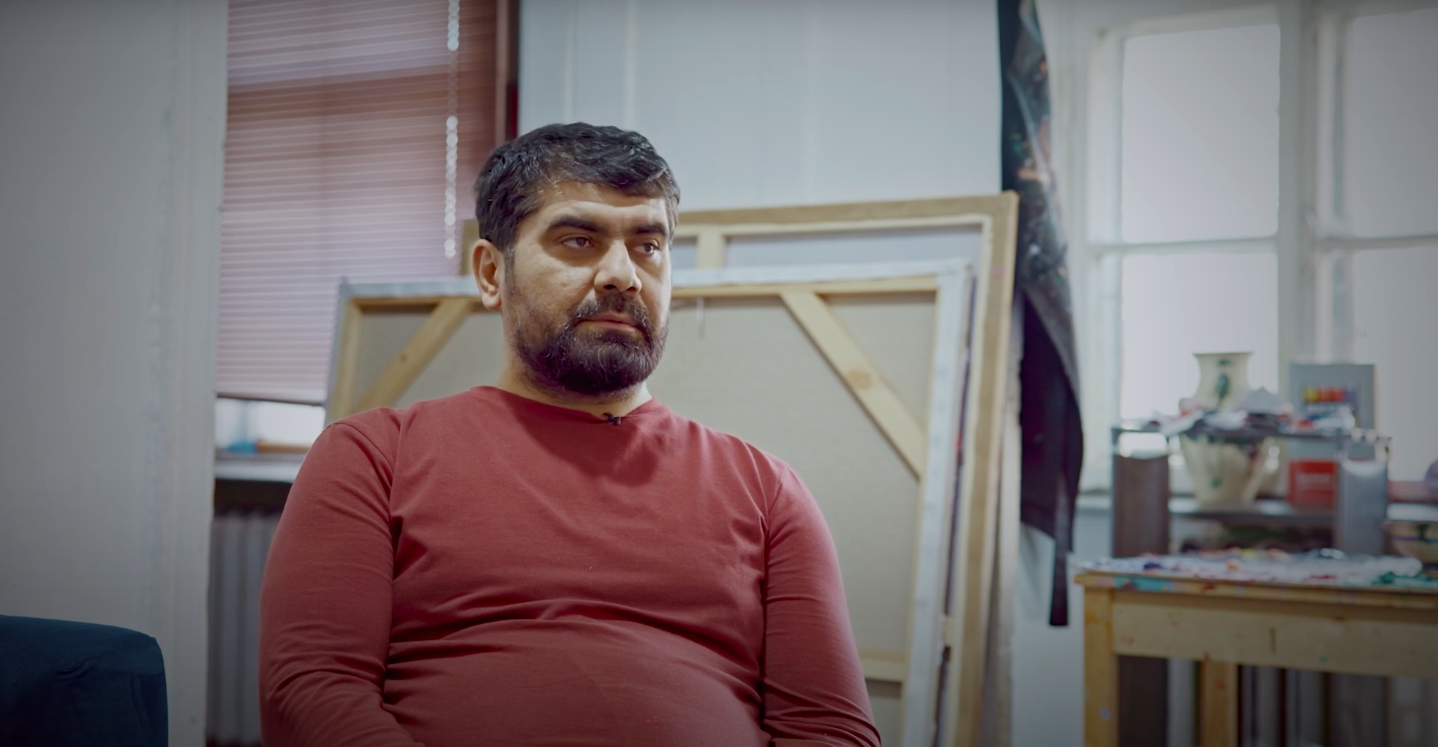 Frame from a video interview
Sanjar Zhabbarov. Still from a video interview
Right after graduation, I started working at the Tashkent Gallery of Fine Arts (NBU Gallery — ed.). From that moment, a completely new stage of my life began — a new immersion into art. Thanks to the gallery staff, I met many artists. Among them was Dier Raziqov, who was the one to involve me in the gallery work. I saw many works of art and began actively participating in exhibitions, which marked the beginning of my real artistic practice. It was during this period that I realized my true calling was to become an artist.
We communicated a lot and gained immense creative experience. I say "we" because at that time, it wasn't just me working at the gallery, but many other artists: Dier Raziqov, Sharifa and Danyar Sharafkhodjaevs, Nuriddin Rasulov, Uktam Saidov... In 2008, we created an art group called "5+1". In the same year, our first exhibition was held at the Fine Arts Gallery. It was a conceptual exhibition where we presented installations and video art. The exhibition turned out to be very successful.
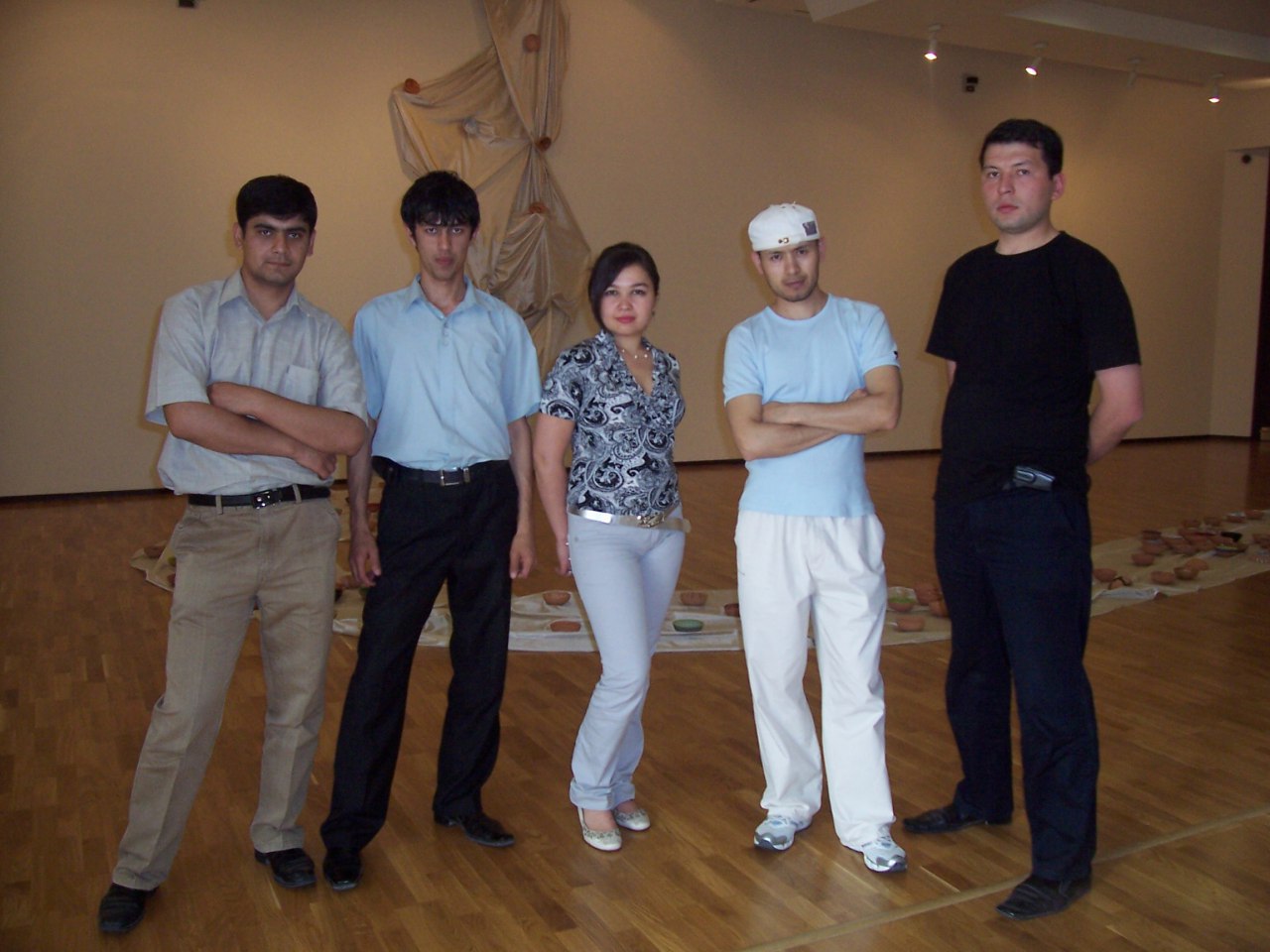 Photo from Sanzhar Zhabbarov's archive
 Sanzhar Zhabbarov with colleagues: Nuriddin Rasulov, Sharifa Sharafkhojaeva, Sherzod Rajamov, Diyer Razikov. Photo from Sanzhar Zhabbarov's archive
After that, our group participated in the Tashkent Biennale and other international biennales. That year, I even presented a performance at an international biennale and received an invitation to a biennale in Greece. In 2009, I went there with a video installation. It was precisely in those years that I took my first steps in conceptual art.
Searching for oneself
Over these two to three years, my artistic experience has significantly enriched. In 2010, I went to Sydney, Australia to study English. I lived there for a year, and it was then that I first seriously took up painting, discovered my style and color palette. An interesting story happened then: in a big unfamiliar city, I felt like a lonely wanderer and often walked the streets in broad daylight with a lit candle.
I recalled the story of Jalalidin Rumi, where he similarly walked through the city during the day with a candle, searching for himself. His disciples asked him, "Whom are you seeking in broad daylight, teacher?" He replied, "I am seeking myself." In exactly the same way, I, with a candle in my hands, was searching for myself in a huge, unfamiliar city. It turned into a very beautiful performance. I sent it to Nigora Rakhimovna Akhmedova; she liked the idea and included my concept and performance in the catalog.
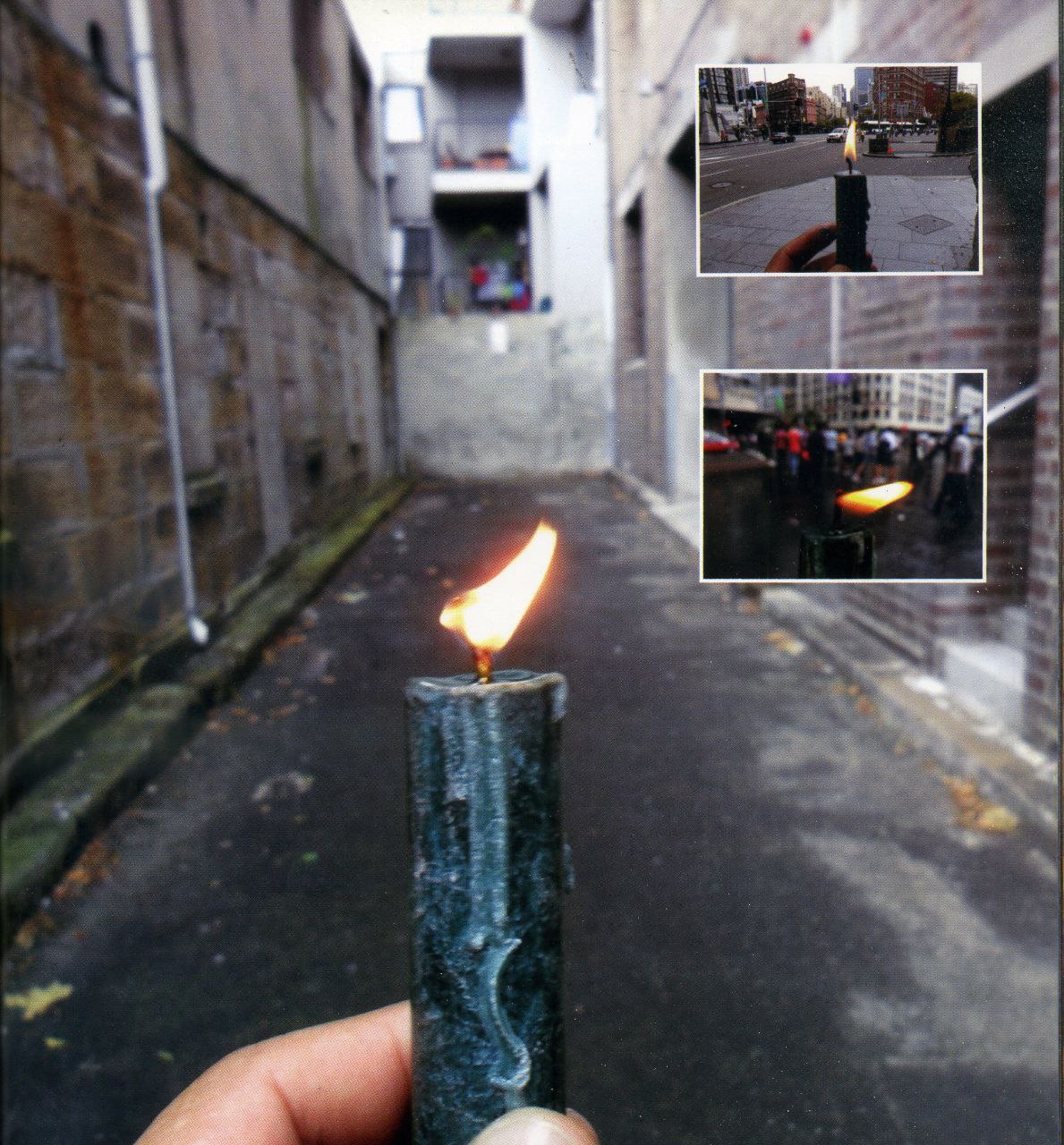 Photo from the archive of Sanzhar Zhabbarov
Frames from Sanjar Jabbārov's performance. Photo from Sanjar Jabbārov's archive
After returning to Tashkent, major projects and interesting events in art began here. The organization "Fund-Forum" held large art festivals every autumn, in which we actively participated along with colleagues. Akbar Khakimov presented his projects, Nigora Akhmedova came forward with her initiatives.
I particularly liked Hakimov's projects—he always created something unusual together with his students. I remember my first project with them was dedicated to a woman and was called "Moon-Faced." In it, I presented my work in the format of video art. While I was away, they organized the project "Aristotle's Riddle", which I unfortunately could not participate in. (The project aimed to inspire young artists in Uzbekistan to have unconventional visions of the world and original interpretations of reality. It was based on Aristotle's idea of mimesis, which asserts that art should imitate nature. However, blindly following this principle limits creative freedom, confining the artist within the bounds of dogma. The project, instead, offered a different perspective on art, going beyond established canons - editor's note).
Then there was a big project "Turkestan Remake", where we had to create works based on old photographs from the "Turkestan Album". This was also a very fascinating project. I also participated in Nigora Akhmedova's project "Signs of Time" with video art — an interview with a blind person about their perception of a big city. The conversation was incredibly interesting.
Akbar Khakimov also had a project called "The Skullcap Seller", in which I also participated with video art. In 2011–2012, we participated in exhibitions in several European countries. In 2014, Natalia Andakulova's gallery organized my first solo exhibition in Dubai and Abu Dhabi, which was a great success.
In 2016, thanks to the same gallery, we were invited to an art residency organized by the Sheikh of Abu Dhabi. For a month, we honed our skills alongside renowned artists. It was an interesting and valuable experience. At the end of the year, at an exhibition, I presented seven painted canvases.
For me, this was an important professional experience: we spent many evenings socializing, exploring the city, and visiting museums and galleries. In 2018, I traveled to China, where I participated in a collective artists' exhibition as part of the "Uzbekistan – China – The Great Silk Road" project.
This trip made a deep impression on me. China turned out to be completely different from what I had imagined—I was amazed by the large-scale museums and galleries. After returning, I continued my creative activities in Tashkent, participating in various projects and biennales.
They turned me down at just the right time!
Currently, I work in my personal workshop, participate in small projects, help colleagues and teachers. For example, I recently helped Akbar Khakimov in one of his projects.
A major practical experience for me was collaborating with Dinara Dultaeva on the book "The Silk Empire", where I worked on the illustrations. Working with Khakimov always provided me with a powerful foundation of knowledge, which I still draw upon to this day. This book continues to inspire me.
From 2013 to 2016, I established myself as a teacher, working at the Yunusabad Professional College of Design and the Tashkent Polytechnic College. This was an important stage, which I believe every artist should go through. I had many students who found their place in successful professions. One of my students even worked with me on the project "Empire of Silk". Such is fate.
Additionally, I have had personal exhibitions in Tashkent. That's the story.
— Judging by your words, you are a multidisciplinary artist working in various genres and techniques. Is your pursuit of such diversity related to your experience working in a group and your education in design?
— Today, I understand that being rejected from the painting department and my studies in the design faculty turned out to be a real stroke of luck for me. I think if I had been accepted into the painting department right away, I might not have been able to become an artist.
In my opinion, an artist is not only someone who professionally masters technique, but first and foremost a person with a broad worldview, capable of clearly expressing what they want to say through their art.
— Is video art easier for people to perceive and understand than classical visual art?
— I believe that if you manage to convey and communicate to people what concerns you, then it no longer matters in which specific style you do it. It could be video art, painting, or an installation. The main thing is to be able to speak out in the right place and at the right time. Then you will definitely be understood. After all, in art, it's not the form that matters, but how clearly you express your thought and inner experiences.
— What is more important in painting and other forms of art—the meaning and content of the work or the artist's mastery of execution, technique, and style?
—I believe that in painting, as in any form of art, there must be meaning and profound content. It doesn't matter if it's video art, an installation, or a painting — every work should say something to the viewer. After all, it is we, the artists, who convey important messages and ideas to people through our works.
Contemporary art - genius or absurdity?
— Many believe that contemporary conceptual artists have reached a certain level of absurdity. For example, "The Comedian" by Maurizio Cattelan has become one of the most discussed works in recent years. We constantly hear various opinions about it, but aren't people now searching for some artificial meaning in it?
— Maurizio Cattelan is a brilliant artist. His ideas truly have the ability to confuse people, shift their usual train of thought, and his unusual performances possess the power to change these people's way of life and even the history of art.
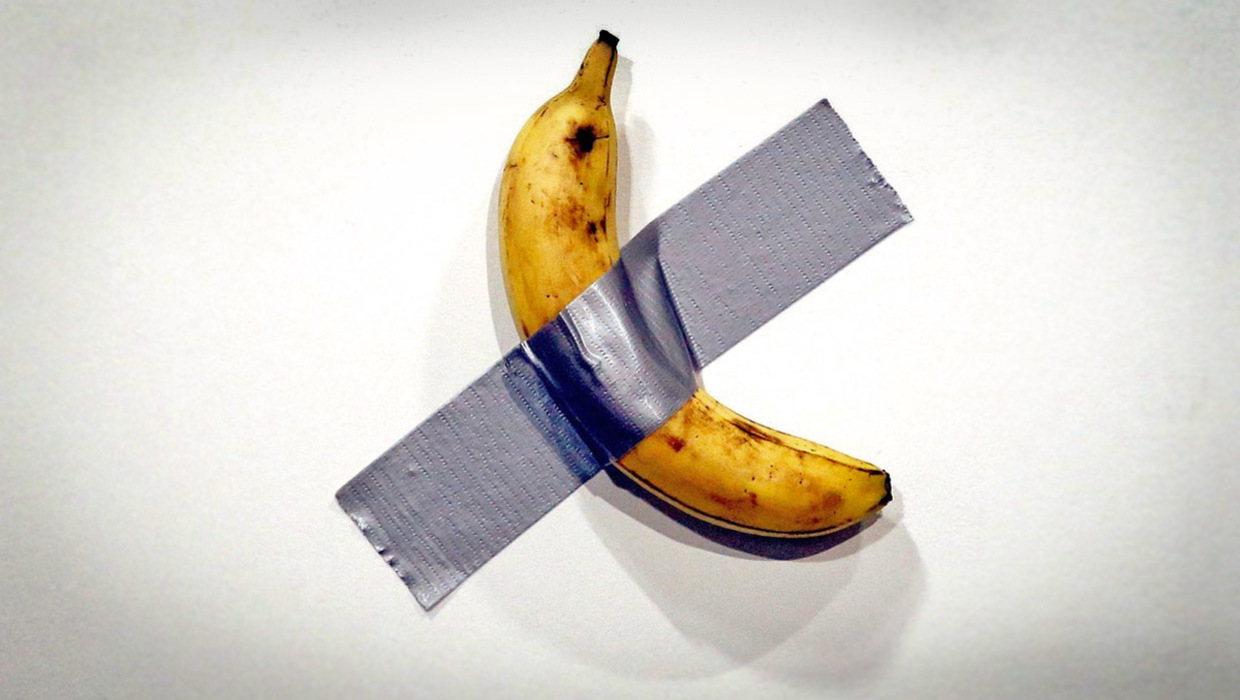
Maurizio Cattelan's work "Comedian"
Perhaps an entire team works on his projects, I don't know. But, like Banksy, he can lead everyone to absurdity or steer them in a completely different direction — he has that power.
In our time, it is very difficult to surprise people due to the high development of information technology. An artist must adapt to this. If they cannot adapt or are late, it means they have fallen behind.
Speaking of bananas, I agree that Cattelan can hammer a nail and call it art, because he has the grounds for it.
There are many examples of this. Damien Hirst and many other artists have turned art into a large-scale industry, bringing them enormous income and worldwide fame, and they consciously support this process. The world, time, and people have changed; they have adapted to this and have changed the history of art.
I don't know if they have become corporations where very influential people work over them. This is about the West. The East is a completely different world, a different trend. Perhaps the East will soon surpass the West because our culture still retains its uniqueness.
I believe that in terms of art and culture, the next stage will belong to the East; we just need to put in enough effort. Take, for example, the contemporary art of Iran, Saudi Arabia, and the Middle East in general. I think very significant changes are happening there, which we can also influence.
— The most vivid and resonant works in art history often address socio-political themes. If our artists also start addressing such issues more, will this help us solve many existing problems?
—Of course. I am confident that art is capable of influencing the resolution of many societal problems.
I am well acquainted with Central Asian artists and can cite Vyacheslav Akhunov as an example. He is an artist whose concepts and ideas are largely similar to Ai Weiwei's approach. In general, we need to strive for that level because the very idea, the very concept of their work is very close to the form in which we, too, should express our art.
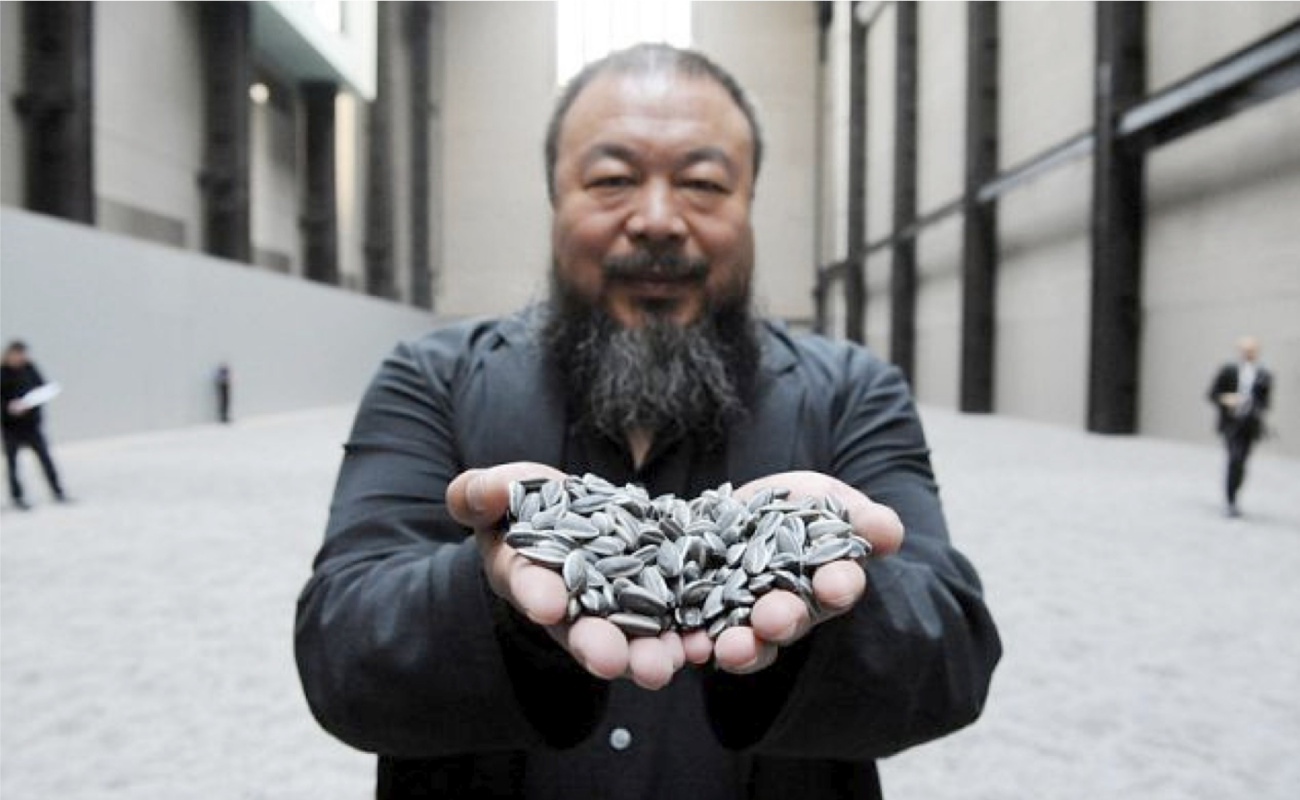
Ai Weiwei
There is another important point: we, the peoples of Central Asia, have historically been sedentary. Why did we have so many scientists, thinkers, and people known throughout the world? Because the sedentary lifestyle provided the opportunity to create profound ideas and large-scale works. This is precisely why even today we have artists with deep philosophy, capable of creating large-scale and significant works.
I believe it is necessary to speak about society's problems and raise pressing issues.
And our artists are already doing this today. I hope that in the future we will have young leaders who will continue this direction and contribute to the development of art.
If an artist wants to find time for creativity, they will definitely find it.
— What is your most memorable work—maybe it was a video art piece, installation, or performance?
— Probably the most memorable work for me, although all of them are important to me, is the video art "The Doppi Seller", which I presented in Akbar Hakimov's project "Turkestan Remake".
In this project, I participated myself as the hero. For me, it became something completely new, a discovery in my creative practice and personal journey in art. I don't know how others perceived this work, but personally, it holds special meaning for me.
Among the performances, I particularly remember the one I did in Sydney, when I walked around the city during the day with a lit candle, searching for myself. Before that, there was another performance in 2008, when I was sealing jars, "canning" pure air. It was my first experience in this genre, so it left an especially vivid impression.
By the way, there are some works I would like to repeat — for example, walking the streets with a lit candle again, as it remains relevant to me to this day.
— Have you already found yourself as an artist?
— No, I am constantly searching. I think that is the answer to your previous question.
I always try to explore different directions. Perhaps when I truly find my own thing, I will understand which way to go. But for now, I am still searching for myself.
— Is family a barrier, an obstacle to artistic freedom for an artist? There are cases where artists, after starting a family, leave art, change professions, or choose a completely different path.
— To be honest, I still can't say that I have fully established myself as an artist yet. And there's no drama or regret in that, it's just me looking at things realistically.
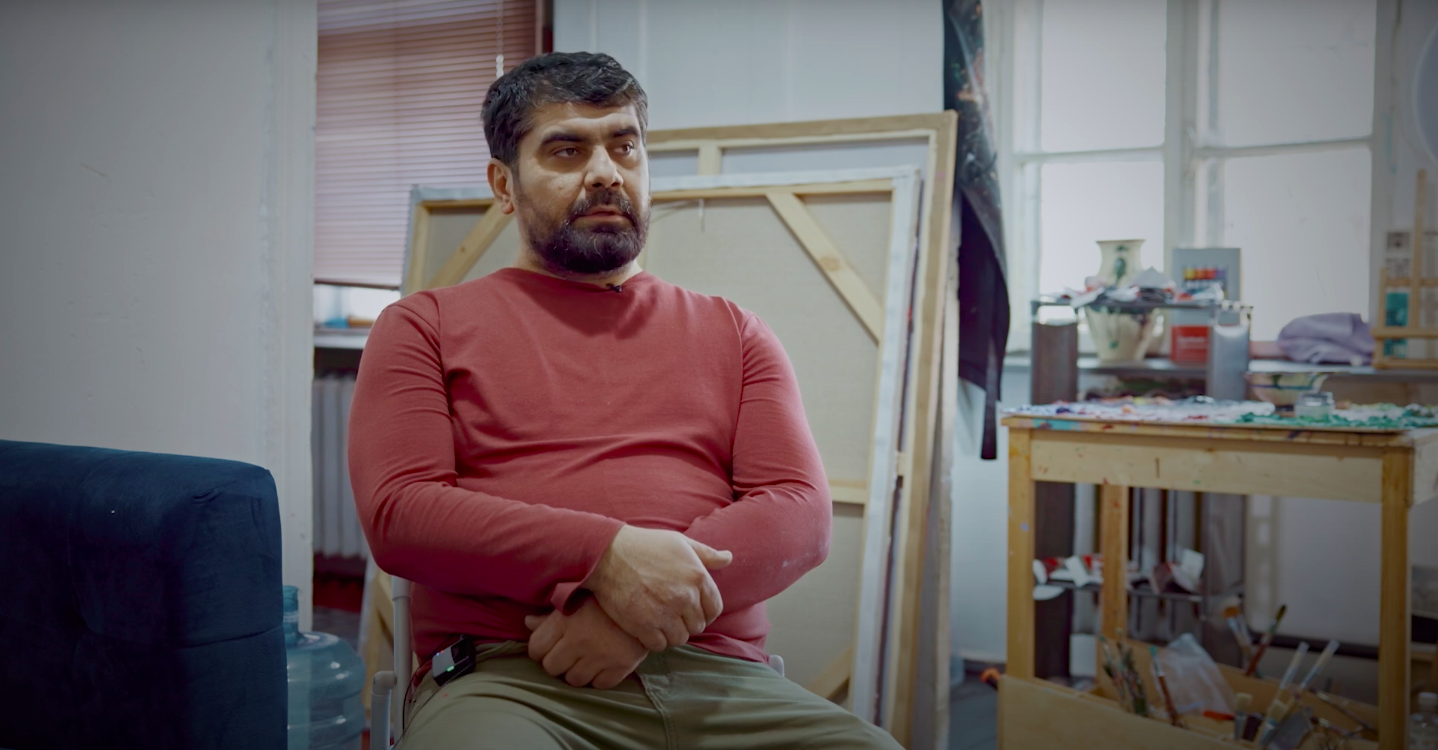 Frame from a video interview
Sanjar Zhabbarov. Still from video interview
When a family and children come along, naturally there is less free time for creativity. But I don't consider this a problem because family is sacred to me; loved ones require special attention and particular care.
In fact, an artist doesn't need a lot of time — sometimes two to three hours a day are enough to create something valuable and meaningful. The main thing is to use this short time as effectively as possible.
After the birth of my second child, I would get up early in the morning when everyone was still asleep and go to the workshop—these were the most productive hours. Interestingly, it is precisely at this time that you sometimes accidentally meet other artists who also come to work at dawn, and these brief conversations remain especially memorable.
If an artist wants to find time for creativity, they will definitely find it. They don't even need a lot of space or any special conditions. When I first started working abroad, I had a very small room where I would just lay a canvas on the floor and paint. An artist doesn't need a large studio—the main thing is the desire to create.
There was a time when I often had to change workshops, and one day my studio was scheduled for demolition. Then my works were simply thrown out onto the street, and I had to collect them literally from under the rain, from some holes. Such moments also happen in an artist's life.
In general, for a true artist, the size of the studio is not important, but rather the desire and ability to create. Everything else is secondary. If the need to create lives within them, they will always find both the time and the place.
— Were there any attempts in your family, be it your parents' or the one you created yourself, to dissuade you from choosing this path?
— No-no, my parents were never against me pursuing art.
Perhaps the older brothers were somewhat opposed, but the parents always supported me. When I got married, I already understood how important the support of loved ones is, especially from a spouse.
I am very fortunate: although my wife doesn't always fully understand my art, she always supports me. This is incredibly important because without the support of one's significant other, it is very difficult for an artist.
She may not fully understand art, but she is always there, supporting me, even if she doesn't completely grasp my creative work. She constantly asks how things are going and visits me in the studio. For me, this is immense happiness.
There are no bad artists.
— What are the biggest problems in Uzbek art today?
— There have always been many problems: some were resolved, but new ones appeared in their place. Now there are also difficulties — some things are gradually improving, while others remain unresolved. However, I don't believe I have the right to propose solutions or discuss these issues, as there are specialists who are working hard on them. I think, in time, they will find a way out.
As for me, my main task is to come to the workshop and create new works. Everyone should mind their own business, because that's the only way change is possible.
Overall, I wouldn't call the current situation in art critical, but there is still a sense of some stagnation. Although, perhaps after such a period, an upswing always follows. Art is a living matter, and it inevitably changes. I think artists always feel these changes more acutely than representatives of other professions.
In any case, we must continue working. There are major projects currently planned in the art sphere. Perhaps better times lie ahead.
— What do you dream about as an artist?
—What could an artist dream of? His greatest dream is to create a new work. That is the most important thing for him.
We, artists, in a way, remain children.
When we create something new, we experience genuine joy, like a child who has received a long-awaited gift. You've probably felt that too—when you get something so valuable to yourself that you can't even sleep from excitement. Exactly! Regardless of age, when we complete even a small task, it brings immense joy. In such moments, you want to celebrate: invite guests, go somewhere yourself, spend time with family.
Because starting and finishing work is a very complex process. That's why I always say: there are no bad artists. No one, except the artist themselves, knows what happens in their studio, what inner experiences they pour into their work.
It is wrong to criticize someone from a superficial point of view. Even that artist who just paints copies on Broadway is still working hard, making a living from it. Some create something new, some engage in repetition, but everyone follows their own path.
So the main thing is to keep working, creating new works.