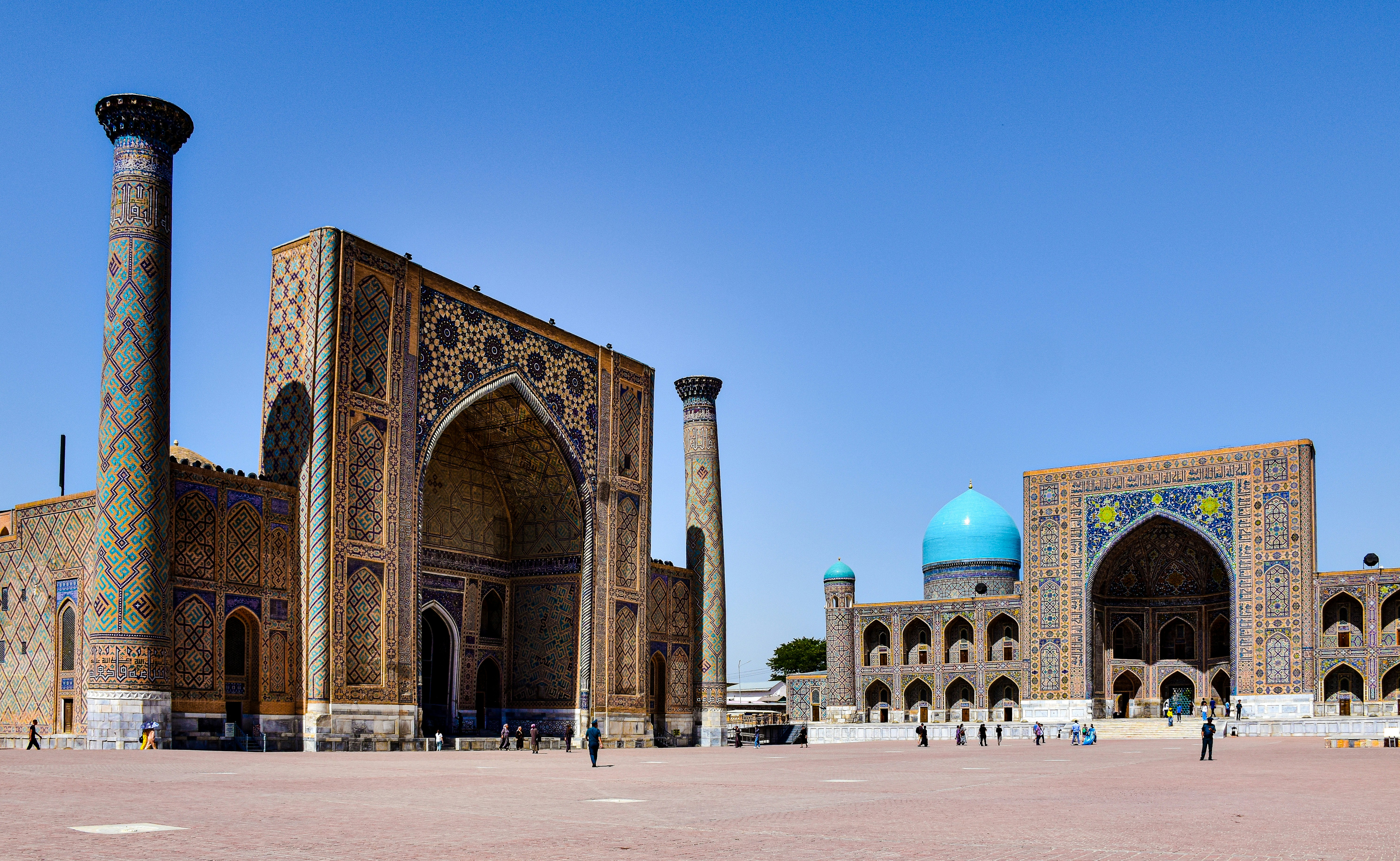
In the autumn of 1918, bookbinders and jewelers whose shops were located on
Registan Square noticed that one of the minarets of the Ulugh Beg Madrasah had begun to lean
sharply to the side – the foundation of the tower, laid in the 15th century,
had been damaged by a powerful earthquake in 1897. Sounding the alarm, the craftsmen sent
for archaeologist Vasily Vyatkin, who was at that time the custodian of the architectural monuments
of Samarkand.
For a man who spent years searching for and excavating the ruins of Ulugh Beg's observatory, the tragic legacy of the great stargazer was no empty phrase. Arriving at the square, he saw that the right, northeastern minaret of the madrasah had deviated from its axis and threatened to collapse directly onto the square. Vyatkin knew everything about Turkestan (he translated the Baburnama and wrote a textbook of Uzbek for local Russian schools) and nothing – about the strength of materials.
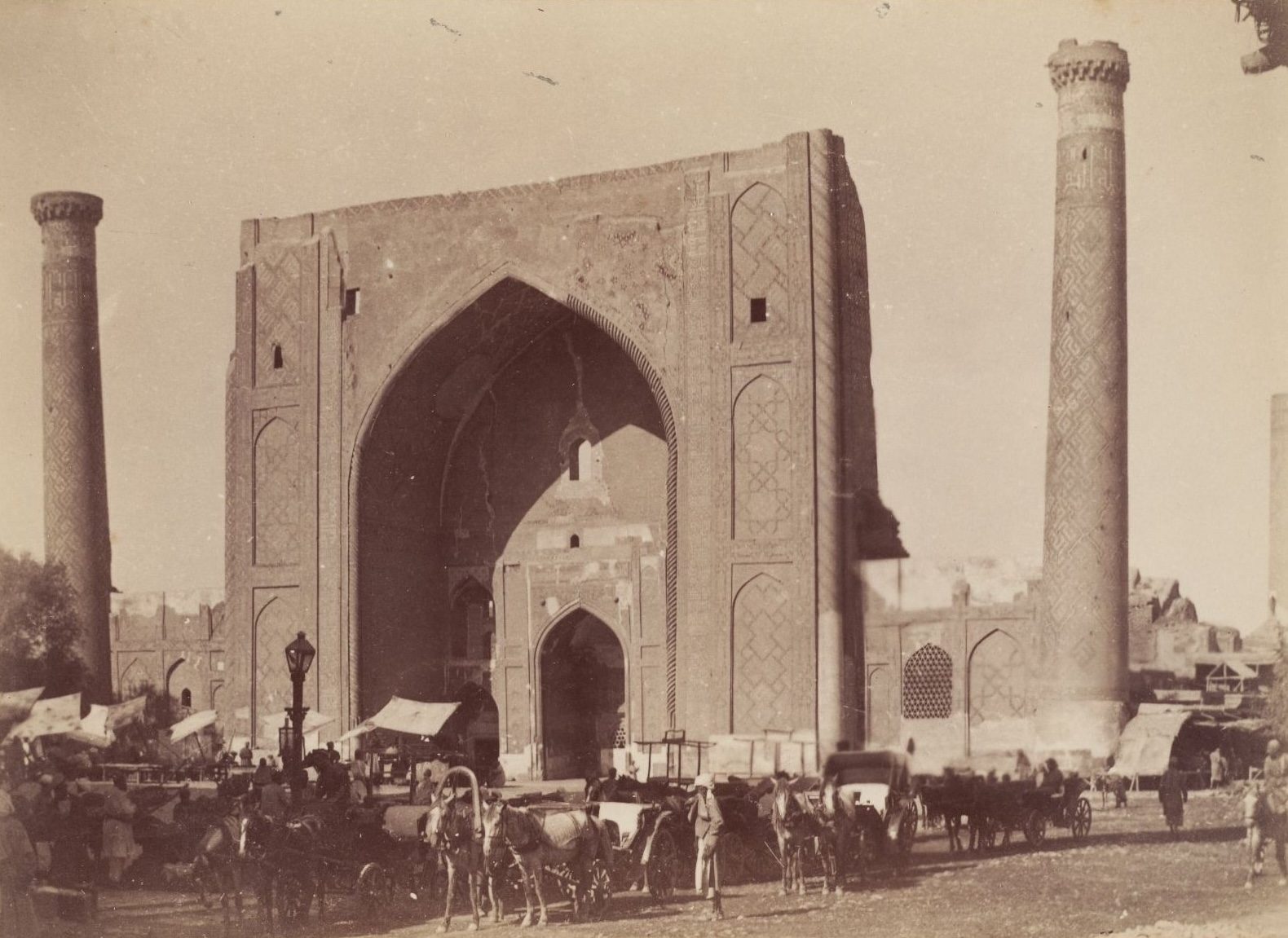
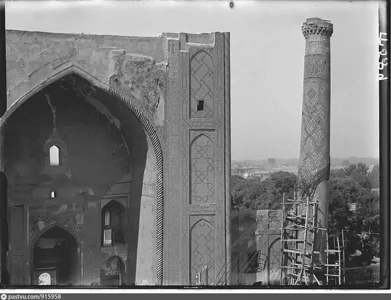
In 1910, the madrasah with a leaning minaret was photographed by Samarkand amateur photographer Georgy Pankratiev. It looks dismal.
They saw it too
He called upon Boris Kastalsky and Mikhail Mauer for help – these were two very different
people. Kastalsky had an excellent military career, was decorated with awards,
and rose to the rank of major general in the tsarist army. Mauer chose the path of a rebel: at the end of the 19th century, he graduated from a military engineering school, joined a
secret socialist society, and was sentenced to five years of hard labor for revolutionary
sedition. The court later showed leniency to the second lieutenant (equivalent to the rank of
lieutenant) with noble roots – his hard labor was commuted to demotion to private and exile
to Turkestan.
Two military engineers were united by the fact that both had built their careers
precisely here. Kastalsky spent his entire career developing the infrastructure
of Samarkand and died there during World War II, while Mauer served as the city
architect in Kokand, Namangan, and Chust. By 1920, the two engineers had formed an
unauthorized commission to save the falling minaret.
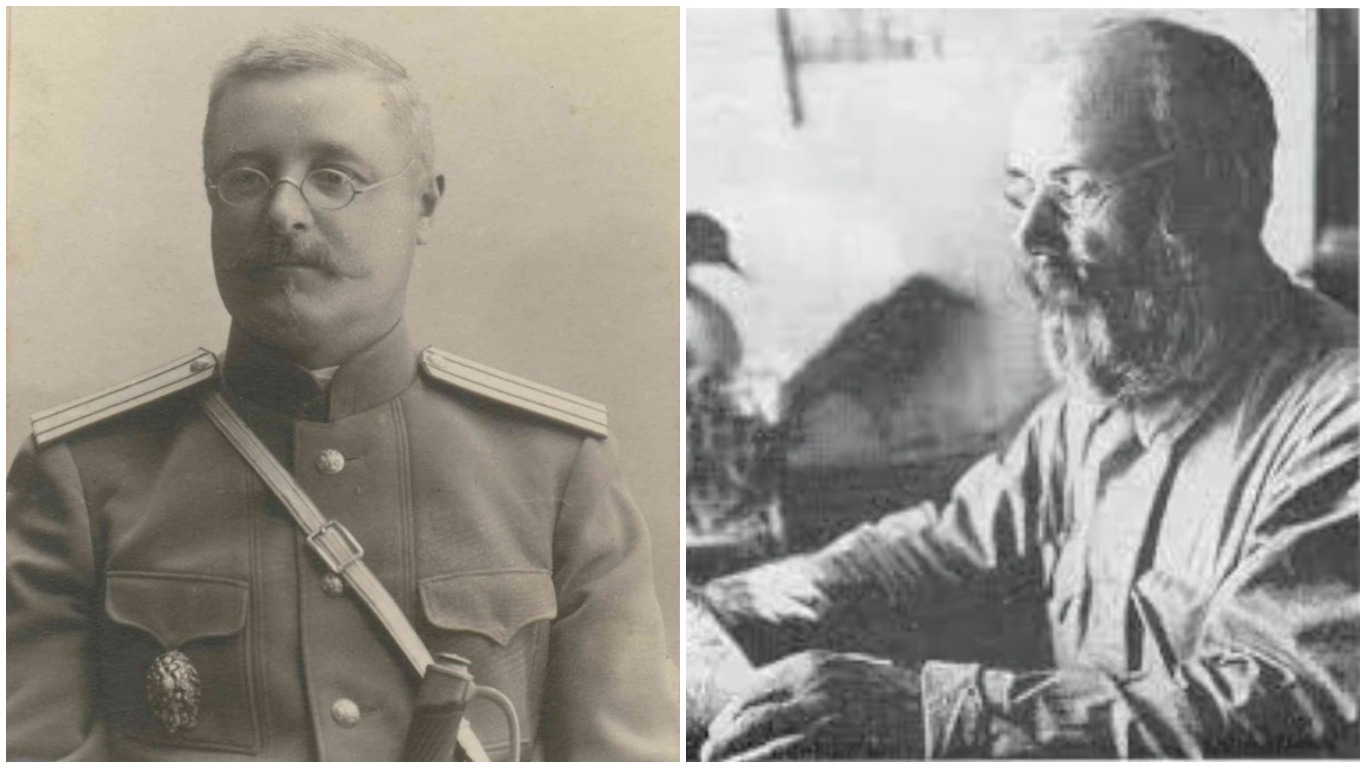
Kastalsky on the left, Mauer on the right.
Kastalsky proposed dismantling and then rebuilding the falling tower on the same site. This option was rejected: a "replica," even if reassembled from the original material, would destroy the tower's authenticity. The architect Kavam ad-Din from Shiraz,
to whom the authorship of the Ulugh Beg Madrasah construction project is attributed, would hardly have approved of such a solution.
"The Devil's Guitar" by Mikhail Mauer
Meanwhile, the 32-meter tall minaret weighing over 2,000 tons
continued to slowly lean towards the ground. A new problem emerged – the falling tower
began to gradually rotate around its axis, like a freshly cut-down
tree.
Mauer proposed an original and bold solution – to try and keep the minaret in place by pulling it back. This option also raised doubts within the engineering community. Mauer put an end to the debates by stating that he was ready to stand at the foot of the minaret while it was being straightened. In 1918, the northeastern minaret was girded with 24 thick steel cables weighing up to 36 tons, having first placed a wooden "corset" under the cables at a height of 12–18 meters from the ground - this was done to prevent the metal from cutting into the brickwork.
The cables were attached to wooden anchors driven into the ground, and when taut, they looked like the strings of a giant plucked instrument. In bad weather, the entire structure hummed mournfully, which is why the Samarkand residents nicknamed it the "shaitan-guitar."
Samarkand listened to this infernal music for 14 years – exactly as long as Mauer managed to delay the fall of the minaret.
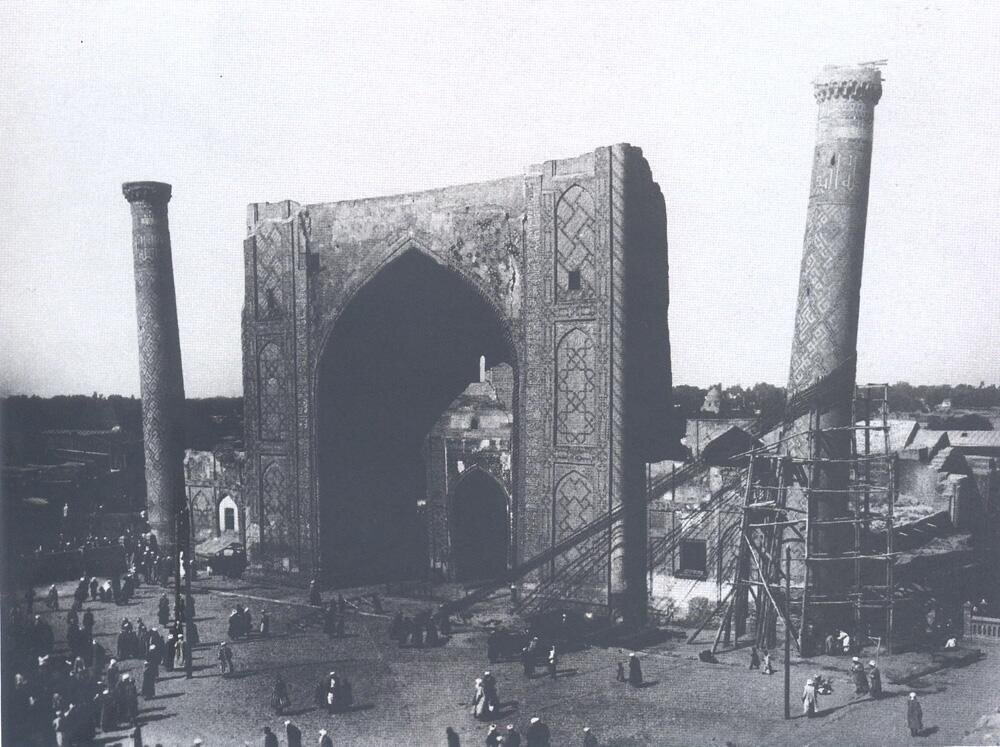 Archive photo.
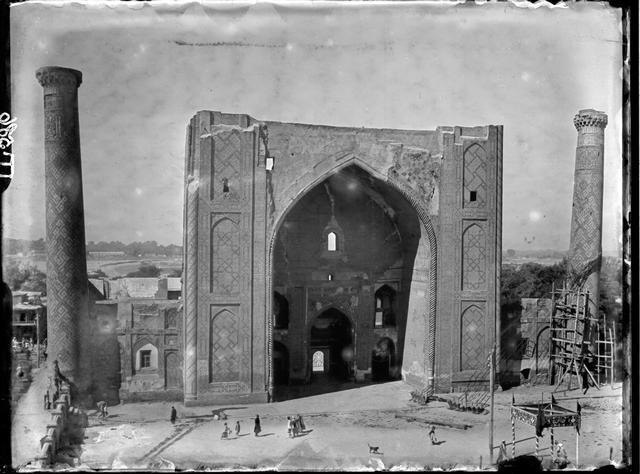 Archive photo.
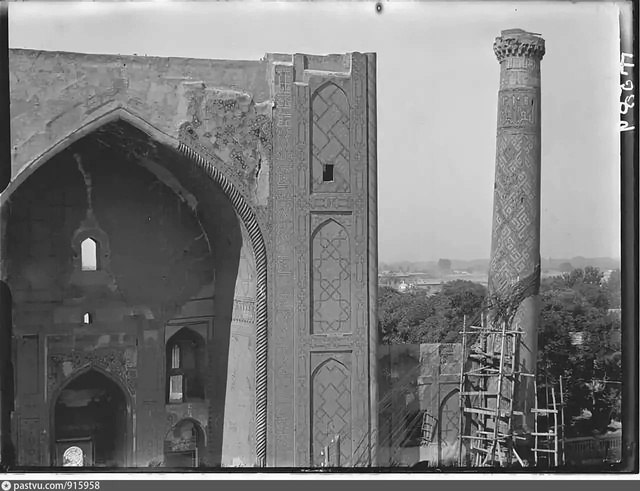 Archive photo.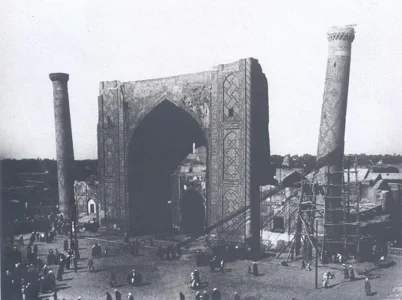
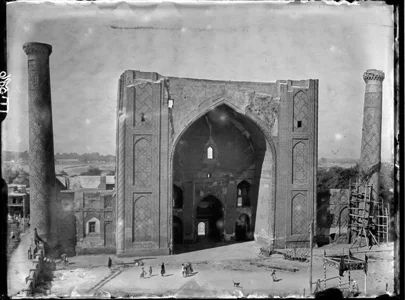
Shukhov's Hyperboloid
In the 1920s, it became clear that Mauer's cables had stopped working. The strings of the "devil's guitar" had halted the tower's fall, but its upper part had still deviated from the vertical by almost 2 meters. Mauer saw this and tried to figure out what could help save the minaret. Professional communication with his Timurid colleagues would have been helpful here—but they had all passed into eternity 500 years ago.
Mauer independently mastered Persian to read literature about Timurid-era architecture,
involved local masons in restoration work on Registan,
communicated extensively with Samarkand old-timers who might know something about
the technical condition of the tower. And also – traveled to Moscow to consult with
academician Vladimir Shukhov.
In the architectural world, Shukhov is considered a pioneer in constructing tall buildings using metal frames. The Shabolovka Radio Tower, the canopy over the platform of Kievsky Railway Station, the metal structures of GUM, and the rotating stage of the Moscow Art Theater—all of these are his structures in Moscow. In Bukhara, a metal hyperboloid structure—a water tower opposite the Ark Citadel—was built according to Shukhov's design.
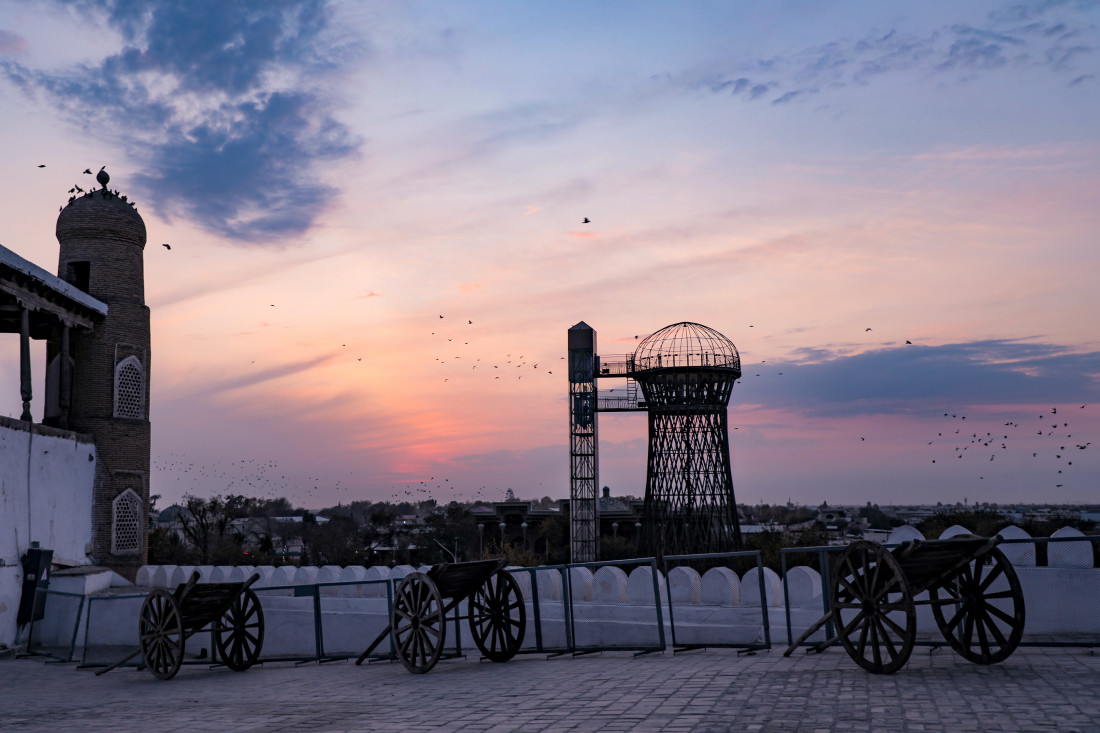 Shukhov Water Tower in Bukhara © uzbekistan.travel
When joining the operation to save the minaret, Shukhov proposed not to raise it, but to lower it under its own weight. He proved that the less the entire minaret tower would move, the easier the subsequent restoration work would proceed. By the early 1930s, there was no longer any talk of straightening the tower with cables – its shaft would inevitably have snapped in the middle. After 14 years, the minaret's tilt had increased to 5 degrees, and its center of gravity had deviated from the foundation's axis by 1 meter. There was no time to waste.
How to properly pump a minaret
On January 7, 1932, under Mauer's leadership and according to Shukhov's design, an unprecedented engineering operation in complexity began in the center of Samarkand.
The minaret was lifted above the deteriorating foundation using jacks,
and a special rocking metal frame was placed underneath it. Then, the original
masonry beneath the tower was reinforced with reinforced concrete load-bearing structures. The tower shaft, as tall as a ten-story building,
was rocked (!) for several hours in the opposite direction of the tilt,
returning it to a vertical position. The builders removed the powerful
support beams and securely fixed the minaret to the reinforced foundation.
The cables of the "devil's guitar" all went slack at once and were removed within a few hours,
after which the wood-metal "corset" was also taken away.
Mauer wrote to Shukhov: "not a single brick fragment collapsed during the work and, as far as can be traced, not a single new crack appeared."
Samarkand was finally rid of the falling tower on January 11, 1932.
The last mentions of Mauer date back to the 1930s. We do not know if he became a victim of Stalin's repressions (his son, a native of Kokand, was arrested for "wrecking").
Shukhov died from an accident in 1939. The straightening of the minaret in
Samarkand became his final engineering project.
The Ulugbek Madrasah was restored several times during the Soviet period and in independent Uzbekistan until it finally acquired its canonical appearance.
This postcard view that you could look at forever. Now you know it could have been completely different.