You don't need a rocket — just a bit of time and a pass card. And you'll get a unique chance to feel the energy of the universe. In this guide, we've gathered the places where the city still holds the dream of the stars.
Mankind started to dream of flights a way before satellites. An ancient legend tells us about Etana, the king of the Sumerian city of Kish, who flew into the sky on an eagle in search of the 'plant of birth.' Afraid of heights, he begged to return. The renowned historian and orientalist, Vsevolod Avdiev, was convinced that Etana fell. Just like Icarus, burnt in the sun's rays. But who knows? Maybe one of them did make it and reached his dream…
Cosmonauts Square
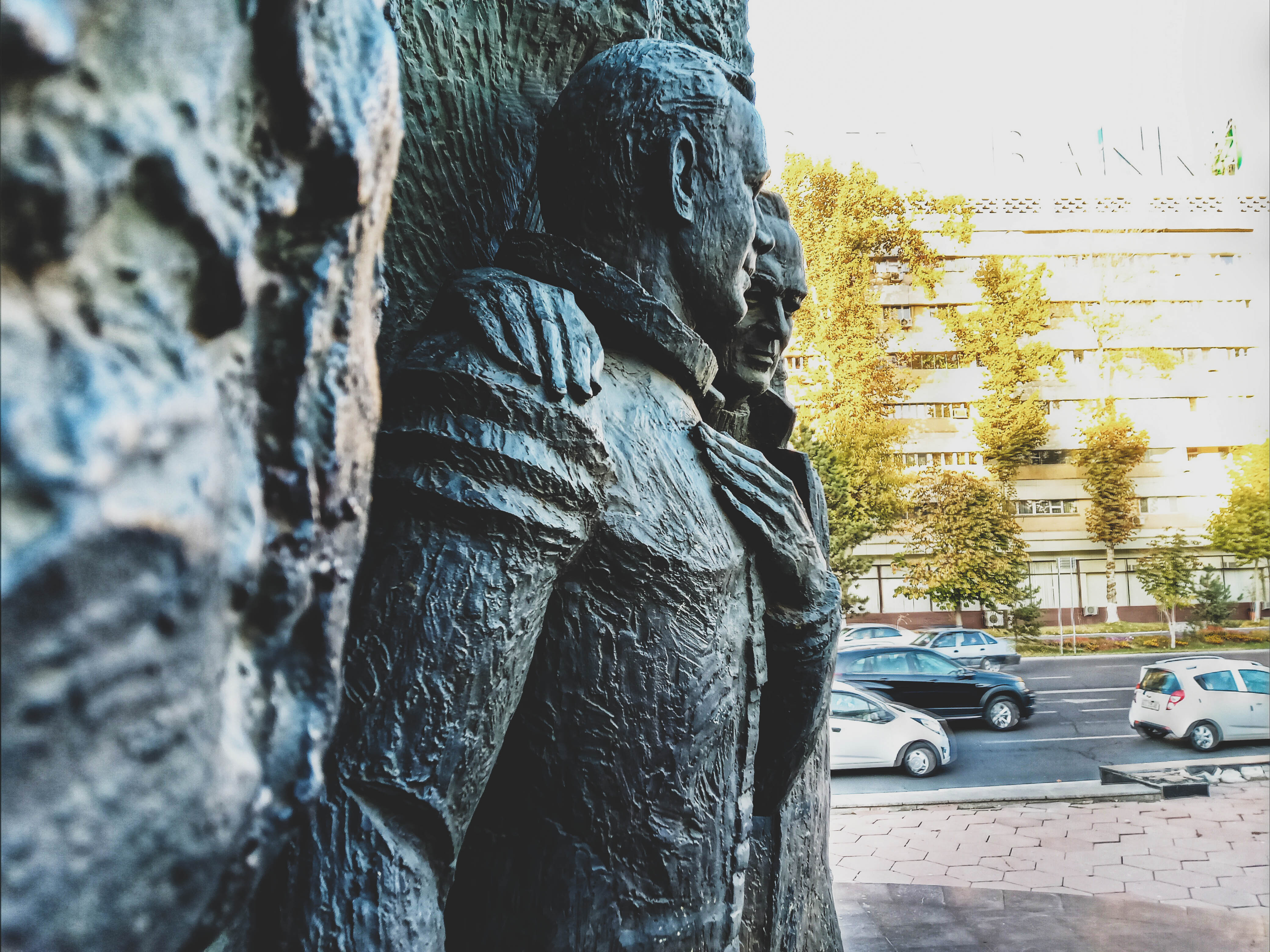
Somewhere in the vastness of space, the cosmonauts gaze out of their spacecraft window at the Earth. And here, on the Earth, in the city called the Star of the East, we have a unique square where Icarus never falls, still soaring high, full of daring, impetuosity and hope.
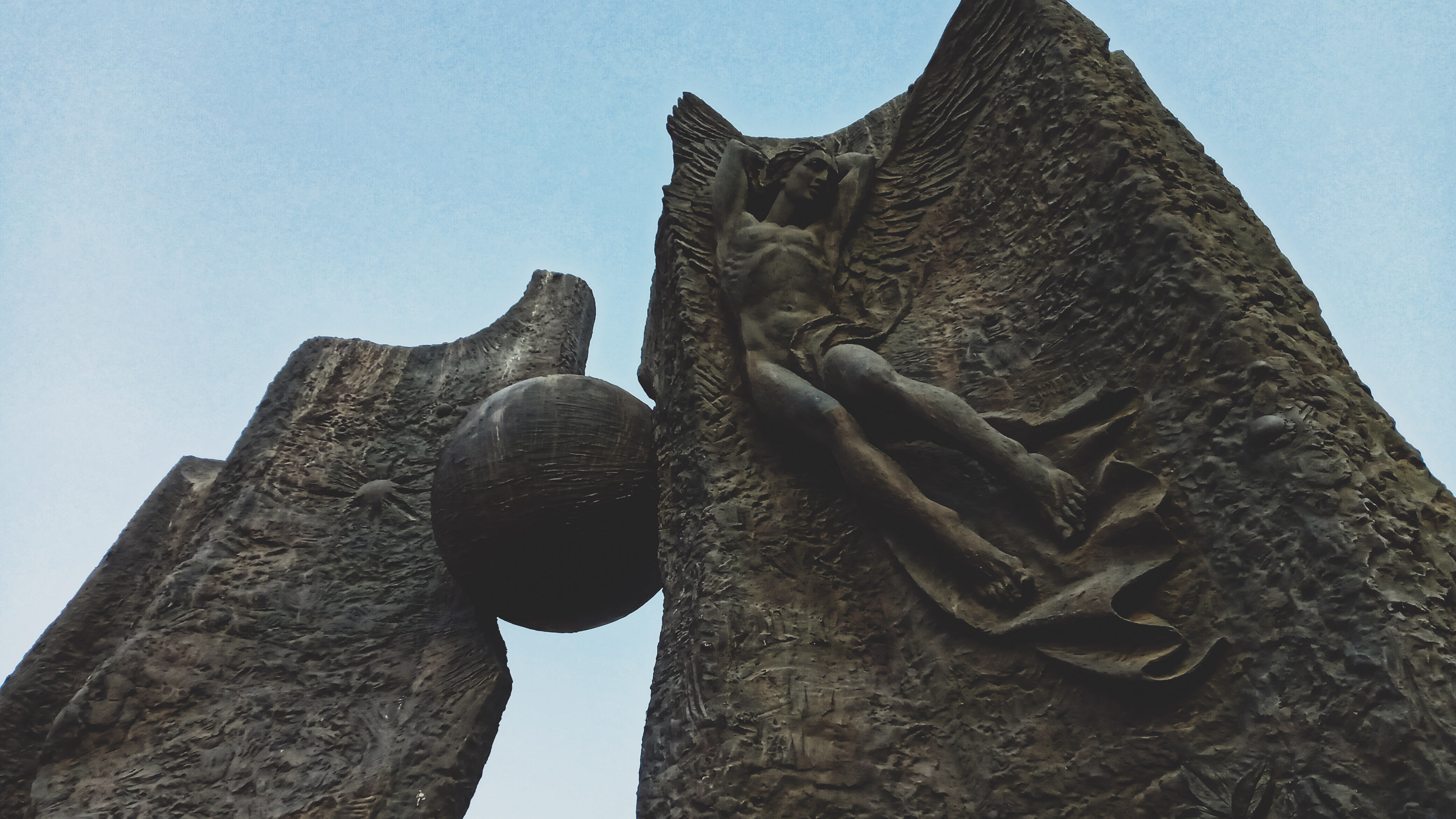
The relief composition 'Space' opened in 1984, have united those who once looked up to the stars: Ulugh Beg, Tsiolkovsky, Korolev, Gagarin. And have harmoniously accompanied them with fictional characters: Icarus and Mother Earth. Two panels joined by a celestial body look like a gateway between epochs and ideas about the Universe.
One of the panels quotes Tsiolkovsky:
“Mankind will not forever remain on Earth, but in the pursuit of light and space will first timidly emerge from the bounds of the atmosphere, and then advance until he has conquered the whole of circumsolar space.”
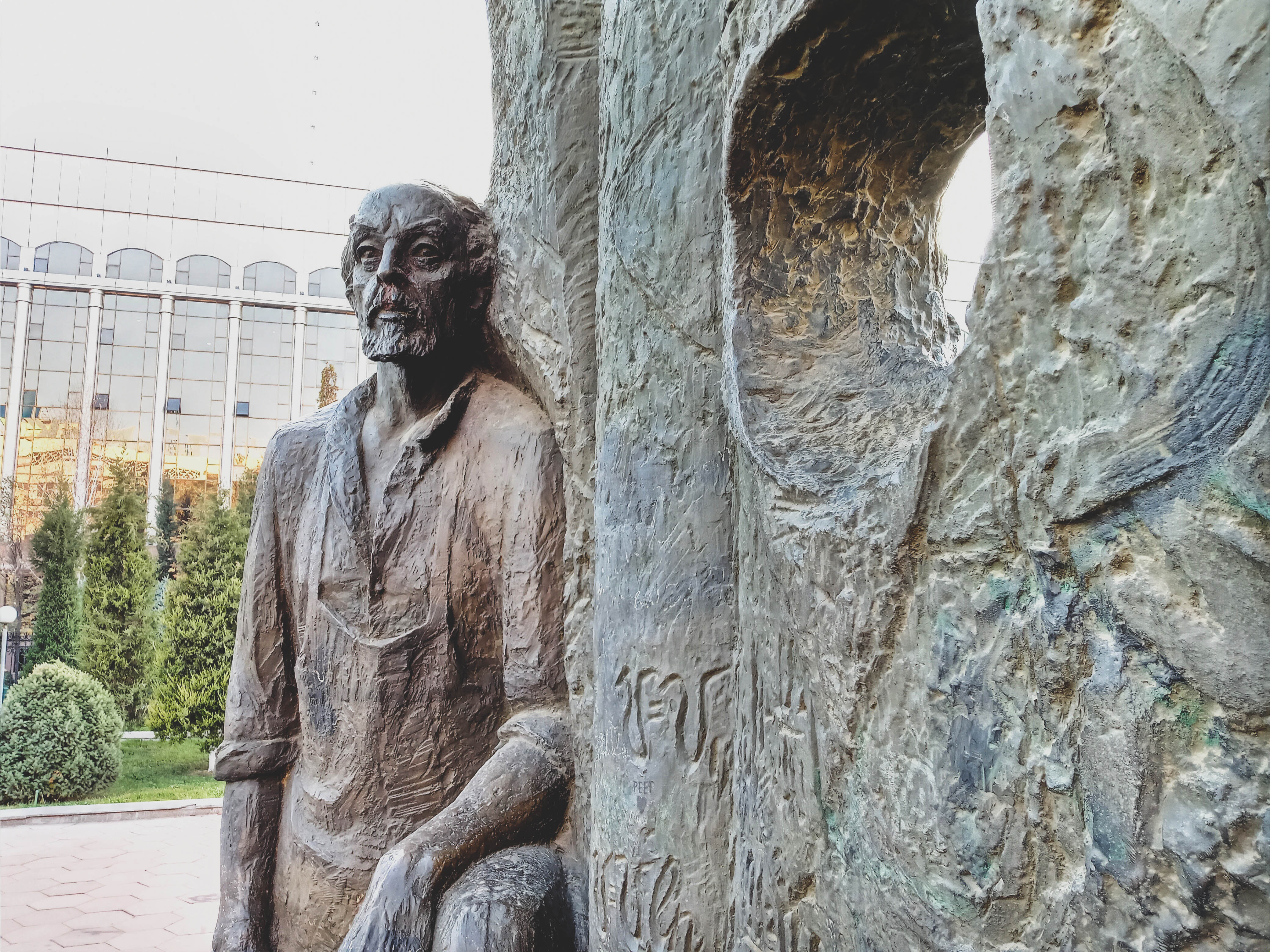
The square was designed by architects Yuri Miroshnichenko and Ravshan Salimov, and sculpted by Yakov Shapiro. All figures are cast in bronze. At first, the pedestals were faced with black granite, which made the whole composition look strict and deep.
In 2022, the square got a makeover: the black granite was replaced with grey stone, the lighting was renewed, and the public got excited. The composition has changed, but the sculptures, luckily, remained intact. Icarus keeps on flying, Tsiolkovsky still looks ahead, and Dzhanibekov remains the eternal participant of this starry conversation.
Location: Afrosiyab Street, beside the Ministry of the Internal Affairs
Opening hours: 24-hours
Admission fee: free of charge
Cosmonauts Metro Station
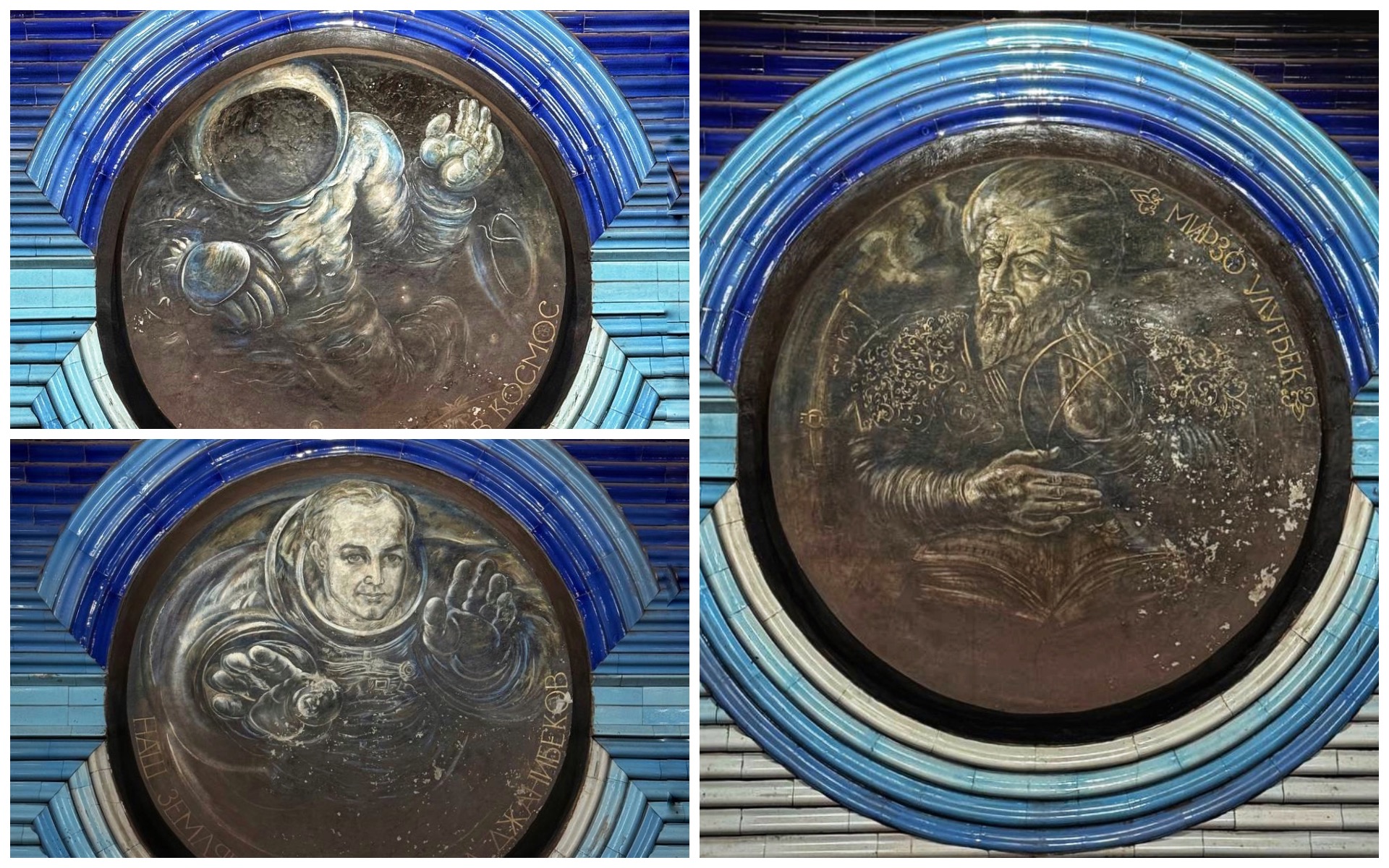
The underground might seem the less obvious way to the stars, but if you go by the blue line of the Tashkent Metro, don't rush to get on the train. Stay for a while at the Cosmonauts station and you’ll see the space explorers and dreamers look at the passengers through the black gaps of the on-board windows.
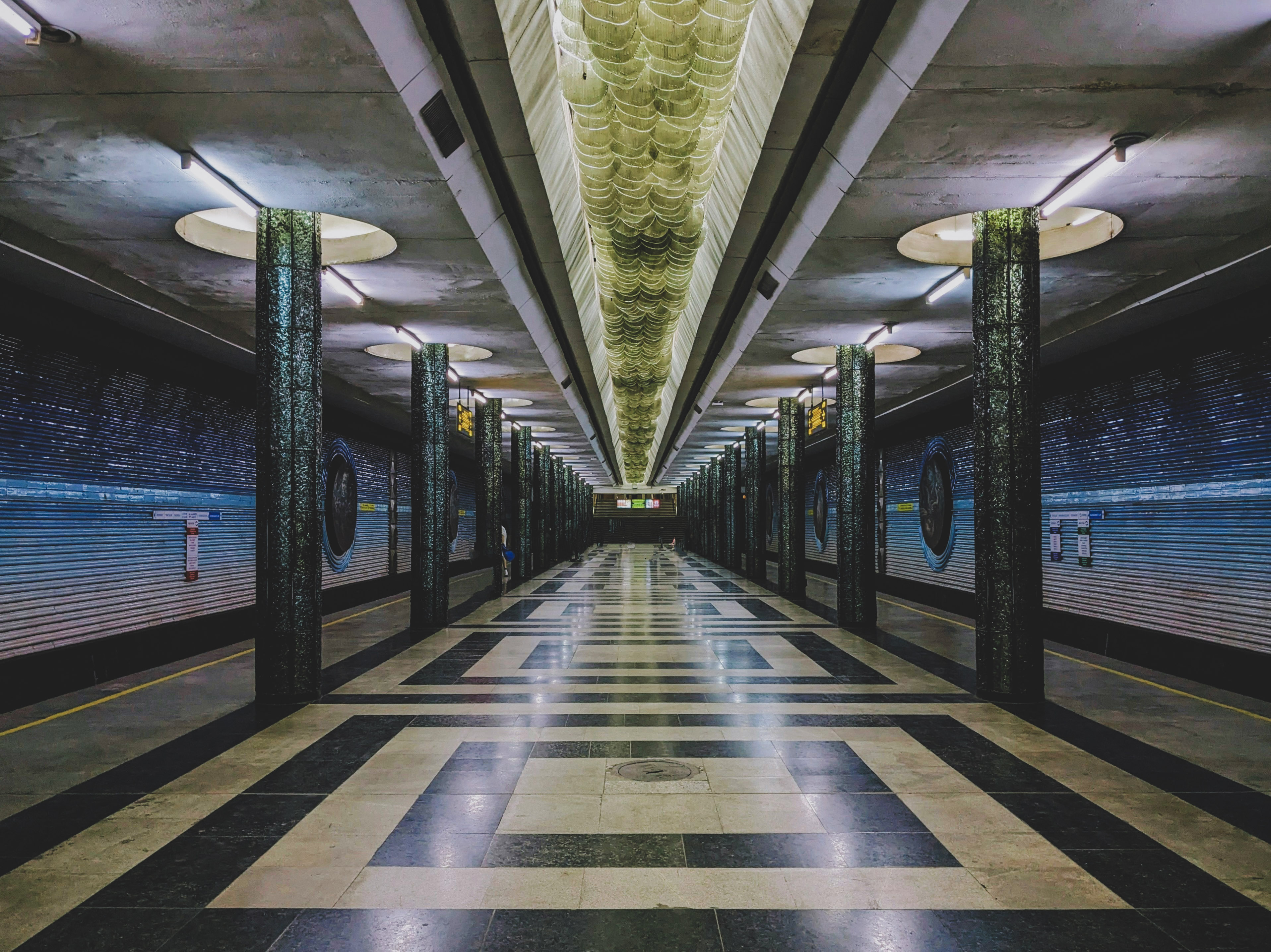
Back in the 1980s, when architect Sergo Sutyagin was designing the station, he was told not to use crystals or mirrors, as they were considered too fragile. Fortunately, Sutyagin wasn't deterred and insisted that at least the columns, reminiscent of the flame of a taking off rocket, be glass. The then head of Uzbekistan, Sharaf Rashidov, gave the go-ahead.
The glass was supposed to be imported from Belarus, but the masters there were busy with their own underground stuff. So glassblowers were found in Uzbekistan, and they did just as well.
The medallions at the station are a special treat. Black and white grisaille by Arnold Gan, like an old movie: Ulugh Beg and Tsiolkovsky, Volkov and Korolev, Dzhanibekov and, of course, Gagarin. The cosmonauts of the Intercosmos program reach out to each other, Soyuz meets Apollo. And all this silent symphony there is a wonderful personification of the universe. And the culmination of this silent symphony is the magnificent personification of the universe.
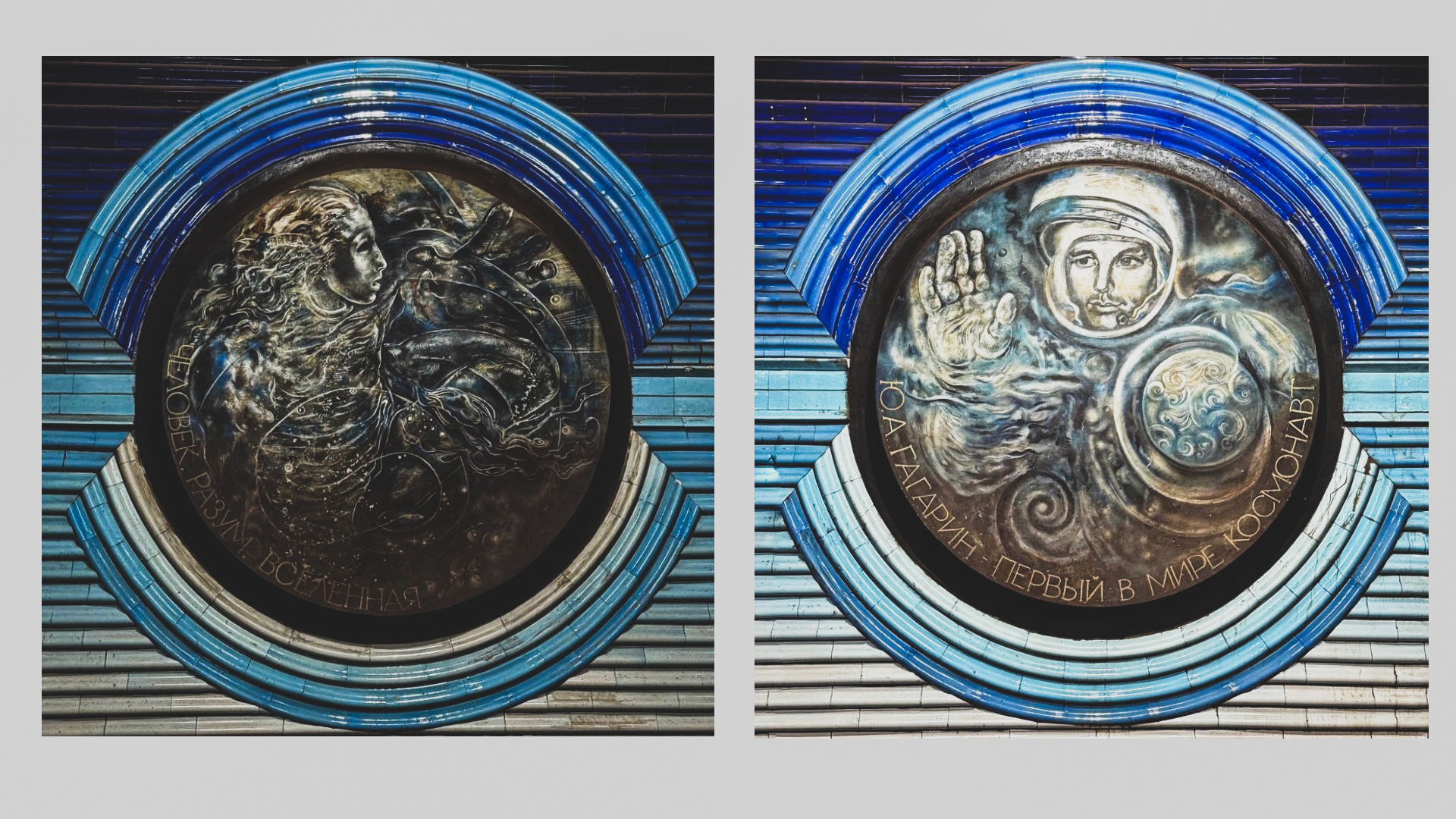
Location: Afrosiyab Street, the Tashkent Metro (Blue line)
Opening hours: from 05.00 to 00.00
Admission fee: 1700 UZS by ATTO card, 3000 UZS by cash
Monument to Yuri Gagarin
Even if you're only 20 and you don’t know much about Gagarin, don’t worry. Gagarin is still there. Though, maybe not exactly where your parents remember it.
Yes, we have already met one Gagarin at the Cosmonauts Square, standing among his space fellows. However, there is another one, a free-standing, a special one, installed near the Chilanzar shopping centre. Just like the man to whom it is dedicated, this monument has also travelled around, though within the same city.
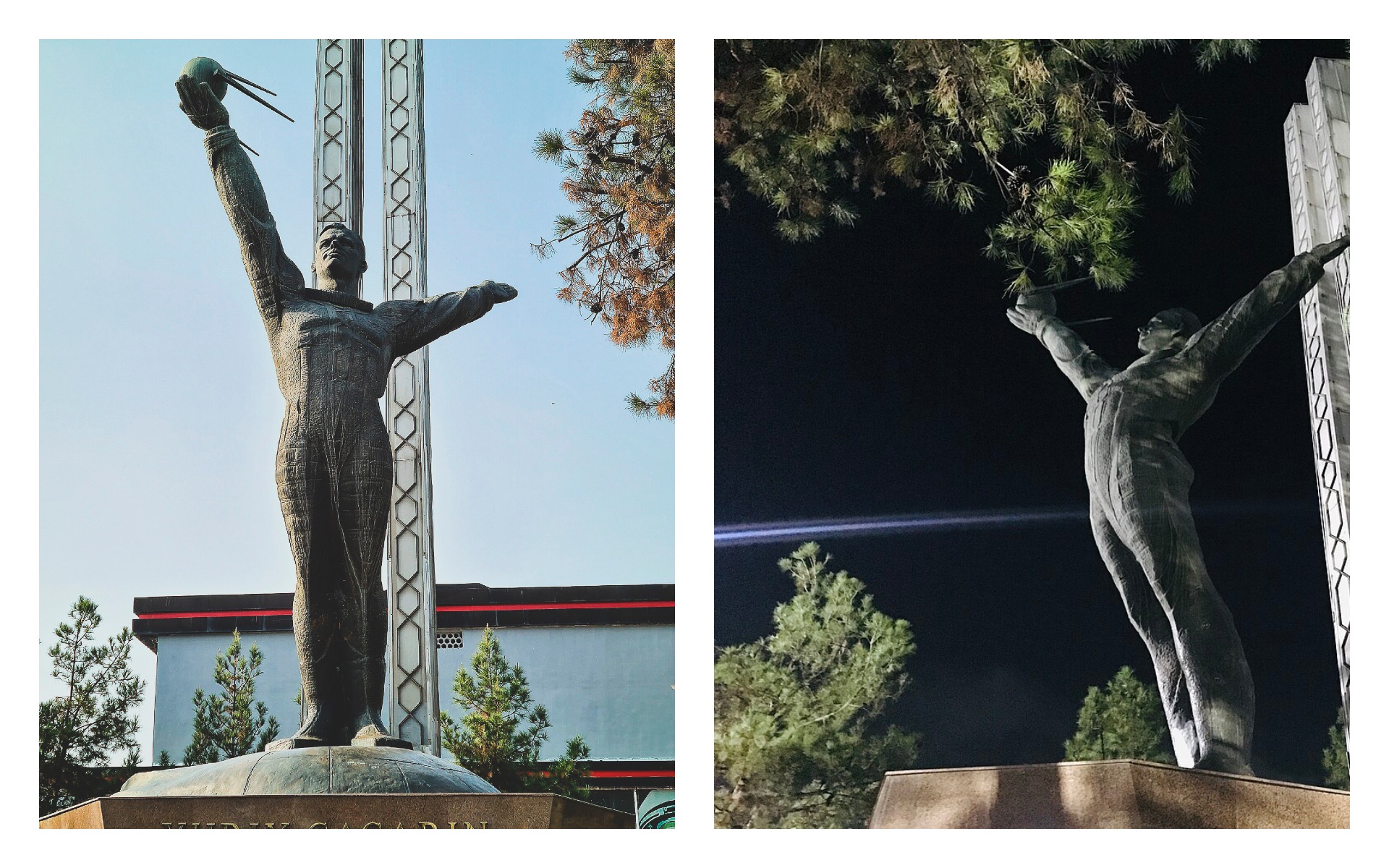
The first obelisk with a bas-relief was installed in Gagarin Park. Ten years later it was replaced by a bronze monument of Gagarin, standing on top of the globe, with his hand stretched to the sky, holding the first artificial satellite. Behind him is a 28-metre high stele resembling a rocket trace. This monument created by Grigory Postnikov and Sabir Adylov remained untouched for 16 years and then was moved to Chilanzar.
Location: Chilanzar district, Chilanzar massif, 3rd quarter, 59
Opening hours: 24-hours
Admission fee: free of charge
Tashkent Television Tower
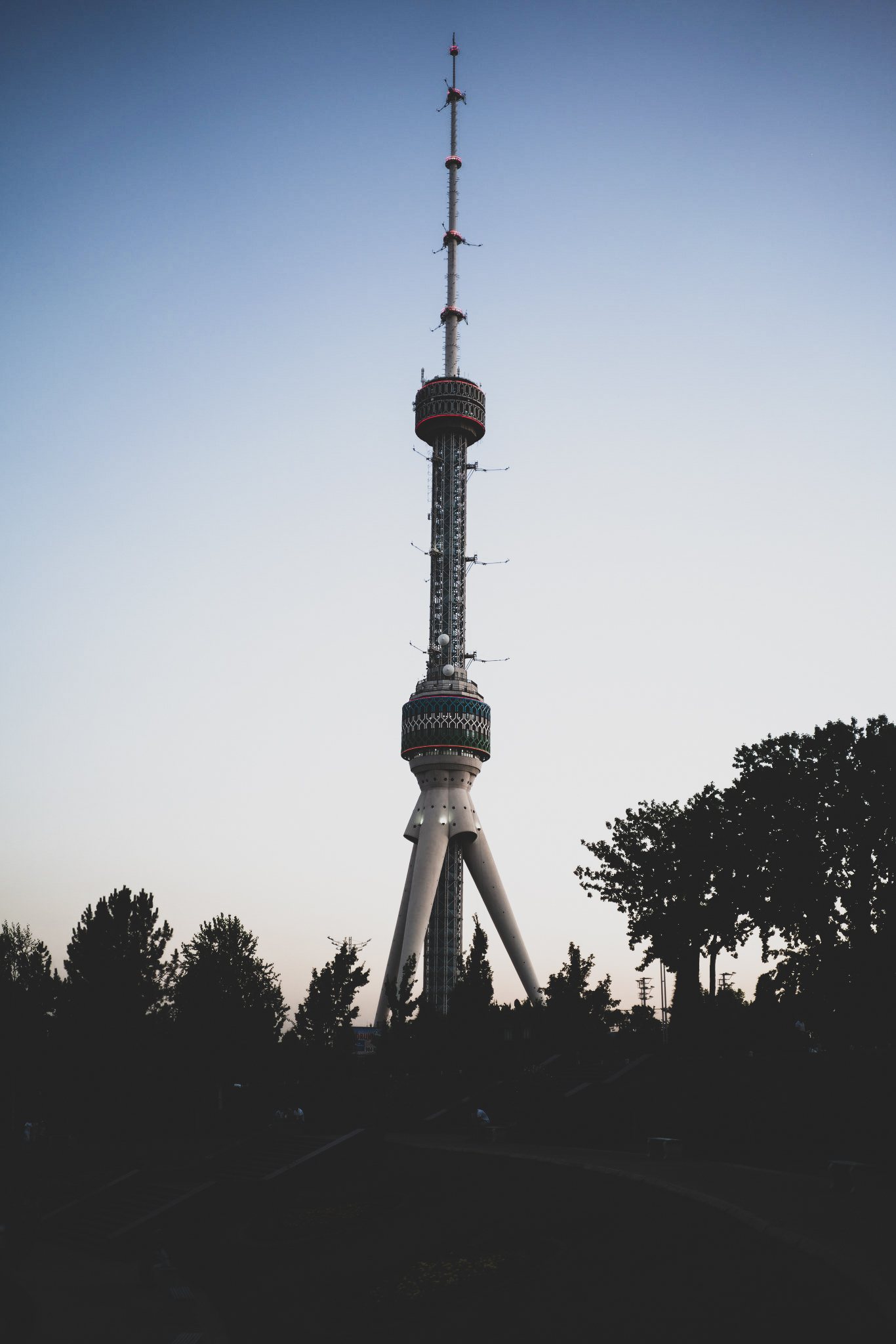
Although the Tashkent TV Tower looks like a rocket, it won't actually take you to space. But, it will definitely give you a bird's-eye view of the city. The contact with space starts right at the very entrance: in the foyer the guests are greeted by a cosmonaut with open arms. This is one of six mosaic panels created by Abdumalik Bukharbayev in 1985.
All six panels are made of semi-precious stones, which the artist is rumoured to have been collecting for three years all over the USSR; the courier delivery services didn't exist back then. Three mosaics are created using the elegant Roman technique, and three other - in the Florentine style. For Tashkent, this sounds almost like science fiction.
Location: Amir Temur Avenue, 109A
Opening hours: from 10.00 to 20.00
Admission fee: weekdays — 40 000 UZS (adults), 20 000 UZS (special rates); weekends — 50 000 UZS (adults), 25 000 UZS (special rates); free of charge — children under 7 years, group I invalids
Mosaics by the Zharsky brothers

The brothers Pyotr, Nikolay and Alexander Zharsky are like three satellites orbiting a planet called Tashkent. They came here after the 1966 earthquake to help rebuild the city and stayed forever. Over a number of years, they decorated about 400 houses with mosaics that were bright, complex and almost cosmic.
- From the end side of house 69/2 on Babur Street, the city is observed by Abu Rayhan al-Biruni. Al-Biruni was like a ‘Mom's Friend's Son’ among the scientists of his time; the man who knew everything that could be known in the 11th century. But now we are primarily interested in his contribution to astronomy. The panel with the image of the great thinker was created by Pyotr, the eldest of the brothers, in 1978. The background of the mosaic depicts an outstretching space: Saturn with its rings, the orbits of celestial bodies. In front of al-Biruni, notebooks with calculations are open, the phases of the moon alternate each other, and in his hand he holds the Tree of Life, frozen in eternal bloom.
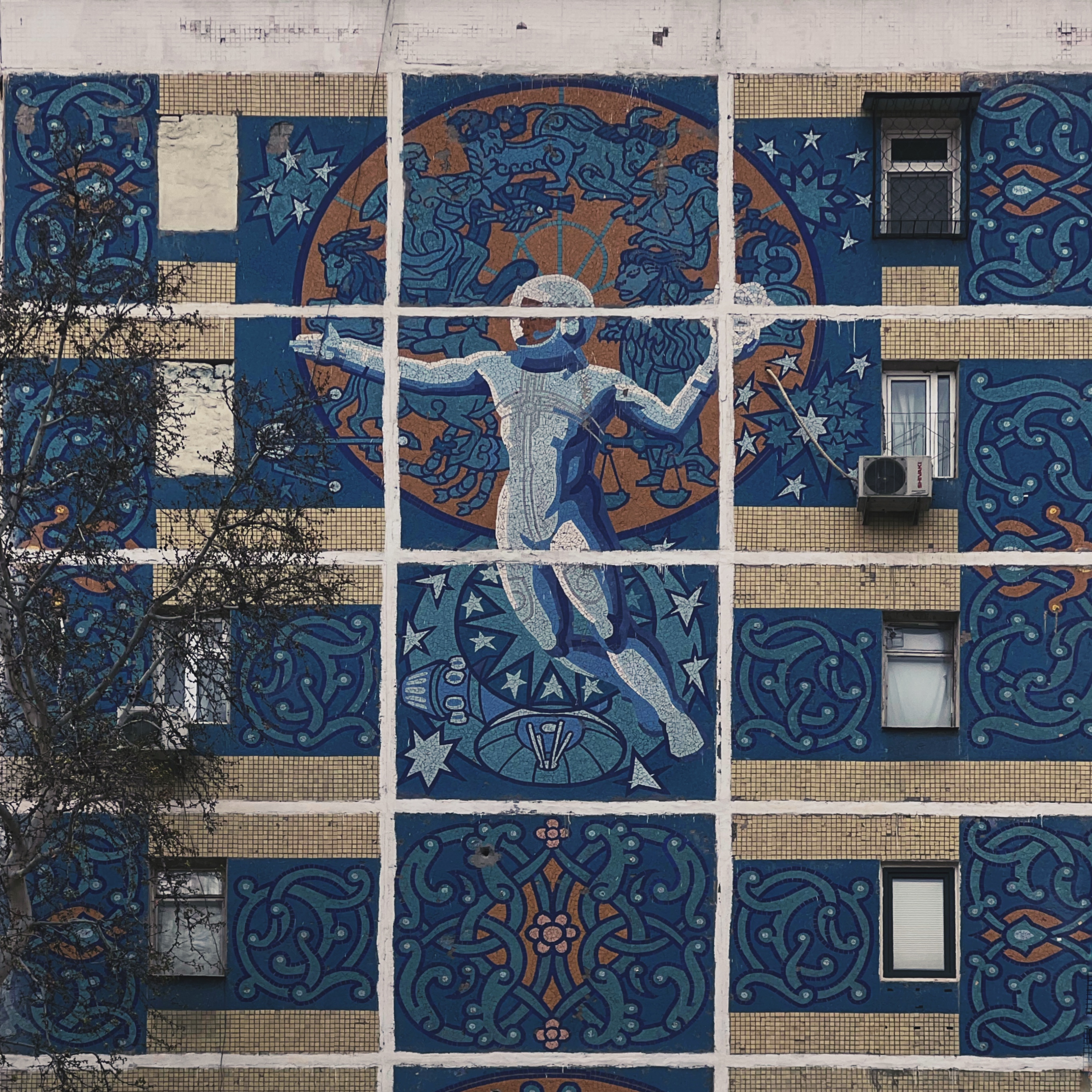
- Nikolay, the second of the Zharsky brothers, used the façade of the house at 30, Labzak Street, to create his image of a cosmonaut, gazing through the starry night sky and Tashkent dust. It'd be great to see his spiritualised face and the atom shining on the palm of his hand, but the public utilities have made their adjustments. They've plastered over the joints of the slabs on the façade. Nevertheless, the satellite and the spaceship still hover side by side, and behind the cosmonaut's back we can see the twelve signs of the Zodiac, like a horoscope of his interstellar journey.
- People living in house number 49 on the Massif Suvsoz have their own supernova star, which was born not through a nuclear fusion, but resulted from the inspiration of Alexander, the youngest of the Zharsky brothers. His ceramic star burst into life in 1978, right in the middle of a cosmic vortex of gas, plasma and maybe even hope. It still shines today, with a soft, warm light reminding us that beauty can appear anywhere, even in the most unexpected places, even in Vodnik. All you need is someone wishing to put it there.
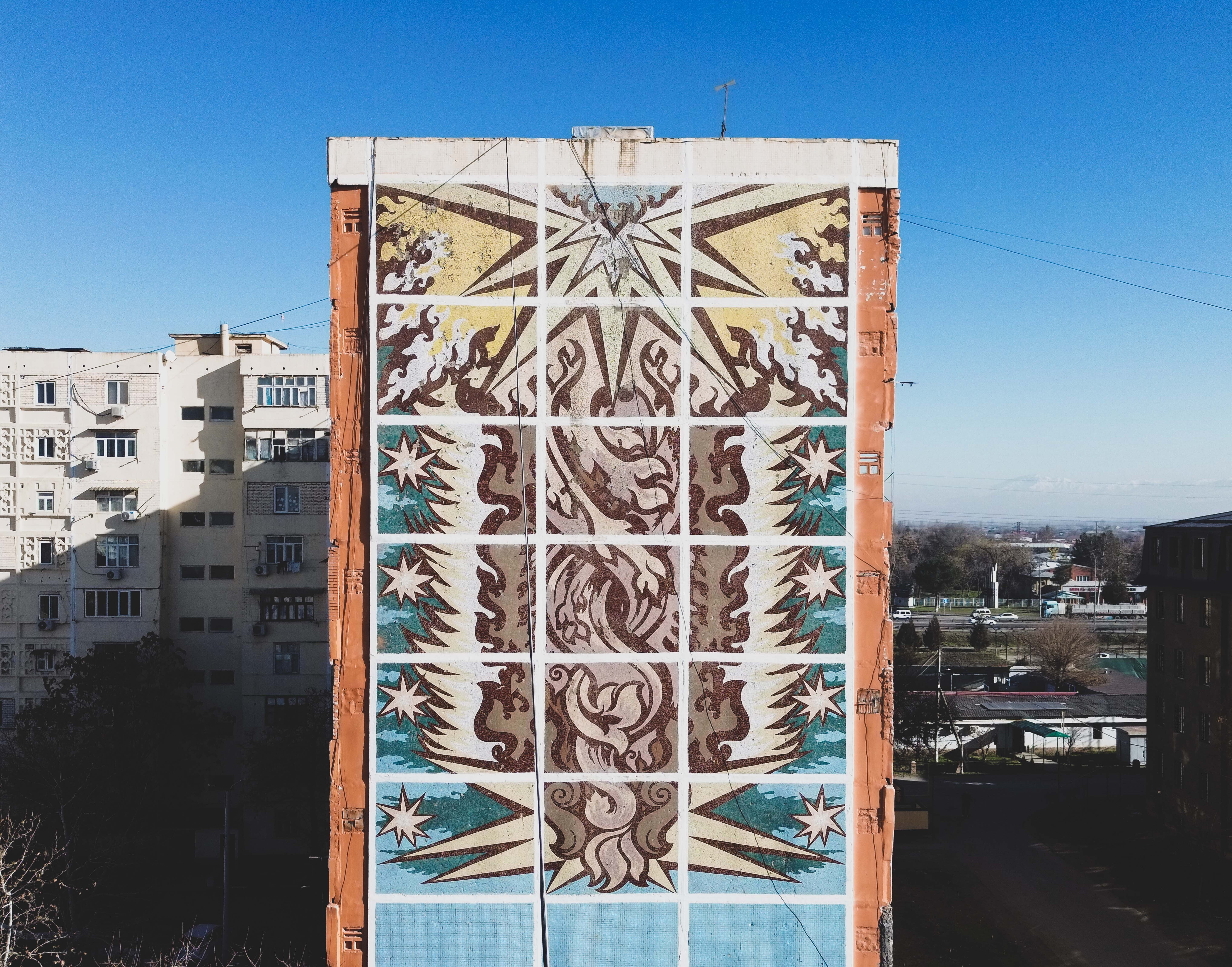
Many mosaics that once adorned the facades of Tashkent houses have been damaged or destroyed; the time, renovations and advertising banners has taken a toll on both the concrete and the art. But, don't lose heart, though. You can still find many of the amazing works that remain untouched. And here's a little hint for you. If you download the Tashkent Mosaics app, and then point the camera at Al-Biruni or the Cosmonaut, you can make these figures appear to be alive in a digital space, where the mosaics continue to shine.
Locations:
• Cosmonaut – 30, Labzak Str., Shaykhantakhur district
• Al-Biruni – 69/2, Bobur Str., Yakkasaray district
• «Birth of a Star» – 49, Suvsoz massif, Bektemir district,
• Opening hours: 24-hours
• Admission fee: free of charge
Where will this journey take the yet unknown space traveller? It's still a mystery. Even the fate of King Etana is open to discussion: whether he fell or returned with the desired prize. Not every flight is a success, but that shouldn't stop us from dreaming.

Newsletter
A letter from the HD editors
Once a week, we send the best stories, events, and cultural discoveries from Central Asia.