Brief summary
Here we have gathered the key thoughts of the hero of the material — for those who want to quickly familiarize themselves with the content. The full transcript of the interview can be found below.
Mиршод, known by the pseudonym Vargunza, has come a long way from being a tomato seller to one of Uzbekistan's most prominent street artists. He is convinced: an artist does not have to be poor—on the contrary, art should inspire and open new horizons. Instead of gray facades—murals; instead of dreary silence—the voice of the street, understandable even to a child.
Vargunza advocates for the legalization of graffiti, catalogs abandoned walls, and proposes transforming gloomy courtyards into open galleries. According to him, the problem is not with the viewers, but with the artists: some become self-contained, others "fly" too high. One needs to be among people, speak with them as equals, and not fear arguments. Because graffiti is not about likes, it's about presence.
Video version of the interview
We have prepared this option for those who prefer to watch and listen.
Full version
Here we present the full version of the interview for careful reading.
— You create in a very unique direction. How did you come to art?
— Before I took up art, I went through a long and difficult path. I'll briefly tell you my biography. I was born in 1999 in the village of Varganza (Kashkadarya region — ed.) — my pseudonym actually comes from the name of this place. Later, we moved to Saint Petersburg for a long time.
Since my youth, I've had two main passions: architecture and fine arts. In St. Petersburg, these fields are highly developed, especially architecture—it's rightfully considered one of the most beautiful in the world. Even the strongest and most talented artists work precisely there. My interest in these areas grew with each year.
But in 2010, we were forced to return to Uzbekistan. After the move, I experienced real shock—we are so far behind in architecture and visual arts. Later, I realized that this is precisely what opens up opportunities for me: there is an entire country that needs development in these areas. I thought I could make my contribution. But life turned out to be a bit more complicated.
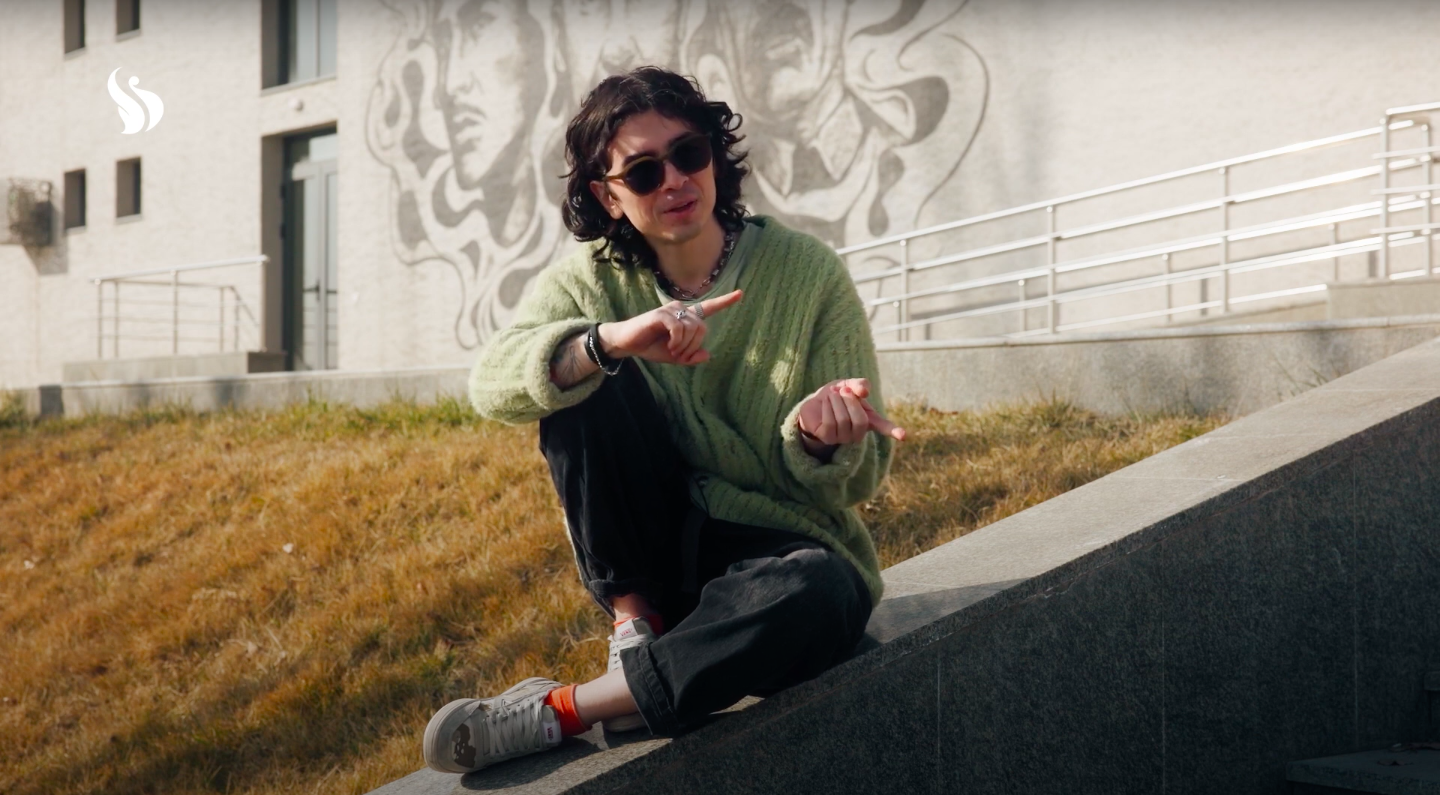
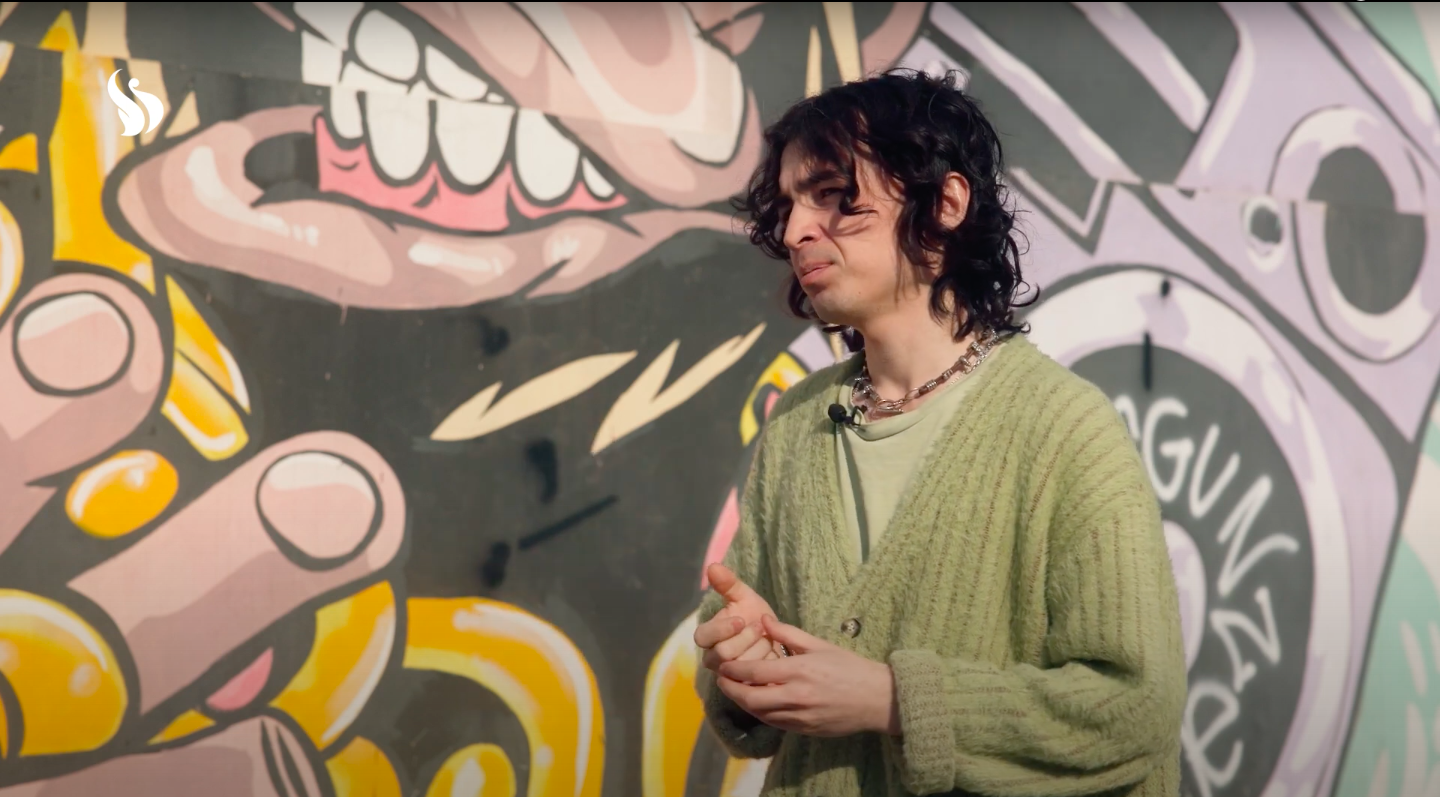
Artist Vargunza. Frame from the interview
Instead of pursuing architecture or art, I was forced to work at the market—selling tomatoes. For five years, I was engaged in wholesale trade. Despite all the difficulties, the market taught me a lot. Without that experience, I might not be sitting here now. There, I learned communication, negotiation—a kind of street diplomacy. I learned to present myself, work with customers, sell goods—and all these skills later helped me both in art and during my studies at the institute.
After saving up some money, I enrolled in the architecture faculty. I had big plans. I worked for three years at an architectural firm—and in the end, I left. Over time, I realized: to develop architecture in Uzbekistan, you have to endure a lot, turn a blind eye to what's happening, and limit yourself. And that path wasn't for me.
Over these three years, my enthusiasm has faded. I've "cooled off" because I've often encountered situations where architectural projects are approved by people who have absolutely no understanding of architecture. Of course, not everyone is like that, but such cases do happen.
Today, Uzbekistan is rapidly developing: investments are flowing in, international agreements are being signed, and there is active cooperation with other countries. But each investor country has its own norms and standards. You cannot "reinvent the wheel" — you must do everything as they require.
I left architecture, but I needed something to do. During my studies at the institute, I worked part-time as a decorator—painting murals on walls in restaurants, educational centers. It helped cover my education expenses. Gradually, I built up a client base and decided to continue working in this direction, hoping to find my true calling later.
My interest in architecture never faded. I still wanted to work with forms, decorate the city, make it more beautiful. And then I realized: graffiti and street art are exactly what suit me. I've been doing this ever since.
— What is street art?
— Street art can be considered a new direction in art. It is urban creativity encompassing many forms: graffiti, murals, installations, and other visual statements.
For me, street art is the art of mood and sharpness. It reflects what makes people happy, and what angers or saddens them. Street art can be sharp, sometimes even aggressive—but it enlivens the urban environment.
— There are many directions and techniques in street art. Could you tell us more about them?
— If we talk about techniques, the first and simplest is tagging. This is when the artist leaves their pseudonym, a kind of autograph. One could say it's the entry point into the genre: you truly become part of the culture when you leave your first tag. Anyone can do this — you don't have to be an artist or have special training.
The next style is throw-up. This is already a more complex form: simple but expressive images, colorful fonts, inscriptions, sometimes with calls to action.
Next is wildstyle. This is already a kind of encryption: the inscriptions become more complex, meanings are concealed. This is the essence of graffiti — it's an art not so much of the result, but of the process. Since it is often illegal, the artist can encrypt a message, hide an idea in a complex composition.
There is also bombing—the most aggressive and outright illegal direction. These are large-scale and often risky actions, such as painting train cars. In Uzbekistan, bombing is practically non-existent—perhaps out of respect for state property and transport. But, honestly, I believe that bombing is already vandalism.
In short, murals are the legal and most spectacular form of street art. Large wall paintings are created with the approval of authorities or public organizations. As a rule, a mural covers an entire wall and carries a social or artistic message, unlike spontaneous graffiti.
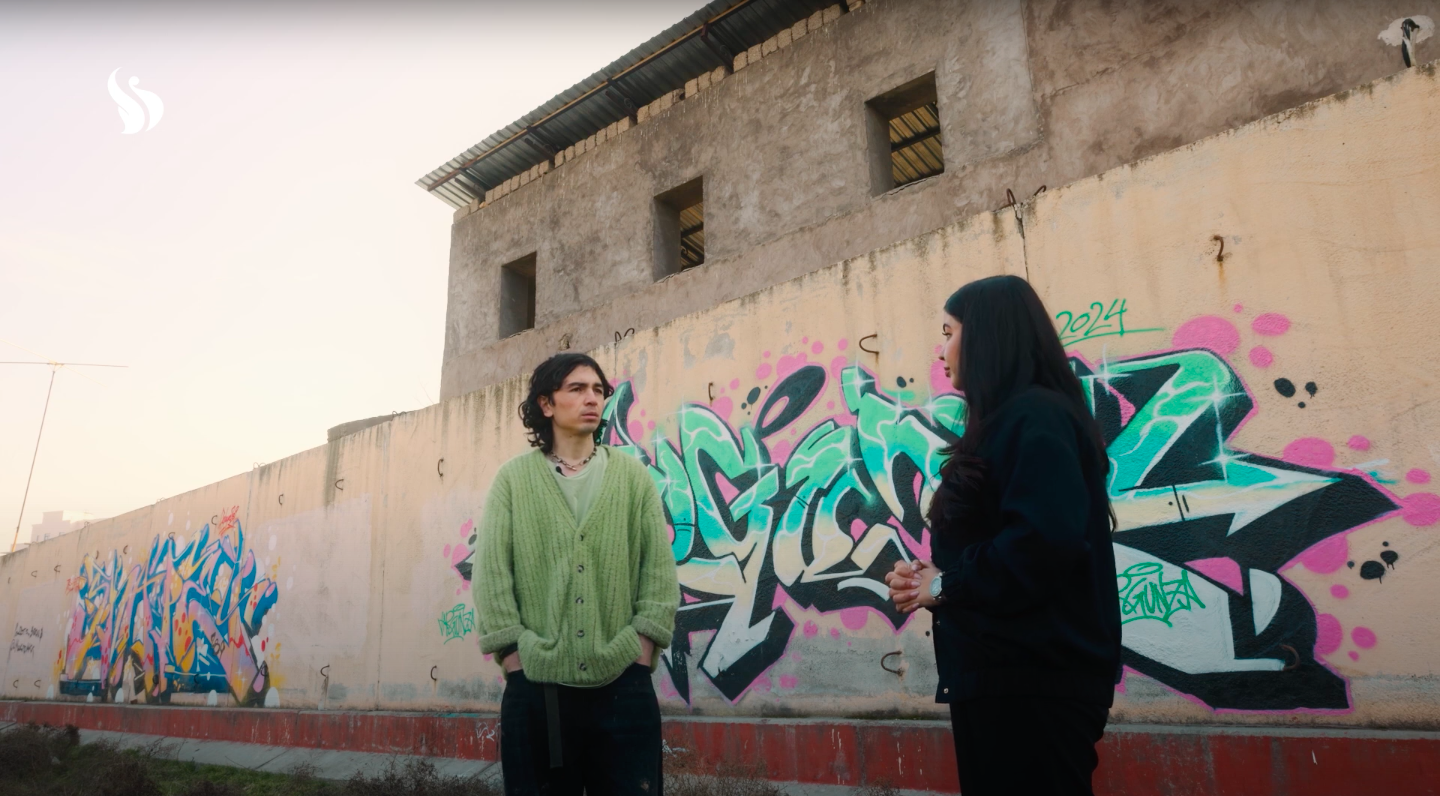
Artist Vargunza. Still from an interview
— Graffiti throughout the city is often painted over or destroyed. This process is called buffing and is usually carried out by government agencies. Could you explain in more detail what buffing is?
— I'll try to express a neutral position, although I have a rather sharp opinion on this matter—I'll talk about it a bit later. Buffing, in translation, means 'removal.' It is a measure aimed at eliminating acts of vandalism, offensive inscriptions, provocative images, and statements that contradict cultural norms and censorship. But it's important to understand: buffing is not always something negative. For example, outdated murals are also subjected to buffing to free up space for new works.
— In recent years, there have been known cases where Inkuzart's graffiti have been painted over or edited by the authorities. For example, on a mural depicting Oksana Chusovitina's Olympic victory, a skirt was 'put on' the heroine. Many call this a form of censorship. Is this legal? Or is it unfair to the artist?
— There are two camps on this issue: the graffiti community and the state structures responsible for buffing. Their views are fundamentally opposed.
For graffiti artists, this is censorship, an attempt to suppress expression. For authorities, it is a measure to maintain a balance between creative freedom and public norms.
Speaking specifically about the Inkuzart mural, it seems someone considered that "people might misunderstand it, the image doesn't align with the local mentality." Therefore, the decision was made to "put a skirt on it" — meaning to correct the image within the framework of buffing.
— Murals are appearing all over the city, often of very low quality. Although they are commissioned by the state, it's clear the work is superficial. It seems they are painted not by mural artists, but by people who don't know how to work with scale. Should such projects be entrusted to professionals, or is it better to let graffiti artists express themselves freely?
The problem is precisely that murals are often commissioned to academic artists. As I've already mentioned, graffiti has legal restrictions — specifically, the lack of legal spaces. Therefore, graffiti and murals are most often created secretly, outside the law. Artists working in this genre remain in the shadows; they cannot officially teach others or share their experience. And those who are known in artistic circles typically work in a completely different context.
Murals follow certain rules: stylization is required, thoughtful composition. When the state invites an artist who has painted on canvas all their life and assigns them a huge wall—they continue working in their familiar manner. What is appropriate in a museum may look out of place and even frightening on the facade of a residential building. Scale demands a different aesthetic and approach.
Therefore, I believe that murals should be entrusted to those who understand the urban environment: graffiti artists trained in monumentalism, professional muralists, or at least enthusiasts with experience. Simply giving a wall to any artist is not enough. They must be able to "work with space."
— What is the difference between public art and street art?
— Although they do look similar, there is a fundamental difference between them.
Public art is official, institutional art. Its purpose is to decorate public space, to make it aesthetically appealing. Street art, on the other hand, is most often a spontaneous statement. It is born from emotion, from an internal impulse, and often breaks the rules. These forms have different goals and contexts.
Artist Vargunza. Frame from the interview
If you imagine them as people, public art is a person in a suit: a teacher, a banker, a professor. And street art is your close friend. Public art speaks in a literary language, politely. And street art can stun you with a bright composition, etch itself into your memory, or tell a bitter truth directly to your face.
— Mosaics and murals have been preserved on the roofs of Soviet high-rise buildings. Today, murals are more common on new buildings. But many still do not distinguish between murals and graffiti. Why?
— This happens because murals are in plain sight — they are created legally, commissioned by the state, and with a specific purpose. Graffiti, on the contrary, is often hidden from view: you can see them near railways, in industrial zones, in places without pedestrian traffic.
Murals are typically located on the facades of 9–12-story buildings and are designed to be noticed. Their narrative is easily readable: it could be a portrait, an illustration, or an advertisement. Graffiti, on the other hand, is often provocative, abstract, composed of bright lines, and not always understandable to an unprepared viewer.
There are also differences in technique. Murals are more complex technically and in scale — they cover the entire surface of the wall. Graffiti is less large-scale and typically occupies only a part of it.
— Do you think the state should fund graffiti? After all, this direction doesn't quite align with its objectives. But perhaps it's a way to popularize the genre?
— I don't think the state should directly allocate money for graffiti development. There are other, more effective ways. For example, you can legalize walls—create officially permitted spaces where artists can freely draw, develop, and share experience. Further collaborations with sponsors are possible, publishing works online, sales through NFTs. There are various forms of monetization.
But if the state starts funding graffiti as a genre, it will create boundaries. The artist will become dependent on commissions and requirements. And graffiti will cease to be what it is—the freest form of art.
Yes, artists in other genres also express feelings and raise important issues. But ultimately, their goal is often recognition, commerce, selling works. That's a framework. A graffiti artist is free. They hide their identity, operate outside the law. If they are recognized—they face a fine. That is precisely why they remain, perhaps, the only truly free artist.
And also with Mirshod, we have the Rabochiy Bag:
— In Central Asia, street art and graffiti still don't provide a stable income. Do you have any ideas on how to earn money from this?
— Yes, for Central Asia this is still a relatively new direction. Although actually—not entirely: there have been murals and mosaics. Now, for example, Tashkent even made it into the Guinness Book of Records for mosaics. But since there are few specialists in this field, it is not perceived as profitable.
One path is to adopt Western experience, particularly European. There are legal platforms for graffiti there. If you want to hold a festival, you don't need to get permission. You just come and paint. No one detains you, asks for documents, or takes you to the police station. There is no fear there — and the absence of fear breeds freedom, and freedom develops creative potential. And you can already earn money from this.
I am currently developing a project to popularize and monetize graffiti. Throughout Tashkent, there are facades in poor condition. They are regularly painted, but it's useless: due to crookedly laid bricks and moisture, the paint quickly washes away, and the walls become gray again. The best solution is to paint graffiti, murals, and street art on them. This will transform the neighborhoods.
Where it's currently scary to walk in the evenings — literally, Hitchcock could film horror movies there — bright, lively images will appear. I myself photograph such facades, measure them, create a catalog — a kind of registry of walls across Uzbekistan where one could potentially paint.
We have underground passages where people are afraid to be. But if street art appears there, people will stop littering. We've already discussed this — and it works.
Next, with this catalog, you can approach NGOs, international organizations willing to support cultural initiatives, and through them — to local authorities for official permission.
First, it will improve the city's visual appearance. Second, street art can simply and vividly address complex topics: domestic violence, drugs, ecology, social problems. Even a two-year-old child cannot read, but will look at a drawing and ask: "Is this our planet? Why is it on fire? What is that black liquid flowing?"
When legal walls appear, artists will be able to collaborate with private companies. This is already happening. Here is an example: when mosaics were restored on one building, the advertising banners had to be removed — and brands incurred losses because they had paid for rent, permits, and printing. If even 10–20% of outdoor advertising integrates into collaborations with graffiti and street art, everyone will benefit — artists, businesses, and the city.
Such approaches can indeed support the development of the genre. If starting with Uzbekistan, the idea could eventually spread to other Central Asian countries.
Artist Vargunza. Frame from the interview
— Which of your works do you consider the most significant and beloved?
— One of the most important works for me is the lighthouse we painted in Karakalpakstan. It stands on the site of the dried-up Aral Sea. This lighthouse used to actually function. After our painting, I think it has become a symbol of hope.
After the Aral Sea disaster, a stressful, depressed atmosphere emerged in Muynak. And I'm not saying this based on hearsay—I was there myself, I saw how people live, I felt this mood. The renovated lighthouse gave them at least some hope.
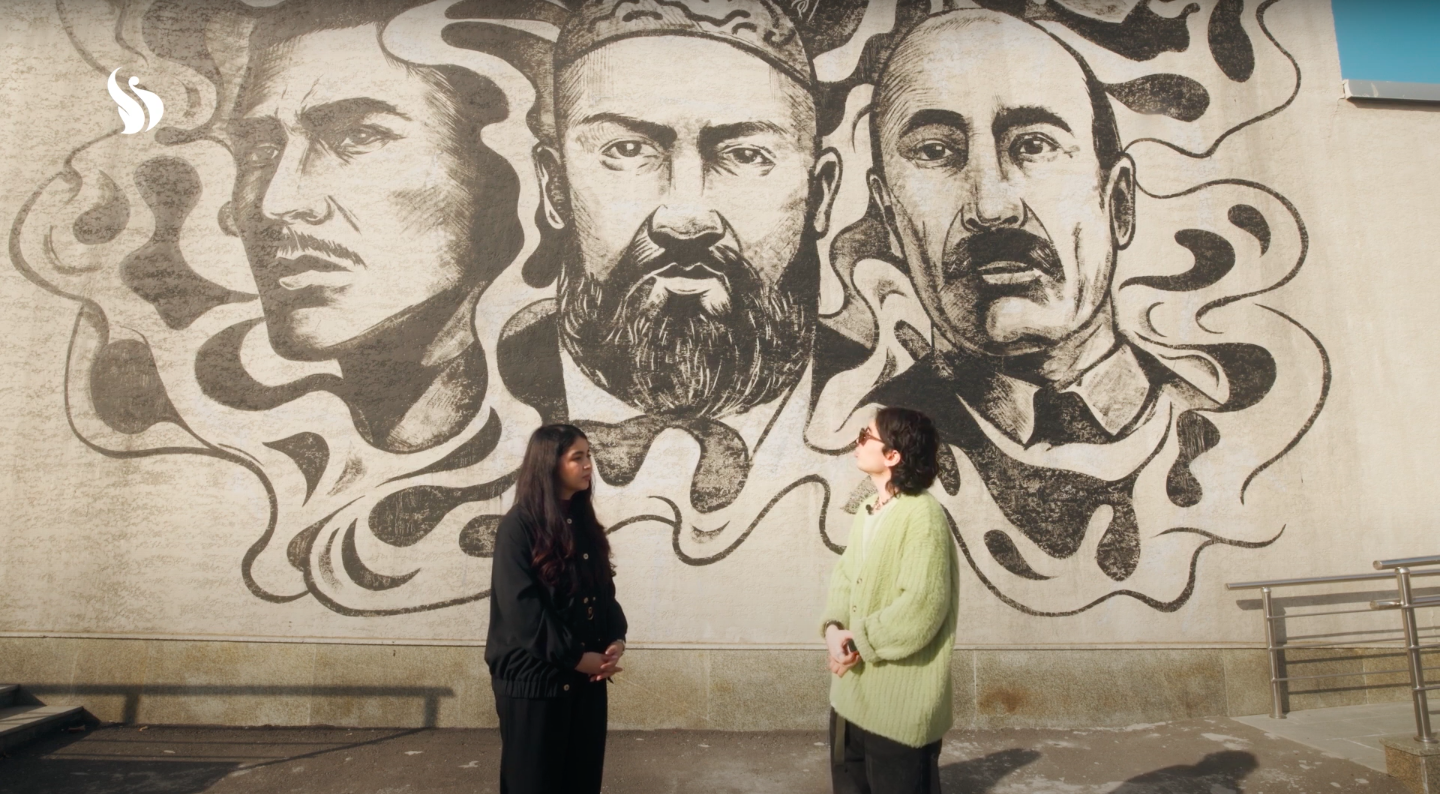
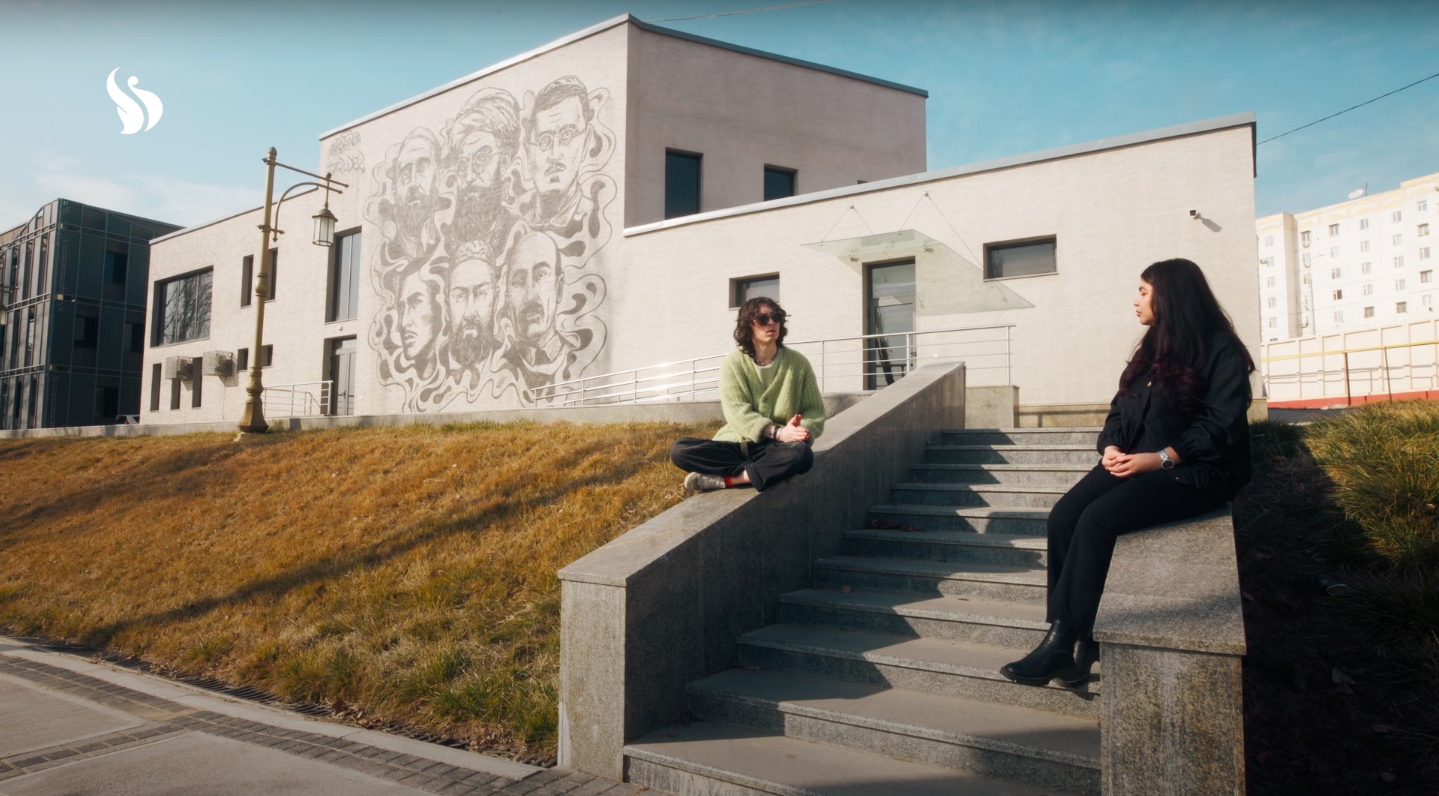
Another significant work is the portraits of Jadids that we painted at the "Shahidlar Xotirasi" square. Through these images, we introduced ordinary people, especially children, to the history of Jadidism. It became a kind of visual guide: the portraits attract attention, spark interest, and encourage people to seek information. We carried out this work as part of an international conference.
I also deeply cherish the mural I painted in my own home. My house, my atmosphere, my favorite color—I tried to create a special mood, a personal space that completely aligns with me.
Another important piece is the one created during the graffiti festival. I faced a lot of difficulties there, but that's precisely why it is especially valuable to me.
— What challenges do street artists face in Uzbekistan?
— Since street art in Uzbekistan is just beginning to develop, many artists currently look to Western or European styles. We don't have our own graffiti school. The older generation often perceives it as something alien, as "disrespect for culture." And due to the lack of legal spaces, artists are forced to work in secret. There's always the fear: "Tomorrow I could be fined."
Another major problem is the lack of systemic support. Traditional art forms still dominate in the country. Even professional artists do not recognize street art—they say: "We are artists, and you are just amateurs." And partly, this is true: the genre is still very young and is only beginning to develop here.
We have no festivals, no forums, no master classes. An artist simply has no space to grow—they don't know where to learn, from whom to gain experience, or how to move forward.
— What is the difference between graffiti and vandalism?
— Graffiti is art. And vandalism is destruction.
Graffiti is an attempt to beautify the city, to leave an aesthetic and conceptual mark. It is an expression of an idea, emotion, personality. Vandalism, however, is a social act aimed at causing harm, destroying public space. They should not be confused.
— Could you name graffiti artists in Uzbekistan?
— Unfortunately, there are very few of them. The most famous one is Inkuzart. He started working in 2020 and quickly became popular because he reflected the mood of society with simple yet precise visual techniques.
There are still several artists. For example, Nadezhda Rikhsieva is one of the first to start designing the urban environment and is now actively working in the street art direction.
There's also a guy named Andrey [Zhuravlev] — it seems he was the first to show how graffiti can work in conjunction with advertising, and essentially laid the foundation for this direction here.
Bahodir Jalol is a kind of "founding father" of Uzbek street art. He started working long before us, realized large-scale projects not only in Uzbekistan but also abroad — in India and other countries. Thanks to him, street art began to be discussed in our country at all.
Watch the interview with Bahodir Jalol on our YouTube channel
Besides these names, I honestly don't know anyone else. There really are very few of us. But if graffiti continues to develop, I'm sure that in 5 years a whole generation of talented artists will emerge.
— In December 2024, Uzbekistan adopted its first regulatory document governing the visual appearance of the city — a design code. Do you think that bright graffiti might disrupt its aesthetic?
— It all depends on the type of graffiti and where it is placed. If the genre develops properly, it's enough to introduce at least basic rules. Then street art and murals will not only not spoil the city's appearance but can also complement and enrich it.
First, graffiti in the city center must adhere to a certain style: consider colors, architectural context, and treat the historical environment with respect. For example, in old districts, it is necessary to use an appropriate palette, references to cultural heritage, and national imagery.
If an artist wants to work in a freer style—spaces outside the center are suitable for this: railway zones, outskirts, underground passages. Everything can be organized to maintain balance.
— Does graffiti help the development of the country and broaden the horizons of youth?
— Definitely. Graffiti can change mindsets — that's a fact. Take, for example, our mural with portraits of Jadids. It spread across the internet. In the comments, I saw people asking: "Why did you draw this? Who are these people?" — and others explaining to them: "These are Jadids." An educational dialogue emerged, and that, in my opinion, is extremely valuable.
Graffiti can be used to address historical, scientific, and social themes. It all depends on the artist: they can convey any idea, any emotion. Currently, socio-political issues are particularly relevant — and the audience is not indifferent to them.
Artist Vargunza. Frame from the interview
— Should we abandon the stereotype that an artist must be poor to preserve the "authenticity" of the profession?
- Absolutely. This stereotype is long overdue for a re-evaluation. Yes, many artists have gone through hardships—but that doesn't mean they are obligated to suffer their whole lives.
If a person has chosen the path of art—they have already made a difficult choice. Now they must inspire, grow, and earn a living. People should look upon an artist with respect, with admiration—not with pity.
No phrases like "don't become an artist—you'll perish." On the contrary: "Look, son, maybe you'll become an artist too. You see, he draws, travels, he's shown on TV, he's successful."
An artist should be an example — bright, free, and self-confident. It is this image that inspires. That is my opinion.
— In your opinion, which organizations should take responsibility for the development of modern art forms, such as graffiti and street art?
— First and foremost, this is a task for the authorities. They must show interest, create conditions, issue permits, and support initiatives. Without the will of the state, nothing will move forward.
Next — educational institutions. If institutes, schools, and colleges start hosting master classes, lectures, and workshops on street art, interest in the genre will grow. Then phrases like, "This is not our culture" or "This is for slackers" will disappear.
Festivals and brands can also play an important role. If graffiti is included as an interactive activity at festivals, it will become popular among other creative communities as well. Even if festival participants are mostly musicians, they are still interested in everything related to art.
Businesses can also support this direction: commission works, collaborate with artists, create legal platforms. This will not only support street art but also enhance the reputation of the companies themselves. I believe that only through such joint initiatives can the genre truly develop. There is no other way.
— Many consider visual art to be something "sublime," far removed from everyday life. But you were born in a village, worked at a market — and never lost interest in creativity. What would you advise others?
— The problem, oddly enough, often lies with the artists themselves. When a person begins to create but does not grow professionally, they usually veer into one of two extremes.
The first is seclusion. The artist begins to consider themselves "not like everyone else," withdraws, refuses to communicate, avoids meetings, doesn't go out in public, and doesn't show their work.
The second extreme is star syndrome. As soon as they earn a little money, they immediately distance themselves: "I'm a star, my paintings are selling, I'm already a millionaire." They lose touch with reality and disconnect from their audience.
As a result, people who already have little understanding of contemporary art continue to not understand it. One artist is in isolation, another is in the clouds. And neither of them can be approached for advice.
An artist must remain a part of society. They must be among people, talk with them, hear them, and share their art with them.
My advice is simple: don't wait for conditions to be created for you. Don't rely on laws, grants, or international funds. If you truly need it — start. Be greedy for knowledge and hungry for success. That's all.