On why the poet struggles with the word
— How would you characterize the style of your poetry? What is it, really: "the poetry of Sukhbat Aflatuni"?
— It's difficult for me to give a definition to what I write. Poetry is precisely a way to escape from definitions, from clear characteristics, including self-definition. For example, a person studied to become a programmer, one can say about them: "He is a ready-made programmer." But to say such a thing about a poet or a prose writer... "A ready-made poet"... A poet is never "ready-made." They are always a little "unprepared," always slightly "half-baked"...
- Why does this happen?
— It's hard to say. After all, we write in the same language that millions of people use daily to speak, think, and joyfully exchange banalities: "Wait for me at the bus stop," "The speaker addressed the gathered crowd…," "I'm hungry." And this everyday language must be translated into the language of poetry, prose, philosophy—into the language of art and thought. An internal "struggle" with the word is unavoidable here.
Poetry is a kind of struggle with language, with words.
On Faith and Silence
— Did you come to God as an event, a journey, or the result of a defeat?
— I think a person doesn't come to God — they return to Him. In my case, this happened quite late: after a perfectly ordinary Soviet childhood in an intellectual, non-religious family. No one took me by the hand and led me to church. Perhaps that's for the best: my step — and I was already over thirty then — was the result of my own choice, free and conscious.
"The result of defeat?" No, on the external level, everything was shaping up quite well: work, family, scientific and literary pursuits. Everything was... not bad. But there was another feeling — of the fragility, the fleeting nature of this "not bad."
Like in childhood: the guests have left, mom is washing the crystal, you take the tray with glass shot glasses, goblets, carry it to the room. Your hands tremble, the glass trembles — you're afraid to drop it, to break it... That's the feeling. It's still with me now: a feeling of fragility, the thin 'glassiness' of existence. But now, at least, I know what to do with this feeling.
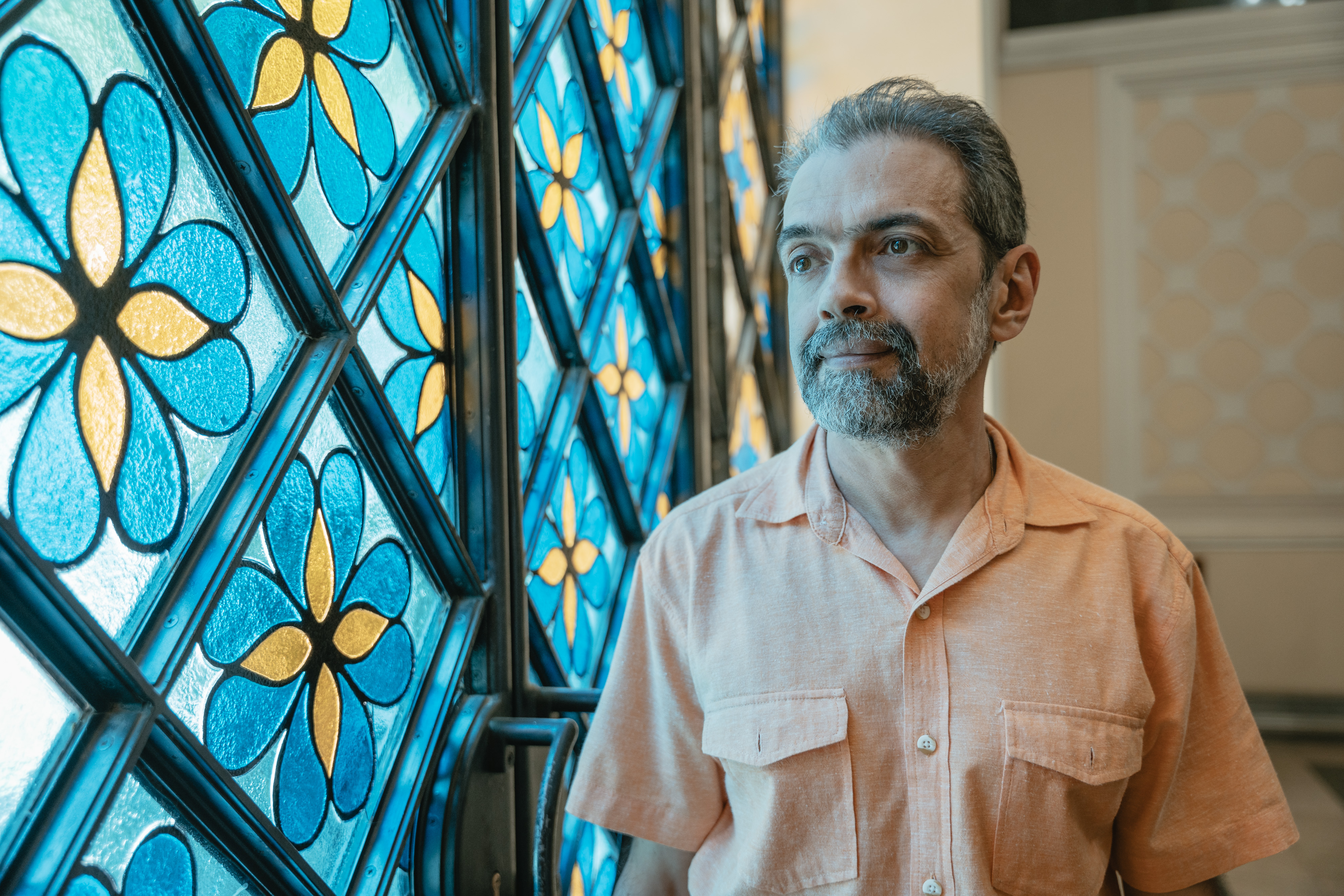 Evgeny Abdullaev © Katerina Kuznetsova / Instagram: tawshan
— How has your poetry changed?
— I think, in essence, it hasn't changed. For example, in my debut 2003 book "Psalms and Sketches," there is already everything that could conditionally be called spiritual lyric poetry. And this was before my acquaintance with Metropolitan Vladimir, who was then heading the Central Asian diocese, before the start of my work in the diocese and becoming a practicing church member. That already happened in 2006.
On the other hand, of course, something changes. I cannot answer, like Joseph Brodsky did in a conversation with Peter Vail when asked if he believes: "I don't know. Sometimes yes, sometimes no." I cannot be a "sometimes believer" — though perhaps I once was. And I say this not to condemn Brodsky — and certainly not to put myself on a par with him. It's just that these are truly different states of consciousness. And they, of course, are reflected in what you write.
— How have you changed as a reader and writer after your spiritual awakening?
— I don't know... Conversion isn't a one-time act: like, a person was "normal," and then—bam!—they "converted." It's, as you said yourself, a journey. A slow, painstaking work on oneself. In my case—for about twenty years now. And, of course, during this time, one's attitude towards the word changes.
It's not so much that self-censorship intensifies (censorship is generally permissible only in exceptional cases), but rather a more responsible attitude toward what you write emerges. An understanding comes that you cannot simply "express yourself." You need to be attentive—to what you want to say to the reader and to how you say it.
— Is it possible to write about God in modern language — without pathos, without ritualism?
— I don't think modern language excludes all of that. Poetry without pathos, without a strong inner feeling, is probably impossible altogether. The question is where that feeling is.
In genuine faith, as in true poetry, it is always somewhere deep within. It hides itself a bit, feels a little shy, avoids theatrical affectation.
As for "ritualism" — it's important to understand what we mean by it. Church realities? Then it all depends on measure and taste. When a poem is oversaturated with details — candles, icons, bows, antiphons, Easter bell ringing — this, as a rule, doesn't work. But also completely without these realities — how?
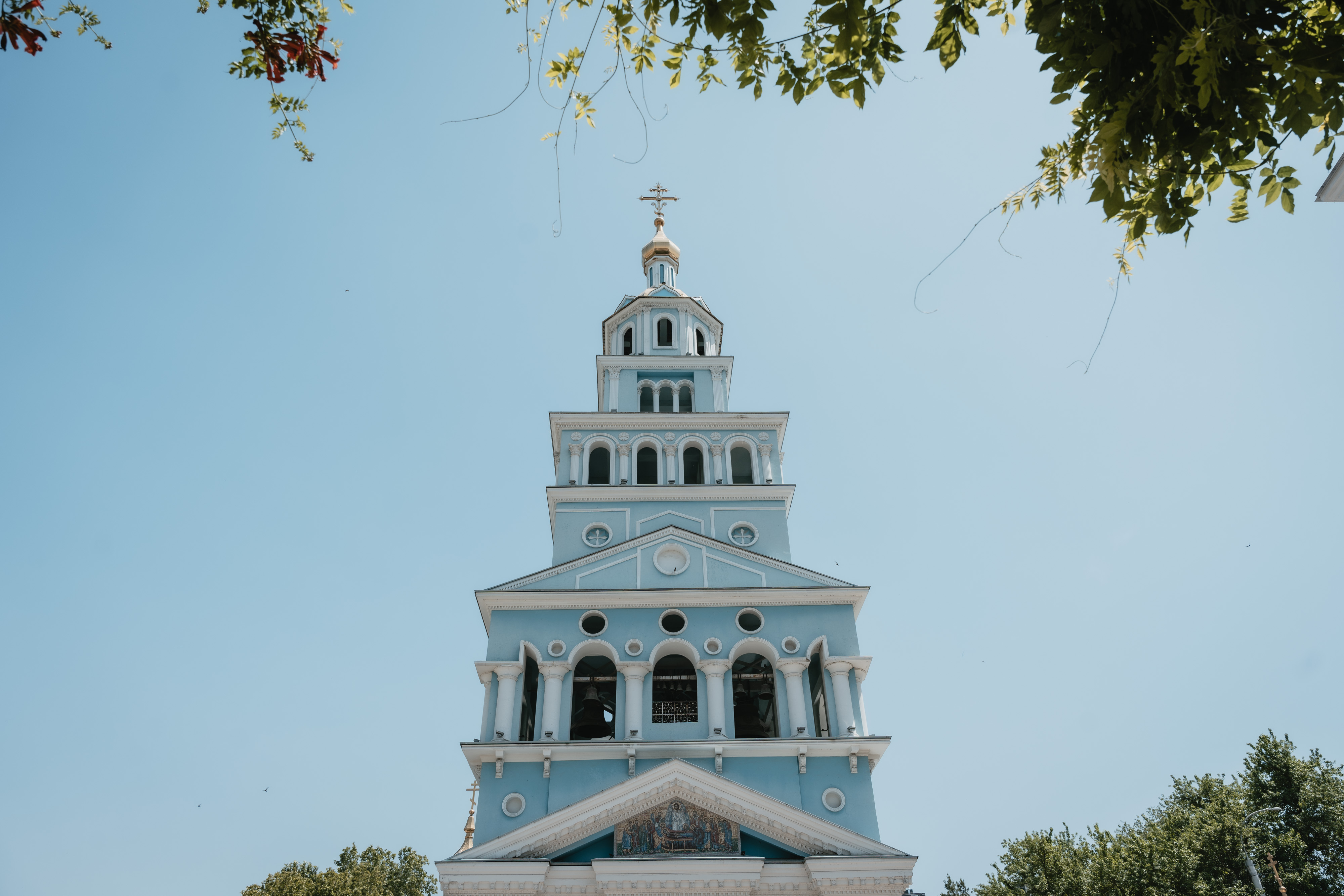 Transfiguration Cathedral in Tashkent © Katerina Kuznetsova / Instagram: tawshan
Recently, we were just discussing this with Aman Rakhmetov from Shymkent, a very interesting poet. He says that although he is not Orthodox himself, he is always struck by Blok's lines: "A girl sang in the church choir..." And yet, there is the church choir and the Royal Doors — all these are church realities. The very ones that, so to speak, belong to the "rituals." And yet — this is poetry that resonates.
— What then should literature be if it is entirely made of words and about words?
— Probably less verbose. More restrained. More ascetic. Quieter.
— And what is "quiet poetry," "quiet prose"? What should they be like?
— Today, there are too many words in the world — unbearably many. But speech is not just words. It is a combination of words and silence. It's pauses. It's the ability to listen.
Thanks to social media and the internet, everyone has gained the opportunity to "speak out," "express an opinion," "make themselves heard"... The result is that no one listens to anyone else, doesn't pay close attention, doesn't hear.
— Many poets — John Donne, Thomas Stearns Eliot, Mother Maria, Hieromonk Roman — have come to the conclusion that poetry can be a form of prayer. What do you think: can a poet be taught to pray in verse, or is this given only to those touched by God?
— I'm not sure about "teach". You can't really teach poetry at all. You can — and should — teach how to write poems, to understand them better. But to teach poetry... that's like trying to teach a miracle.
And yes, many poems truly sound like a prayer. "Fathers of the desert and wives immaculate..." by Alexander Sergeyevich [Pushkin]. Or "The Garden of Gethsemane" by Pasternak. "Little Life" by Arseny Tarkovsky. "Amnesty" by Yuri Dombrovsky... Some will name other names.
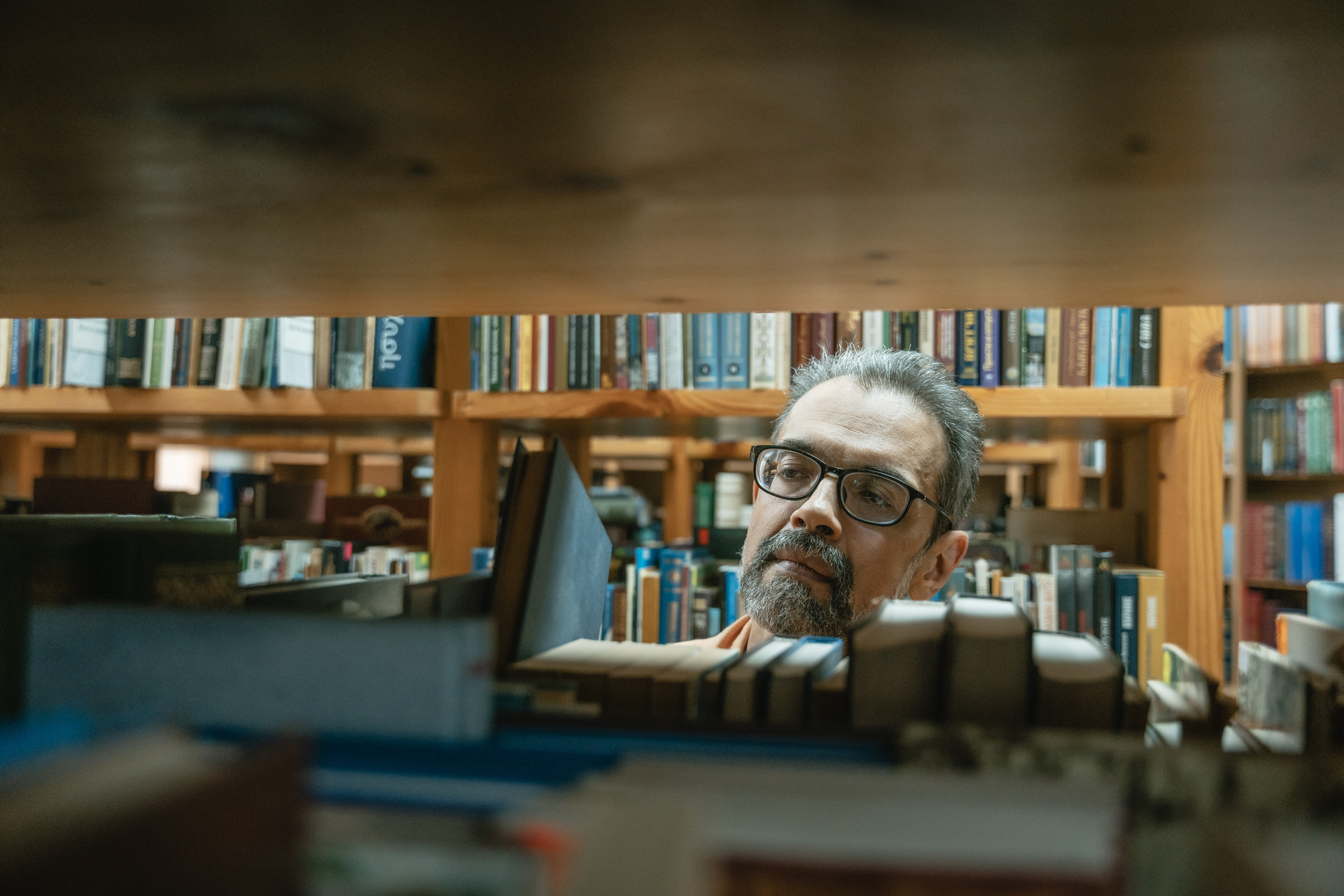 Yevgeny Abdullaev © Katerina Kuznetsova / Instagram: tawshan
On the Poetics of Religion
— What is religion in poetry and what is poetry in religion?
— In our magazine "Vostok svyshe" (East from Above), since 2013, there has been a column called "Poetry and Faith" — these are conversations with contemporary poets who write, among other things or predominantly, spiritual lyric poetry. We have already spoken with more than twenty authors, as well as several literary critics. And in almost every one of these conversations, this question arises. The answers are the most varied. Some believe that all genuine poetry cannot be non-religious.
But overall, this is a very complex issue, not just for one interview.
— Which biblical stories would you highlight as defining for world literature?
— This is perhaps a topic not even for an interview, but for a dissertation. But in short — the parable of the prodigal son. It is universal. It is about each of us.
About the "East from Above" Journal
— You head the diocesan journal "Vostok svyshe" (East from Above), which is already 25 years old. What was it like before you, and what new elements have you introduced?
— This is probably a topic for a separate interview. The magazine was founded in 2001, and until 2012, its editor-in-chief was the wonderful Alexey Ustimenko. So, I have been running the magazine for thirteen years now. What has changed? I think not that much. The main themes—Christianity (ancient and modern), Central Asia (ancient and modern)—have remained. We updated the cover design a bit, and the circle of authors has expanded. But overall—we are maintaining the tradition.
— Did you work under Alexei Ustimenko? What attracted you to working at this magazine?
— No, under Alexey Petrovich I was only part of the editorial board—it was more of a formal position. And I wasn't at all drawn to working at the magazine—it was drawn to me. After Ustimenko left, Karim Yegoubaev unfortunately worked as editor-in-chief only briefly. Then the magazine was left without an editor, and the question of its closure arose. Well... and that's how it all started.
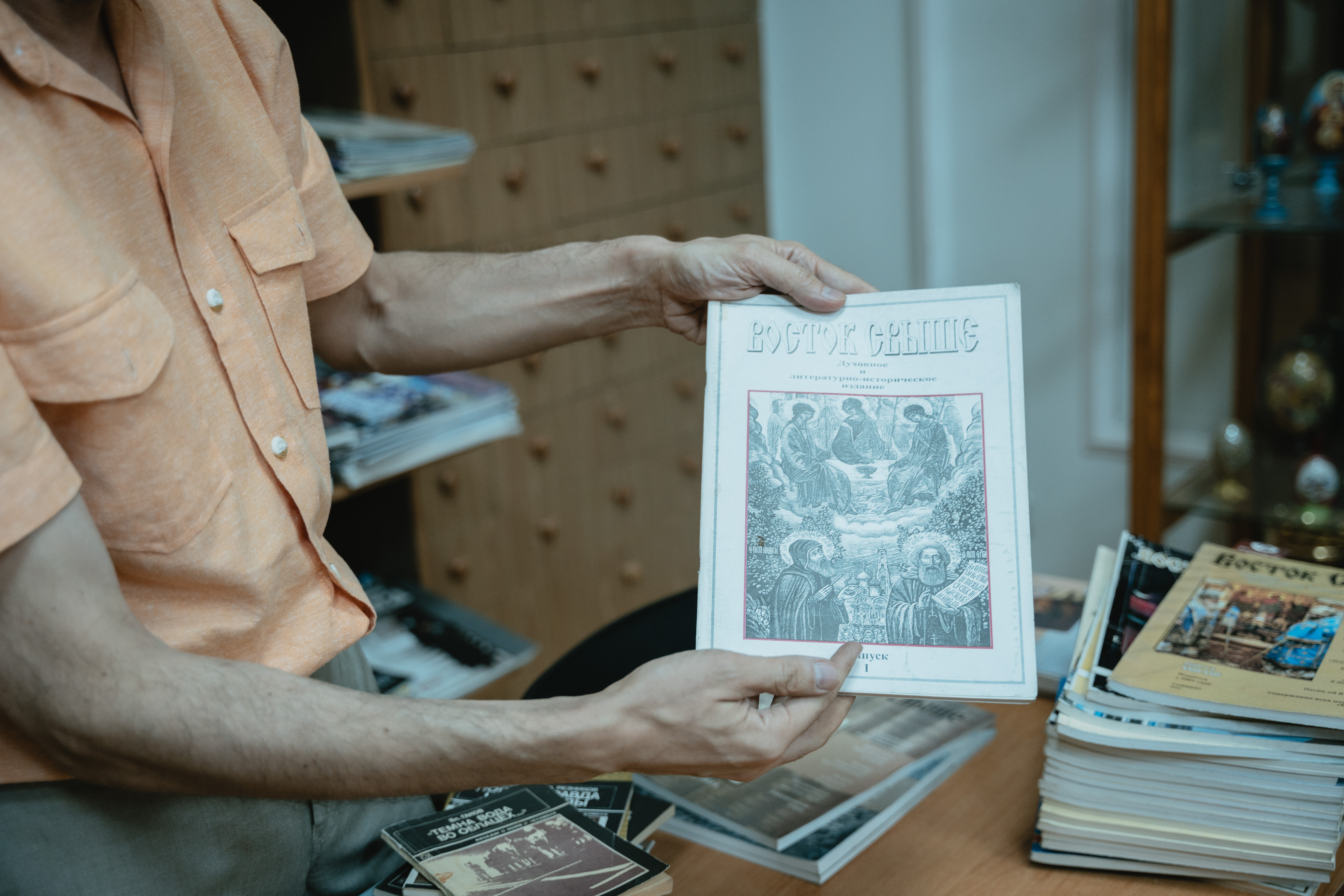 Issue of the magazine "Vostok svyshe" © Katerina Kuznetsova / Instagram: tawshan
— The journal publishes not only Orthodox authors; the themes of the issues are diverse, as is the circle of contributors. Do they take the initiative to collaborate on their own, or are the texts formed based on editorial requests?
— Some people submit texts on their own, we invite others to send them, and we ask some. Of course, over the years, a distinct circle of authors has formed around the journal. Most live in Uzbekistan, but many are abroad. Historians of Central Asia: Bakhtiyar Babadjanov, Alexander Galak, Alexander Dzhumaev, Roman Dorofeev, Daniil Melentiev, Ruben Nazaryan, Ekaterina Ozmitel, Yuri Flygin... Literary critics: Vadim Murathanov, Elena Safronova. Publicists and essayists: Archpriest Sergei Statsenko, Priest Sergei Kruglov, Priest Alexander Kolotovkin, Mikhail Kalinin. Translator Alexey Pernbaum. Far from all are named here.
About the Three Hypostases of Tashkent
— How does Tashkent affect you — a city where East meets Europe, and silence meets noise?
— …And the noise keeps increasing every year. For me, this is already some kind of third Tashkent. The first one—the one I grew up in—ended somewhere in the early nineties. When the wave of departures passed, and life itself changed. But the city as a whole remained the same. Some things changed, but locally, in spots.
And now — this is a different Tashkent again. I walk through it, I ride through it — and I don't recognize it: not the houses, not the people. So, I've lived in three different Tashkents. Just as I was getting used to one, settling in — bam! — it changed.
Probably, each of them influenced what I write in different ways… But it's hard for me to say exactly how. Perhaps I'm just trying to create some kind of my own Tashkent — constant, warm, internally complex.
— Does a poet have a homeland—or only an interlocutor and an addressee?
— Everyone has a homeland; we all grow from something. It's just that for some, this sense of place is more important, for others—less. For me—it's important. But this doesn't exclude, but rather presupposes what you mentioned: an interlocutor, an addressee. After all, I'm not just speaking from somewhere—from a city, from a country—I'm speaking to someone. I'm addressing someone. And—I receive a response. Or I don't. And it's not so important where the person who hears me is located.
About Plato and the Pseudonym
— What spiritual questions do modern seminary students most often come with? How do they differ from the generations of the 1990s or 2000s?
— It's hard to say... Probably because these, as you put it, 'spiritual questions' themselves are not yet fully formed in them. For today's students, maturation — both in a social and spiritual sense — happens later. The realization of life's complexity. If before a student would come with these questions, now it seems to them that everything is clear as it is, and what isn't clear can simply be 'googled'. And this applies not only to seminarians — I am periodically invited to meetings in secular universities as well.
Therefore, perhaps my task as a teacher is not to help find the answer, but to help find the question itself. To help feel the depth and ambiguity of what seems flat and simple, like a manga page.
— What does a modern seminarian read besides theological literature? What classics are recommended for him?
— I don't teach literature at the seminary. But I know what they read — both Gogol and Dostoevsky, and Hugo. After all, a seminary is not just about canons, but also about culture.
— And what philosophy books do you read with them?
— Vladimir Solovyov's works, for example, "Three Conversations," I still read with students — page by page. A powerful, at times searing piece. We also read Plato's "Phaedo" in its entirety. And I would recommend it to everyone. It's not overly difficult reading, but nor is it a philosophical nursery rhyme. It addresses the most crucial theme: what will happen to us after death? Is the soul immortal? Plus — Plato himself. His astonishing, fluid philosophical language. I still enjoy it to this day — sometimes in large gulps, sometimes in small sips, savoring it. However, I didn't choose my name by accident: Aflatuni — from Arabic, meaning "Platonic"...
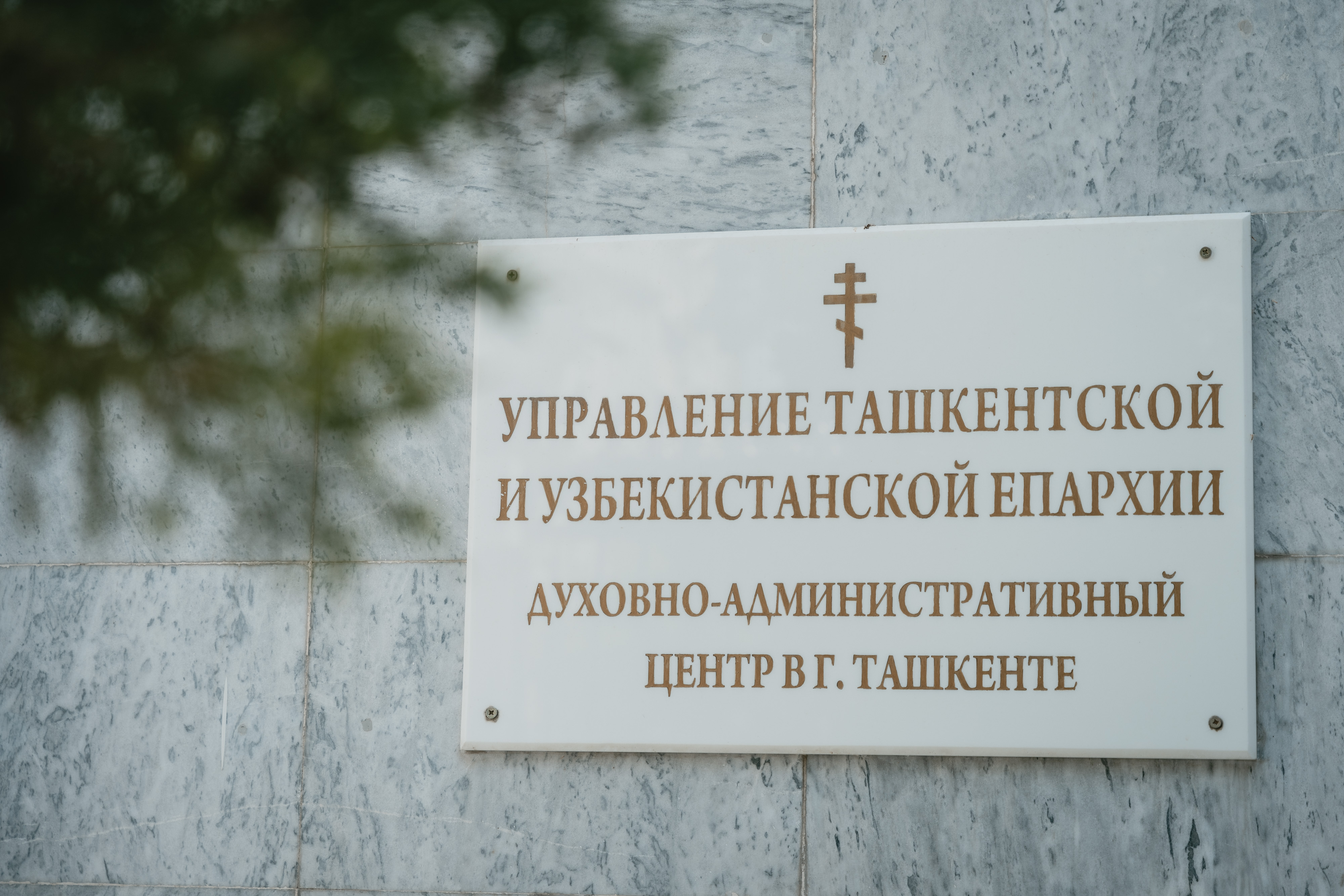 Tashkent and Uzbekistan Diocese © Katerina Kuznetsova / Instagram: tawshan
About life without television
— In your opinion, what does a person in the 21st century need in order to not lose their soul, to think clearly in a world of speed, numbers, and superficial meanings?
— Honestly, I don't know what a person in the 21st century needs. Sometimes I don't fully understand what I need myself... Probably, some kind of information hygiene is necessary — the ability to shield oneself from the flow of information, which is often very aggressive. Moreover, it's not so much the content itself that matters — whether it's "correct" or not — but rather the volume and constant pressure. You need to learn how to dose these waves rushing at you, to find ways to escape from them.
How to do this? In the 90s, it was easier: I moved to a new apartment back then and simply decided not to take the TV with me. And I've lived perfectly well without it ever since. Now, of course, it's more difficult: giving up a smartphone, news websites, social media, podcasts… is harder than giving up the TV. But even here, you can build internal filters and reduce the noise. How exactly—that's already a matter of personal choice. I'm not a guru to hand out recipes from a high mountain.
— If you had only one text you could leave behind, what would it be?
— I don't know. What remains will remain. Even if it's nothing. If right now, at this very moment, someone is reading my texts—and they help them (him or her) understand themselves, their life, the world around them a little better—then I didn't write in vain. As for what will happen later… That's no longer up to me. Whatever will be, will be. Thanks for everything.