Brief summary
Here we have gathered the key thoughts of the material's subject — for those who want to quickly familiarize themselves with the content. The full transcript of the interview can be found below.
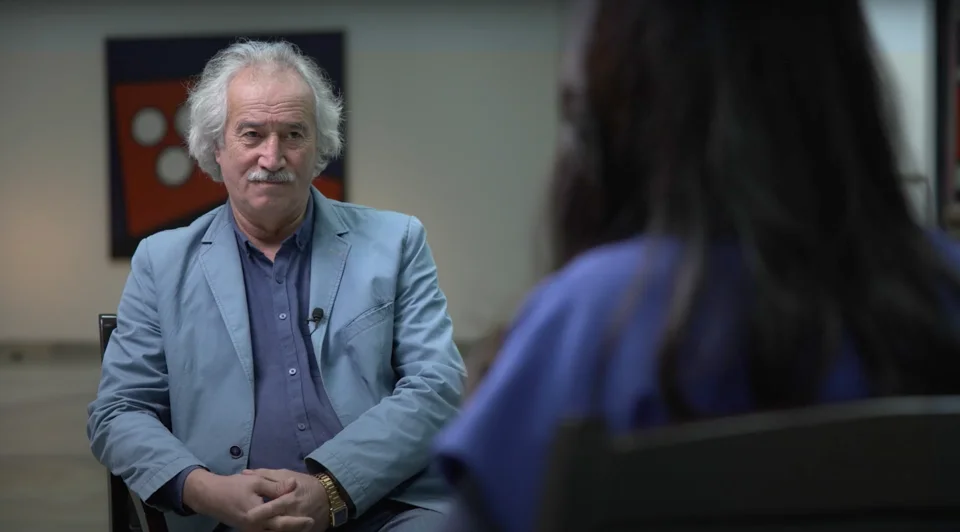
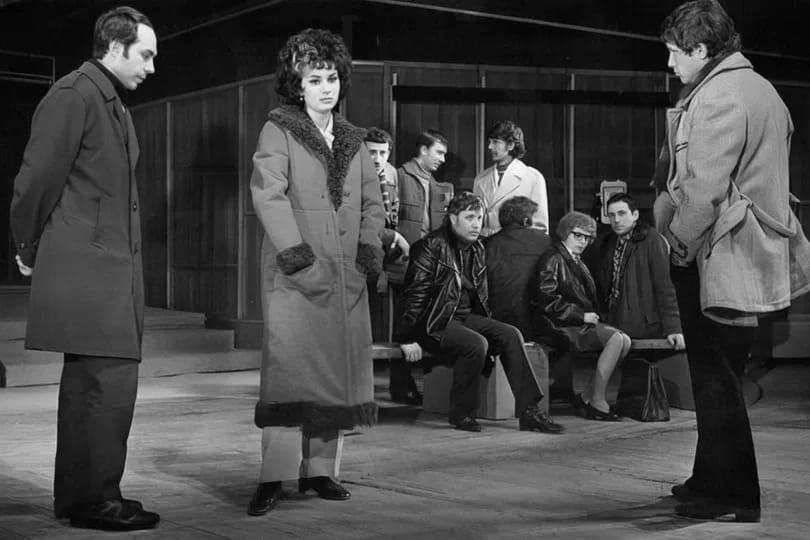
Bakhodir Jalol is one of the leading monumental artists of Uzbekistan, a student of Chingiz Akhmarov and a graduate of the Repin Academy of Arts. He speaks of his love for the wall as the primary medium, recounts how the changing eras shaped his approaches but never broke his inner striving for sincerity and spiritual expression. The artist reflects on the philosophy of life, the role of nature and technology, the freedom of creativity, and the importance of self-determination. He recalls meetings with Chagall, Akhmarov, and other masters, values the Regeneration project, and speaks of love as the foundation—in family, in art, in the world. Art for him is a way to live in harmony with oneself and with the times, and to teach others to do the same.
Video version of the interview
We have prepared this option for those who prefer to watch and listen.
Full version
Here we offer the full version of the interview for careful reading.
— You have had an impressive creative journey. Why did you choose monumental art specifically?
"Javlon Umarbekov and I, while studying at the Benkov Art School, met Chingiz Akhmarov — our great monumentalist, People's Artist of Uzbekistan.
Once, he invited us to his workshop and showed us his project—he wanted to paint murals on the walls of the Institute of Art History. We were, of course, delighted: all his works are murals depicting beautiful people, historical themes, rituals, and traditions. I personally liked it because it felt so close in spirit.
Javlon and I started helping him, and from that moment on, I developed an attraction to monumental painting. I thought then that in the future, I too would become a monumentalist and would paint my own stories, glorifying the culture and traditions that exist on our land.
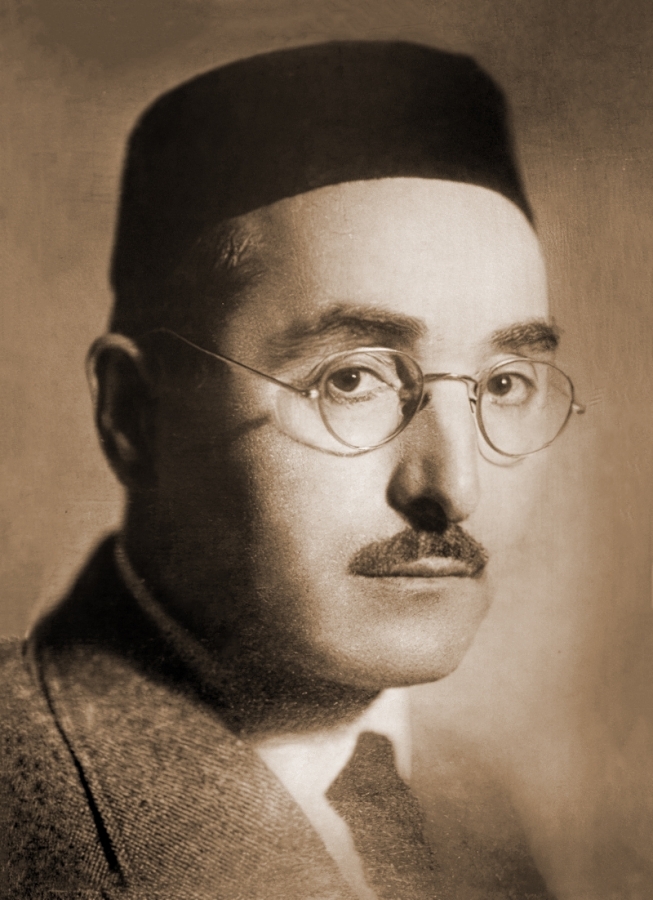
Chingiz Akhmarov
That's what I've kept inside me. When I finished school, I went to St. Petersburg (then Leningrad), to the Repin Academy of Arts. For two years, I studied in the department of easel painting. I had a very good teacher — Neprintsev Yuri Mikhailovich, one of the leading and very interesting artists in Russia.
I happily completed these two courses, and then chose another workshop — that of Andrei Andreevich Mylko, the monumental department. There were also battle painting workshops: Evsei Evseevich Moiseenko, the Oreshnikov workshop, where there were already portraits, the easel painting direction.
I chose the monumental department — and it became interesting to me. Of course, it was very difficult because I had to fully master the entire technology.
There are many different types of techniques — the encaustic technique, the technique on dry plaster, sgraffito: two or three layers with alabaster color pigments formed the base, then it was carved. It was necessary to go through everything.
The most difficult and valuable part was comprehending the monumental composition. With Chingiz Akhmarov, we looked at already finished works, sometimes trying to help and paint, but in Leningrad, we had to figure everything out ourselves—there were a great many tasks set.
After that, my desire to become a monumentalist was finally solidified. Painting work continued in parallel because, whether you want to or not—you already have command of drawing, have mastered studies, painting technique, and that's not all that difficult.
But for me, the wall has always been the main thing.
— Throughout your life, you have changed and never stayed in one artistic direction. How did you find new styles and approaches for yourself?
— Every theme or subject that stands before you requires its own solution — color-wise, compositional. If it's a portrait — then a psychological solution as well. Style always comes from the object — how you see it and how you want to depict it.
For example, I painted a portrait of Malik Kayumov, a film director. For contrast, I painted our clown — Akram Yusupov. I also painted Kamil Yarmatov, also a film director.
I tried to find my own manner through the contrast and status of the characters — not so much a style, but an individual expression. Again, everything stemmed from the character or state of the person sitting in front of me.
If you're painting a ballerina - that's one state, if an athlete - it's completely different. Based on such comparisons, whether you want to or not, you find the style, format, color solution.
— You have worked in different historical periods. Have changes in eras and ideologies influenced your creativity and understanding of themes?
— If you have stability within you, a drive for creative impulse, these eras, whether you like it or not, will somehow reveal themselves in your works.
You meet the demands that the times dictate. If you have a creative foundation, if you possess solid knowledge and desires—you can create in any situation, maintain a stable state of creativity. Let it be a different era—today's or an intermediate one.
For example, if we compare our era and the Middle Ages... In the 15th century in Europe, particularly in Italy during the Renaissance, artists primarily glorified religious and biblical themes. They created frescoes, painted on canvases.
What was interesting: they didn't think about color because everything was laid out — what clothing, what shadow, how to paint a face. The colors were ready for the artists. They simply executed their plot with ready-made products.
But now it is a completely different time. This is already a transformation. There was Baroque, Rococo, then the period of Modernism. Of course, everything that humanity has contributed to culture was respected and preserved. But still, human capability, the potential inherent in nature, leads to a constant search, a desire to create something new.
And the most valuable thing humanity has achieved: scientists, musicians, artists have come to self-determination—who you are. This turning inward—you must express what is inherent within you in your creativity, your works. This applies to poetry as well.
There are many examples — Shakespeare, Dante, Pushkin, Lermontov, Tolstoy, foreign writers like Marquez. Where a person lives through their creative self-expression, singing in their works through their inner moods and experiences.
The 20th century is a pivotal, culminating, exceptionally vivid one. In theater, for example, there's Meyerhold; in painting—a new perspective, a new vision. Salvador Dalí presented his work based on classical school—surrealism, his visions, his perception.
Picasso made a revolution in art. Humans have this inherent immediacy of vision, an immediacy of desire to reflect what exists. He conveyed his first impression. We can say children have this: when they are delighted, they preserve their own vision and express their mood in a drawing.
Picasso also went through a journey, mastered studies, and consciously arrived at a new way of seeing and looking. Or Gustav Klimt — this is an almost parallel or slightly earlier period. He created an entirely different, special poetry, aesthetics, rapture, sophistication, subtlety in relationships between people, between lovers. He produced many interesting works and is one of the initiators of the modernist period.
There were very many such artists. The 20th century completely changed everything: architecture, music, poetry. Today we live on the basis of these accumulated values and try to understand ourselves. And in this understanding, we try to find ourselves.
You say: I work in different ways. For example, I believe that just as the weather changes, so does a person: in harmony and unity with nature. We cannot deny that we are children of nature. Our state creates amazing moods in painting, in drawing.
Our goal is not only to decorate but also to give people a spiritual connection with the work, to lay a philosophical foundation so they can reflect on and understand what exactly is happening in the work.
Also, gallerist Natalia Andakulova spoke about Bakhodir Jalol in an interview with HD magazine:
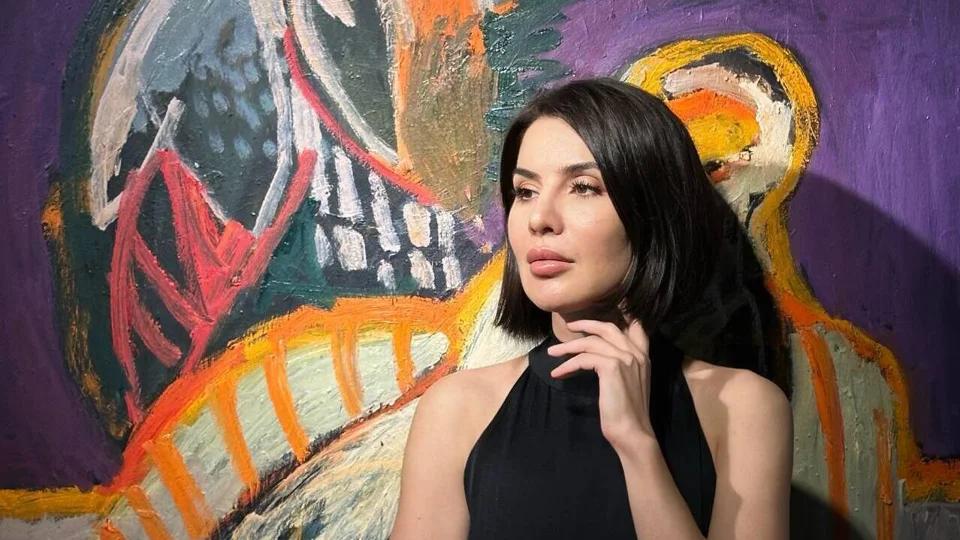
— Please tell us about your life philosophy as an artist.
— Philosophy is reality itself. It is the definition of your life's creed, the comprehension of everything you see around you and what you try to transform in your art — your state of being — and convey it to the viewer.
Ultimately, it turns out that our entire life is philosophy. If we recall the sages — Laozi, Confucius, Al-Khwarizmi, Al-Biruni — they too tried to philosophically comprehend their existence on this earth. They sought to understand what they had arrived at, what they had gained, and what they left with. This is a very complex moment in life.
— You said that an artist should feel nature, the theme, the era. How can one develop this ability and learn to convey it in a work?
— There are no hints here. What makes a person unique is that they see the world in their own way and strive—if it is given to them and inherent within them—to convey these changes happening both in the world and in people, in their psychology.
For example, technologies are now actively entering our lives: artificial intelligence, IT, various media.
Artificial intelligence, figuratively speaking — a robot — seems to be trying to interfere. But I am confident it will not succeed. It is stuffed with information, but it has no soul, vision, feeling. So it is incapable of seeing what I can see and what I want to see.
It's packed with information. It can pack me with information, but remains flat in conveying this information. Of course, it all depends on who is working with the artificial intelligence to get information. It can provide information if a person knows the topic deeply and through their internal state formulates the query correctly. But this is also a kind of chaos of your mood and query.
Artificial intelligence can assist with illustrations, in books, and in historical reconstructions. Currently, artificial intelligence is attempting to revive and showcase a great deal: plots, stories, modernity, space. But all of this is an abstract aspect.
But when it's one-on-one, it cannot compete with a human. Humanity is still in the process of development, and we ourselves have not yet achieved what is inherently embedded within us from above.
I'm trying to convey this to the students so they clearly understand: they are individuals created by God, messengers. And they must achieve their revelations in their creativity and in the environment where they live.
If there is no love and harmony — humanity may drown.
— What principle or philosophy do you aim to instill in your students?
— First and foremost — it's sincerity. Sincerity in attitude, in relationships. To try to understand everything that is happening, and what was, to comprehend it, to understand the reality in which they live, and what they want to see after themselves.
In the end, it turns out that we are constantly searching. The search is a moment of comprehension, realization, contemplation, delight, and inspiration. This is the very foundation and soil for the philosophical understanding of everything you do in creativity. This is probably the most fundamental thing.
— You've been teaching for many years. How have you changed as an educator over these years?
— At first, as a young teacher, I tried to instill in the students the concept of study, drawing, handling materials—paper, pencil. In painting—the concept of working on canvas, technique. These are the basics, like solfeggio: do, re, mi, fa, sol, la, ti, do.
In the first year, I taught the knowledge I had mastered myself. Over time, I changed myself and tried to make students aware of the transformation process.
I introduced them at the very peak of art so that they would burn with desire. While they are young, while they can do something — they painted huge canvases, the themes were global, human. This process helped shape me as a teacher, an artist, and a person.
Seeing their purity and spontaneity, I tried to preserve that in myself. And I worked on myself, practically constantly gaining experience. Being a teacher is very difficult. At first, you give knowledge step by step, and then you yourself grow and think: what to give the student, what knowledge is the most important, and what needs to be developed.
— Tell us, how did you choose the themes for your frescoes and how did you prepare for each of them?
— First, when you're invited to a certain location, you sit and think. You study the interior, the place itself, the meaning — what kind of place it is and how much it needs your work.
What needs to be done so that it's not just a formal execution of one's job, but so that a person can come and think, look at how beautifully a flower or a branch is written... And some meaningful substance is needed.
Monumental art, beyond contemplative perception, possesses spiritual movement and enrichment of the inner state.
When I was invited to Talimarjan, Kashkadarya region, to the reservoir — there is steppe, desert. They asked me to create a work. Water is life. I made a mural depicting harvest gathering and harvest festival. I showed how a person, through their labor and love for the land, creates paradise for themselves and achieves results.
Then there was the House of Cinema. At that time, the director was Malik Kayumov, a film director and People's Artist. I once asked him: "What should I do?" And he replied: "Do what you want."
Read also:
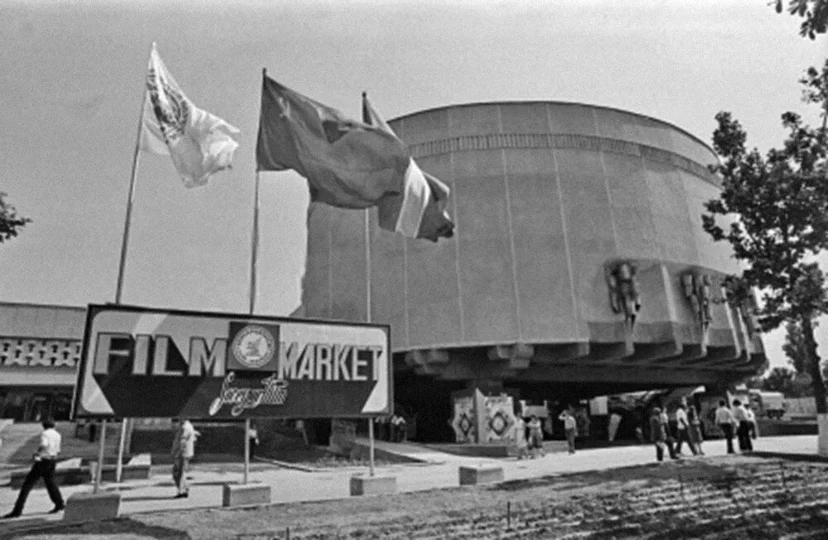
On one wall, I depicted the struggle for freedom and independence of the soul and morals—I portrayed Europe and Latin America. On the other wall—our film directors who contributed their part to the history of cinematography. In fragments, I showed who reflected which period, who shaped the cinematography of the country and the world.
There were many such works: in Belgium, Italy, Moscow. Everything was going normally: we worked, and in Tashkent—many projects. Some works were eventually replaced by works of other artists over time because they no longer met new requirements.
And you know, some experience, the path I've walked — it's not just an accumulation of information, but facets of life: sometimes good, sometimes evil, intrigues, processes. We only read or saw this in Shakespeare, in Omar Khayyam — the theater as life. And so it is. Through their experience and knowledge, they revealed the amazingly complex world of man.
— How did you commission frescoes and monumental works in different years?
— I can tell you one example. When Sharaf Rashidov was the country's leader, a concert hall was being built in Tashkent. There was a hall where artists and management gathered after performances. I was asked to make a tapestry. I prepared a sketch.
There was a tradition – the work had to be approved by someone from the leadership. We went to the Central Committee in the morning. Present were the chief artist, the director, and me – the author. Sharaf Rashidovich looked at it and asked:
— Has the art council reviewed it?
We replied:
— Yes.
— So what?
— Permission granted.
He said:
— Go ahead, start. If a professional body has approved it.
He trusted the specialists. It was a moment I will never forget.
Later, the clients also reviewed the works, but there were no such complicated moments. However, after the change of power, with the onset of independence, new criteria emerged. Some of my works were said to be replaced by other authors due to non-compliance with the new requirements.
At first it was hard to accept, but I realized that life goes on, and I began to create again.
— Do you believe it's possible for art to become timeless and transcend political or social processes?
— I often traveled abroad. From my experience meeting artists or when I myself completed some commission and met such people, I saw: abroad, the artist is deified. For them, the artist is a miracle-worker. They are interested in your perspective.
They give you the topic, but don't tell you how to do it. They take into account how you perceived this topic, that you are a foreigner. They are interested in how I will resolve the topic. It was pleasant: they were surprised by my perception of their topic, their concept. And they received with an open soul how I understand their requests, their concept, which they gave to me.
Free perception and expression in creativity are valued there. During the Renaissance, Leonardo created "The Last Supper" in his own way. Other artists—in their own way. The theme is the same, but look at the richness the artists have left—each in their own way.
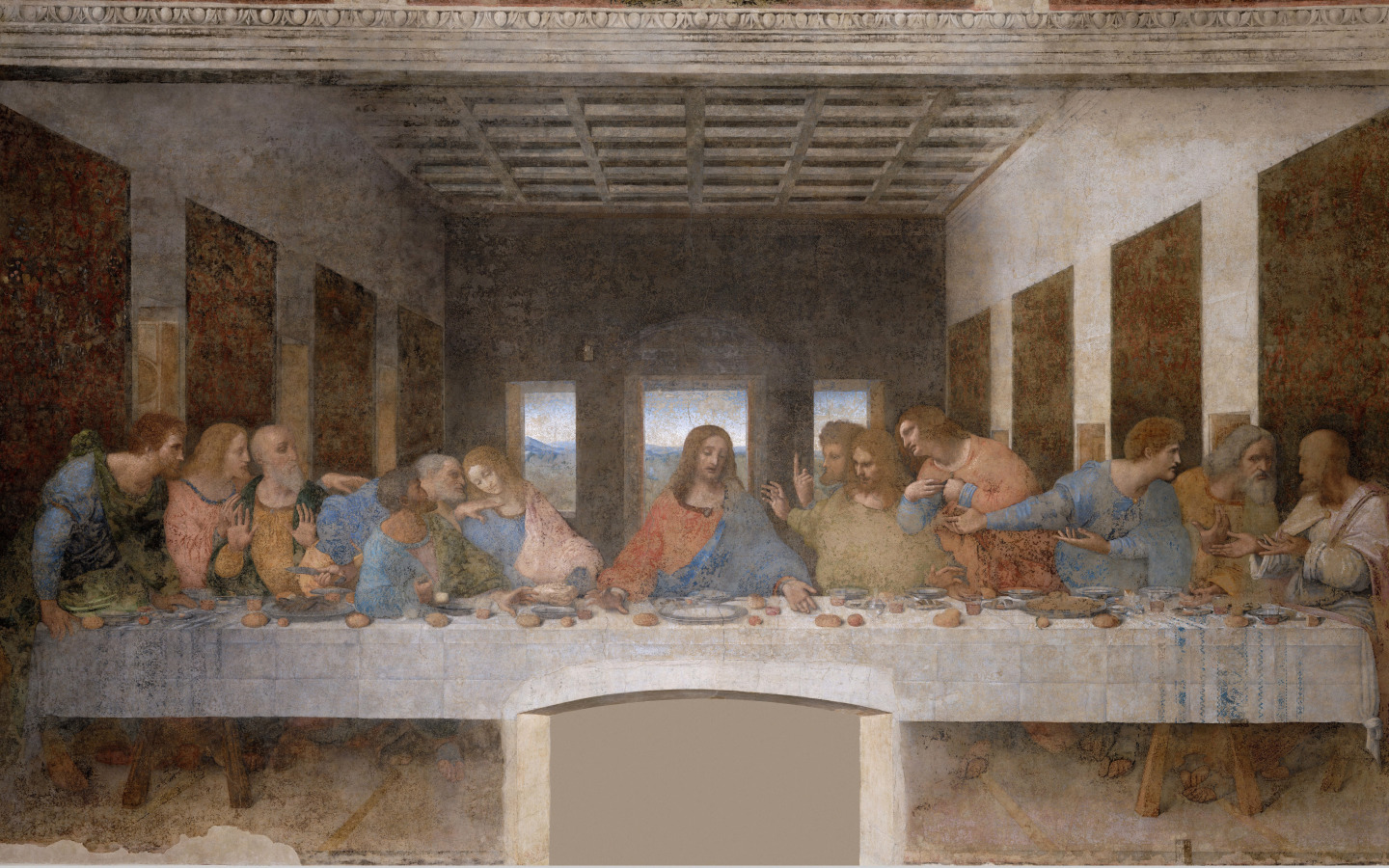
The Last Supper by Leonardo da Vinci
Personal perception of a topic is the most valuable thing. I sometimes wonder: how do people know when something is wrong? When they say: "This won't work. This is wrong." I want to ask: how do you know that?
— Tell us about the most significant meetings in your life.
— The most important thing is the trips, the meetings during them. In America, in the East, I met kings, political leaders, the queen. I painted them. It just happened that fate brought us together.
During my studies, I met Marc Chagall. Our teacher, Andrei Andreyevich Mylnikov, suggested: "Would you like us to organize a meeting? Chagall is in Leningrad, on his way to Vitebsk, we can meet." We, of course, agreed. A living legend was sitting right in front of us!
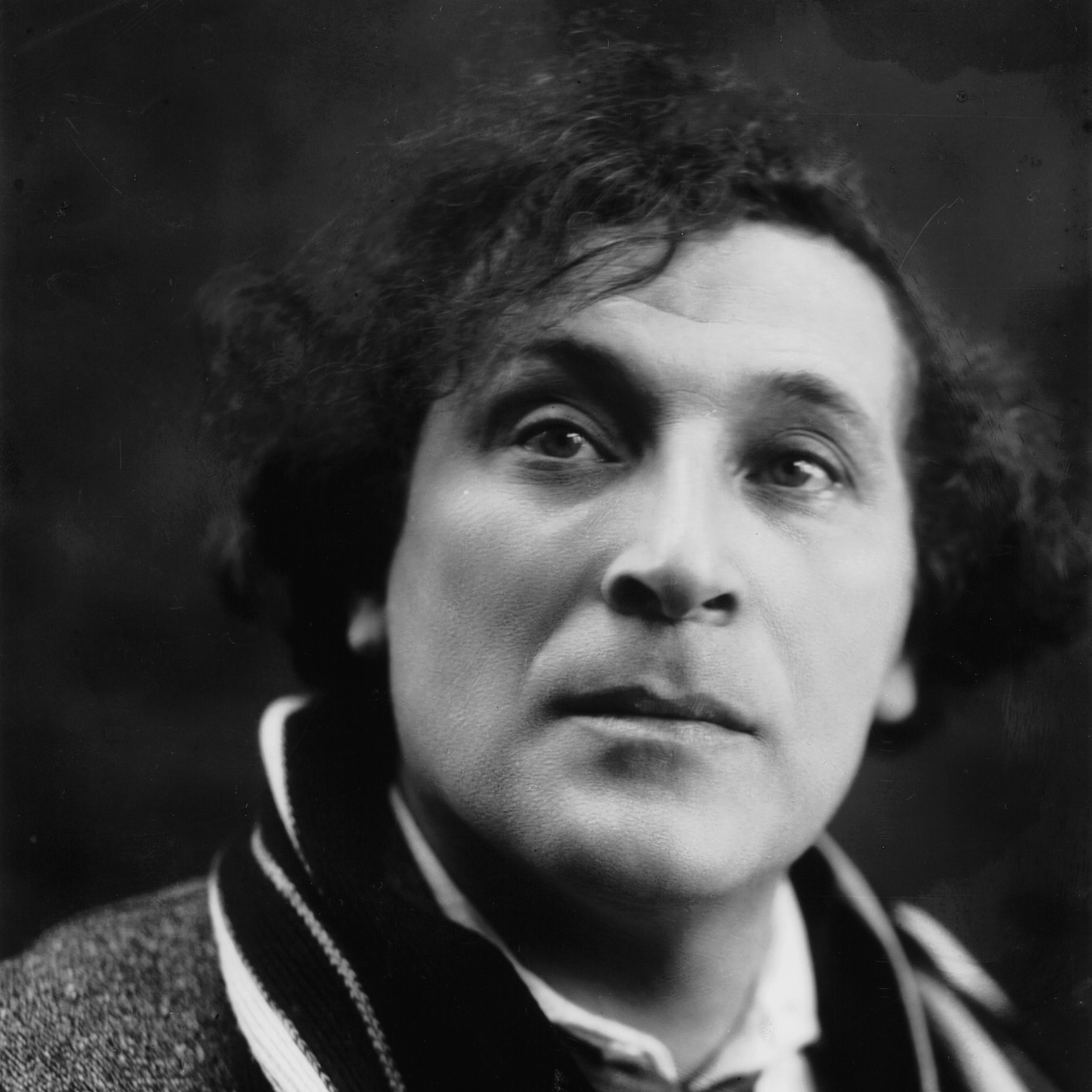 Photo: Petr Shumov
Marc Chagall. Photo: Pyotr Shumov
We listened to him, wanting to achieve the same state so that we too would one day be honored in such a way when we reach a certain stage.
Valuable were the meetings with our artists: Abdukakhkhar Abdullaev, Rakhim Akhmedov — we often met with him, as he was the chairman of the Union — Chingiz Akhmarov, and the interesting art critic Rafael Taktash.
There were many encounters that shaped us as people and artists. And this enriched our creativity, our attitude, and our communication with people.
— Do you think the peculiarities of our so-called Eastern mentality—the habit of relying on others' opinions—influence the processes occurring in art?
— I grew up in a completely different environment. Life was different back then. We are products of a completely different era and environment. There was no dogmatism. I always had freedom. The desire to achieve, to go straight for the goal, convincingly.
I am Uzbek, raised among Uzbeks. From Margilan. My father is from the Fergana Valley. There, I received my upbringing, delved into the culture, the tradition. The ethical side, love for one's neighbor — this was given to me in childhood, and it has remained.
I don't consider myself sentimental. I want to assess the situation realistically. That is what drives me. I want to scream—to express my pain through canvases. By processing what is happening through myself, I try to capture the pulse of the time.
I am very emotional, sensitive. I try to comprehend and capture impressions in sketches, drawings, paintings, installations. A great many curious things are happening.
The exhibition I'm currently working on is my heartfelt cry. I'll try to convey my pain or joy to the viewers. I want people to see how I lived, what is ingrained in me, how I perceived the world.
— What do you think about the cultural processes happening today in Uzbekistan? How do you evaluate the work of young artists?
— You know, especially in recent years there have been interesting processes, searches, flashes. But since last year, a very interesting project from the Karimov Foundation has emerged — Regeneration. I consider it one of the best projects in recent years.
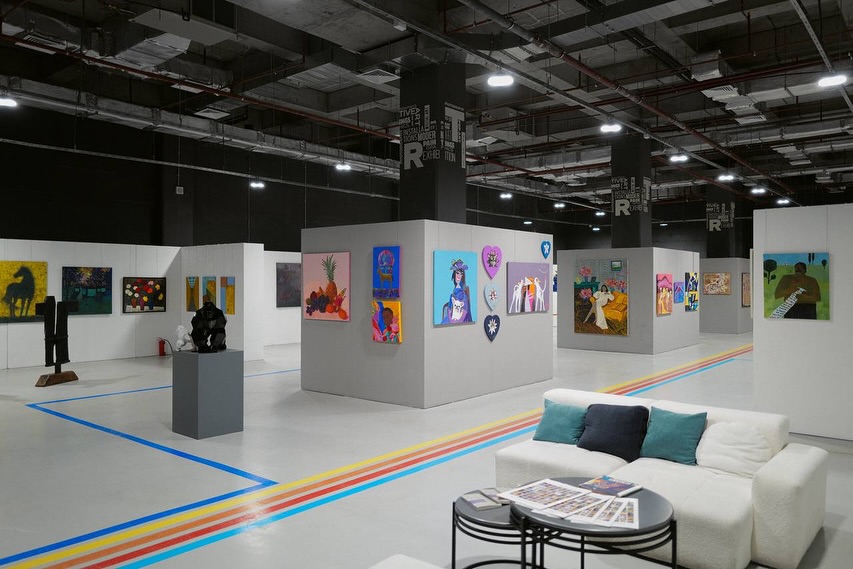
Exhibition Regeneration Art Gallery at Tashkent City Mall
There is the Academy, the Artists' Union, galleries that could run their own projects and showcase art. But this project gave the freedom that had long been awaited. The organizers found young artists from all regions. It was a cry from the soul, a search, answers to the dynamics and transformation of the times. This was already visible at the first exhibition. The second exhibition was more refined. New names were established.
There is hope for tomorrow that art will exist. The most important thing is freedom: self-determination, revelation, perception of everything happening and its expression. The foundation supported this. I believe it is a phenomenon, a turning point. I am grateful that there is a foundation and people working for the benefit of their country and for the benefit of art.
There are other galleries that set their criteria at a high level, but for now Regeneration is at a high level.
— You mentioned that your wife is your main support. Could you please tell us more about her and your partnership?
— I am a happy man. During my student years, I found a person with whom I reached a mutual understanding. Galina, my wife, is from Karelia, her surname is Ivanova.
At that time, we didn't think about nationalities. The main thing was the inner mutual understanding and relationship. That happened, it worked out. I am grateful to my wonderful wife, my Galina. My development, my formation, how I think... I hope I have achieved some success — that is her enormous work and support. That is my happiness.
We raised two wonderful daughters who also connected their lives with art—they continue to create and live. We live as one family, sharing joys and sorrows together. The COVID period, which the whole world experienced, was difficult. Family is a shield. We supported and helped each other.
When I became seriously ill, of course, my family supported me; but the leadership of the Academy of Arts, Akhmadkhon Khabibzhanovich Nur, also provided assistance instantly, on the very same day. And in fact, within three months, I returned to life and work.
I am grateful to the doctors who showed care. Sometimes you feel unity, solidarity. Love for one's neighbor is always inherent in a person by nature. It is the mind and a certain state that hinder people.
A person is born pure, open, with delight, with enjoyment. But the atmosphere, the environment, turn people against each other. I created a series of posters called "Man Against Man." It is a conscious process. It has always been this way.
But I believe that purity, love, faith in the future always save. Periods changed and repeated. But I am sure that humanity realizes that what is happening is the wrong course on its part. Globalists are consciously trying to lead humanity astray, into nothingness. They say: "There are too many humans, the planet can't handle it," back and forth, but you look—there is still so much in nature.
So I think: after all, a person with love and consciousness will open and achieve the path to the light.
— How to preserve this light? How do you maintain your love for life?
— We must not forget that God — some say Allah — created man in His own image so that man would marvel at His creation: nature. To nature He added fauna, flora — so that man would not be bored.
And also what is inherent in a person — both in fauna and in flora — these same DNAs, let's say, neurons that exist in a person, also exist in nature. They also multiply, they are also born. Autumn, winter — a constant exchange takes place. He created harmony.
This harmony leads us to the light. There are personalities who try to eclipse the sun, the light.
But remember Diogenes. When Alexander the Great heard that some eccentric was living in a barrel and walking with a lamp in daylight, he wanted to see. And many know this parable: how he approached him, an old man sitting in a barrel, and there stands Alexander the Great himself. And Diogenes said: "Do not block my sun."
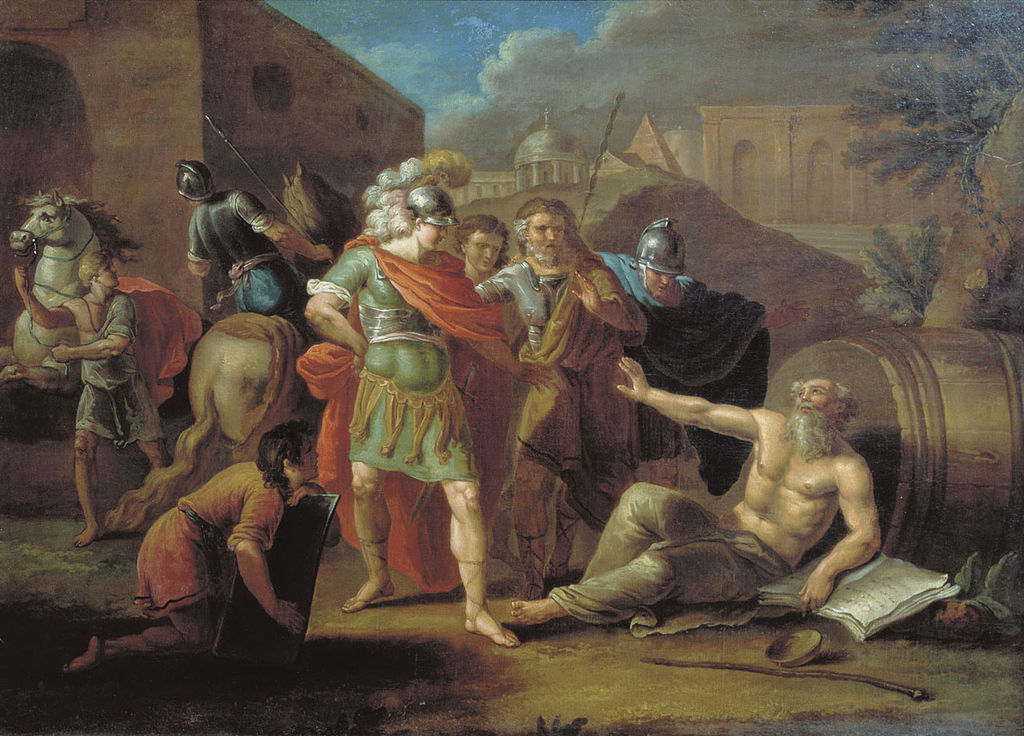
"Alexander the Great Before Diogenes." Tupylev I. F., 1787.
This openness, this freedom given to a person from birth—we must not forget about it.