
By 2025, advertising had become so pervasive that a specific term even emerged to describe this trend — ad creep. There is no precise translation into Russian, but this concept can be interpreted as "sneaking advertising": marketing is now encroaching not only on public but also on personal spaces, which were recently free from aggressive PR.
The term ad creep appeared in 1996 in the Chicago Tribune, where it referred to the influence of marketing on the plots of TV series and shows. Later, the focus of the discussion shifted to the invasion of advertising into restrooms, schools, and even dreams. With the advent of the Internet, advertising has ceased to be merely a part of life—it now literally shapes reality, preaches certain ideologies and cultures. Slogans, images, and patterns repeated over and over normalize certain behaviors, whether strictly consumerist or within the family.
Women are the markers of epochal shifts; due to their vulnerability, they are the most sensitive to any social changes. Central Asia serves as a vivid example of the interplay between advertising, value systems, and political structure.
The image of women in the Soviet era
In the pre-Soviet era, women were virtually absent from commercial imagery. The situation changed dramatically in the 1920s, when the female image was exploited by state propaganda as a symbol of social and cultural revolution. On the wave of the «Hujum», campaign, which the Soviet authorities launched in Central Asia in the 1920s—1930s, women's departments, maternity hospitals, schools, and clubs accessible to "liberated women of the East" began to appear here en masse.
The "Hujum" is most remembered for the movement to abandon the paranja. For many, joining the campaign ended in violence from parents, husbands, relatives, or even death. For example, activist Alymkan Mamytkulova from the Kyrgyz SSR was killed by her husband in a courtroom during divorce proceedings.
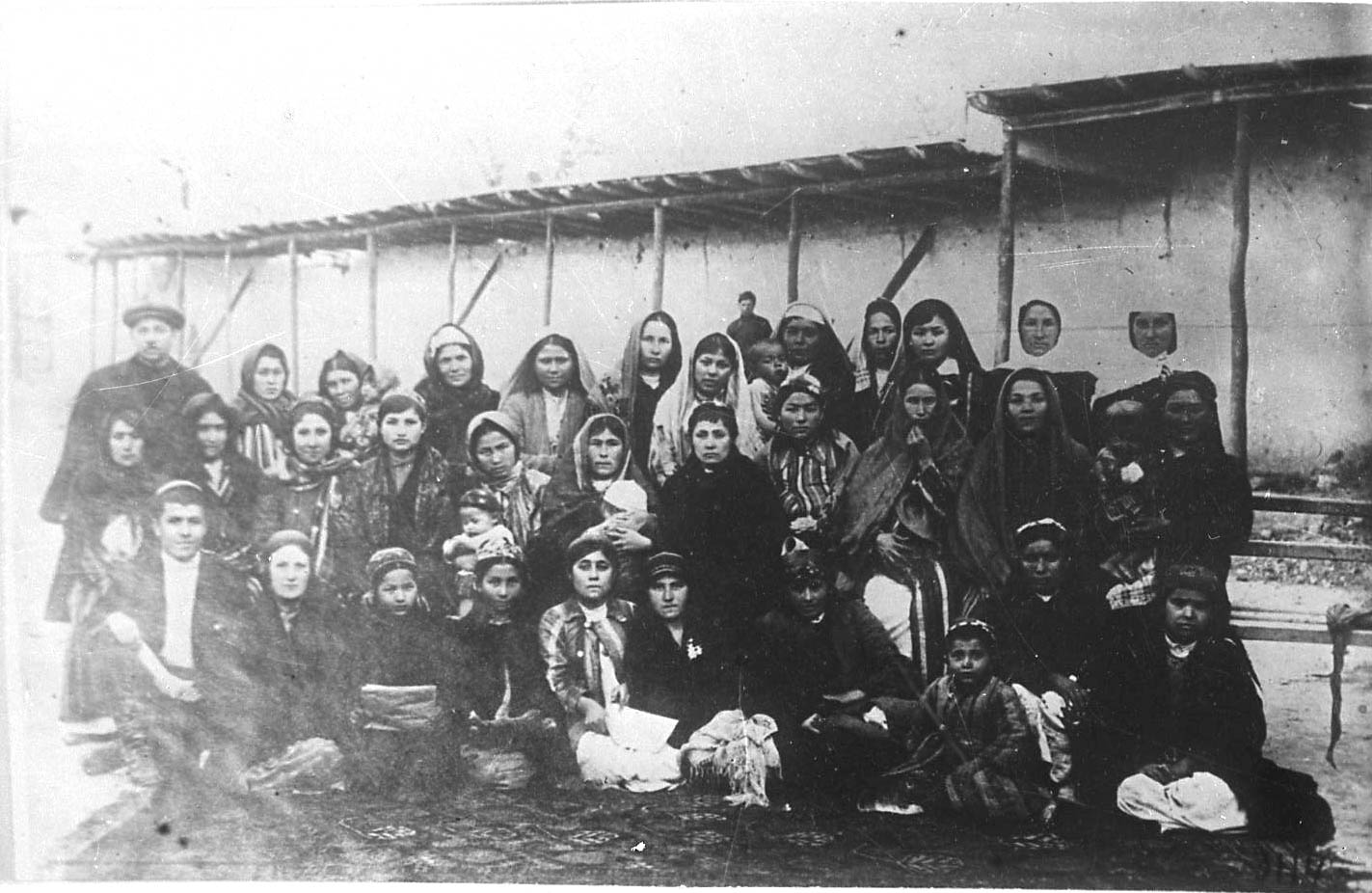
A group of Uzbek women, photographed without their paranja for the first time. Photo: National Archive of Film, Photo, and Phonographic Documents of Uzbekistan / Gazeta.uz
In Soviet visual propaganda, the "woman of the East" was primarily presented as a labor unit, actively participating in the creation of a new society. The state saw its female citizens as a workforce resource, therefore it strongly supported emancipation. Public relations, as a rule, is closely linked to the dominant values in society, its current needs, and the economic model.
On the first posters of the Uzbek SSR, women in most cases wear traditional clothing emphasizing their national identity. By the 1930s, they are increasingly depicted in work clothes, and posters appear calling for the removal of the paranja and to "emancipate oneself." In the 1940s, the focus of visual propaganda shifts towards post-war reconstruction, but female images still emphasize their independence, activity, and education. If elements of traditional costume did appear in advertising, it was only to emphasize the international character of the USSR, to showcase the integration of national identities into socialist society in a favorable light.
The dissolution of the USSR in 1991 led to a complete reassessment of values, and the economic model shifted from socialist to market-based. Globalization did not erase national elements from advertising, but it established Western visual imagery as progressive, most desirable, and fashionable. At the same time, advertising increasingly began to emphasize the role of women as keepers of the family hearth—experiencing an acute identity crisis, society turned to traditions, including patriarchal ones.
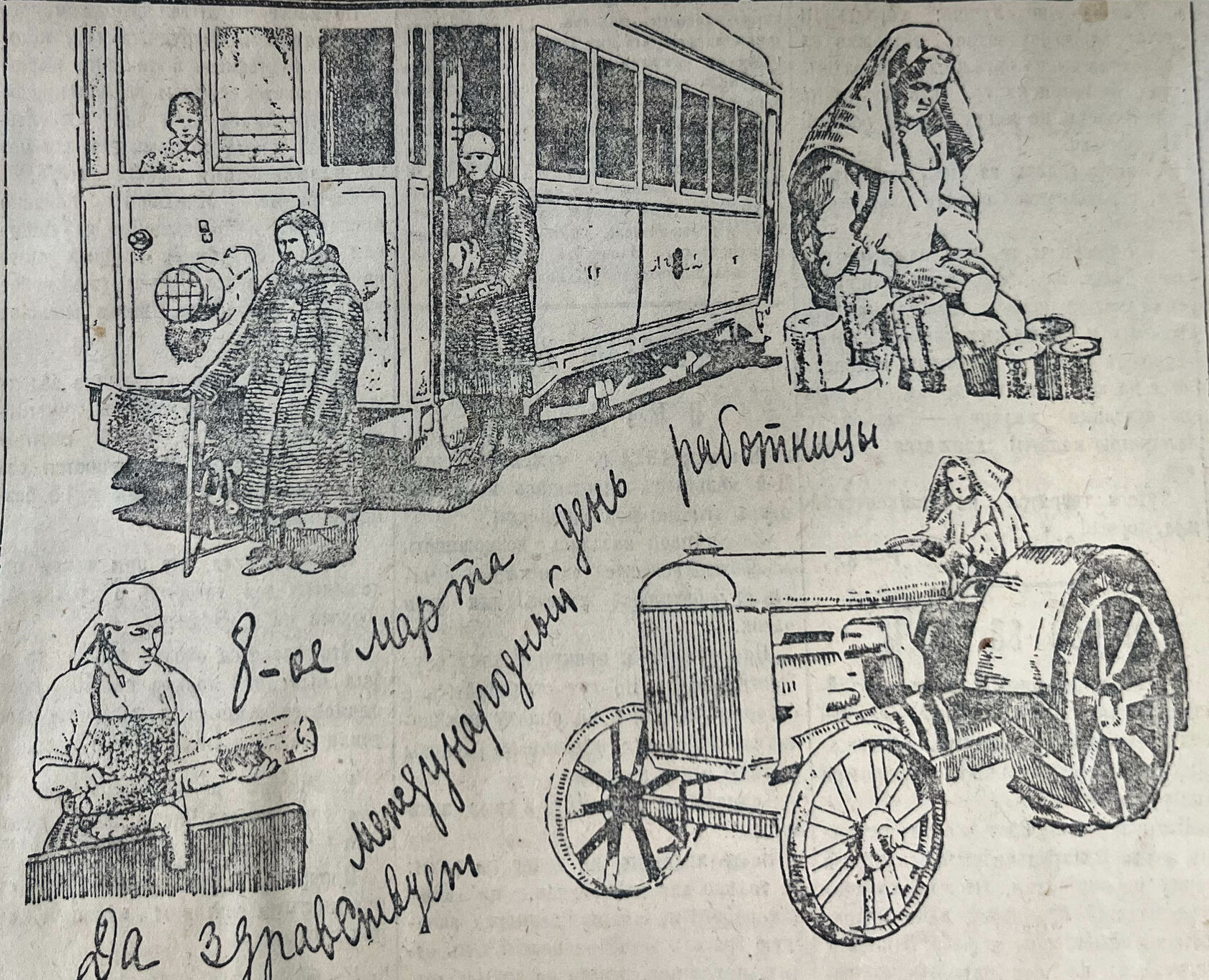
Soviet poster dedicated to March 8. Photo: National Archive of Film, Photo and Phonodocuments of Uzbekistan / Gazeta.uz
Paradoxically, media began demanding that women conform to completely opposite standards: on one hand — independence, financial autonomy, sometimes even frankness in style; on the other — submissiveness, self-sacrifice, modesty.
Selling Sex
Marketing is no longer focused on labor resources as such—now women's purchasing power and their external attractiveness have become more important. In capitalist society, anything can be turned into a commodity, including sexual availability. A woman transforms from a producer of values into their form—into someone else's dream, into an object of desire. Advertising actively utilizes provocative imagery, following the sex sells strategy.
One striking example of the sexualization of women in the regional advertising industry is the commercial by the Kazakh air ticket sales service Chocotravel, in which completely nude flight attendants, covered only by their pilot caps, urged people to buy tickets. In 2024, the Tashkent bar Escada Lounge made headlines with a scandalous pre-New Year advertisement: in the promo video, girls stand with their backs to the camera, a young man walks past each one, slaps their buttocks, and announces the dates of holiday parties.
Sexualized advertising came to Central Asia from the West, but the irony here is that it is precisely Western experts who are now increasingly questioning the effectiveness of the "sex sells" approach. Scientists from the University of Illinois claim that sexualized imagery has almost no influence on purchasing decisions. Such advertising, on the contrary, repels women. Moreover, for Generation Z and Alpha, vulgar hypersexualized images provoke rejection, as they are perceived as something old-fashioned, immoral, or tasteless.

Screenshot from the Chocotravel commercial / YouTube
Abduction for promotion
Advertising that appeals to patriarchal values still finds its place in the Central Asian market. Sometimes, advertising content uses not just stereotypical images, but scenes that simulate criminally punishable actions.
So, in Kyrgyzstan, ala kachuu is officially recognized as a crime, with the country's Criminal Code stipulating 5 to 7 years of imprisonment for it. Nevertheless, ala kachuu is romanticized by Kyrgyz advertisers: in 2023, the Kozu Grill restaurant posted a video in which a man abducts a girl for marriage. The enraged father of the abducted woman bursts into the yurt where his daughter is being held, but drops his claims after tasting the meat from the advertised restaurant. The message is clear: a woman is equated to a product and is worth less than lamb. Following public pressure, the video was removed.
A similar plot was used in a commercial for the construction company Nurzaman. In it, an abducted girl writes a message to her father asking for help and shares her location. Upon receiving the message, the father happily wishes his daughter good luck—because she is being held in a house built by this very company.
According to UN data, every fifth family in Kyrgyzstan is created precisely this way. Victims of kidnapping often find themselves in a position of complete economic dependence on their partner and face domestic violence.

Screenshot: Instagram / Roza Ashirbayeva
A similar incident occurred in Kazakhstan, where "bride kidnapping" is classified as human abduction and punishable by a prison sentence of 4 to 7 years. In that same year, 2023, the construction company Ram published an advertisement in which a man brings a kidnapped girl to a relative's house. She tries to resist, gets slapped, and falls on the stairs. The scene ends with a "comical" twist: the girl admires the quality of the assembled steps and railings — precisely the product Ram manufactures — and decides to stay. The video garnered 2.5 million views and nearly four thousand comments, sparking a heated debate about the permissibility of marketing that promotes violence.
Kazakh entrepreneur and blogger Beibit Alibekov also did not stay on the sidelines. His advertising campaign to promote a Rolls-Royce car included a viral video that claims the screams of a kidnapped girl from the trunk will not be heard—meaning it's a good car.
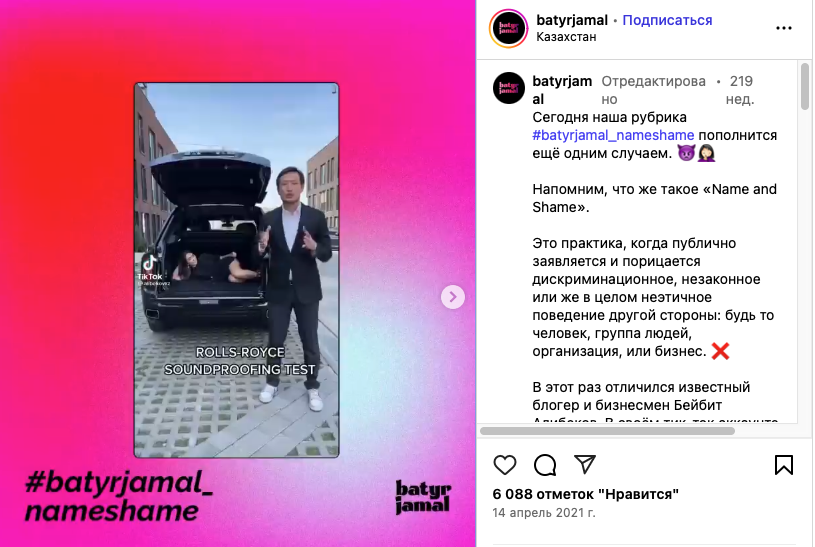
Screenshot: Instagram / Batyrjamal
Monetization of Polygamy
An equally heated debate is ongoing about polygamy, which has been historically practiced and continues to be unofficially practiced in Central Asia. Polygamy is often accompanied by coercion, age disparity, domestic violence, financial dependence, and the deprivation of women's rights to inheritance and child custody.
In Uzbekistan, polygamy is prohibited by the Criminal Code, which provides for punishment in the form of a fine from 50 to 100 BRV, corrective labor, or imprisonment for up to three years.
Nevertheless, the normalization of the phenomenon hidden behind "humor" can be noticed in more than one advertisement — for example, the slogan of the electronics store Elmakon caused a lot of noise in February 2023: "Ikkinch xotin"ga g’amxo’rlik qiling ("Take care of your second wife"). The Anti-Monopoly Committee banned placing banners with this phrase in Tashkent and also halted the promotion of another slogan, also alluding to traditionalism: "Mahrga texnika so’rang" ("Ask for appliances as a mahr [dower]"). The company stated that the advertisement played on men's attitude towards their own car, as reverent as towards a "second wife." However, one cannot expect everyone to delve into the hidden meaning, while the literal meaning of the phrase lies on the surface.
In Kazakhstan, polygamy is also prohibited, but this does not stop marketers from using this phenomenon in a "humorous" context. In the summer of 2018, the Kazakh Aviasales created collections of vacation spots with a baibishe, that is, with the first legal wife, and with a tokal (second wife). A quote from the text:
"Whether to introduce your mistress to your wife is your business. But you need to take both on vacation. Which means you'll need different plans for different women. We've selected five options for each of them and one for a vacation with all three."
Finally, there is a vast layer of advertising that does not appeal to any particular custom but introduces tolerance for physical violence into the list of patriarchal attitudes. At the center of such campaigns is the image of a submissive, humble woman, whose sole purpose is to perform household duties and care for the family.
In January 2024, an electronics store in Uzbekistan, Credit Asia released a video in which a man interrupts a woman's monologue by striking her in the face, then places her in a freezer, having first asked the salesperson: "How many kilograms does it hold?". The laundry detergent Aprel, in one of its ads, compared a daughter-in-law to a washing machine—and presented it as humor.

Screenshot: Instagram / NeMolchi.uz
One might assume that these are isolated unsuccessful advertising campaigns launched by obscure companies. However, the frequency of such scandals and the broad sample of brands involved suggest otherwise. At the same time, due to strict censorship and restricted access to advertising content, it was not possible to obtain information from Tajikistan and Turkmenistan. Only the most prominent cases become public; one can only guess how widespread such content might be.
The advancement of technology amplifies the influence of advertising, and the phenomenon of ad creep is only gaining momentum. In a world of voice assistants, smart devices, unlimited internet, and digital platforms, the possibility of going offline approaches zero. And if this information environment encourages gender stereotypes, lacks basic sexual education, and critical thinking is not developed, advertising becomes not merely a means of promoting a product, but a tool of social suggestion—that very "norm" which no one consciously chose.