Brief Summary
Here we've gathered the key thoughts of the hero of the material — for those who want to quickly familiarize themselves with the content. The full transcript of the interview can be found below.
Anatoly Kim started as an entrepreneur far from the world of art: he was involved in business, making money, and decorating his office with paintings "for coziness." Everything changed after he met a girl who had abstract canvases hanging in her home. At the time, he still argued that art should be understandable—with beautiful subjects. But in the end, he married her, bought his first painting, and unexpectedly found himself drawn into the world of painting. At first, he simply looked for places to buy works more cheaply, often from Korean artists with whom it was easy to find common ground.
Over time, the hobby turned into a collection, and the collection — into a gallery. This led to the realization that he wasn't just buying paintings, but preserving the cultural memory of the Korean diaspora in Uzbekistan.
Video version of the interview
We have prepared this version for those who prefer to watch and listen.
Full version
Here we offer the full but edited version of the interview for careful reading.
— You collect Korean art. Tell us, how did it all begin?
— Without going into too much detail, to open any gallery, two things are needed: money and the motivation to collect unnecessary things. Money appears when you're in business—I started doing that over 30 years ago. At first, we were computer speculators, then we became respected IT professionals. Things took off, and funds appeared.
And that's when I met a girl. She had abstract paintings hanging in her home. I was struck by their "absurdity"—just some splotches, nothing understandable. I argued: how could this be art? After all, proper art is beautiful girls, clear narratives. But it was precisely this incomprehensibility and her passion for it that, I think, stuck with me.
In the end, I married her. And I realized: if a person is doing something strange, it can arouse interest. And if they've sacrificed their freedom for it — that means it works.
She once showed me a painting and said she paid 400 dollars for it. And 30 years ago, that was a huge amount of money. Moreover, she gave up her vacation for this painting. And it stuck in my mind: people even pay money for these "incomprehensible things."
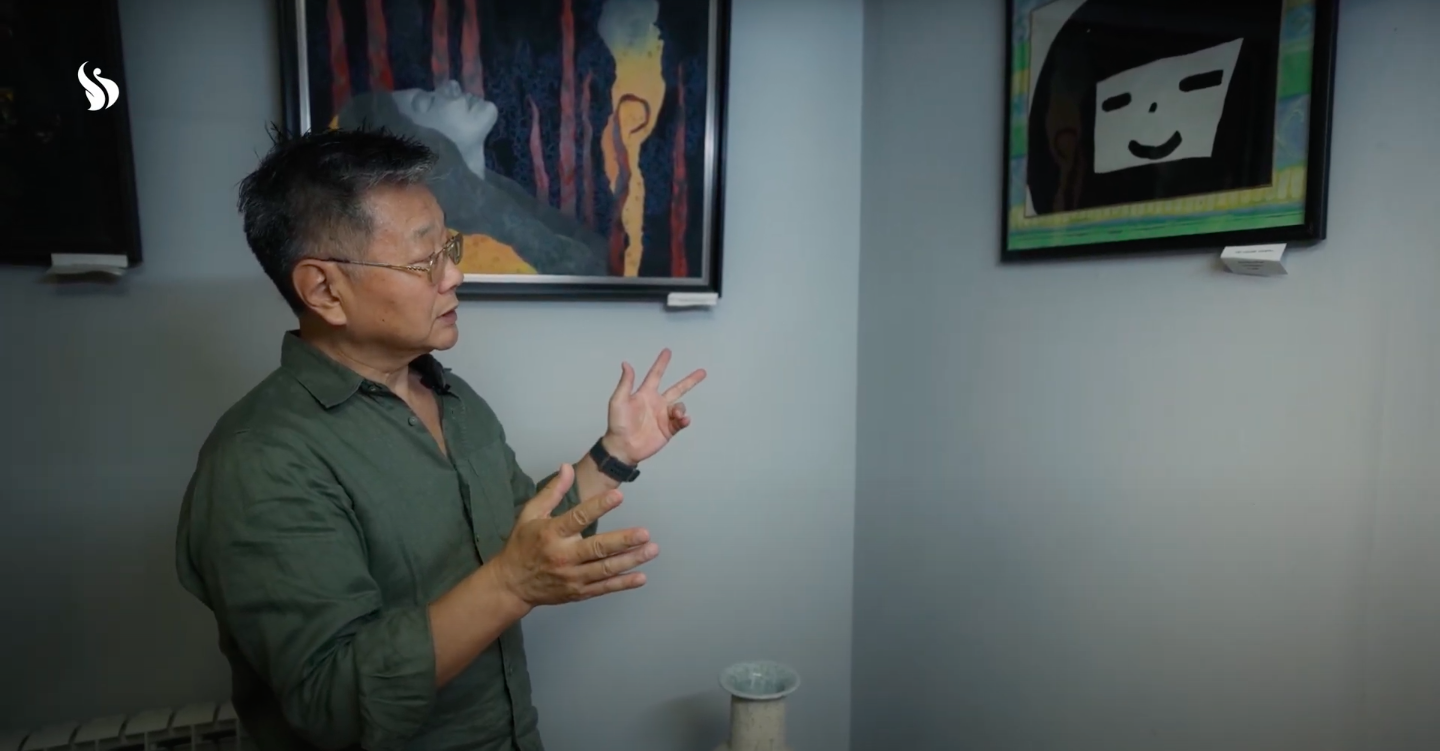
If this sparks interest — maybe I should get into it myself? I just need to find the original source, where to buy such paintings cheaper.
And as often happens in life, circumstances began to align. I met a girl—she was into art—so I started thinking about where to find paintings. And then, suddenly, art historian Tatiana Yugay appears—now she works in landscape design, but back then she was a lobbyist for Korean artists. She came to our office and said, "Your walls are empty; there should be paintings hanging here."
I thought: here is a person who can take me to where I can buy good works cheaply. We went to artists' studios—artists are sitting there, a bottle of strong alcohol is on the table, and all the seated artists are looking at me. The atmosphere is friendly—conversation, toasts. They start treating me to alcohol, trying to relax me, draw me into the atmosphere so that I would want to buy paintings—a kind of advertising campaign. And I, in turn, treat them—after all, the more they drink, the more agreeable they become, and perhaps I can buy the works not for $400, but for much less money.
Basically, we got each other drunk. And indeed, alcohol became a means to reach a compromise: I started buying the paintings relatively cheaply. That's how it all began.
- Do you remember your first purchased painting?
— Yes, I remember. I even remember how I was "handled". I set a certain budget, came to the workshop. The artist shows me one piece, a second, a third... And I'm at a loss: after all, paying money for a piece of work is a big responsibility.
You'll hang a painting at home, someone will see it and say: "Are you serious? You actually paid money for that?" Implying you have no taste.
I walked around for a long time, observing. And at some point, I was drawn to the texture of the paint—it amazed me. Especially the foliage—it seemed unusual. I said, "I'll take this one." And then artists start gathering around me: "What taste you have! You must have a natural gift! You've chosen the best piece!" I even relaxed and thought: maybe I really do have talent if I picked such a thing on the first try. Later, of course, I realized there were many works like that. But I still remember this particular one.
— Did you already think back then that you would become a collector?
— Not exactly. I just realized that something should be hanging on the walls. These designer "spots" — at least you can discern some meaning in them. But the main thing I decided for myself then was: to stop being afraid of looking like an amateur.
The argument "I like it" is infallible.
Someone comes up to me and asks, "What did you buy?" And I answer, "What's it to you? I like it. It hangs there, pleasing to the eye. That's my taste." And what are you going to do about it?
You can admit: "Yes, I don't understand art. But I have something that warms my soul." At the initial stage, this is a very important support—to choose what you like.
— Why did you choose specifically Korean art, the Korean diaspora in Uzbekistan?
— Well, to be honest, the motives were quite prosaic. As with any entrepreneur: to get something cheaper. Even if it carries some functional load, the main thing is the price-to-value ratio. It was important for me to get the works cheaply. And from whom can you buy cheaply? Probably from Korean artists. I could tell them something, bring some alcohol — and the painting would cost less. That's why I initially started buying specifically from Koreans: firstly, they wouldn't cheat me too much, and secondly — the prices were reasonable.
— Could you tell us more about the Korean diaspora in Uzbekistan? Why do you think there are so many talented people there?
— I wouldn't say these are my conclusions. Everything happened by chance, or, more precisely, circumstances themselves led to this. We weren't building a collection from the start—we were simply buying bright accents to make the office look beautiful and aesthetically pleasing. And when there were many of these accents, a feeling emerged: this is good, and that is not so good.
And at one point, Rimma Varshamovna Yeremyan walked into our office. Perhaps it wasn't by chance—after all, we were well-known IT specialists, pioneers in digital technologies in Uzbekistan. Our company Nuron was the first to implement digital layout for publishing products in Uzbekistan. We were also the first in the country to start working with digital color separation—meaning, to print a color image, it had to be separated into inks, and previously this was done using completely different methods.
So, Rimma Varshamovna – a well-known art historian, daughter of a People's Artist – came to us with an idea: to publish an album about Korean artists of Uzbekistan. In the end, the album was published, and we helped with its layout.
At first, it was just a job: a client came to us, we completed the order for money. But then she says: "The layout is ready, all that's left is to print it, but there's no money." And here, you know, my conscience woke up. We read the texts written by Rima Varshamovna and understand: an art critic of Armenian origin wants to publish an album about Korean artists of Uzbekistan with her own funds. And you — a Korean — are standing on the sidelines? So, we decided to join the cause — and printed the entire run at our own expense.
What struck Rimma Varshamovna was precisely that there turned out to be so many Korean artists in Uzbekistan. They were contributing to the development of modern Uzbek art.
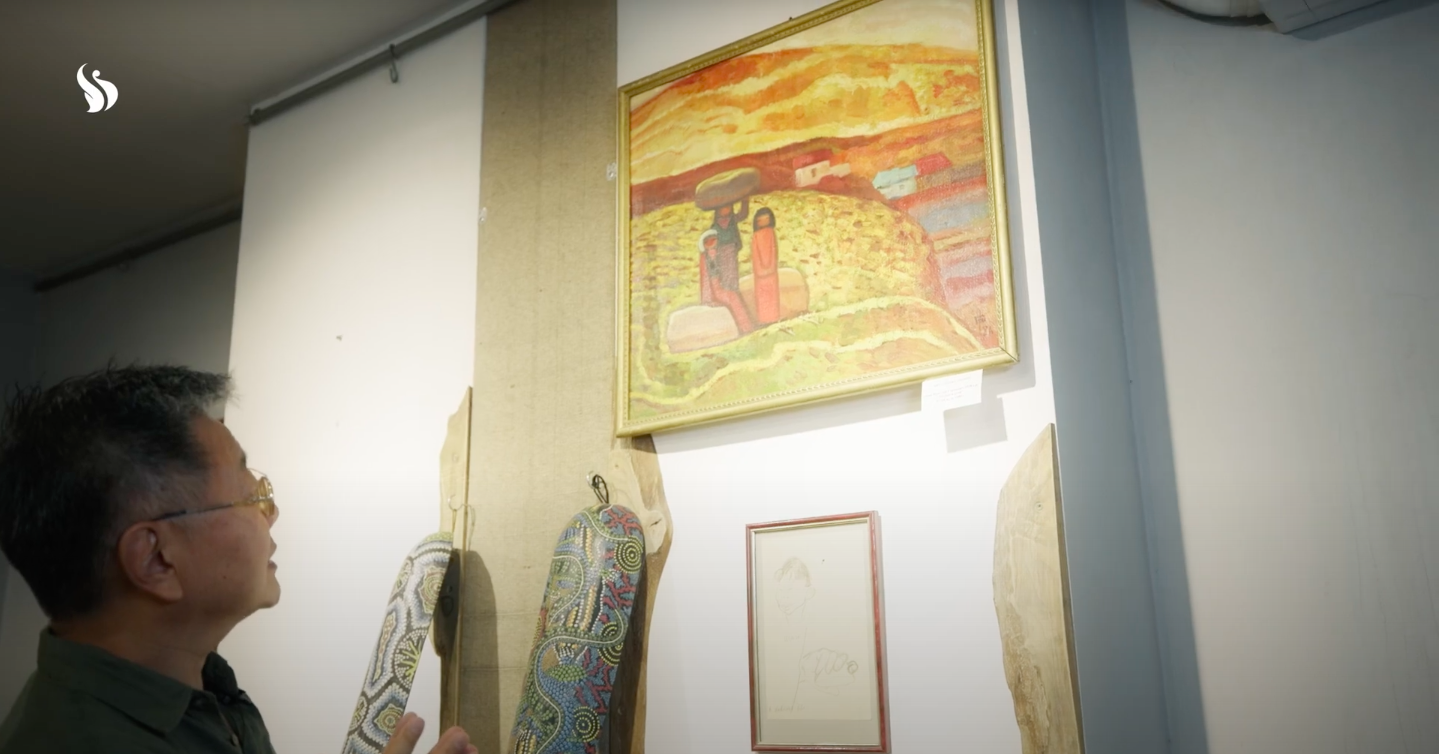
We have two People's Artists of Uzbekistan of Korean origin — Nikolay Shin and Nikolay Pak. Pak worked in the style of socialist realism. We were lucky: we acquired his work completely by chance. One of the female artists called and informed us that two paintings by Nikolay Shin were being sold at the art museum. We came immediately and bought them. Currently, one of them is on display at the Cultura gastrobar, and the second one is with us.
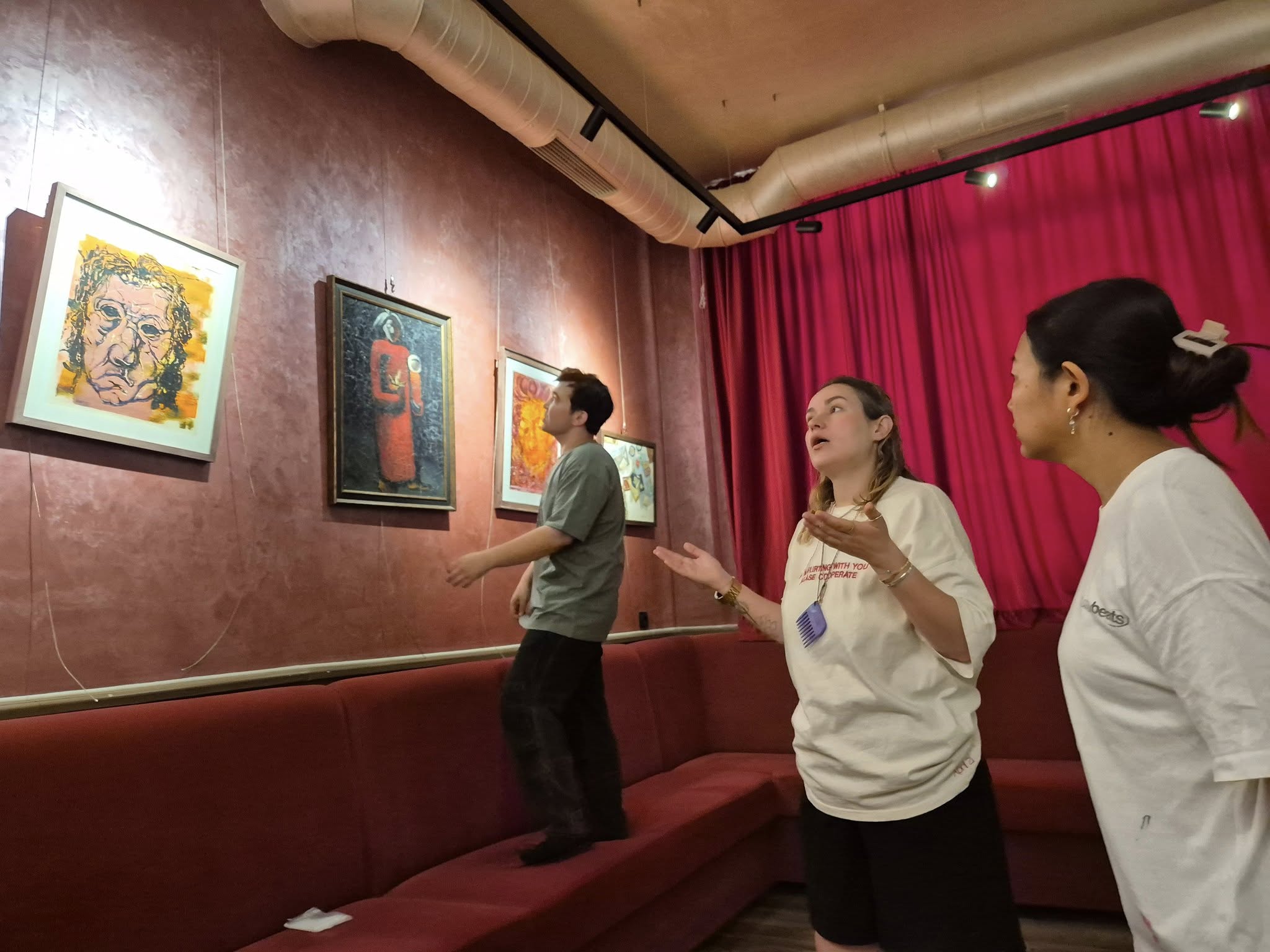
Exhibition of paintings from the "Nuron" gallery at Cultura gastrobar
— You mentioned that initially you built the gallery almost like a reseller. At what point did the transition to collecting happen — to the more social aspect, to supporting Korean artists?
— This also happened by chance, but in a natural way. At first, we were just decorating the space. We didn't even think we were doing anything significant. But at some point, it became clear: we were shaping a social phenomenon. Unnoticeably, we began preserving the cultural heritage of those engaged in creative work.
The transition from purely mercantile to social happened unconsciously. The office walls became beautiful, the space—atmospheric. We started holding presentations, including on the topic of Korean identity. Over time, we formed a strong team: a blogger, a writer, a Korean studies scholar. And in conversations with them, the idea emerged: what we have assembled is a unique phenomenon.
In their historical homeland, Koreans certainly have many artists, museums, and galleries. But abroad, everything is different. Koreans living in Japan, China, and America are mostly occupied with earning money, not art—it's too risky a field. Therefore, nowhere outside Korea has such a concentration of Korean artists developed, and consequently, there are no galleries of Korean contemporary art there.
But in Uzbekistan, things turned out differently: there were many Korean artists, and we started collecting their works. The collection formed on its own. When we heard that this collection was unique, we liked that. We started thinking: how can we make it even more significant?
That's when the realization came that simply "buying what you like" was no longer enough. If you're creating a social phenomenon — you have obligations. You need to collect not just "understandable" or "beautiful" works, but everything — so that future researchers have access to the material. This is no longer a matter of taste. You might not like something — but that doesn't mean the work is bad.
We realized: we are not a filter, we are a vacuum cleaner. We must collect as much cultural heritage as possible so that scholars can work with it later.
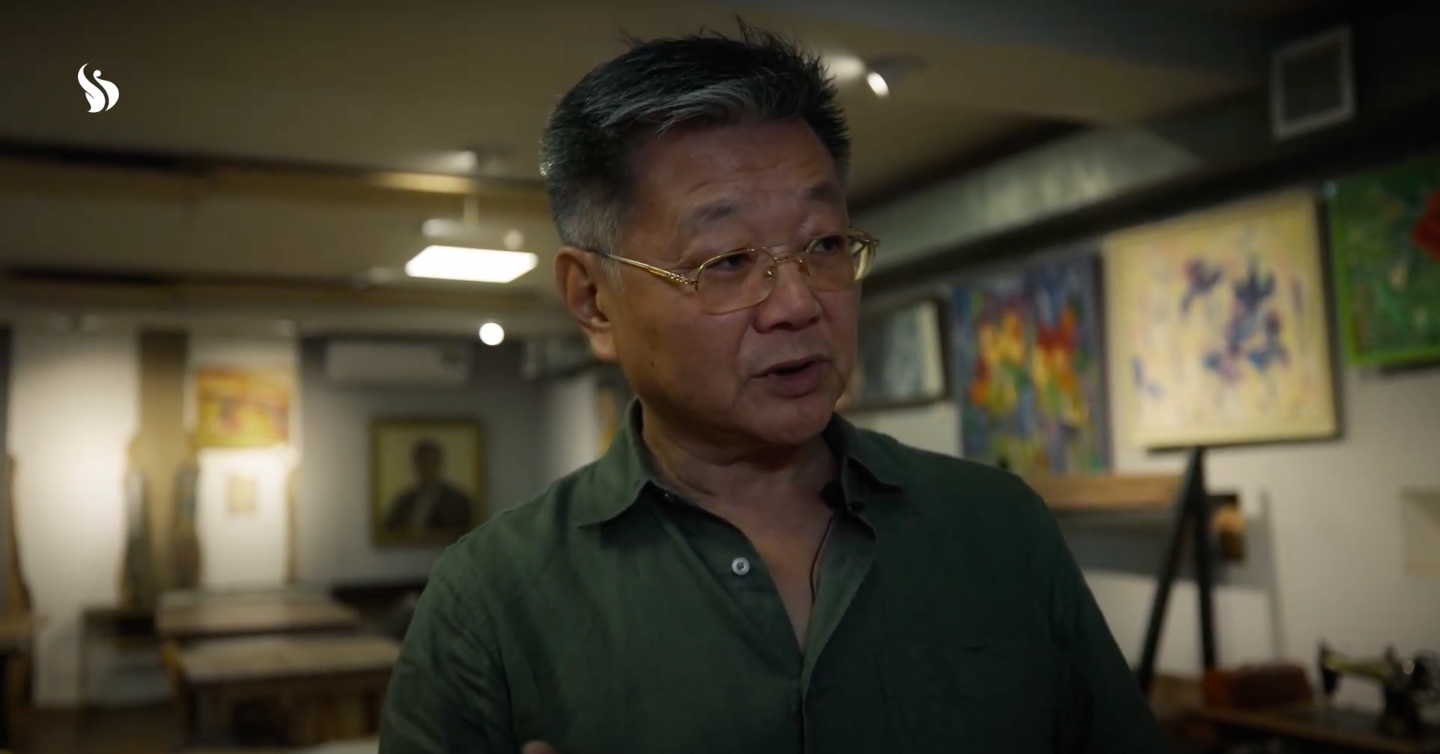
— And how did you integrate the gallery into your business projects?
— Actually, it's the opposite — the business is integrated into the gallery. We, being honest people, allocated separate spaces where the paintings could hang properly. Initially, the idea was to create a space for generating creative content.
We have screens and projectors in all rooms. We wanted creative people to be able to talk about their work, shoot videos, make films in this atmospheric environment—and post it online. But, unfortunately, we didn't find people who would pick up and implement this idea.
But for an entrepreneur, it's not typical to have a space sitting idle and not bringing any benefit. So now, in this space, we are selling furniture.
— Can you tell us how many artworks are currently stored in your gallery?
— We don't know for sure. We just collected everything we could find. Paintings often just lie around somewhere. Usually, we find a place to put them temporarily, and then we frame them. We haven't gotten around to all of them yet.
— And what kind of works predominate?
— There are currently a lot of works by Khristofor Innokentyevich Kan. There really are a lot. We just physically don't have time to process them all — we keep moving them back and forth.
— And are there any favorite artists in your collection?
— It's difficult to talk about favorites now.
We moved away from the "like — dislike" criterion. This filter wears off over time. The taste that used to help determine what is beautiful and what is not has become dull — we acquire everything indiscriminately. Including under the influence of others.
For example, take Kan Khristofor Innokentievich. We specifically traveled to see him in Fergana. He was an orphanage child, lived alone, already an elderly man. He had no relatives, only a caregiver. After his death, as often happens, his apartment simply passed to someone else, and his works could have disappeared.
He knew that after death everything would be lost, and he himself gave us his entire archive—about 300 works. Moreover, the works were of a high level. We just took them. When there is a lot of something—you don't appreciate it right away. Just brought it from the warehouse, and that's it.
We framed and hung some of these works. And then Dmitry Ligai comes to us—a well-known young illustrator. He's generally quite skeptical of others' work, especially our collection. But upon seeing Khan's paintings, he said: "I'm amazed. There's such energy there, I can feel it." And then we also started looking at these paintings differently. If even Ligai says so—then there must really be something to them. And you unwittingly become captivated, start loving "your own child" whom you hadn't noticed before.
Now we think more about the value of works as part of a social phenomenon than about subjective preferences. But there is also a problem. In Uzbekistan, people are not yet ready to spend money on art.
We understand how unique this is: the artist conceived the plot themselves and transferred it onto the canvas. This cannot be replicated. Nowadays, the consumer is spoiled: beautiful images are produced 'from under the printer' and cost very little. That's why it's especially interesting when you, without knowing how to sell paintings, suddenly get some material 'perks' from them.
My most profitable deal was like this. I had a one-bedroom apartment that cost me $7,000. I didn't know what to do with it. At the same time, I had a debt—about $15,000 to a Korean entrepreneur. We had some joint business, and I ended up owing him. He was planning to leave Korea for Canada, to Vancouver, and, after seeing our collection, he became interested in the works of one artist—Vladimir Sergeyevich Kim.
He had complex, interesting, but expensive works. The entrepreneur said: "I want you to buy me ten of his paintings instead of the debt."
I came to Vladimir Sergeyevich and said: "You wanted a studio for yourself, didn't you? I have an apartment. I'll give it to you for 20 of your works." He agreed. In the end, I got 20 works, gave 10 of them to settle a debt, and kept 10 top-tier ones for myself. I would never have been able to buy these works myself—they ended up in the collection thanks to this deal.
Vladimir Kim works in various genres, for example, one of his paintings is The Last Supper in the style of Bosch. My Korean partner particularly liked the biblical subjects. Kim had a whole series of such works. Some of them remain with me.
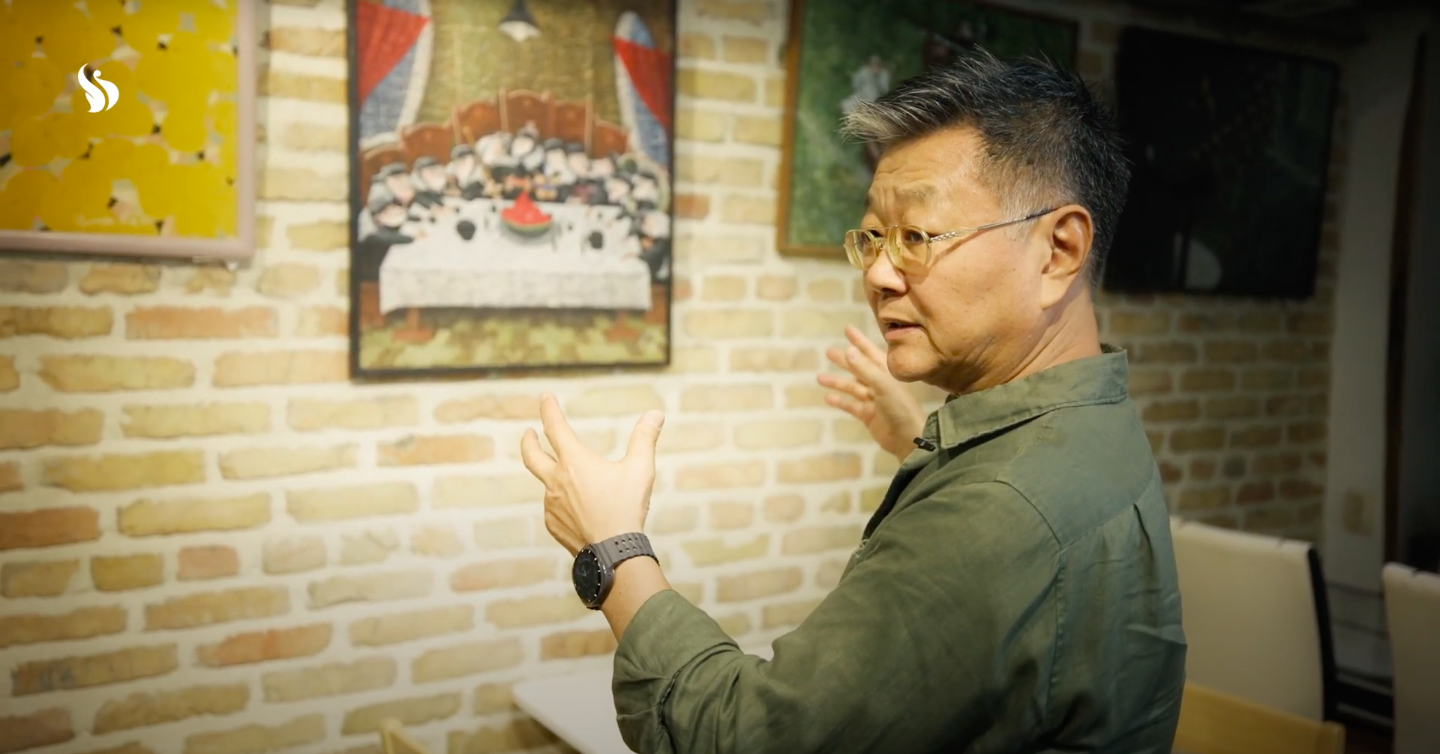
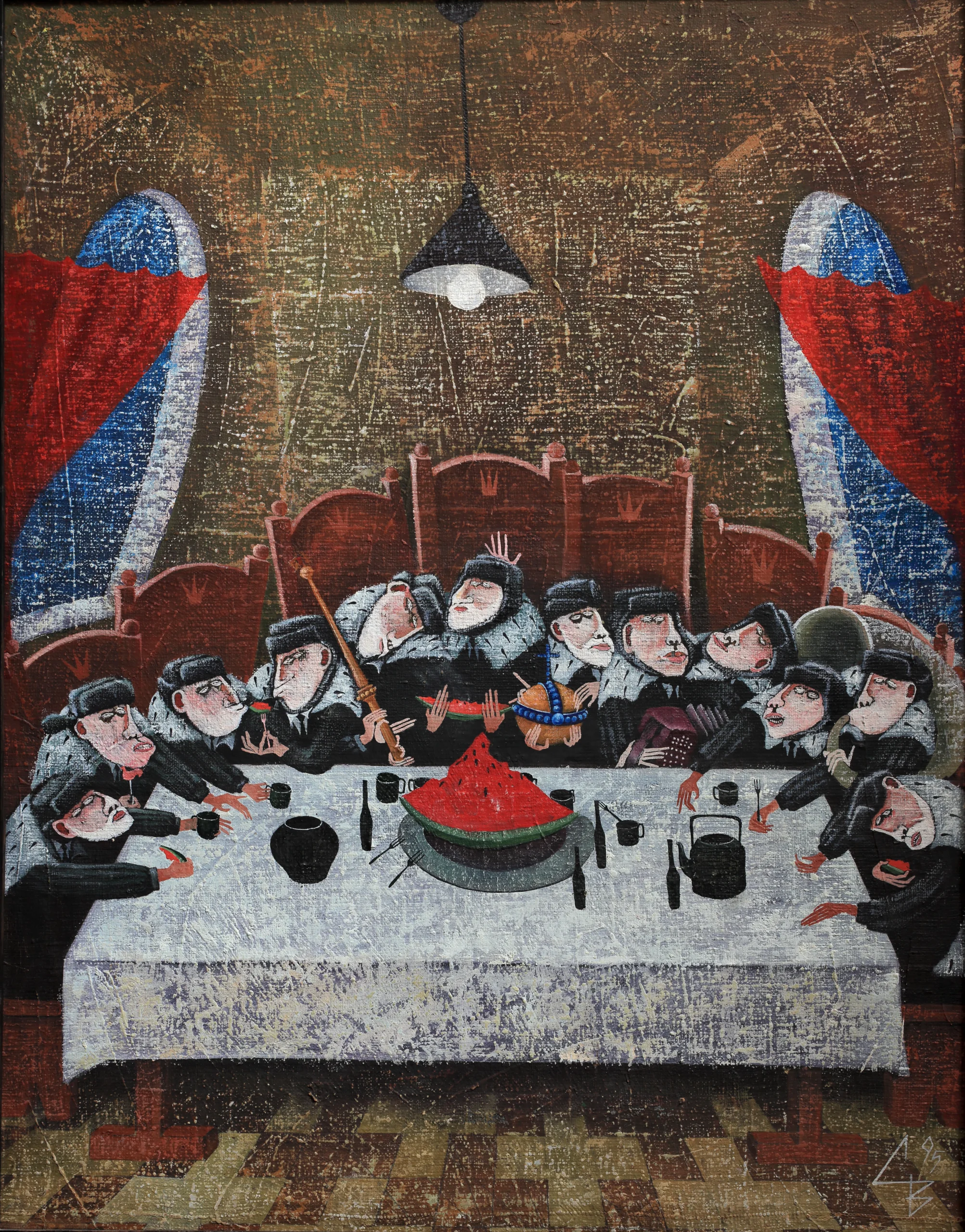
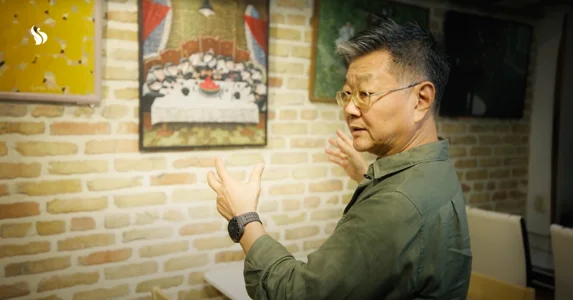
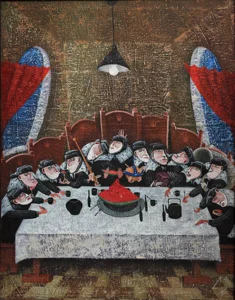
Vladimir Kim's works, which were used to settle the debt
But there's a major problem. We cannot monetize what has already been created. Yet money is needed: for framing the works, for art historians to sort through what we have accumulated. We need an inventory, a website, we need to tell people about the artists. All of this requires investment.
And yet — out of my old, speculative habit — I want what I've assembled to start somehow "giving back." I'm thinking about that very thing right now.
We even opened a carpentry workshop — to make frames for the paintings. The number of works is already large, and will be even larger. Store-bought frames are very expensive. And we make wooden ones from natural material. They flexibly adapt to each work — matching the theme and aesthetic. Unlike modern plastic frames, which we don't like. We want the painting to be framed in wood, a living material.
— Why do you think there are so few collectors in our country? Why don't people want to engage in this?
— I think the issue is that people who have money and could theoretically engage in this simply underestimate what art even is. And engaging in art—it seems to me—gives you a kind of pass into other spheres. There are noble pursuits—if you understand paintings, if you are somehow connected to that world, if you are an artist yourself—you become interesting to a certain circle of people. Owning a collection—to put it cynically—is a pass 'upwards,' into a special circle. If people understood this, they would view collecting differently.
When you do this, you start to understand a complex, non-transparent field. For example, I used to be very skeptical about abstract art. But now I understand why that particular yellow spot is in exactly the right place. I can already interpret a painting—not necessarily as the artist intended, but in my own language. And if you can speak this 'incomprehensible' language, it commands respect. People sense that you are oriented in a complex field.
Art educates. Previously, if I saw an incomprehensible work, I would feel aggression: "What nonsense is hanging there at all?" But over time, understanding comes: if something is unclear to you, it doesn't mean the thing is bad. It's simply that you haven't yet grown enough to understand it. And then you look at the world differently as a whole—you become more tolerant, calmer.
Once it seemed that money opens all doors. So what? You earned money — you became richer. But inside you remained the same hustler you were five years ago at the market. Money doesn't change you. But art — does. It shapes other qualities in you. After all, a person is not created just to earn money. And collecting — it's a way to become different. If people realized this, they might treat it differently.
— Your daughter is the artist Daria Kim. Do you think her development is a result of the environment in which she grew up? Or conversely, did you yourself become closer to art because your daughter became interested in it?
— I don't know. Everything I've told you is just coincidences. It's the same with my daughter. Parents don't deliberately sit down and say, 'Now we're going to have a daughter, she'll be like this, she'll become an artist...' Everything happens by accident. You don't pay attention—and suddenly you have a daughter. Mothers probably think differently. They're closer to the children; they think about their future, their education. But I can only speak for myself.
Fathers typically get involved in raising children later — when they can already be talked to, when they start to think. But by that time, children are already formed. We introduced our daughter to drawing at the age of three. And when she became truly interesting to me — she was already about ten years old. And then I realized that I had taken almost no part in her formation.
Although, of course, there is genetics: my father painted, and I painted, and in general, everyone around me was somehow connected with the visual arts. And my daughter too—it's just part of that environment. As for her becoming a professional artist—that, I think, is a confluence of circumstances. In this world, everything happens by chance.
— What future do you envision for your gallery?
— First of all, I like that I am the owner of artworks. It brings pleasure. Well, as a collector — I enjoy sorting through, revisiting what I have.
The future? First, the gallery is a pleasure. Second, a social benchmark has already been established. The gallery needs to be "brought into the light," to show its significance. Let everyone know: Koreans didn't just work in the fields—they also wielded a pencil and a brush. It's important to emphasize the diaspora's contribution to art.
There is also a practical aspect. I have a daughter who is a professional artist. Soon she will become great, everyone will know about her. But she is far away, and that worries me. Especially her mother. There is a fear of losing connection. And the gallery is that connecting link. It helps maintain family relationships. We are an artistic phenomenon, and my daughter is an artistic phenomenon. If we are engaged in this business, it means that a commonality is preserved between parents and children. The gallery becomes a means of family communication.
— Would you like the gallery to become a museum?
— Functionally, it has already become a museum. Out of around fifteen hundred works, approximately five hundred are of museum quality. These are pieces that cannot be parted with. They reflect how the Korean diaspora has managed to preserve its creative identity. So, the museum component is already in place. Essentially, it has already been created.