
Cotton is one of the most persistent cultural stereotypes about Uzbekistan. Imposed from outside, it has nevertheless become ingrained in the mentality of entire generations of Uzbeks. "White gold" has become an Orientalist symbol as recognizable as "Eastern hospitality," pilaf, the sun, and the songs of the band "Yalla."
Cotton cultivation officially became Uzbekistan's designated role within the Soviet system. In the first version of the anthem of the Uzbek SSR (used from 1947 to 1956) there was the call: "Flourish, land of cotton, our Uzbekistan...". The text contained the obligatory mentions for that time of "our own Stalin" ("Assalom, dohimiz Stalin, jonajon") and "the great Russian people" ("Assalom, rus xalqi, buyuk ogamiz"). In the later version of the anthem, Stalin and cotton were no longer mentioned, but a characterization of the republic as a "land of earthly treasures" ("Tupro'ing hazina") appeared.
"Earthly treasures" were depicted on the coat of arms of the Uzbek SSR in the form of a wreath, intertwined with ribbons in the colors of the Soviet republic's flag: on the right were ears of wheat, on the left — open cotton bolls. A similar cotton-wheat wreath can be seen on the coat of arms of independent Uzbekistan, the sketch of which was approved in 1992, as well as on the coat of arms of Karakalpakstan.
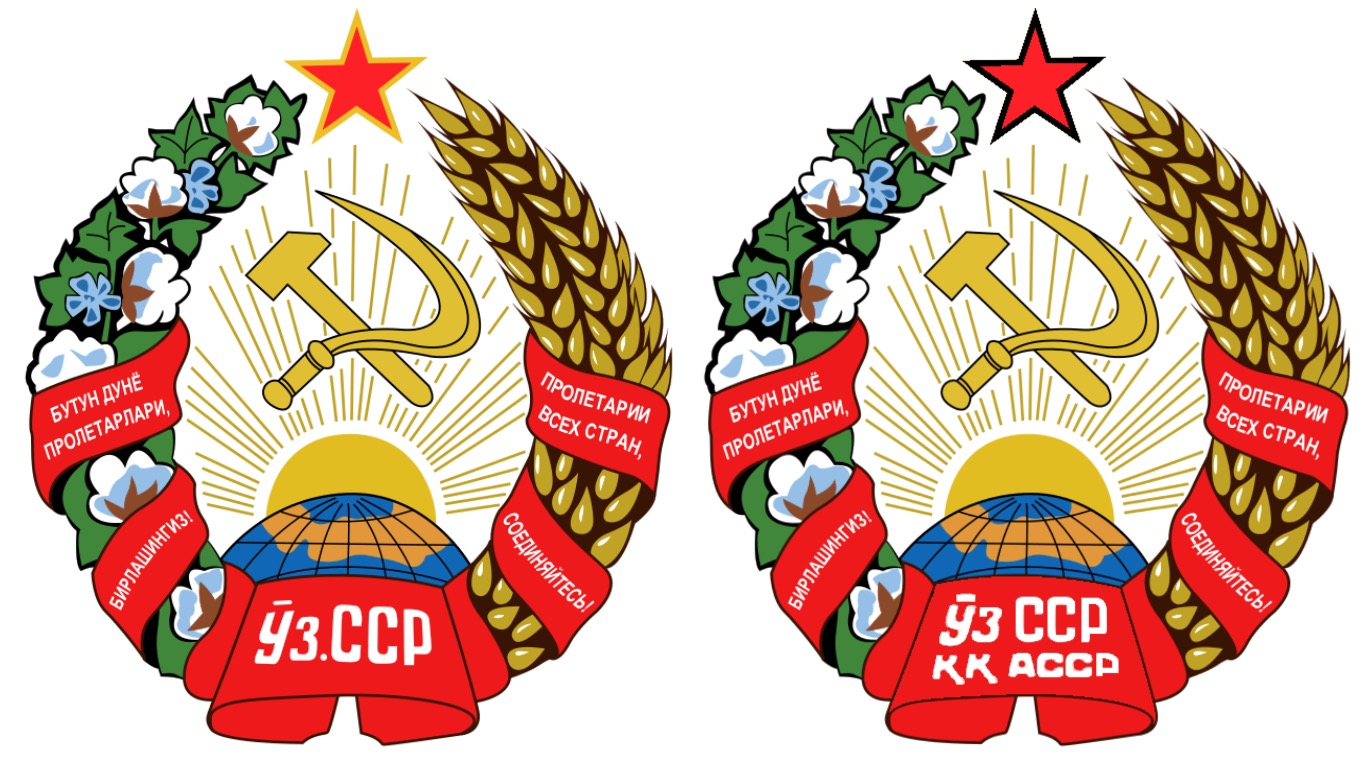
On the left is the coat of arms of the Uzbek SSR, on the right is that of the Karakalpak ASSR.
Cotton as a visual mainstream
The cotton theme was also present in the culture of Soviet Uzbekistan. The poet Kuddus Mukhammadi wrote a "Song About Cotton," which describes in enthusiastic tones the journey of cotton fiber from the field to the factory. In children's poetry, cotton was compared to snow. "Our cotton is whiter than snow. All your shirts are from our fields," wrote Kudrat Khikmat, emphasizing Uzbekistan's contribution to the textile industry of the USSR.
The Soviet press glorified the workers of the cotton industry, who were regularly awarded honorary titles and decorations. In the 1950s, Tursunoy Akhunova (1937—1983) became famous — for her record-breaking cotton harvesting figures and the introduction of mechanization into cotton cultivation, she was twice awarded the title of Hero of Socialist Labor. Her image became a symbol of the Uzbek cotton grower, and she herself became a heroine of newsreels and propaganda posters.
The labor of cotton growers in Soviet Uzbekistan was praised on par with the feats of miners and soldiers. In the 1960s–1970s, the exhibition of the Uzbek SSR at the VDNKh in Moscow included bronze busts of Kim Pen Hwa and Khamrakul Tursunkulov — the collective farms they led, "Polar Star" and "Star of the East," harvested hundreds of thousands of tons of cotton. By the 1970s, entire parks with monuments to cotton growers had appeared in the Uzbek SSR.
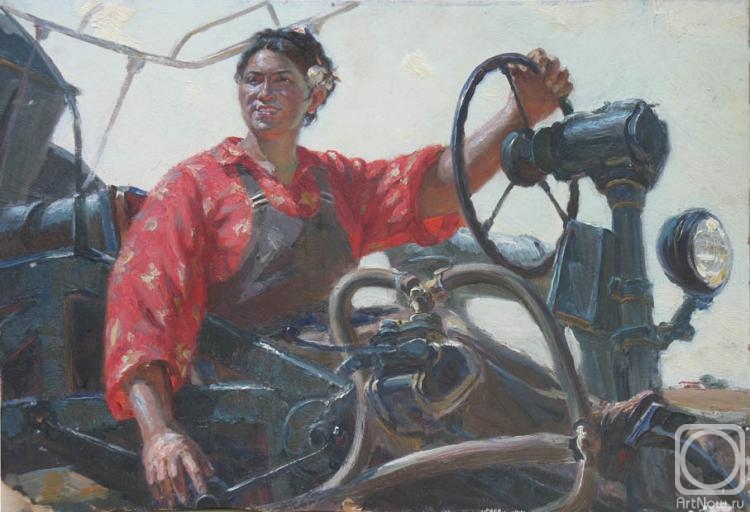
Tursunoi Akhunova in a painting by artist Vladimir Petrov.
In the applied arts of Uzbekistan, the "pakhtagul" pattern, stylized as a cotton flower, became established. Since the 1950s, Tashkent began painting tableware with white bolls on a blue background. Over time, teapots and bowls with this ornament became part of the assortment of every store selling national souvenirs. The cotton motif is found not only in ceramics but also in embroidery: in suzanis, one can see cotton branches—a symbol of prosperity and abundance.
Cotton was also depicted in mosaics that can be found in the metro and on the facades of panel buildings. The green-blue panels with cotton branches by the Zharsky brothers have adorned the platforms of the Tashkent "Pakhtakor" station since 1977. In Tashkent, there are about 13 mosaics with cotton motifs left, some of which are listed as cultural heritage sites.
The price of "white gold"
After the collapse of the Soviet Union, Uzbekistan proclaimed a rejection of the planned economy model, yet cotton long remained the primary source of state budget revenue. The authorities attempted to reduce dependence on the monoculture: for food security, part of the cotton fields were allocated to wheat and other crops. In the first 15 years of independence, cotton cultivation decreased from 2 to 1.5 million hectares, and the gross harvest fell from 3 to 1.2 million tons. Cotton's share in exports dropped from 45% to 17%—this was how Uzbekistan attempted to diversify its economy.

At the "Uzbekistan" station of the Tashkent Metro, the ceiling lamps are stylized to resemble opened cotton bolls.
Nevertheless, cotton remained the primary source of foreign currency earnings and rural employment. Uzbekistan consistently ranked among the world's top ten producers of raw cotton. In 2023, the country ranked 8th, harvesting 2.9–3 million tons, and the 2024 harvest exceeded 3 million tons.
After gaining independence, the cotton industry remained under state control, and the system of forced cotton harvesting continued to exist under the guise of "voluntary assistance" to the country's agro-industrial complex. Since the early 1990s, schoolchildren, students, and public sector workers across Uzbekistan have been massively sent to the fields in the spirit of storming, inherited from Soviet times.
By the early 2010s, international organizations increasingly stated that forced and child labor was widespread in Uzbekistan's cotton industry. In 2011, 331 companies, including Adidas, H&M, New Balance, Zara, IKEA, Carrefour, and Amazon, signed a public pledge not to use Uzbek cotton if it is produced using forced labor.
In the late Karimov years, cotton gave rise to another persistent stereotype about Uzbekistan — it became associated with a country where hundreds of thousands of people are exploited in its agriculture. According to the World Bank, until 2017, nearly 2 million adults and children were mobilized annually for the cotton harvest.
What did this mean for the average Uzbekistani? University, institute, and college auditoriums emptied from September to early November — that's when the "battle for the harvest" took place. It wasn't just students who went to pick cotton; teachers, nurses, and civil servants did too. There were various ways to get out of the cotton duty: students brought doctors' notes, employees of state institutions, university staff, and school teachers hired local people to go in their place. In April-May, the cycle repeated — people were taken to weed the cotton fields.
Old Cotton in "New Uzbekistan"
After the change of power in 2016, changes began in the cotton industry. The new president, Shavkat Mirziyoyev, set a course to abandon the old practices of managing the cotton industry. Already in 2017, the Cabinet of Ministers abolished the mandatory mobilization of people for the cotton harvest. Under the supervision of the International Labour Organization and the World Bank, a monitoring program was launched, and in 2022, international experts confirmed: systemic child and forced labor in Uzbekistan's cotton farming has been eliminated.
The industry's economy also changed. The state abandoned rigid planning, betting on market mechanisms. Cotton-textile clusters began to be established across the country: farmers grow raw materials, and within the same system, it is processed into fabric and clothing. This increased procurement prices, created jobs, and allowed the country to shift from exporting raw cotton to domestic production. Already in 2023, all harvested cotton was processed domestically into yarn and semi-finished products.
The textile industry is now one of the largest employers in Uzbekistan. While fewer than 200,000 people worked in the sector in 2018, by 2024 the number had risen to over 600,000, the majority of whom are women and youth. The income of cotton pickers has also increased: they now work voluntarily and earn from 1,500 to 1,800 sum per kilogram.
Uzbekistan paid a high price for turning into an abundant "cotton land." Cotton gave the country an economic foundation but also became a source of long-term problems—from the dried-up Aral Sea to reputational losses due to the widespread use of forced labor. It still influences agricultural policy, keeps textile factories busy, and is a major export item. "White gold" defined Uzbekistan's development for decades and remains part of its cultural and economic landscape.


