Brief summary
Here we have collected the key thoughts of the hero of the material — for those who want to quickly familiarize themselves with the content. Read the full interview transcript below.
How does a museum space come to life? Who transforms ancient walls into a living museum, and silence into a conversation with the past? Konstantinos Politis knows how a ceiling-printed mihrab sounds, how display cases are assembled overnight from glass and travertine, and why a museum is more than just an exhibition. In our extensive interview, we explore the story of a designer who has created and restored museums in Greece, Turkey, and France, and then came to Uzbekistan to search for meaning, preserve memory, and challenge minimalism.
Full version
Here we offer the full version of the interview for careful reading.
On the path to the profession
— A museum is not just a building, but an entire world. That's why a museum interior designer is a special profession. How did it all begin?
— Exactly so: a museum is a separate universe, and working with it requires a special approach. My journey began in Greece, at Aristotle University of Thessaloniki. The atmosphere of a country where every stone holds history influenced my choice. Later, I continued my studies in France, at the Avignon Institute of Arts, studying art restoration and completing a course in museology — the science of the museum as a cultural and emotional space. And even during my studies, I understood: it's important not only to preserve an object but also to create the right environment for it — that very museum atmosphere. I interned at French museums.
My first museum project was in my native Thessaloniki — a city where everything breathes history and Orthodox tradition. I designed the museum of religious art at a local church, and this experience became a real school for me: I learned to hear the silence of a sacred space, to work with icons, and to understand the language of relics.
Later, I spent almost five years on the Athos peninsula — in the monastic republic, where I created exhibitions for three monasteries. There, a museum is not just an exhibition, but a continuation of the prayer rhythm, and every display case had to speak softly and precisely.
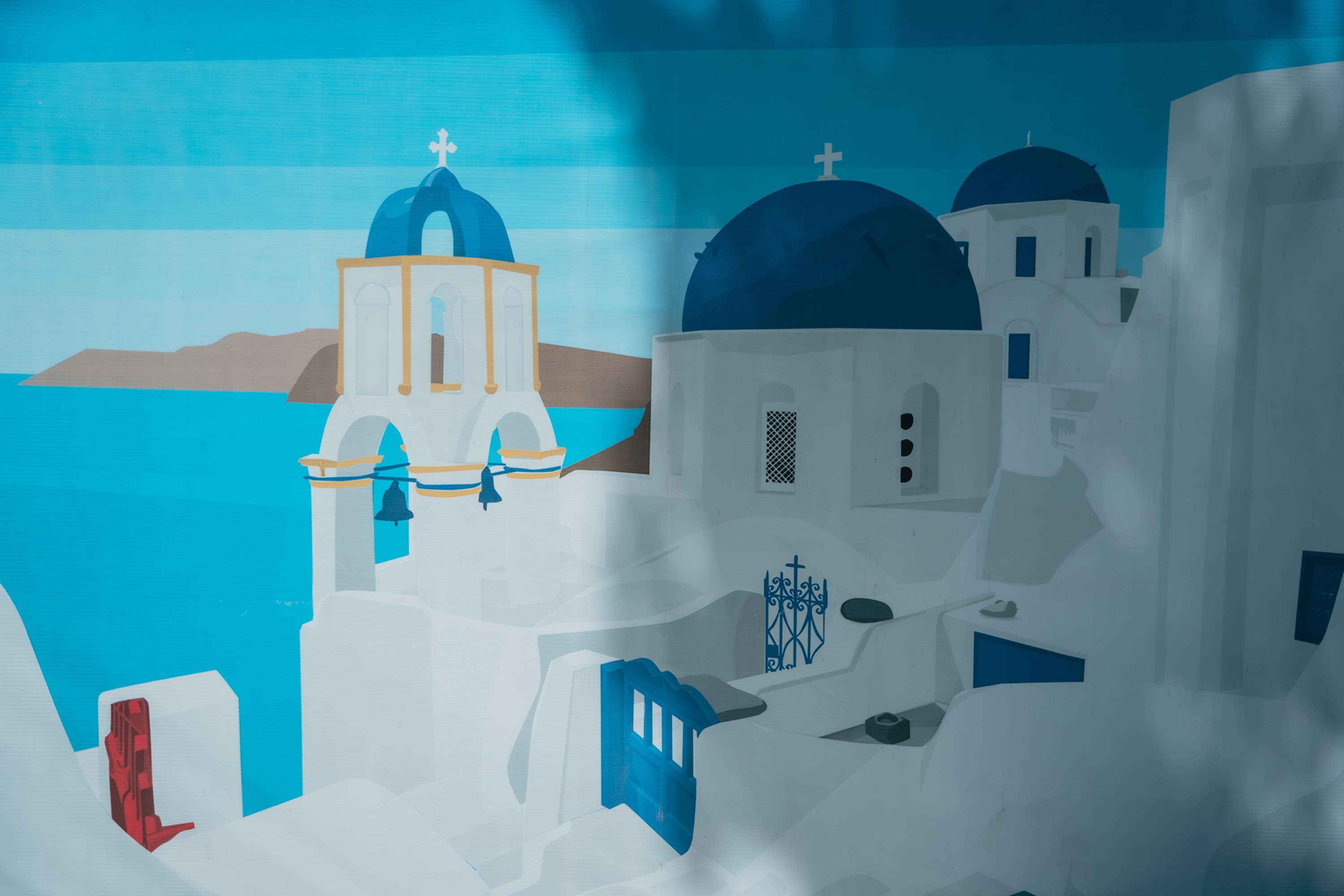
Painting at the Greek Culture Center. Photo: Katerina Kuznetsova
In the city of Alexandroupolis, near the Turkish border, I designed another religious museum — it was important here to preserve the spirit of the region, weaving it into a modern exhibition format.
In Istanbul, I first encountered private collections. One museum was dedicated to painting and applied arts, another to vintage automobiles. It was a completely different experience: to combine museum precision with the personal history of the collector, to find a balance between professional rigor and emotional individuality.
— The museum is often confused with an exhibition hall. What is the fundamental difference between the two?
— Indeed, the museum is often confused with an exhibition hall, but these are fundamentally different things. A museum is an institution of memory; its mission is to preserve art and convey its meaning to future generations. It is built not only from exhibits but also from concept, text, route, and light. It is an integral system where every detail matters—from the label to the logic of movement. An exhibition, however, is temporary, expressive, but rarely carries a deep educational layer.
Only 30% of the collections are accessible to the public—the rest is stored in the funds, where scientific work is in full swing. The true heart of the museum is behind the scenes. But despite this, the museum is not just a repository, but a dialogue. The space must be lively and welcoming. A visitor should not get tired—they should become engrossed, linger, and reflect. If they leave not with a photo, but with an emotion—then we have succeeded.
— Where does the creation of a museum space begin?
— From the script. We, like directors, build the dramaturgy: introduction, development, climax, conclusion. Then comes the layout: lighting, displays, texts, sound. Everything must work to create the atmosphere. The cultural context is especially important — a museum speaks the language of its era.
Today, immersive design is trending, where the viewer doesn't just watch but feels as if they are stepping inside the story. A team of specialists works on the project, and the designer's task is to merge science and art to create a real, genuine interaction between the exhibit and the viewer.
Bukhara: The Unrealized Museum
— Tell me about your projects in Uzbekistan. As far as I know, your contribution to the museum field here is quite significant.
— I came to Uzbekistan in 2003 under the direction of The Christian Fund as a specialist in restoration and museum design. The first project was Bukhara — and it remains special to me to this day. Back then, on the initiative of UNESCO and with international support, I was creating the Museum of History of Bukharian Jews in a house next to the synagogue.
The work lasted almost a year: we restored the interiors in a traditional style, deciphered the Hebrew inscriptions, and collected authentic artifacts. We reached out to the Bukharian diaspora—in Uzbekistan, Israel, and the USA. The community in Queens (New York) was especially active—they shared photographs, household items, music, all for the sake of preserving cultural memory.
Alas, over time the museum disappeared — the building was converted into a cafe. Despite my attempts to intervene, it turned out that the space had no official status and, in essence, was not protected by law. This became an important lesson for me: for a museum to live, you must not just create it — you must integrate it into a system that will ensure its future.
Savitsky Museum: Laboratory and Breakdown
— Your second project in Uzbekistan — the Igor Savitsky State Museum of Arts.
— Yes, exactly. The work lasted about six months: it was necessary to systematize, assess the condition of the unique collection — from avant-garde to Eastern applied arts and archaeology.
I understood: it couldn't be done alone. I invited restorers from Spain, Italy, and Greece, opened a laboratory at the museum, purchased equipment and materials. But the main goal was not just to complete the task, but to transfer knowledge to local specialists, to inspire, to build a bridge between tradition and modernity. In museum work, you cannot impose—you can only share.
However, enthusiasm quickly collided with reality: meager funding, absurd deadlines. Finish everything in three or four months? But this is not an exhibition for an anniversary—it is a repository of meanings. In protest, I closed the firm and stepped away from museum work for several years. I did not want to betray my principles.
But I couldn't completely leave. My name was already known, and soon new offers appeared. When the topic turned to the Museum of Islamic Civilization, to the Mamun Academy—I didn't hesitate. These projects became a part of me. Over the years, Uzbekistan has become my home. Maybe not by passport, but in spirit—I am Uzbek.
Khiva and Karshi: Fast Timelines and New Technologies
— You mentioned the Mamun Academy. So, after Bukhara, your path led to Khiva?
— Exactly. After Bukhara, I ended up in Khiva — working on the museum for the Mamun Academy. And although the project was large-scale, it's difficult to recall it with pride. Initially, it was supposed to be a permanent exhibition dedicated to the heritage of Khorezm, its scholars, and the culture of the Middle Ages. But later, an order came down — to design a full-fledged museum.
In words — inspiring. In reality — a problem: there were no genuine exhibits. And without them, a museum turns into a set piece, an educational installation, but not a living space of memory. We finished the project, but a sense of satisfaction never arrived. I gave it my knowledge, time, and effort, but a museum without authenticity is like a book without text.
— And then — Karshi. Two sites right away: the Regional Historical Museum and the Archaeological Museum at the Odina Mosque. Were these complex projects?
— "Challenging" is putting it mildly. Especially the Archaeological Museum. I was given just one week to realize it—a task bordering on absurd. Creating a museum space in seven days is impossible... but we did it! The entire team—archaeologists, designers, restorers, builders—worked literally without sleep. We came up with an unconventional solution: modular display cases and podiums made of travertine and glass, assembled like LEGO bricks. We ordered the panels and components directly from the factory, calculated everything down to the millimeter. Manufactured in two days. Simultaneously, work was done on the texts—I always insist that information plaques not be a formality but become a bridge between the artifact and the viewer.
We made it in time. The opening was ceremonial, but I didn't get to see it. I was taken to the hospital — nervous exhaustion and a severe cold.
I recall this project as one of the most intense, yet also one of the brightest pages in my career. Years later, Prime Minister Abdulla Aripov once mentioned that story—as a symbol of true dedication to the cause.
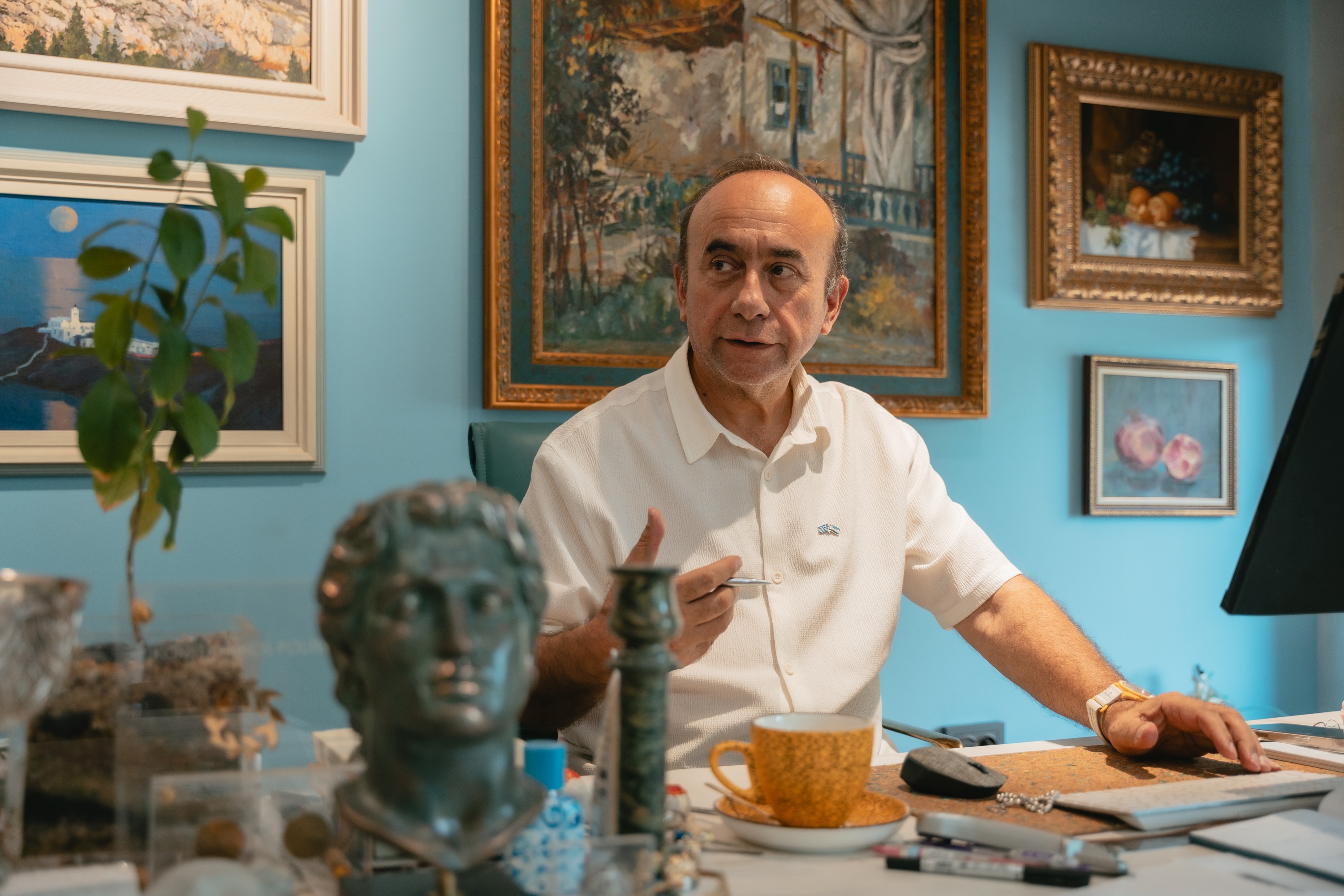
Konstantinos Politis. Photo: Katerina Kuznetsova
House-Museum, Memory Museum, and New Formats
— One of the museum's special formats is the house-museum, connected with a personality and memory. Your portfolio includes the project of the house-museum of writer Abdulla Qahhor in Tashkent. What experience did you gain from this work?
— The House Museum of Abdulla Qahhar became one of the most complex and personal projects for me. When you work with a space where a person lived and created, you enter into a silent dialogue with his life, thoughts, memory. Here, not only the exhibits speak, but also the walls, the smells, the silence.
The writer's family played a special role: they were not merely observers but the keepers of the house's spirit. Their participation was sometimes helpful, sometimes requiring subtlety—it was important to find a balance between the museum's concept and living feelings. We didn't limit ourselves to objects—we studied the writer's work, spoke with the family, and gathered invisible-to-the-eye details to create a space that was not formal, but authentic, filled with biographical sincerity.
— One of the most unusual museums in Tashkent is the two-domed Museum of Memory of the Victims of Repression. How was the work on it carried out?
— Working on the Museum of Memory for the Victims of Repression became something special for me—both emotionally and professionally. Initially, it was a monument of sorrow: a single dome, a black monument in the center, unsettling red corridors—the architecture itself engaged in a dialogue with the pain of the past.
But then officials intervened. Instructions began on where and what photographs to place—as if it were not a museum but a shop window. The final stage was overseen by the first president of Uzbekistan himself. After inspecting the building, he ordered the project to be expanded—to add a second dome to emphasize the scale of the theme.
I suggested a glass extension, but it was decided otherwise: a second hall with mirrored architecture emerged, housing documents, books, photographs—quiet witnesses of time. Thus, the museum gained not only a new volume but also a new breath, becoming a symbol of the country's historical memory.
Projects he is proud of
— Are there any projects you're particularly proud of? Ones where you managed to implement everything you envisioned?
— Certainly, there are such projects. One of them is the facade and interior sketch for the new Mir-i Arab Madrasah in Bukhara. It is not a museum in the conventional sense, but a spiritual academy, where the museum element merely complements the sacred and educational space. Here, I aimed to propose a contemporary perspective on Islamic design: instead of traditional turquoise — wood, ceramics, calm shades of blue, white, and gold. For the first time, we used a Sufi treatise as part of the architectural composition — its text covers the entire ceiling, resonating as a spiritual statement.
Another project is the interior of the museum at the Center of Islamic Civilization. The French concept seemed impersonal to me, and I proposed a new idea inspired by the local cultural code. Dark green walls, brickwork, the play of light through metal mesh, the geometry of Eastern ornament on the ceilings—all this created a deep, multi-layered space filled with meaning.
— One of the most famous museums in Uzbekistan is the Islam Karimov Scientific and Educational Memorial Complex. How was the work on it carried out?
— This was one of the most responsible projects. Creating a museum dedicated not just to a politician, but to a national leader, means working with the history of the country, with the memory of the first years of its independence. It was necessary to maintain accuracy, respect, and rigor, while also creating a living and contemporary space capable of speaking to the viewer—regardless of their age or views.
The task was to update the concept of the existing exhibitions. We aimed to show not only the scale of the personality but also the human dimension. For example, we designed a garage with four of the president's personal cars — this part of the exhibition particularly moved visitors.
One of the expressive techniques was applying photographs directly onto the walls—a new technology that creates the effect of a chronicle inscribed into the architecture. This solution became a real "visual feature" of the museum. And on the third floor, the first Uzbek Nexia, personally signed by Islam Karimov, was installed—a symbol of the beginning of a new industrial era.
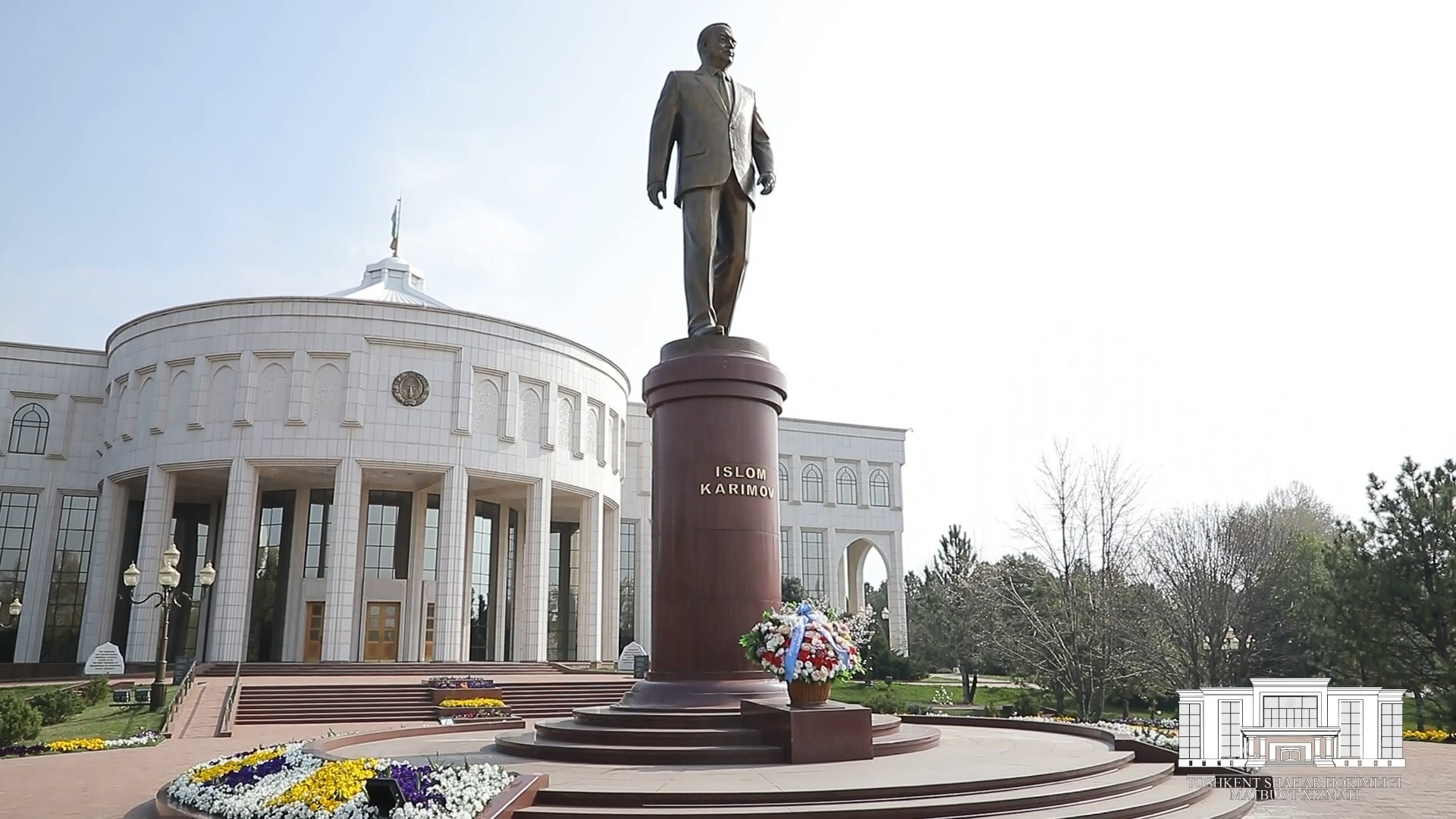
Memorial complex named after Islam Karimov. Photo: mytashkent.uz
Of course, such a project could not be without compromises and external interference. But I am pleased with the result: the museum turned out to be cohesive, meaningful, and, most importantly, — respectful.
— What is a museum to you? What has it become over the years of work?
— For me, a museum is not about walls and display cases. It is a space of memory and silence, where a dialogue between the past and the present resonates. In every project, I tried to create not just an interior, but an atmosphere one wants to enter and stay in. Where a person feels they have entered a different dimension—a world of meaning and spirit. Of course, not everything turns out perfectly: mistakes happen, there is pressure, compromises. But if a visitor lingers, reads, looks closely—it means the space has come alive. Over time, I understood: my profession is not about decor, but about ethics and responsibility. And perhaps that is precisely why Uzbekistan has become a home for me—here I feel my work is needed. And that is the most important thing.