
The reliable stronghold of friendship among peoples
These lines from the USSR anthem enshrined the "friendship of peoples" as one of the key ideological pillars of the Soviet state. This slogan had many manifestations and was broadcast at all levels — from school wall newspapers to the international platforms where the Soviet Union was present.
According to the official Soviet postulate, the USSR was formed by the will of "fraternal" peoples who united in a voluntary union. At the same time, the Russian Empire was declared a "prison of nations" — this catchy expression is traditionally attributed to Vladimir Lenin, but its author was actually the French writer and traveler Astolphe de Custine (1790–1857), who published the travelogue "Russia in 1839." The book was successful in Europe and reinforced the image of imperial Russia as a state of the oppressed.
Soviet social science for decades refined and clarified the concept of the friendship of peoples. In the Dictionary of Scientific Communism (1983 edition) it was defined as follows:
"Friendship of Peoples is a comprehensive fraternal cooperation, political, economic, military, and cultural mutual assistance among nations and nationalities that have embarked on the socialist path of development."
As noted by Russian sociologist Svetlana Lurie, this model was applied both to Russian culture, which after 1917 aimed at the imperial assimilation of the peripheries, and to the cultures of other peoples of the collapsed empire, who already shared a significant layer of common cultural space with Russians.
The Soviet people, as an aggregate of nations without a past, were meant to become the ideal of internationalism—with a self-awareness that denied the imperial experience and was oriented toward the future.
The complexity and contradictory nature of this ideological construct shaped the Soviet cult of friendship among peoples as a special system, which reflected both the self-perceptions of Russians and other peoples, as well as their images of each other.
This system was built on shaky compromises: nationality was not formally denied, but it was colored in ideological tones, bracketed out, or replaced by a collective internationalist identity. For example, peoples with historical conflicts between them could not bring their disagreements into the public space.
The Visual Language of Friendship
The ideology of friendship among peoples was regularly reproduced in Soviet culture, serving as a basic integrator of the multinational society. The key visual image of this construct became the relationship between the "elder" and "younger" brothers. The Russian people were fixed in the role of the "elder" brother—enlightened, progressive, leading the way; the other peoples—in the role of the "younger" brothers—grateful and loyal.
On Soviet posters, the Russian protagonist was typically placed at the center of the composition, with representatives of other nationalities positioned on the sides—often in stereotypical national costumes. In films about World War II, the friendship between a Russian soldier and an Armenian, Georgian, or Uzbek became a mandatory plot motif. The myth of Mikhail Yegorov and Meliton Kantaria, who raised the Victory Banner over the Reichstag, was interpreted as the embodiment of this ideology.
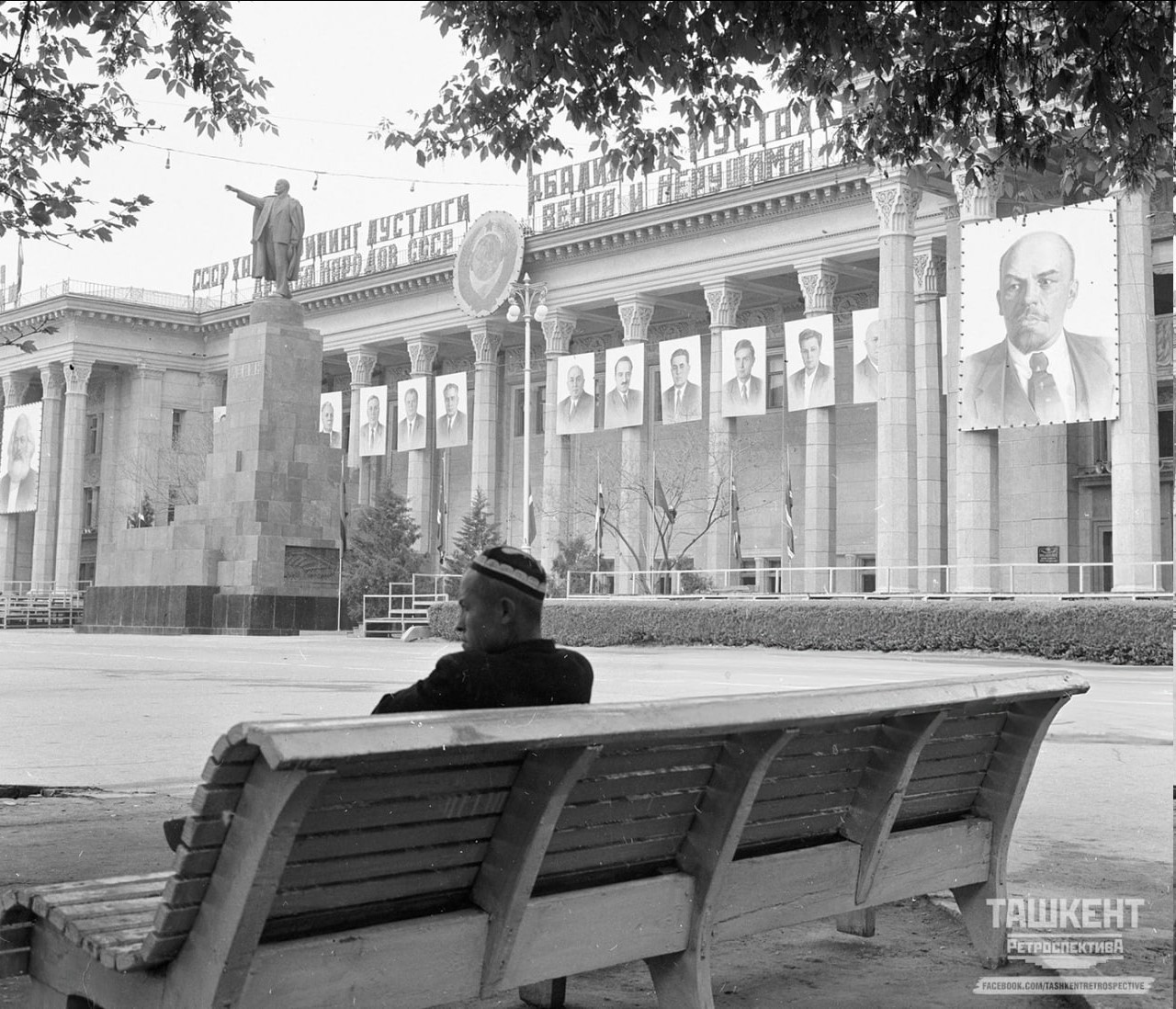
Tashkent, Lenin Square (1960). Photo: Mirrorpix archive / Tashkent Retrospective
Another significant symbol became the "Friendship of Nations" fountain at VDNKh, featuring sixteen female figures representing the union republics that were part of the USSR at the time of its construction. Opened in 1954, it was originally referred to in the project documentation as the "Main Fountain" and the "Golden Sheaf." Its current name appeared after the VI World Festival of Youth and Students in 1957, which was held under the slogan "For Peace and Friendship."
In 1976, in Tashkent, at the site of the 1966 earthquake epicenter, the "Courage" architectural-sculptural complex and the Museum of Friendship of Peoples were opened as a symbolic gratitude to the union republics for their help in restoring the city. The tenth anniversary of the tragedy provided a convenient occasion for the leadership of the Uzbek SSR to publicly express gratitude to the USSR government for its participation in renewing the architectural appearance of the capital. The museum's exhibition included photographs, newsreels, and other materials telling of the mutual aid between the republics during the war and in the post-war period. In 1996, the site was transformed into the Museum of Olympic Glory, and the memory of it practically vanished.
Teenage years
With the development of samizdat and the dissident movement, the ideological model of the friendship of peoples began to falter. By the end of the 1960s, a nationally oriented intelligentsia, less receptive to official agitprop, was forming in the Soviet republics. Scholars, writers, and publicists began to comprehend their peoples' cultures, create historical narratives in literary and artistic forms, and search for the specific, the unique—that which distinguishes "us" from "them." Thus, the processes of national self-determination were launched—still in a cultural, not political, form.
However, the problem of vertical inequality still persists. Cultural scholar Igor Yakovlenko writes that the "younger brothers" were expected to be tolerant and accommodating, whereas the "elder brother" — Russians living in the union republics — often did not strive to learn local languages or integrate into local cultures.
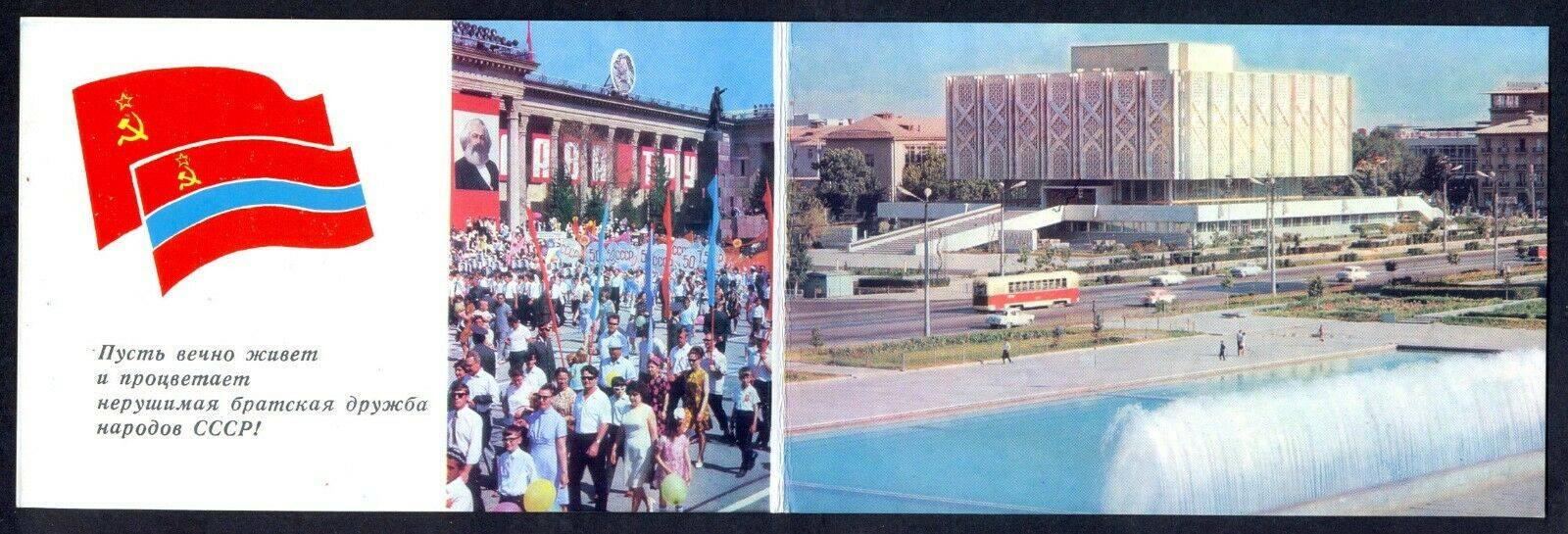
Holiday demonstration in Tashkent. Postcard from 1971-1972. Photo: Tashkent Retrospective
The rise of national self-awareness and the demand for identity was accompanied by an increase in everyday racism. By the end of the Soviet era, this problem was becoming increasingly noticeable. Residents of the national republics were moving en masse to Moscow, Leningrad, and other privileged cities of the RSFSR in search of work or education.
"Merchants and laborers, students and professionals ideologically linked their ability to succeed in the heart of the USSR with the principle of equality of citizens; and only a few believed that it was precisely inequality that motivated their striving to succeed," writes Canadian historian Jeff Sahadeo in his book 'Voices from the Soviet Peripheries'.
The researcher asks: were Soviet megacities territories of privileged native Russian residents — "whites" — or did they truly remain open to everyone, regardless of origin.
Migrants from non-Slavic Soviet republics "sincerely believed that a state indifferent to skin color would provide means of mobility—both social and geographical—and freedom to choose a profession, if not for themselves, then at least for their children."
Reality, however, turned out to be different:
Migrants [from Soviet national republics] noticed manifestations of racism, expressed in disrespectful attitudes toward newcomers, in sidelong glances, condescending speech, or humiliation—up to acts of violence, although all these attacks could not compare with the cruelty in Western cities toward local black people.
The imbalance accumulated, and during perestroika, the system of interethnic relations cracked. It turned out that, in addition to the "Russian vs. non-Russian" dichotomy, there were many hidden problems and long-standing conflicts within the union republics. In many of them, the movement to secede from the USSR was gaining strength.
Military conflicts in Transnistria, Karabakh, Georgia, and Ukraine during the post-Soviet thirty years have shown: the Soviet idea of friendship of peoples collapsed along with the Soviet state itself.
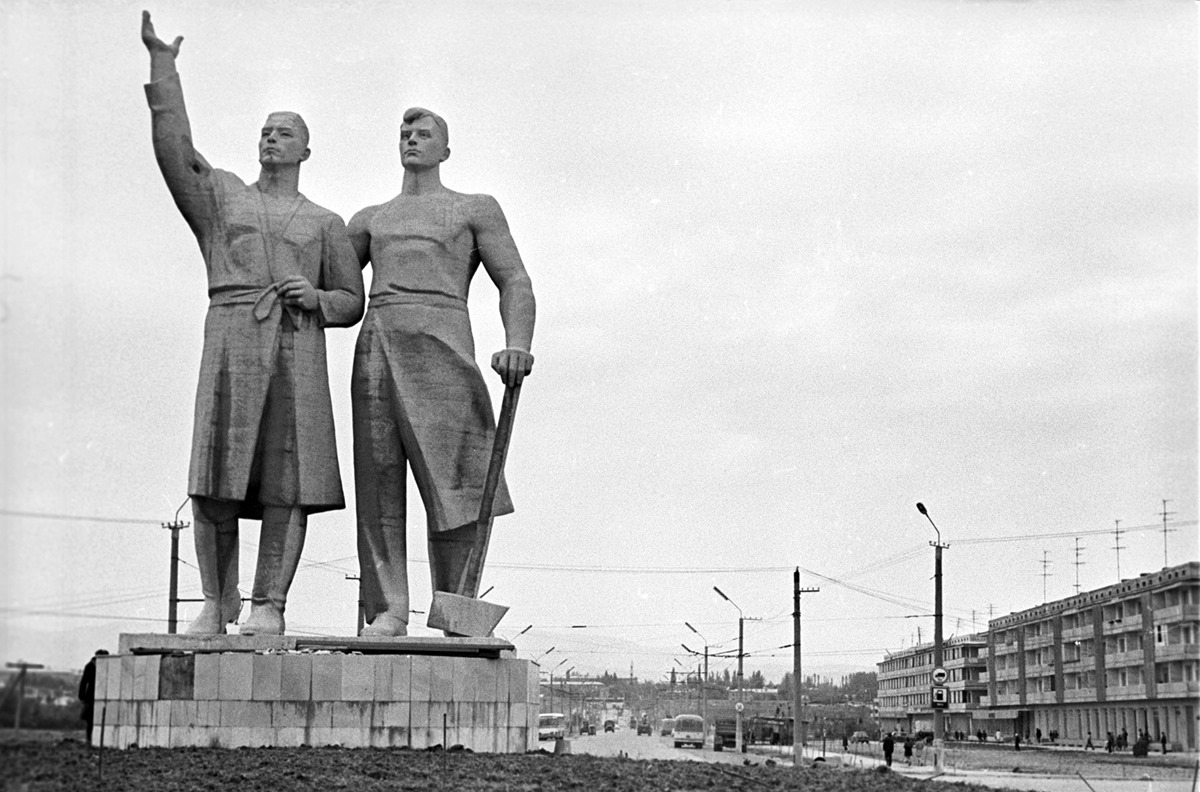
Monument "Chemist and Metallurgist" (1978) in the city of Almalyk, Tashkent region. Currently lost. Photo: Tashkent Retrospective
A Celebration Without Memory
Despite the central position of this concept in Soviet ideology, there was no official holiday of friendship of peoples in the USSR. There were streets, squares, concert halls, the Order of Friendship of Peoples, Peoples' Friendship University — but there was no specific date.
The modern International Day of Friendship, celebrated annually on July 30, was established by the UN General Assembly in 2011. The initiative was spearheaded by UNESCO, based on the Declaration and Programme of Action on a Culture of Peace, implemented during the International Decade for a Culture of Peace and Non-Violence (2001–2010).
Uzbekistan is the only country in the post-Soviet space where this date has received official recognition. The law establishing the new holiday—the Day of Peoples' Friendship—was adopted on February 10, 2021. Although its name inadvertently evokes the Soviet past, the holiday itself represents more of an attempt by Uzbekistan to follow in the wake of international cultural diplomacy aimed at combating xenophobia and strengthening intercultural dialogue.
In Kazakhstan, the equivalent became the Day of Unity of the People, established in 1996 to replace May Day. It also appeals to ideas of harmony and friendship, but within the logic of a nation-state. In Russia, Tajikistan, and other former USSR countries, International Friendship Day does not have official status but is sometimes celebrated at the public or private level.


