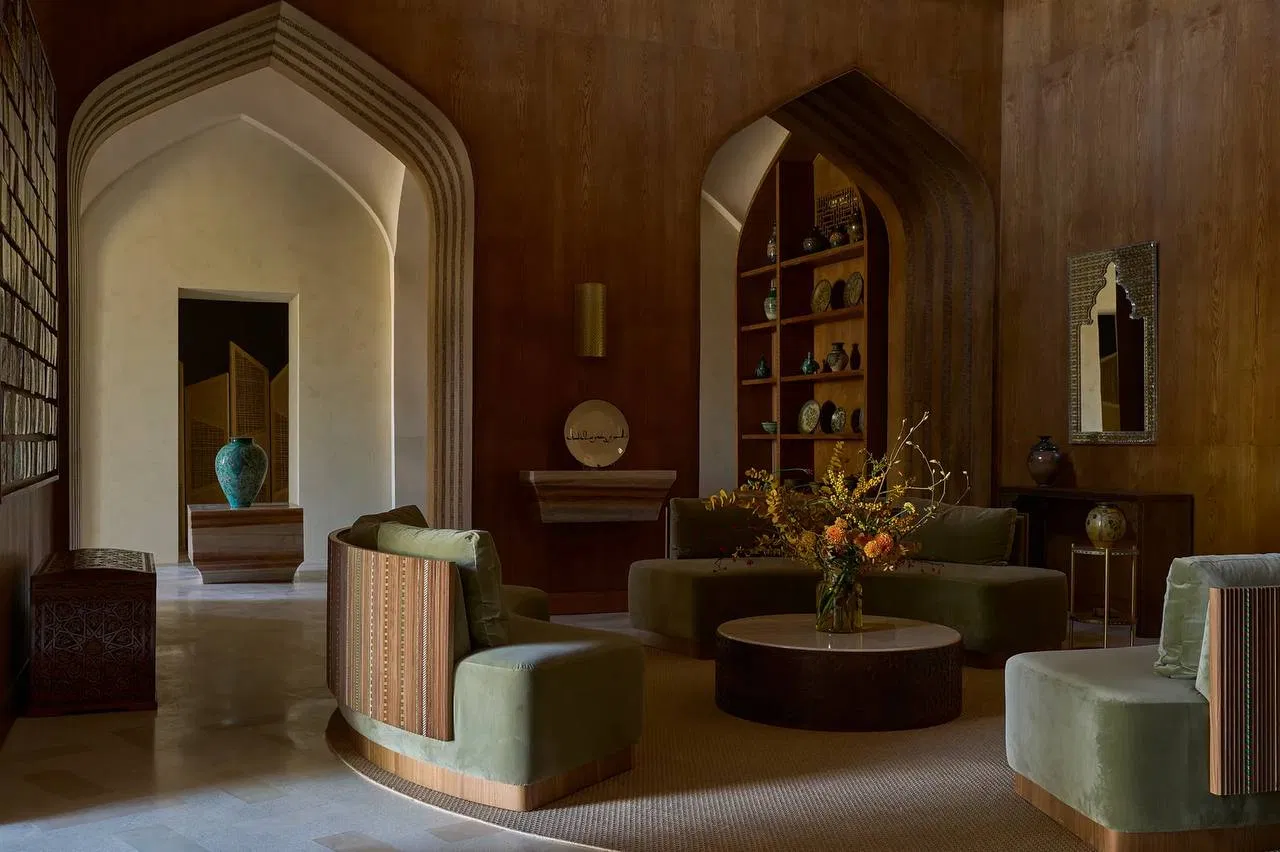
The historic mosque building, constructed by local craftsmen in 1775, has been restored with the preservation of its core architectural forms and proportions. At the same time, the interior and exhibition spaces have acquired a contemporary artistic expression that creates a dialogue between past and present.
Preserving heritage through craftsmanship and contemporary design
The concept of GOZAR of ARTISANS is based on the principle of respectful interaction with the historical environment. Traditional craft techniques, ranging from ganch carving to ceramics, mosaics, and artistic woodwork, are integrated into the space as full-fledged elements of a contemporary design language.
The exhibition features works by artisans from various regions of Uzbekistan:
- ceramics from Rishtan, Gijduvan, Samarkand, Khorezm, and Tashkent;
- suzani and Bukhara embroidery;
- Khiva wood carving and Samarkand stone carving;
- metalworks and jewelry.
Special attention is drawn to the artistic installations: a ceramic composition by Sirojiddin Rahmatullaev, wooden panels by Dilshod Isroilov, a metal installation by Jurabek Siddikov, and a ganch ceiling composition by Abdullatif Sultanov. The interior is complemented by specially designed furniture pieces by Nada Debs.
The project was initiated by the Art and Culture Development Foundation of Uzbekistan (ACDF) with the participation of Lebanese designer Nada Debs. The space is located on the grounds of the restored 18th-century Okhun Gozar Mosque and is set to become a new point of attraction for artisans, artists, and art enthusiasts from across the region.
As the organizers note, the project goes beyond an exhibition function. Adjacent to the GOZAR of ARTISANS space is the Naqsh School of Crafts, established in collaboration with the King’s Foundation School of Traditional Arts. This allows for the creation of a comprehensive cultural cluster that brings together education, craft practice, and contemporary creativity. In the future, regular master classes will be held here, aimed at preserving and passing on traditional craft knowledge to new generations.
“This space continues the tradition of Tashkent’s craft quarter, historically known as a center of blacksmithing and artistic mastery, restoring its cultural function in a contemporary format,” representatives of the foundation note.
Gayané Umerova, Chairperson of the Art and Culture Development Foundation of Uzbekistan, added that GOZAR of ARTISANS reflects the foundation’s belief that craftsmanship is not only a form of skill, but also an important source of knowledge and cultural memory, capable of inspiring new creative exploration.