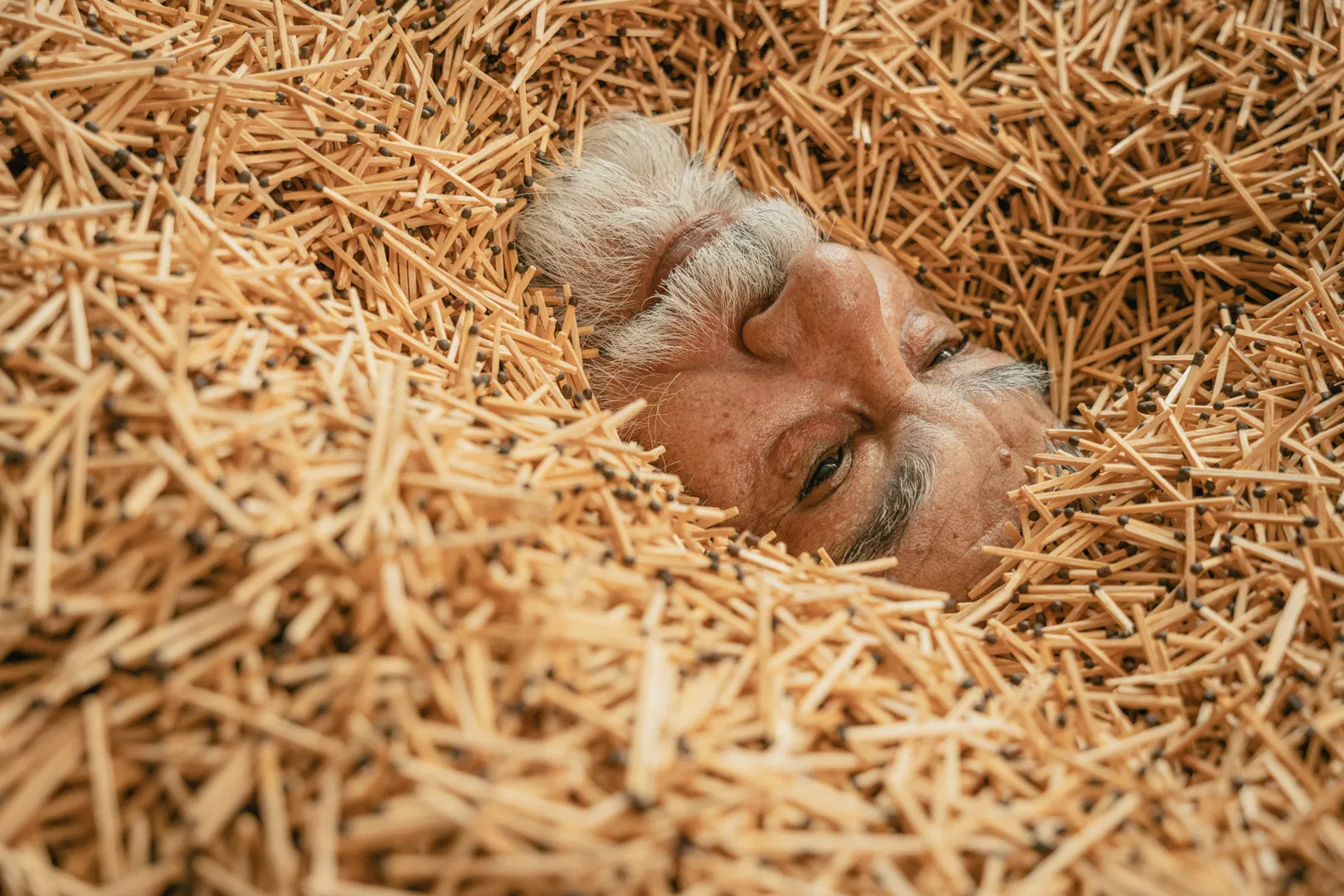
Name from the military collective and diapers made from footcloths
This is a strange story. I was given the name Vyacheslav by... a collective. Not my mom, not my dad, but a collective. A military one. My father was serving at the time as a private artist in a construction battalion. And when I was born, my first swaddling clothes were... made from brand-new flannel footwraps.
Dad wanted to name me Raphael. After Raphael Sanzio, the great Italian painter. Mom says: "No. What, is he going to be Rafik or something? That's just... well, what kind of Rafik would he be?" Because they simply shortened Raphael to Rafik.
Then the military intervened—soldiers, officers. They said: "No, no, that won't do. We need something more substantial." And at the meeting, it was decided to name me after the Minister of Foreign Affairs, Molotov.
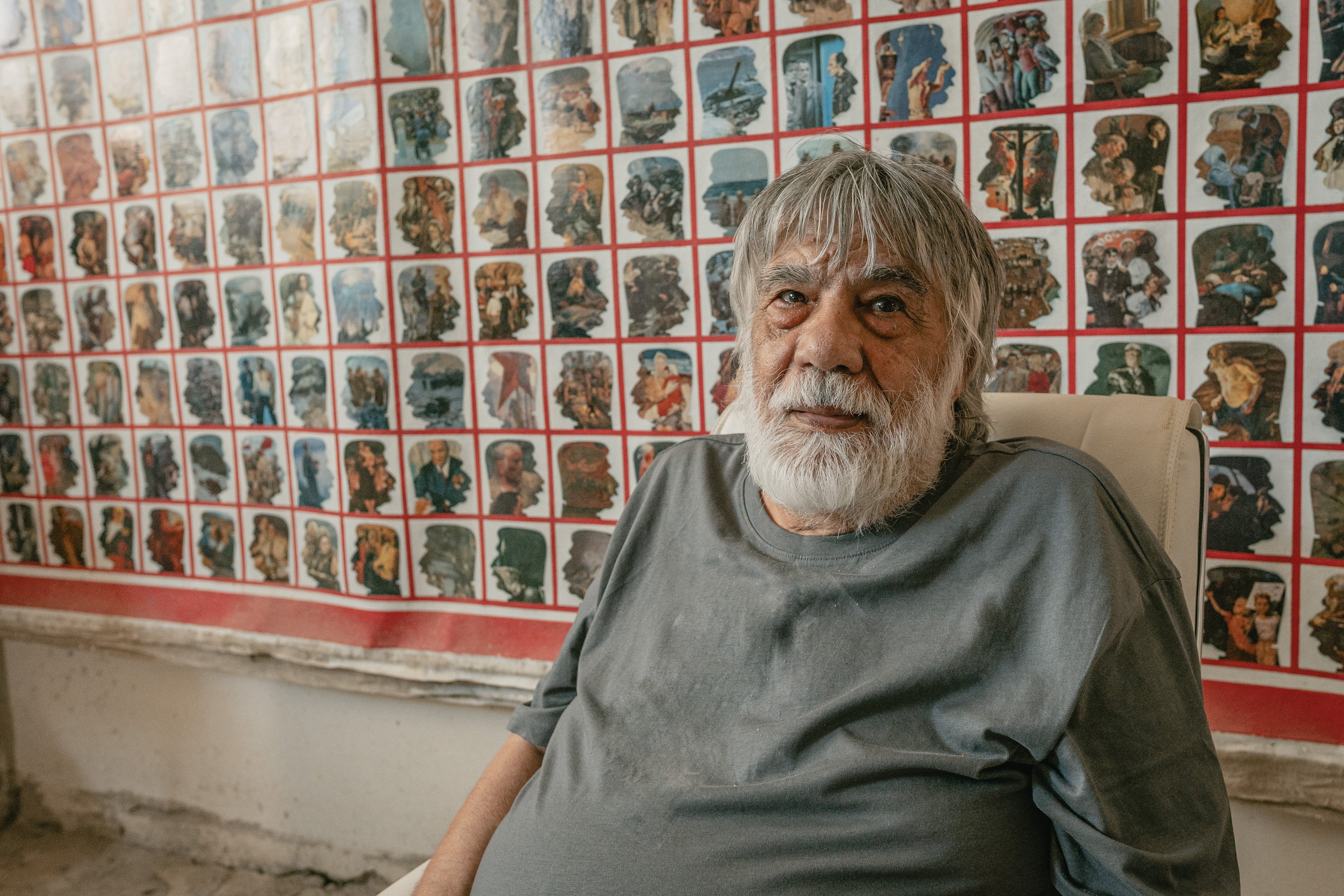
Photo: Katerina Kuznetsova
Three Scents of Childhood
For a long time, childhood smelled like kindergarten to me because my mom worked there as a teacher. And how it's all connected to mom. With that very kindergarten. With the smells of the children's groups. The smell of cod liver oil: we were lined up, brought a terrible mixture—and a spoonful in the mouth. We gagged, we felt sick.
But our kindergarten also had a splendid garden with fruit trees in bloom. Those scents…
And there's another one - a special smell - the smell of a cemetery. There was a cemetery next to the kindergarten. After the war, in the fifties, three or four war veterans were buried every day. Car after car. Always a brass band, in front - medals and orders on pillows. A truck with an open side, moving slowly, women in black headscarves on it, wailing. A war veteran lies in the coffin, and a yellow nose sticks out of the coffin. And we, little kids, would hang on the fence and watch this every day.
At some point, we even started pretending to bury each other. And those smells—thuja, juniper. There were no fir trees in Central Asia—wreaths were made from juniper. And that smell haunted me for a long time. I still can't eat tandyr-kebab here and I can't drink gin—it's the smell of a cemetery to me.
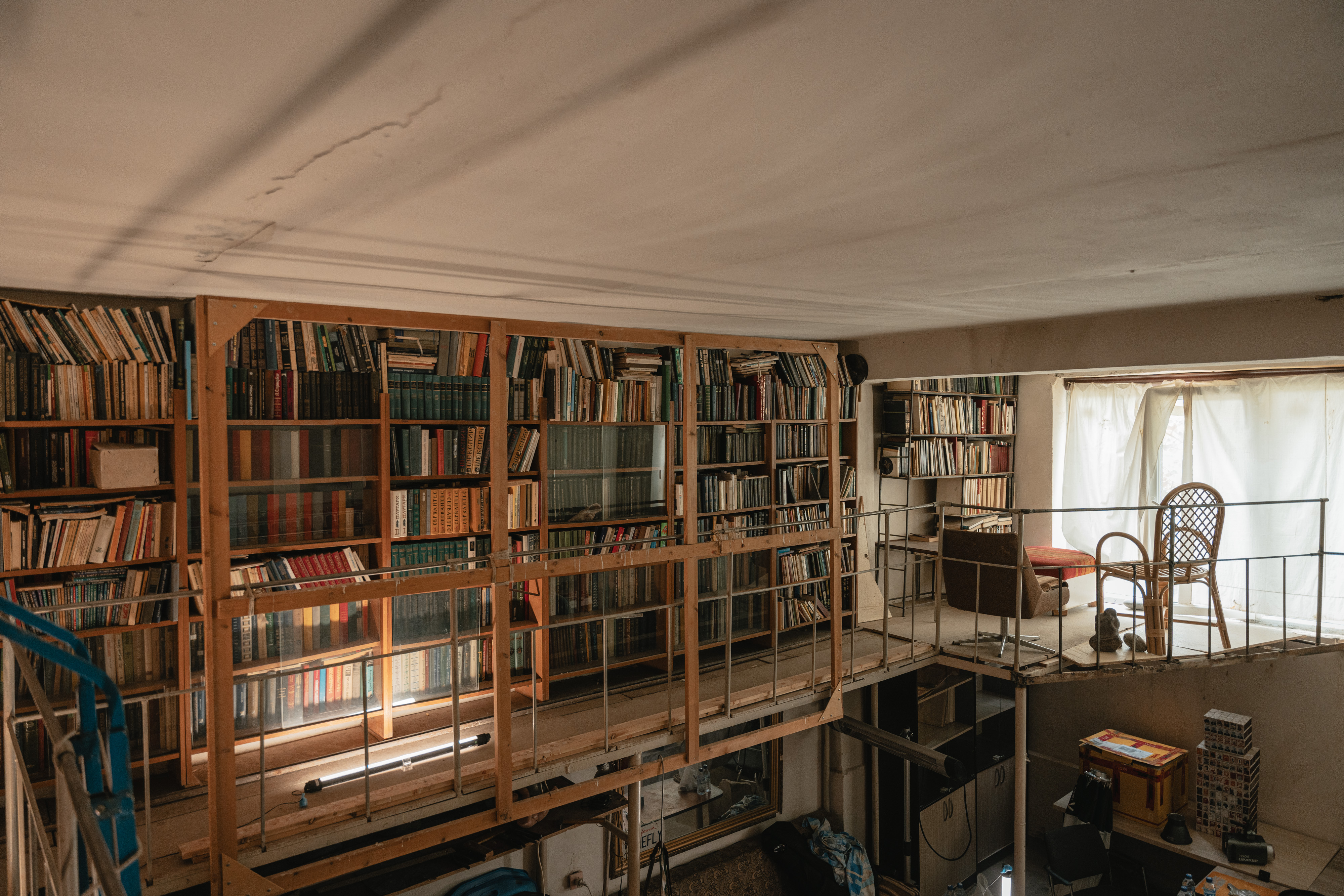
Photo: Katerina Kuznetsova
Shoemaker in a booth and night watchman: dreams of solitude
Since childhood, I dreamed of first becoming a shoemaker. I liked it: he sits in his little booth in winter. It's cold outside, but in his booth it smells of glue, leather. Your parents send you to get shoes repaired—and you come, and there's one spot for customers. You sit, he has a kettle on a hot plate, it's warm. And those smells. And most importantly—he is alone. No team. I liked that so much—being alone.
And then, as I grew older, I wanted to become a night watchman. Also alone—you sit in a little booth like that, a transistor radio there, you look through the windows, snow is falling, slush. And it was something obsessive—to be alone, without a collective. I understood later why. Because father also goes to the workshop—he is alone. Alone. He comes when he wants. No political information sessions, nothing.
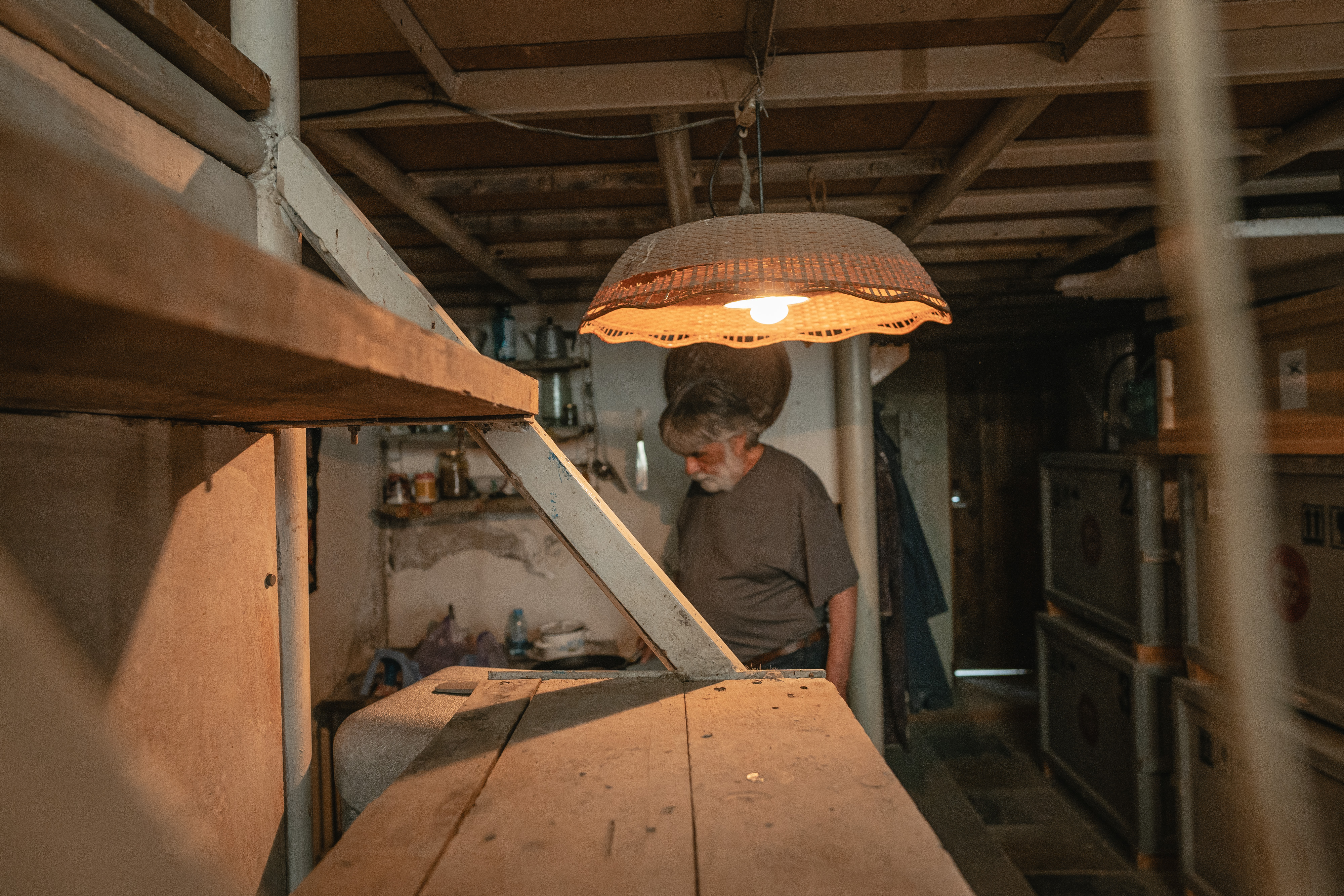
Photo: Katerina Kuznetsova
Emptiness is that from which things are born
Generally, I think that loneliness is the lot of artists. Not all, probably. There are, for example, groups of artists who gather together. "Blue Noses" — Slava Mizin, Sasha Shaburov, some people join them, some leave. There were the Kukryniksy, who worked as a trio, painted together. And there are people who need solitude.
I think conceptualism loves solitude. It loves reflection. I feel uncomfortable when there are many artists around—at meetings, openings, large exhibitions. All of that causes anxiety. That's not the right state. But in solitude, you are focused. It becomes not loneliness for you, but another form of emptiness.
Everyone thinks that emptiness is just emptiness. But if you look at it from a Taoist perspective, it's not like that at all. Emptiness is what gives birth to things. Things, ideas come precisely from it. Ancient Chinese teachings say: everything is born from nothing.
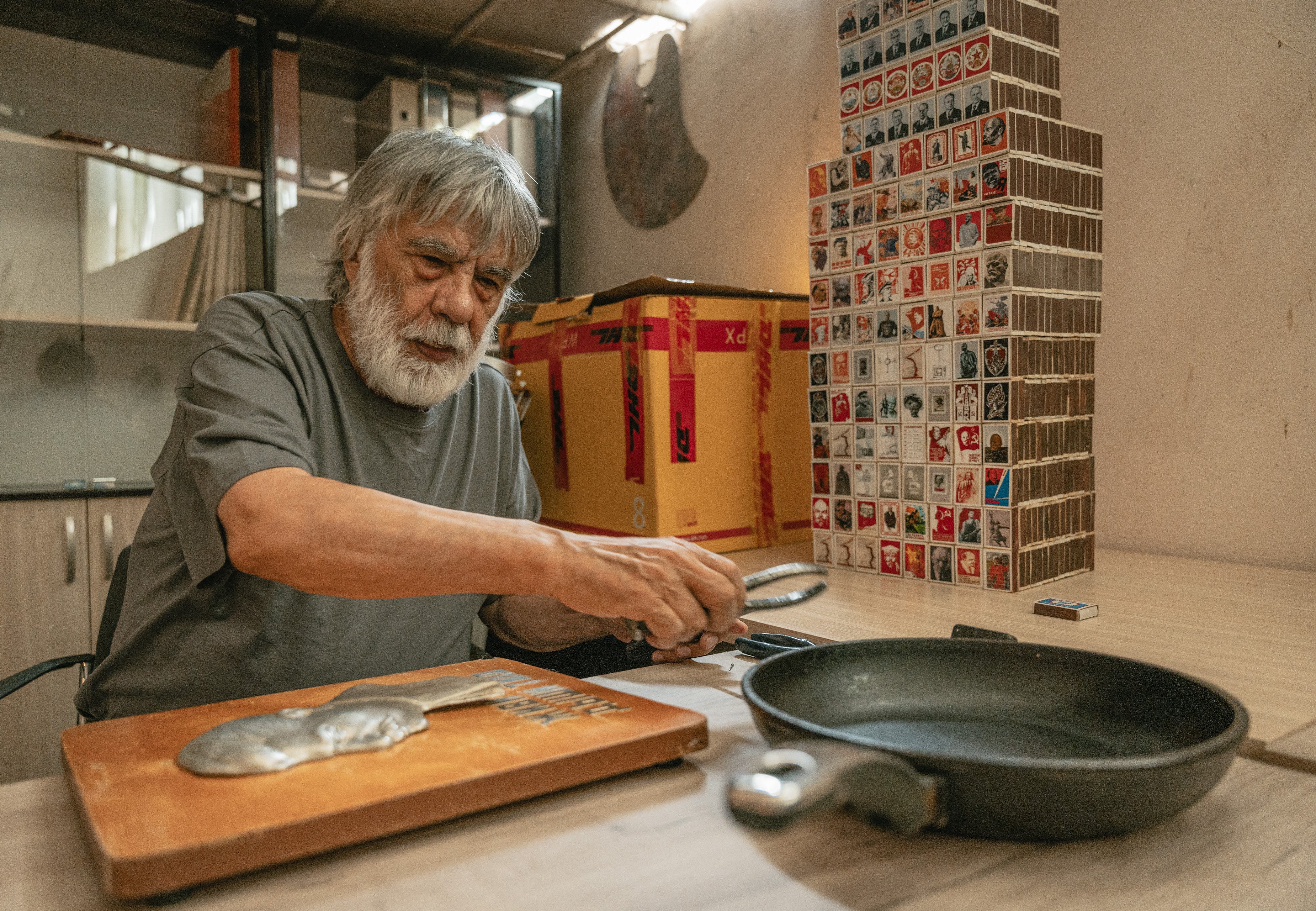
Photo: Katerina Kuznetsova
A dreamer who caught London on the radio receiver
As a child, I was calm. Very calm. And kind of... well, introverted. Too much of a dreamer. I didn't like exact sciences. I liked history, literature. And I liked to dream. I was a bit of a dreamer, just going about. What I dreamed about—I don't even remember now, but about something.
And I really enjoyed tuning the radio, catching waves. It was written: Moscow, London, different cities. I thought: if I point it to London, I'll hear London. To Paris, I'll hear Paris. Well, of course, it was just a design like that.
But one day I heard amazing music. It struck me so deeply... I memorized where on the scale the notch was, where you had to tune. And in the evenings, while my parents were in the other room, I would find that station to hear it again. It turned out to be an English station from the island of Ceylon. And that music was jazz.
Three reactions to Stalin's death: tears, swearing, and the executed prosthesis
I remember that March very well. A gloomy day. And suddenly - sirens. Throughout the entire city. Not just military ones, but factory whistles too. It was the news: Stalin had died. My mother, a teacher in a white apron, and the cleaning ladies in mouse-colored robes came out - and began to sob uncontrollably.
I, a little one, felt freedom: I could break away, run off. I always searched for last year's nuts under the trees. And there, near one hazel tree, stood a drunk man. Limping, from the front, it seemed. He was urinating on the tree and muttering: "That bitch died... that bitch died."
I couldn't make sense of it all. And then the shots rang out. Through the clay fence, in one of the holes, I saw the father of a boy from my kindergarten group. He was lying in the mud. The weather was bad, March. His leg—a wooden prosthesis—was hanging on an apricot tree. He was shooting at it with a double-barreled shotgun. Oakum was flying out of the leg. And then he shot at his medals and orders. He was screaming, cursing. For him, everything was the end of the world. Stalin died—life was over. A terrible, terrible scene.
I ran to my mom in horror. When a child tells their mother: "a foot on a tree" — it sounds like surrealism. But I led her there. And it all turned out to be true. She covered my eyes and led me away.
Here are three reactions to Stalin's death. My mother is crying. The man by the hazel tree is cursing. And my friend's father shoots his prosthetic leg and his medals. And yet, he had waited a long time for that prosthetic. I remember how he and my father celebrated it in a restaurant—the new, crisp prosthetic leg.
That day stayed with me forever. If it weren't for the horns, the crying, the foot on the tree—maybe I wouldn't have remembered.
Photo: Katerina Kuznetsova
Performance by the father, the KGB, and the belated tie
I remember the Pioneer initiation. It was a joyful day, I remembered it for my whole life. In the spring, they didn't accept me. I was supposed to be accepted in the spring — in the fourth grade, I think. But they didn't accept me. Everyone was accepted, except me. I was offended, upset. How could this be — am I some kind of an outsider?
And all because my father decided to put on a performance. Well, back then it wasn't called a "performance" — it was just... My dad was looking at magazines — "Ogonyok," newspapers — and there was a photo of American workers. They were standing there in such raincoats, in Borsalino hats, begging for alms. And the caption: "This is capitalism! See how they live!" These were typical pictures for Soviet propaganda magazines.
And dad asked photographer Yakov Sutkevich to take a photo of him in the center of the city of Osh — he put on a Chinese cloak, a Borsalino hat, stood there, and also seemed to be begging for alms.
But someone saw it. Maybe from the KGB. They took my father. And the interrogations began: "Why? What are you depicting? Are you saying life is bad for you? Are you begging for alms? Are you lacking something? What are you trying to disgrace? We have no beggars in our country. The Soviet Union is not a nation of beggars!"
Well, basically, they tortured my father for three days and then let him go. Because he was able — the only one in southern Kyrgyzstan at that time — to draw Stalin, Lenin, the leaders.
And I was accepted into the Pioneers later, along with the outsiders—the underachievers and such. It was autumn, cold. Near the Lenin monument, they tied our neckerchiefs on and congratulated us.
I remember walking along, feeling so joyful. I thought: everyone is looking at me. Here he is, the boy - he's been accepted into the Pioneers. It was as if I had been awarded a medal.
And I come to a sort of "T-junction": there was a "Detsky Mir" (Children's World) store, a nail salon opposite, everything for ladies—we called it "Mom's World," and next to it was the "Pamir" restaurant, which we decoded as "Dad's World."
And, of course, my dad and his friends were standing outside the restaurant "Pamir": that photographer Sutkevich and others. I walked up: "Dad, I've been accepted into the Pioneers." And they picked me up and took me into this restaurant. They sat me down, put my schoolbag on the chair so I could sit higher at the table. In short, their drinking began, and I sat there—like the birthday boy. And if it weren't for that restaurant, I would never have remembered that day.
Photo: Katerina Kuznetsova
Poisoning by creativity in Amankutan
Once - it was during my musical career - I used to play in a restaurant in the evenings, and my father came. He came to the restaurant, called me over to his table, and said: "Tomorrow I'm going with friends on motorcycles through Central Asia. Do you want to come?" I said: "Yes, of course."
I left my guitar with the guys and left with my father the next day. They, the artists, were painting, and I wandered and wandered, looking at these landscapes. And then I took a brush and started to paint. And I created some very surprising work. I even remember the place — Amankutan, a village on the pass between Samarkand and Shakhrisabz. It was a success. And suddenly I was amazed that I could actually do something.
That's when I felt—yes, I felt that I was poisoned. Poisoned by creativity. I wanted to repeat it again, and again, and again. To write, to write. That is what poisoning is—in a good sense. To be poisoned—it can be something like Pavel, when he was walking and suddenly... He was skinning people, killing there—and suddenly, bam!—faith came to him. Exactly like that. It's the same kind of blow you receive when suddenly something works out for you.
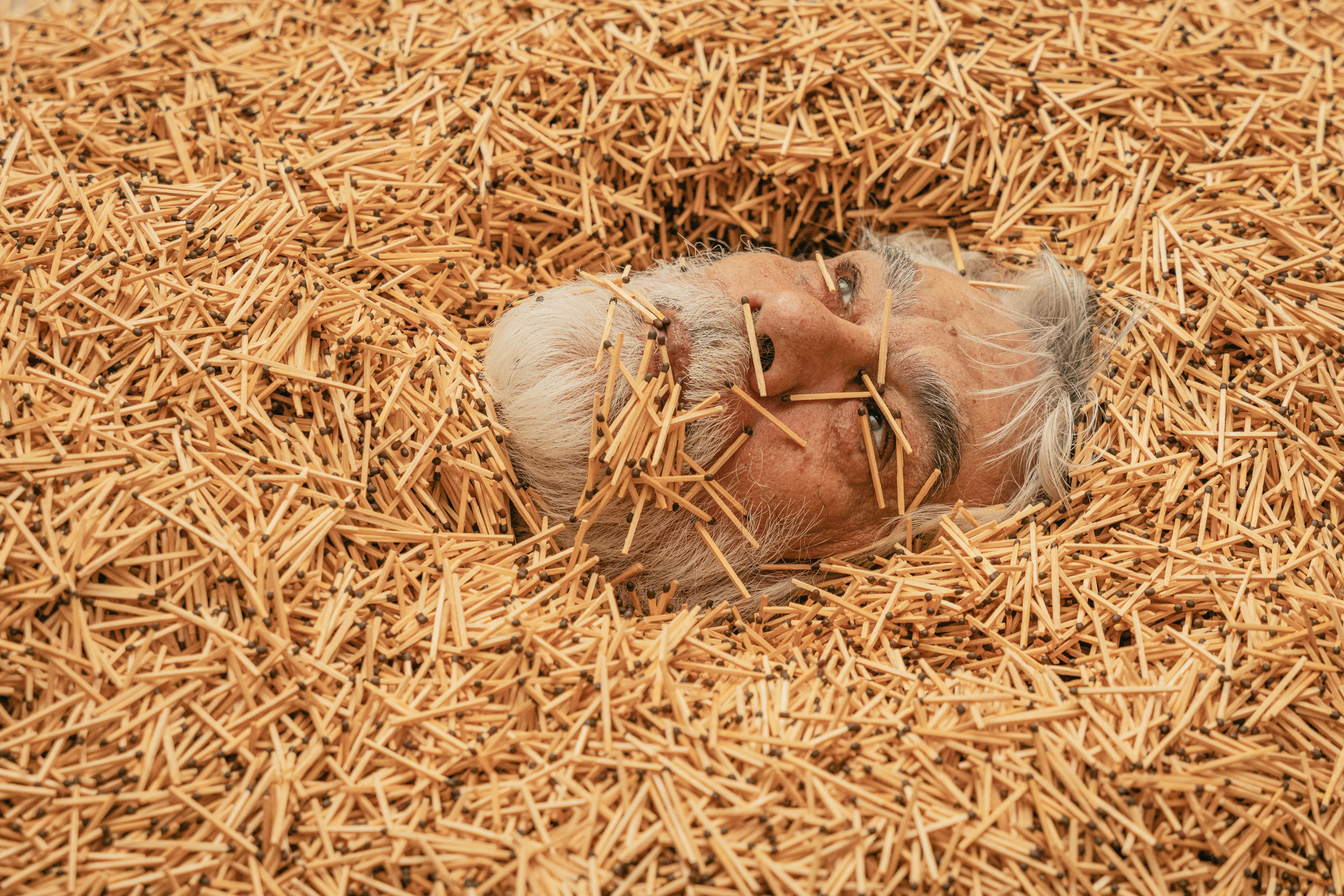
Photo: Ekaterina Kuznetsova
Next to Chuikov: the youngest artist of the republic
Then we returned from that trip—it was in the spring. And by autumn, I had already painted a larger work, using tempera. And this work was accepted for the republican exhibition "Earth and People." It took place in Frunze—now it's Bishkek.
My work was hung in the museum where the exhibition was taking place, next to the work of Chuyikov Semyon Afanasyevich. He was one of the founders of painting in Uzbekistan, born in Pishpek—that's Frunze before it was renamed. Him—as the oldest artist, and me—as the youngest. That's how the exhibition organizers hung it.
And then a laudatory review came out in the newspaper. I carried that newspaper with me until I lost it. But I wasn't at the opening—my father was, he also had works in the exhibition. And Lydia Ilyina approached him—a graphic artist, People's Artist of the USSR, very famous. And she said: "Your son must study."
After some time — a month, perhaps — my father took me to Bishkek, brought me to the school, and says: 'Go on. You already took the exams back in '62, then you ran away, and now — get reinstated.' So they accepted me straight into the third year. A year later I graduated and then enrolled in the Surikov Institute in Moscow.