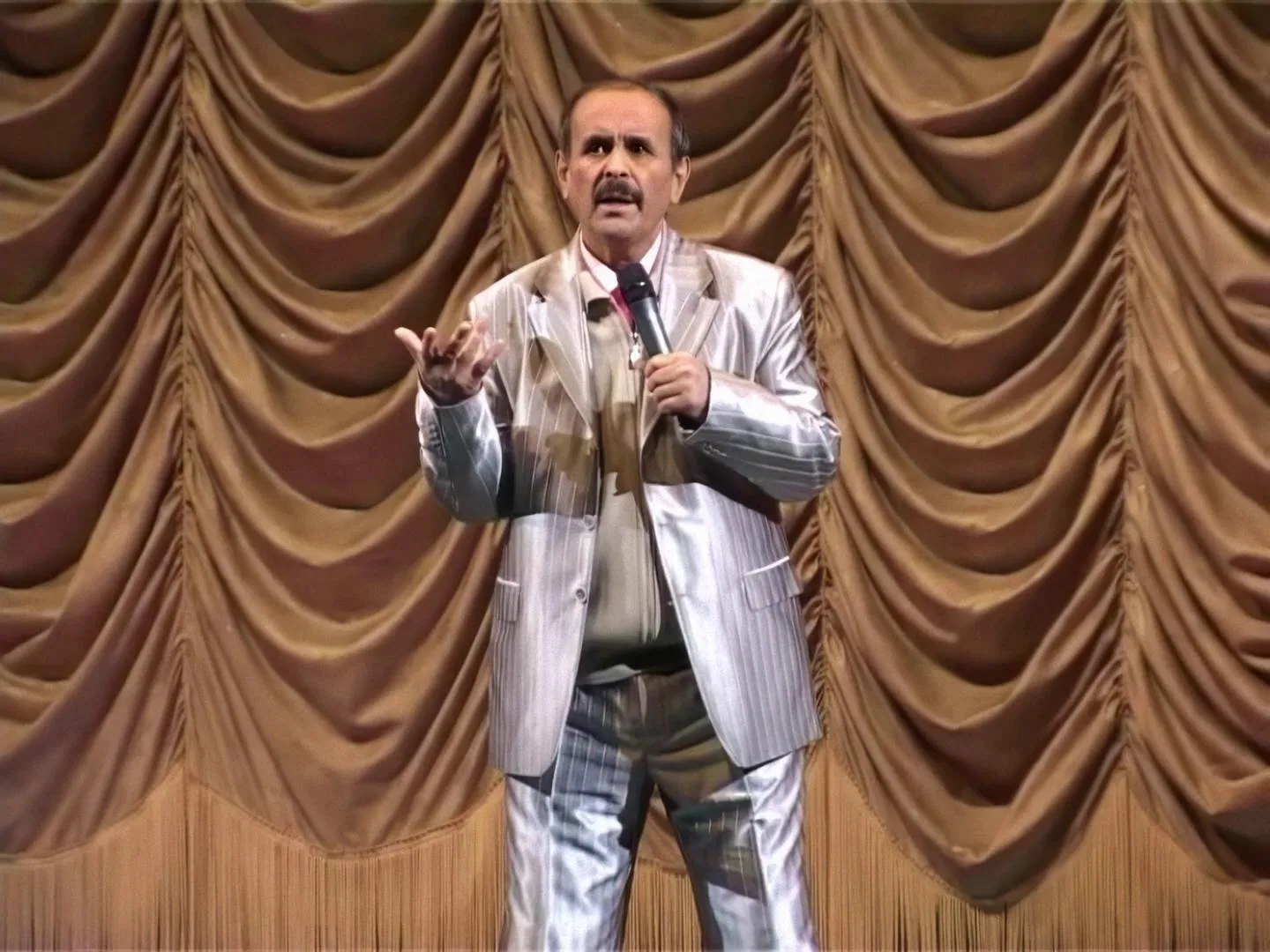
Yusufjon qiziq Shakarjanov
Shakarjanov is regarded as the founder of askīya as a stage art in Uzbekistan. His humour revolved around intricate wordplay, often embedding up to four meanings in a single phrase. Unlike the straightforward roasting typical of much comedy, his style relied on subtle puns and layered subtext. In this sense, all subsequent Uzbek comedians can be seen as his heirs.
Khozhiboy Tozhiboyev
Tozhboyev performed in the one-man theater genre. His humor drawn from funny sides of everyday life, observations of people and their foibles,
offers what can be called a precise portrait of a person in a recognizable situations. Critics noted that his performances provided “food for thought,” which was rare in the Uzbek humor industry at the time. Many of his phrases became part of the vernacular.
Many of his phrases entered everyday speech as proverbs.
Many of his phrases entered the vernacular as popular sayings.
His humour was equally popular in Uzbekistan and Tajikistan, as it did not require translation, thanks to its universal nature.
Mamasiddiq Sherayev
One of the few professional askiyachi (askiya performers), Shiraev specialised in live, unscripted verbal duels.
The key to his humor was skilled, audience-gripping improvisation. His comedy demanded engagement from the listener, as missing the subtext could mean missing half the joke.
Khotamjon Khakimjonov
Khakimjonov’s humour has become so deeply ingrained in the national consciousness that his appeal extends far beyond the capital. In the regions, at weddings and in everyday social settings, where humour thrives outside theaters or stand-up clubs, his jokes about neighbours, family, the bazaar, and everyday absurdities always find a receptive audience. market life, and the everyday absurdities of daily life always found a receptive audience.
Mirzabek Kholmetov
Kholmetov’s humour relies on transforming into recognizable characters from everyday life, capturing their unique mannerisms, voices, and, naturally, opinions. Few in Uzbekistan who appreciate humor forget the iconic trio of Kholmetov, Valijon Shamsiev, and Shukurullo Isroilov. If you’re planning to take a nostalgic trip back to your childhood this evening, revisiting his performances is an absolute must.
Shukurullo Isroilov
During a brief period in 2003–2005, he even managed to tour the United States, performing for the Uzbek diaspora – a fact which speaks to the scale of his recognition.
A comic performer with professional theatrical training, Isroilov took to the stage as early as 1982 at the Soviet Variety Arts School. His humor thrived on sketches and daring transformations. Between 2003 and 2005, he even toured the United States, performing for the Uzbek diaspora, which itself speaks to the scale of his recognition.
Valizhon Shamshiyev
Actor, comedian, and director, Shamsiev’s humour relies
largely on character transformations. Each performance brings a new persona, complete with a unique voice and personality. In his book Kulib yashayman (I Live Laughing ), he emphasises that for him humor is not just a profession but a way of life. Together with Mirzabek Kholmetov and Shukurullo Isroilov, he formed the comedy trio that remains a beloved memory for many Uzbeks from their childhood.
Obid Asomov
Asomov often joked about Uzbeks struggling with Russian and the humorous situations that arose from it. He famously remarked, “Mocking someone is a poor form of humour.” That is why his comedy resonated with audiences both in Tashkent and in Moscow; he never humiliated or mocked anyone, but simply portrayed people without insulting them. His cassettes were widely sold in bazaars across the country.
He also translated and adapted monologues by Arkady Raikin and Mikhail Zhvanetsky for Uzbek audiences. At the Krivoe Zerkalo theatre, he explored cultural contrasts, often a la “Eastern guest in an unfamiliar setting.” Ironically, in 2009, Uzbekistan’s television banned him; that very paradox where the nation’s most gentle and humane comedian was deemed “offensive.”
Avaz Okhun
A comedian skilled in live audience interaction, Okhun focuses on everyday life in his humor. In 2020, he performed a concert without an audience in support of quarantine measures, showing that he views humor not just as entertainment but as a form of social support. He continues to sell out stadium shows, with humor accessible to a broad audience far beyond urban stand-up clubs.
Million Jamoasi (Million Team)
A sketch troupe that focuses on everyday absurdities, presenting situations familiar to everyone. Their humor requires no context
– you see it, you recognise it, you laugh. This approach earned them 25 million views from a single performance.
In 2014, their license was revoked over jokes with sexual undertones, which in itself shows that they were
pushing boundaries of traditional Uzbek humor. However, after a political change, they became officially supported.
Bravo Group
Performing sketch shows for broad audiences, Bravo focuses on light, entertaining humor rather than satire. Their shows take place in large venues like “Druzhba Narodov,” offering viewers relaxation and laughter without deeper subtext or the need for interpretation.
Dizayn
Originating from collaboration with Bravo and Million, Dizayn now works independently. Their sketches revolve around daily life, occupying the same niche as Bravo: light, mass-appeal entertainment.
Mirshakar Fayzulloyev
Fayzulloev combines satire with analysis, dissecting society and the state while still delivering simple jokes and sharp humor. He adapts his humor to different audiences, ensuring that anyone attending a SAHNA or other large stand-up platform has something to laugh at and reflect upon. He was among the first to perform stand-up in Uzbek bars, often giving his solo shows playful titles like Borim Shu and Malades.
Ozod Shukrulloev
One of the country’s first Uzbek-language stand-up comedians, he travelled to Moscow with Fayzulloev to perform in bars in order, in his own words, to find out just how unfunny he could actually be. He now performs in both Russian and Uzbek.
Indira Mifrakhova
The first female stand-up comedian in Uzbekistan, Miftakhova was also the first to give a solo show in Uzbek. Her material focuses largely on societal mentality, women constrained by tradition, and personal stories. She uses comedy to address pressing issues and support women young women restricted in work or social life . During school, Indira chose comedy over a teaching career. She has also performed for the Uzbek diaspora in the United States.
Pavel Kim
The first Uzbek comedian to openly state that stand-up exists in Uzbekistan only in Tashkent, Kim draws humor from his Korean heritage. He jokes about stereotypes of Koreans in Uzbekistan and embraces self-irony. In interviews, he emphasizes that every Uzbek comedian lives with internal censorship: jokes about religion or specific people are off-limits, and this is understood by everyone without further explanation. Yet, he does not shy away from sharp humour, and every audience member who has attended his performances is sure to leave smiling.