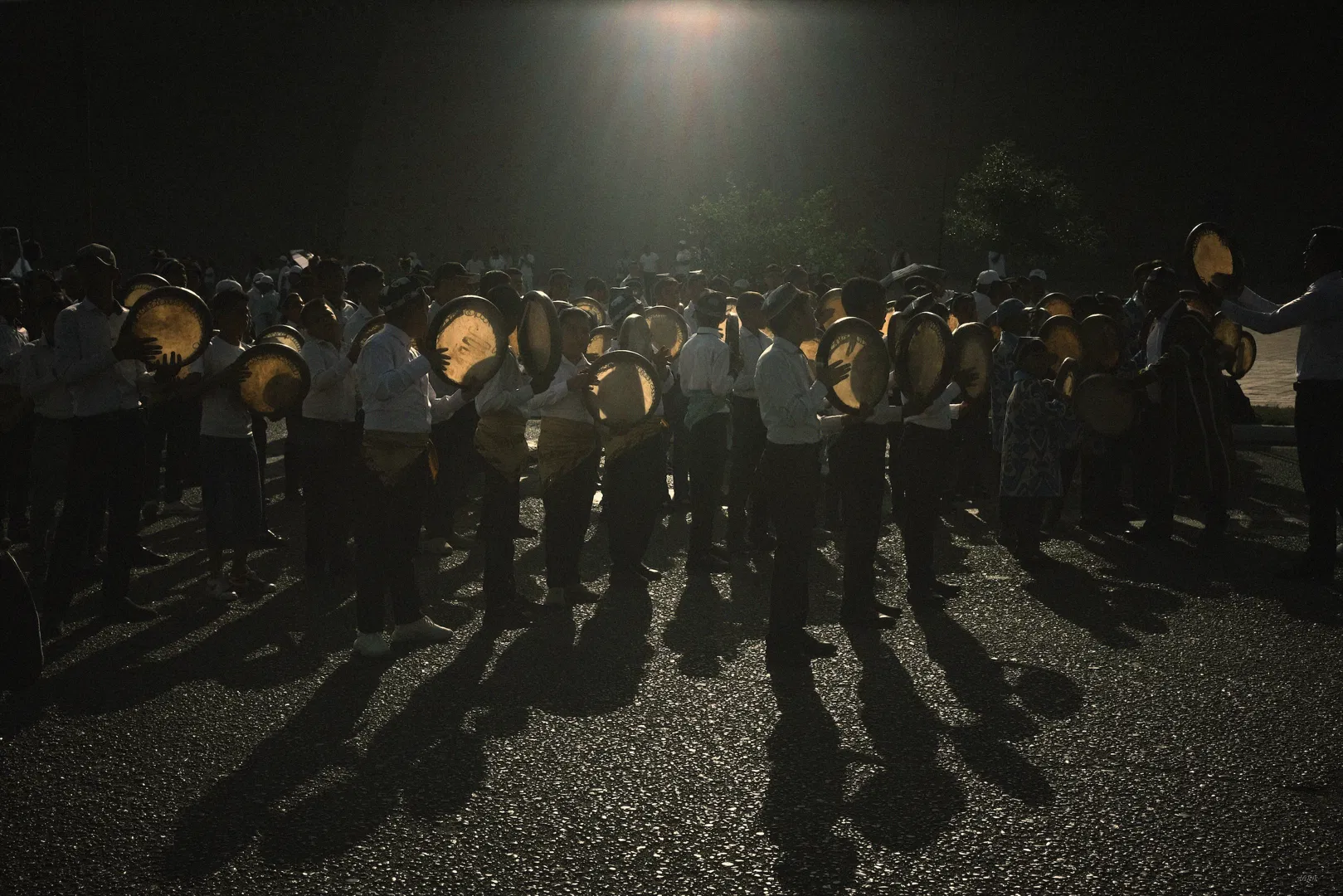
Most listeners expect “Eastern music” to be either something soft and lyrical, like Tajik romances, or something simple and immediately accessible, like pentatonic melodies that require little effort and quickly fade into the background. Uzbek classical music does not align with these expectations. In reality, it differs radically from both the Tajik romance tradition and pentatonic systems, and indeed from what most people are prepared to call “pleasant” music.
When Uzbek classical music comes up in conversation, I am often asked what I find in it and why I turn to it at all, given that my primary musical background is in rock. The question is usually asked with a degree of puzzlement, and sometimes even with barely concealed irritation.
Uzbek classical music is often automatically grouped with the Arab modal tradition, folded into that familiar image of “Eastern music” associated with deserts, caravans, camels, a drawn-out melody over a steady rhythm, and an exotic colouring. This image is so strong that, for the unprepared listener, anything that falls outside tempered tuning and the major–minor system merges into one undifferentiated “East.” falls outside equal temperament and the major-minor system merges into a single, generalised “East”. Yet this is precisely where the distinction becomes fundamental. Arab modal systems, for all their subtlety and richness, often rely on relatively stable intonational formulas and a pronounced ornamental character that is easily read as exotic. They may sound unfamiliar, but they rarely provoke the sharp irritation or, conversely, the deep internal dissolution that Uzbek classical music can produce.
The Uzbek maqom tradition is organised differently. It contains none of this imagined “journey through the desert”, no illustrative quality, no external colouring. It does not paint a picture or accompany an imagined landscape. Instead, it works with inner time, with tension and release, with the gradual and highly precise unfolding of form. Attempts to hear it as “Arab music” lead to the same result as trying to hear it as a romance or a pentatonic melody: the ear searches for a familiar pattern and fails to find it. As a result, the music may seem strange and irritating or, if some point of alignment is reached, it exerts an unexpectedly powerful effect, not as exoticism but as a direct emotional and intonational impact.
This difference manifests not only as misunderstanding but as outright rejection. The situation is familiar: Uzbek classical music is switched on in a car, and within seconds, sometimes almost immediately, comes the sharp and emotional response: “Turn it off.” This reaction does not come only from outsiders. It is often voiced by Uzbeks themselves, people born and raised in Uzbekistan. The music does not simply fail to appeal. It irritates. It presses, unsettles, creates a sense that something in the sound is out of place. This matters, because irritation is a deeper response than mere lack of taste or habit.
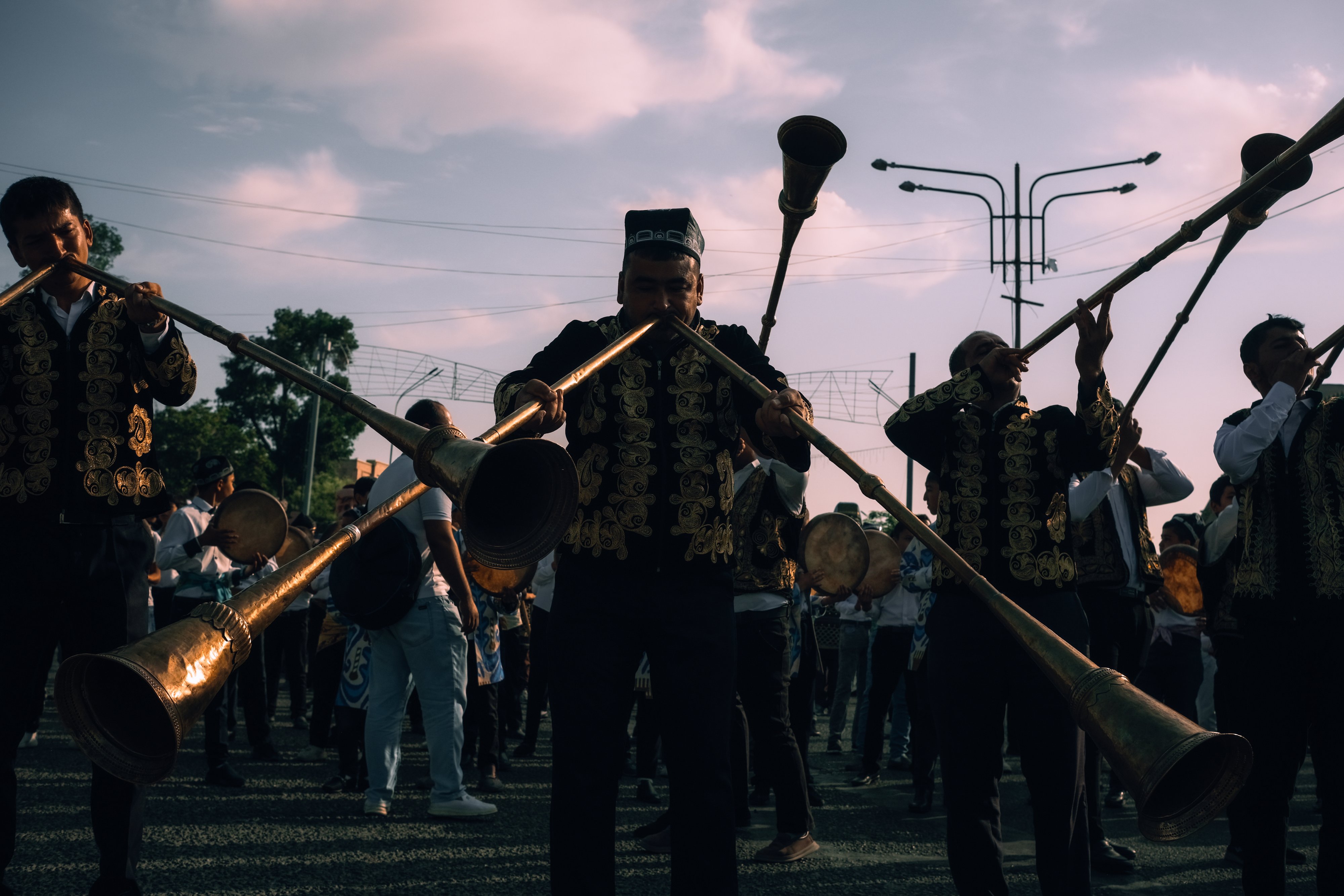 Photo: Ildar Sadykov
The reason lies not in complexity as such, nor in any notion of "high culture". Tajik romance can be equally complex, yet it rarely irritates: its intonation is closer to the European ear, its melodic logic is intelligible, and its emotional code is easy to read. Pentatonic music almost never provokes resistance, because it fits readily into familiar listening patterns. Uzbek classical music, by contrast, disrupts those patterns at every level simultaneously: pitch, intonation, timbre, rhythm and the very sense of time. An ear shaped by equal temperament and harmonic thinking hears not music but a constant unsettling of expectation. The reaction is therefore not intellectual but physical. One simply wants to turn it off.
And yet there exists an entirely opposite reaction, no less intense and no less genuine. Where some feel an almost physical need to stop the music, others are affected so deeply that, in their own words, they simply "melt". I have seen this many times: outwardly tough, restrained men suddenly fall silent, look away, and their eyes fill with tears. This is not performative emotion or cultural pose. It is a response to something hitting its mark, to an alignment between a person's inner state and the way the music unfolds its intonation, time and tension.
This contrast is crucial. It shows that Uzbek classical music is not simply “difficult” or “unpleasant”. It polarises. It either fails to enter at all or enters at once, and deeply. For those whose ear, through environment, experience, or inner readiness, can accept untempered sound, living micro-intonation, and the slow unfolding of form, the music ceases to seem strange. It begins to act directly, bypassing rational explanation. In such moments, analysis falls away entirely. There is no thought of tuning, form or style. There is only the music, where every shift in intonation and every pause feels exact and necessary.
That is why the same works can provoke diametrically opposed reactions, from irritation to an almost dissolving, bodily experience. It is not a question of cultural belonging or education. I have seen Uzbek classical music leave indifferent those who grew up within the culture, while profoundly moving those with no formal connection to it whatsoever. What matters is not knowledge, but the ear's ability to relinquish control and allow the music to move in its own time, without demanding immediate explanation.
In this sense, the phrase "it either irritates or moves one to tears" is not a metaphor. It is a precise description of how this music works. It does not seek a middle ground, nor does it try to please everyone. It demands alignment, rare but powerful. When that alignment occurs, the effect is so strong that words become unnecessary.
Where, then, does the ability come from not only to listen to this music but to reproduce its most complex classical melodies accurately, not fragmentarily or by intuition, but with a full sense of form, with a proper opening, development, climax, and resolution? For many, this seems puzzling, especially when the person is not a professional performer within the tradition. The source lies not in genre or formal schooling. Like many of my generation, I grew up in an environment where music was never background. Renowned musicians came to our home not for praise but for precise listening. My mother could hear where a form was incomplete, where an intonation had lost its meaning, where a climax had failed, or where development had stopped too soon, and she could articulate it in a way that made performers understand exactly what needed to change.
Such an environment does not foster attachment to any particular style so much as it develops an ear for musical structure. From an early age, music is heard as something unfolding: where it is going, why it pauses, where tension gathers and where it must ease. This makes it possible to engage with both a multi-part rock composition and an Uzbek maqom on equal terms. The real distinction lies not between genres, but in the depth of listening and the ability to grasp form.
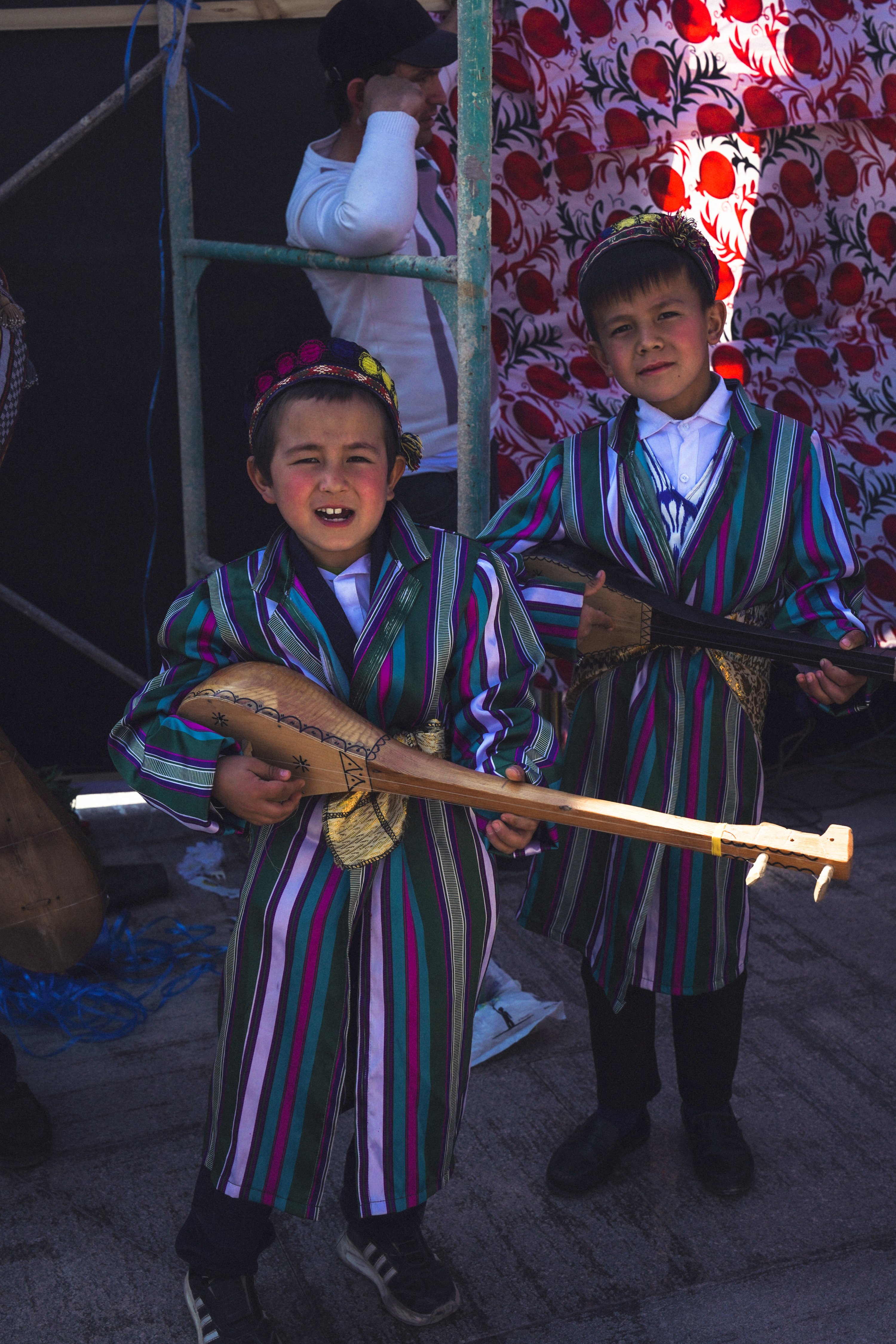 Photo: Ildar Sadykov
From this perspective, Uzbek classical music proves especially demanding. It is not intended as background listening, does not aim for ease, and makes no effort to please immediately. It requires an ear capable of accepting untempered sound, living micro-intonation and the extended unfolding of form. As long as it is approached with expectations of a “pleasant melody” or a “recognisable pattern”, it will almost inevitably provoke irritation and rejection, up to that sharp "turn it off." Everything worth saying begins here, with the recognition that the issue lies not in the music but in a mismatch of listening frameworks.
***
Uzbek classical music is perceived as a distinct musical world not because it uses "different notes" in a primitive sense, but because it employs a different way of organizing pitch, time, and meaning. Its foundation is maqam-based modality, where the key element is not European tonality with its familiar harmony and modulations, but a modal-intonational logic: stable tones, pivotal sounds, typical melodic patterns, rules of intonational "movement," and the gradual unfolding of modal space. Here, pitch is not a fixed cell on a grid of 12 equal steps, but a flexible zone dependent on context: the same "nominal" sound can be rendered slightly differently depending on the direction of the melody, the pivotal tone, the register, and the style of performance. Hence, the primary acoustic principle: the natural, "living" sound in such traditions relies on non-tempered tuning and microtonal inflection. Equal temperament, familiar to us from the piano, is physically always a compromise: it simplifies and "spreads out" the natural frequency ratios for the sake of a keyboard instrument's universality and harmonic freedom, but the price paid is the loss of some acoustic purity in intervals and some subtle intonational meanings. In maqam music, this "price" often appears as the destruction of expressiveness itself: what the European ear calls "hitting the note" does not always align with what the tradition considers precise and beautiful.
Another fundamental characteristic is the timbral ideal. Uzbek classical music is largely timbre-centric: what matters is not only pitch but also how the sound lives within itself—overtones, coloration, "grain," vibrato, glissando, attack, the method of sustaining a long tone, the relationship between voice and instrument. In the European academic tradition, timbre often serves harmony and form; here, timbre itself becomes a carrier of meaning, and therefore instruments and voice are perceived as "speaking," not merely "singing." Rhythm and time are also structured differently: alongside sections of free, breath-like phrasing, there exist stable cyclic rhythmic formulas (what in Eastern traditions are described as *usuls*, roughly translatable as techniques)—not a simple "one-two-three-four" meter, but more complex patterns where the sense of time is built on cycles and internal articulation. Consequently, form develops not as in the symphonic logic of "theme—contrast—harmonic drama," but as a gradual unfolding of melodic-intonational space: a slow "entering," an accumulation of tension through intonation and rhythm, an opening of register and timbre, transitions between sections as a shift in state, not as a change of key in the European sense.
This music is effectively inaccessible to many—both Russians and Tatars, and even to many Uzbeks; moreover, it is often not merely "disliked" but actively irritating. This is usually not a matter of "poor taste," but of musical socialization: the ear is trained from childhood, and the brain becomes accustomed to certain expectations—what constitutes "in tune" and "out of tune," where the "proper resolution" lies, how a phrase should move, what constitutes "meaning" (harmony, rhythmic drive, verse-chorus structure, virtuosity, etc.). When a person with a tempered standard and harmony-centric habit hears the micro-intonation of a maqam and its long melodic unfolding, the recognition system perceives the signals as "almost familiar" (after all, there is a melody, there are modal anchors, there are repetitions), but constantly receives violations of expectations: "the intervals seem off," "there is no familiar harmonic support," "the vocal manner is unfamiliar," "time feels stretched," "the development doesn't resemble a song or a symphony." In such conflict, the brain often reacts defensively—not with indifference, but with rejection: "this is wrong." And here, the inaccessibility becomes particularly evident even within the country: if previously the ear was reproduced through a living environment and master-to-student transmission, through family listening and a context of use, in modern times this chain is often broken. The music remains as a concert-based "museum" genre without an everyday function, and musical education for the majority reinforces a different standard (piano, European intonation, the tempered norm). In this position, the maqam becomes not a "native language," but a "foreign" one, and without regular listening practice, it does not open up. Therefore, the musical world of Uzbek classical music appears closed not due to elitism or "snobbery," but due to untranslatability: it cannot be truly explained in words to those whose ears are not attuned; it requires time, entry through familiar anchors (timbre, short fragments, comprehensible rhythmic cycles), gradual acclimatization to intonational zones, and only then—to the long form. Most people are not prepared to pay with attention and effort, and society rarely offers a gentle, intelligent "entry level" without vulgarization. Hence the result: the tradition remains highly valuable for those inside, and almost closed to those outside—even if they were born right next to it.
It is also important to understand that non-tempered sound is not at all an exotic phenomenon limited to "Eastern traditions" or folk music. On the contrary, it is precisely to this that the greatest performers instinctively gravitate, even within European and popular music, when they seek to achieve maximum expressiveness and emotional depth. The human voice is inherently non-tempered, and any major vocalist possessing intonational freedom inevitably steps beyond the bounds of the equal-tempered grid. Freddie Mercury is one of the most vivid examples: his vocals are constantly filled with microtonal pitch shifts, "scooping" into notes, and stretched intervals, especially in sustained notes and climaxes. These sounds are not "precise" in the piano sense, but that is precisely why they are so powerful and so pleasing to the ear: they align with the natural acoustics of the voice and the overtone series, not with a mathematical grid. The same can be said of many outstanding opera singers and jazz vocalists—from bel canto to blues and soul—where expressiveness is directly linked to deviation from the tempered norm.
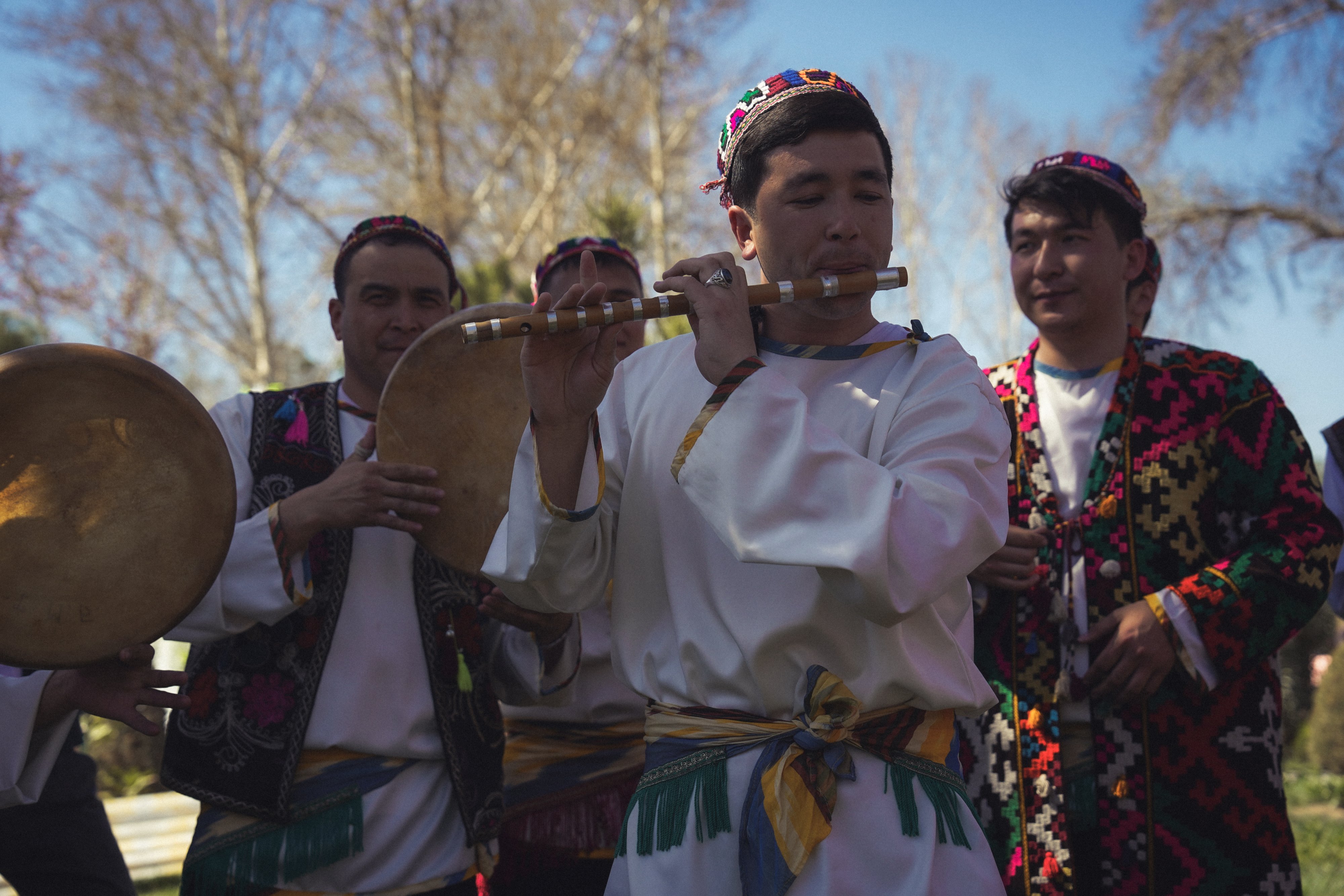 Photo: Ildar Sadykov
The violin serves as an almost perfect example here: a fretless instrument, entirely subject to the ear and hand of the performer, it almost never plays in strict equal temperament within a live ensemble. The violinist constantly adjusts pitch based on harmonic context, register, dynamics, and even the hall's acoustics, and this is precisely why a well-played violin sounds "warmer" and "more alive" than a piano, even if it is formally playing the same notes. The electric guitar is another illustrative case: techniques like bending, string pulls, vibrato, and the "crying" notes in blues and rock are essentially a conscious departure from equal temperament. These micro-variations in pitch are not perceived as out-of-tune; on the contrary—they create a sense of expressive truth, tension, and emotional breath. Fretless bass guitars and double basses demonstrate the same principle: in the hands of a good musician, they "breathe intonationally," subtly tuning the sound to the harmony and ensemble, and this is exactly what distinguishes a living, rich performance from one that is mechanically precise but lifeless.
In this sense, Uzbek classical music turns out to be not something "alien" or "archaic," but, on the contrary, music that consistently and fundamentally relies on what in European and popular tradition appears fragmentarily, intuitively, and most often in the work of genius performers. Where the maqam system makes microtonal inflection the norm and foundation of the language, European music permits it only as an exception—in vocals, in string instruments, in jazz, in rock, in blues. Therefore, an ear capable of hearing the beauty of non-tempered sound in Mercury, in a good violin, or in a sustained electric guitar note, theoretically already holds the key to understanding Uzbek classical music. The problem is merely that this key is rarely used consciously: the listener is accustomed to considering such intonations as "ornamentation," not as the foundation of the language. In maqam, everything is the opposite—here, precisely the living, non-tempered intonation is the language itself, not an ornament. And as long as this distinction remains unacknowledged, the musical world of the Uzbek classical tradition will remain closed not because it is inaccessible, but because people try to approach it with the wrong auditory tool.
Read also
 Music and Audio Art
My Own Shiva: Kyrgyz Metalcore with an Indian Soul
Inna Kolpakidi
 Music and Audio Art
Kyrgyz Metal Sharing the Stage with Guns N’ Roses: An Interview with the Vocalist of My Own Shiva
Cyrill Grishin
 Music and Audio Art
80 People and One Bluetooth Speaker: The Story of “Kuda Propalo Solnce?”
Darya Zabrodina
Newsletter
A letter from the HD editors
Once a week, we send the best stories, events, and cultural discoveries from Central Asia.