
The application of classical postcolonial theory to the former Soviet republics does not always explain all Soviet realities. Firstly, it is not entirely clear where the boundaries of its applicability lie, which territories can be considered colonies and which — cannot. Secondly, there is a rather influential postulate by Alexander Etkind, according to which Russia, throughout its history, has engaged in the colonization of both itself and a conditional Other — notably, this Other could be either a "non-native," or a Russian peasant.
To understand these contradictions, we turned to the renowned anthropologist and historian Sergey Abashin. With the author's permission, we are publishing an abridged version of his essay "Soviet = Colonial (Pros and Cons)," which was written in 2016. You can read the full text of the essay here.
[...] The ambivalent attitude towards the Soviet as colonial is largely explained by the fact that the question of the imperial nature of the USSR was and remains an element of politics. From the very beginning of the Soviet state's existence, its external and internal opponents/critics used references to coloniality as a tool of struggle and delegitimization of the regime. This rhetoric intensified especially in the 1970s and 80s, when geopolitical opponents, having formally gotten rid of their own colonies, increasingly turned their attention to the Soviet peripheries, including the "Muslim regions." In turn, within the USSR itself, the most diverse efforts were made to prove the non-colonial and even anti-colonial nature of the country and society. This theme was popular in the 1920s and early 1930s, when it was important for the authorities to draw a distinction between the pre-Soviet as colonial and the Soviet as anti-colonial. There was also a surge in the 1950s, when, on the wave of the disintegration of world empires, anti-colonial rhetoric became a tool for acquiring new allies in the "Cold War."
After the collapse of the USSR, this debate, oddly enough, did not subside but continued. The Russian authorities, who essentially initiated the liquidation of the Soviet system themselves, nevertheless decided to build their legitimacy not on the idea of a "new state," but on the idea of continuity from both the USSR and the Russian Empire. On the other hand, external critics of the post-Soviet Russian regime used the old labels of "empire" and "colonialism" to politicize real or perceived divisions within Russian society and divisions between Russia and its former sister republics. And although the USSR has disappeared, and present-day Russia has nothing in common with it in its ideology, the theme of Sovietness remains strongly politically and emotionally charged.
[…] Reducing the discussion of the Soviet as colonial exclusively to a political and geopolitical explanation would be incorrect, however. This would greatly oversimplify the situation. There is also the state of historiography, which has its own specific features. The collapse of the USSR led to the idea of a certain distinctiveness of the Soviet experience being shaken, and the arguments proving this seemingly once indisputable fact were devalued. Scholars studying Soviet history—both foreign and Russian—attempted to incorporate it into the global historical context, and this normalization of Sovietness often carried not so much a critical as a sympathetic undertone. In doing so, the closest analogues to the USSR turned out to be the great European empires—it became very convenient to draw parallels between them.
Moreover, the collapse of the country coincided with a period of criticism of various hegemonies and the flourishing of, for example, postcolonial studies, which inevitably flowed into the post-Soviet space as "new" and "fashionable" ideas.
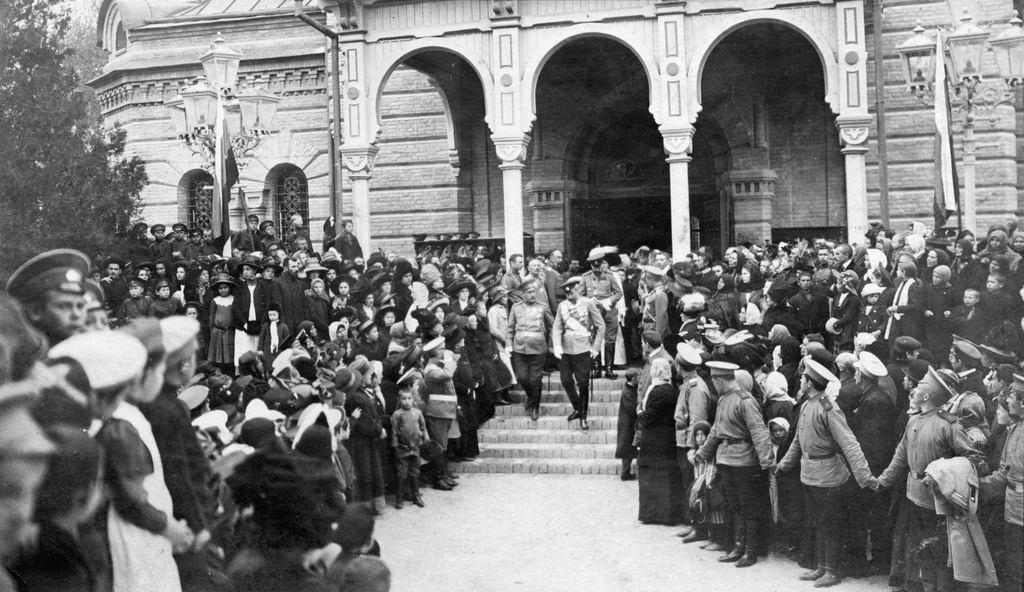
Visit of Grand Duke Konstantin Konstantinovich to Tashkent, 1911. Photo: Tashkent Retrospective
If we nevertheless try to distance ourselves, as much as possible, from the political background of the discussion and attempt to systematize the arguments for and against, then to what extent could the term 'colonial' be useful in a conversation about the USSR, particularly about Soviet Central Asia (here I am not including Kazakhstan to slightly simplify the reasoning)?
To avoid delving too deeply into theoretical discussions about what constitutes colonialism, let's give it the simplest and most widely accessible definition, taken from Russian and English Wikipedia: "Colonial policy is a policy of conquest and, often, exploitation by military, political, and economic means of peoples, countries, and territories predominantly with a non-native population, typically economically less developed"; "Colonialism is the establishment, exploitation, maintenance, acquisition, and expansion of a colony in one territory by a political power from another territory. It is a set of unequal relationships between the colonial power and the colony, and often between the colonists and the indigenous population." Both definitions focus on inequality between regions, with emphasis on conquest, political rights, and economic exploitation. Let's try, in a very first approximation, to test how applicable these propositions are to the USSR. In doing so, I will expand the set of features and add to them the social sphere, culture, and identity.
So, let's take a quick look at all these aspects:
Was there a conquest?
The incorporation of Central Asia into the USSR can in no way be described as peaceful. The former Turkestan Governor-Generalship endured a multi-year war, which intensified after the military defeat of the Turkestan (Kokand) Autonomy, declared by "native" parties and political leaders in 1918. In 1920, Bukhara and Khiva were essentially reconquered by military force, and in 1924 they formally lost their status as independent states and became part of the Soviet Union. Combat operations involving regular troops continued throughout the region until 1923, but the armed confrontation did not end there. The last major military clash occurred in 1931, when a detachment of rebels, having previously retreated under the pressure of the Red Army into Afghanistan, invaded the southern regions of Tajikistan and was defeated. All of this is known as the "struggle against the Basmachi movement".
The incorporation of Central Asia into the USSR can hardly be described as peaceful.
To this purely military history, one must add the repressive policies towards the local political elite, first of the imperial period, and then of the Soviet era as well. Under the pretexts of uncovering conspiracies and combating nationalism, many prominent political leaders and their close associates were removed from their positions, subjected to arrests and deportations, imprisoned, and executed. In a sense, this too can be considered a form of forcibly keeping the region under the control of Moscow—the Center.
But is everything so clear-cut? Let's try to find arguments against. The first is that the line of confrontation in this story did not run strictly along the cultural divide of "newcomers" and "natives." In all the events of that time, local residents were on both sides of the barricades. Central Asian society and its elite, like the Russian ones, were split not even into two, but into many factions, classes, parties, and groups fighting for their own interests. Many ordinary people, from various "native" strata of the intelligentsia and peasantry, fought against the "Basmachi." Many Central Asian leaders formed alliances with Soviet power, hoping to achieve their goals, integrated into the Soviet political and administrative system, and often themselves acted as those who persecuted and repressed opponents of the Soviets. Yes, many of those who entered these alliances were later overthrown themselves, but it remains a fact that at some previous stages of their biographies, these people also fought on the side of the Bolsheviks. In turn, the anti-Soviet resistance movement was far from consisting only of the local population; it also included people from Central Russia, just recall the Peasant Army, which fought against the Bolsheviks in the Fergana Valley in 1918-1920.
The second argument is that intense military actions and repressions mainly occurred during the early Soviet period. If we look at the post-Stalin period of the 1950s-1970s, we no longer see anything like that. No uprisings, attempts at armed rebellions, mass political opposition—nothing, unlike, say, British India or French Algeria. Political purges also ceased.
On the contrary, the power in the Central Asian republics was taken for entire decades by local leaders who, by agreement with Moscow-Center, received a sufficiently high degree of autonomy in resolving internal affairs, while maintaining, of course, complete loyalty to the basic Soviet principles.
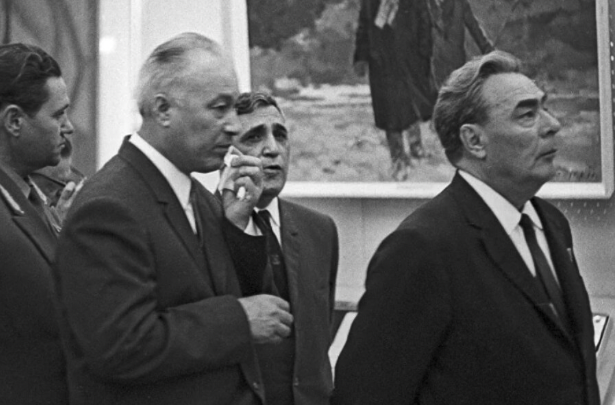
Sharof Rashidov (left) and Leonid Brezhnev (right). Photo: upl.uz
Sometimes the "cotton affair" in Uzbekistan in the mid-1980s is classified as part of the repressions, which may be partly true, as it clearly reflected Moscow-Center's desire to restore and strengthen its control over what was happening in the region. But even these events were not perceived in terms of political confrontation and political accusations, as was the case in the 1920s-1930s; and those punished were replaced by local cadres. And again, this did not have an exclusively cultural subtext, since exactly the same attempts to change the rules of the game and replace the elite were undertaken in the 1980s in Moscow itself and in Russia.
In the end, Soviet power in Central Asia fell not at all due to local anti-colonial resistance, but as a result of the Center's own decision to 'cut the peripheries loose'. This is a rather rare case in the history of empires.
Was there cultural dominance?
[…] The question of colonialism is, first and foremost, a question of how a cultural boundary is constructed in relations of subjugation. This is what is mentioned in passing in the Russian-language Wikipedia definition as the exploitation of "predominantly foreign-national populations," and in the English-language version as the inequality between "colonists" and "local populations." Without such a cultural boundary, subjugation may have a class-based, political, or some other essence, but it is not colonial at all, since there is no reason to label everything that involves inequality as colonial.
In the issue of cultural development in Soviet Central Asia, we also see a contradictory picture, as in all previous cases. I will list several points that may indicate the colonial status of the region. These include the repression of many representatives of the local intelligentsia in the 1920s-1930s.
The strongest blow was dealt to Muslim leaders, Muslim institutions, and Muslim tradition, which formed the foundation of the entire pre-Soviet culture and thought of the region.
Throughout the Soviet period, intensive Russification took place: the alphabet was first Latinized and, from the late 1930s, became Cyrillic; compulsory study of the Russian language was introduced in schools; institutional conditions were created under which any successful career and social mobility were possible only with a command of the Russian language. Along with the Russian language, many Russian (and through it, "Western") models of art, literature, science and education, as well as everyday norms, penetrated local life, influencing the development of the entire cultural "matrix" within Central Asia itself—primarily in cities, but gradually in rural areas as well.
In fact, these two issues — the diminishing importance of local, "native" languages first and foremost, and Islam second — were the most painfully perceived in the region and always existed as latent discontent. The latter occasionally erupted in various public complaints, protests, and demands by intellectuals, which occurred, in particular, already at the very end of the 1980s and in 1990-1991. This was the main field of resistance, expressed in the condemnation of "mankurtism," i.e., the voluntary or involuntary forgetting of one's "origins."
READ MORE:
But even here, despite the obvious Russification and struggle against Islam, things are not so simple. The Russian or Russian-imperial came to Central Asia often as the Soviet, i.e., filled with somewhat different, albeit utopian, meanings, and it allowed, through connection with this universal (understood as universal) Soviet, to avoid a conflictual self-identification with the Russian/Russian-imperial or a rejection of it.
The author of the term "mankurts" — Chingiz Aitmatov — was not an underground anti-Soviet rebel, but a quite respected Soviet figure, even one of the most vivid symbols of the Soviet era.
And many other local intellectuals, who quite justifiably lamented the loss of many cultural symbols and the insufficient role of "their" culture, occupied various positions in official institutions, i.e., had the opportunity to influence society and politics.
This influence was often expressed through the creation of cultural products that entered the all-Soviet cultural fund while simultaneously satisfying the need to strengthen one's own distinctiveness and selfhood. This paradox, described by the formula "national in form, socialist in content," was the compromise that allowed for some consideration of the complaints and demands of the cultural elite. Within this framework, there remained the possibility to discuss what was forbidden, what was permitted, and what was desirable at a given moment, and bargaining over these points constituted—not only in the republics but also in Russia—the cultural process itself. Something similar occurred with the Spiritual Administration of Muslims of Central Asia and Kazakhstan, established in 1943-44, which became a form of legalizing Islam and religiosity.
Within these compromises and negotiations in Central Asia during the Soviet era, numerous cultural (in the broad sense, including science, education, sports, cinema, etc.) images and artifacts were created, and of the most outstanding quality, which received public and official recognition in the republics themselves and in the USSR, and partly in the world. Remaining Soviet, they also belonged to the local society, were accepted by it as "their own," and not as externally imposed colonial standards, even if such standards can be detected in them upon external examination.
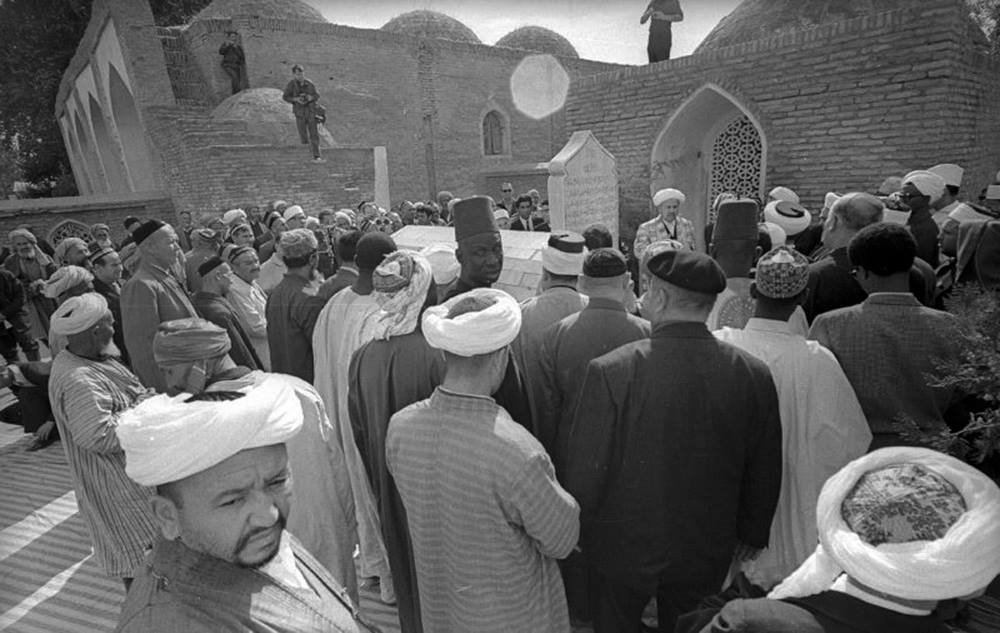
Participants of the International Muslim Conference in Samarkand, 1970. Photo: Multimedia Art Museum (Moscow)
What identity?
The question of identification, i.e., the self-determination of people and the formation of their identity, continues the theme of culture and cultural boundaries as the most obvious signs of coloniality. The thesis has already been mentioned above that local residents had formally equal rights with other citizens of the USSR, but at the same time, various forms of mutual alienation existed.
Various forms of Orientalization of the Central Asian republics also took place, their exoticization as "other/Eastern/Asian/junior" even within the "fraternal peoples," with all the accompanying set of stereotypes and phobias about "underdevelopment," "patriarchality," and "feudal remnants," "lack of genuine culture," "lack of hygiene," etc.
In Russia and other regions of the USSR, there was a very weak understanding of how citizens of this distant region actually lived, and high-ranking officials could easily confuse different republics with each other, such as Uzbekistan with Tajikistan.
At the household level, there existed xenophobic and even racist divisions into "us/them" in the form of offensive nicknames, everyday conflicts, and strict rules against mixing—for example, in marriage.
Undeniable evidence of mutual alienation can be gathered in vast quantities, which is often done today by those who call the Soviet era colonial. However, there are also quite a few facts pointing to the opposite. Along with Orientalization and exoticization, there was a consistent and active implementation/cultivation of a pan-Soviet universalism, in which cultural and phenotypic differences, at least in the public sphere, were pushed to the background and even leveled out.
One striking example of this duality/ambiguity are national identities that were not merely incorporated into Sovietness and imbued with Soviet symbols, but were even constructed with the direct involvement of the Soviet state as its constituent elements. Xenophobia and racism were officially persecuted and not elevated to the norm, seen as deviations from it; colonialism was criticized—though as someone else's problem. In everyday life, between representatives of different cultural communities, there arose both camaraderie and close friendship, even kinship; numerous interactions occurred that created shared habits and practices, and joint identities as well.
In other words, Soviet society was not strictly hierarchized according to cultural (ethnic, religious, regional) principles. It had other divisions (social, professional, educational) through which groups constructed their identities. Furthermore, there was active horizontal and vertical mobility, which led to the crossing of boundaries, communication, and mixing.
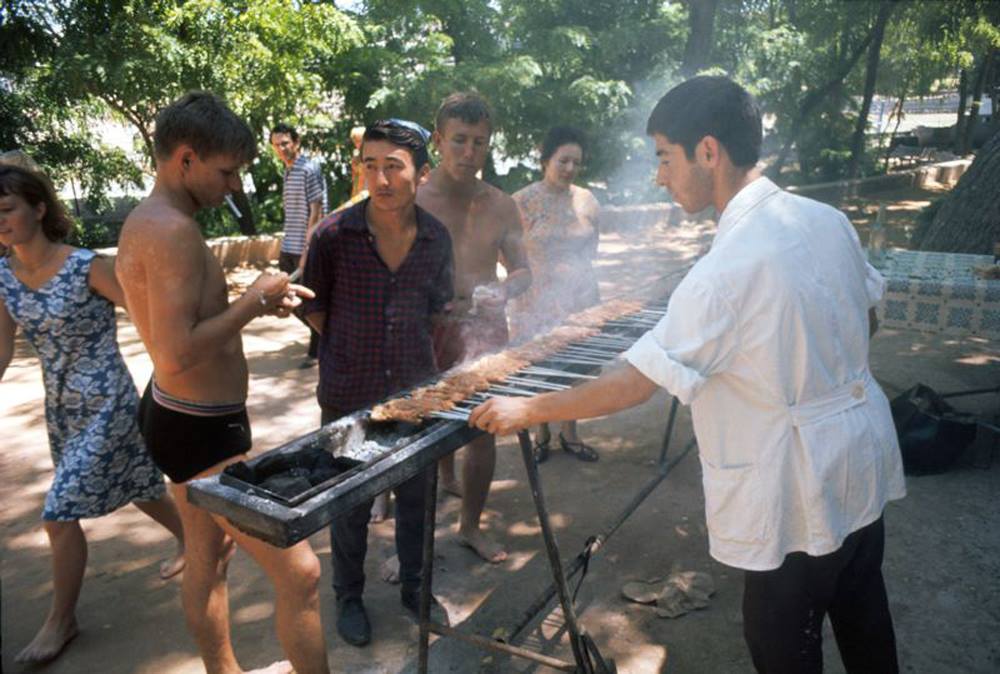
The shashlyk chef in Tashkent's Victory Park. Photo: Georg Mirsky / Tashkent Retrospective
An interesting and revealing fact for analyzing identification processes, in my opinion, is that in the current states of post-Soviet Central Asia, its elites and residents themselves are not very eager to call themselves colonial and post-colonial. While acknowledging the cruelty and injustice that existed during Soviet times, publishing books and making films about it, and even specifically creating museums dedicated to the repressions, these countries still reject the label of "colonialism" in relation to themselves and more often prefer to speak of totalitarianism, in which there is no longer a cultural distinction and it is more about the excesses of the Stalinist period.
Perhaps this is explained by today's nostalgia, in difficult times, for Soviet stability and the social state, which were partly real and partly imagined. Perhaps it is the result of Russian propaganda, which, through selective promotion of the Soviet, advances its current interests. Nevertheless, the mass, though not unanimous, refusal to consider oneself as a former colony tells us that Central Asian society has, to a significant extent, accepted many features of Soviet socialization and formed its own Soviet identity. This Soviet self-determination was contradictory, but it existed.
When will the argument end?
So, we have a set of arguments that fit quite well into the general understanding—at least in the versions of the Russian and English Wikipedia—of what colonialism is. And we also have arguments that rather refute the colonial nature of the USSR. Both sides—those for or against—can cite indisputable facts and appear quite convincing. But what then is to be done—since these two points of view exist or are formed in opposition to each other, actively contesting one another? It is clear, in my opinion, that we must acknowledge the facts presented by both sides, but at the same time develop some third point of view in which the presented evidence will not be in irreconcilable conflict but will enter into a dialogue.
To break free from the self-perpetuating and thus dead-end discussion of "for or against," it is necessary, I believe, to adjust one's vision in order to see and accept the contradictory, ambiguous, complex nature of the Soviet—complex both in terms of its temporal stages, its spatial diversity, and the coexistence of competing projects, personal experiences, and trends. Within this ambiguity, there was room for both inequality and attempts to overcome it, for coloniality alongside anti-colonial practices, for mass political restrictions, including repression, alongside equally mass social mobility, and for nation-building alongside the construction of a supranational community.
We must see: both direct and indirect violence or coercion—and simultaneously a policy of negotiations, alliances, and exchanges; both mistakes, crimes, and failures—and simultaneously achievements and grand plans for the future; both strict hierarchies and centralism—and simultaneously competition and autonomy; both grievances and suffering—and simultaneously joy and enthusiasm; both plunder and ruthless exploitation—and simultaneously development, construction, modernization.
At different times, in different regions, and in different situations, the balance of all elements looked unique and changed rapidly, which should be the subject of specific detailed research rather than schematic generalizations.
There is nothing exceptional about this Soviet complexity. Countries we consider "classical" colonial empires were also contradictory and ambiguous; they too contained different trends, experiences, and projects, and attitudes toward their legacy have also been and remain varied. No, in my view, there is no necessity and no methodological basis for ascribing to the USSR some unique—whether with a positive or negative sign (which are easily swapped)—place in the history of the 20th century. All countries, including the Soviet state, followed a common path, which contained elements of colonialism, nationalism, mobilization-based modernization, fascism, and the social state.
[…] Regarding coloniality, I would propose the following formulation: it, coloniality (in the form of various practices, institutions, or events), was certainly present in the Soviet context, but the Soviet itself was far from being exhausted by the colonial and cannot be reduced to it. In certain periods and situations, the colonial character of relations could intensify or appear more significant, but overall, during the Soviet era, this type of relationship was not a dominant factor or a structural foundation that determined all state policy and the entire fabric of everyday life.
On the other hand, we often recognize the postcolonial character of today's situation much more clearly than the colonial character of the Soviet one, i.e., postcolonialism is an independent phenomenon and apparently arises from the totality of contemporary conditions, not necessarily exclusively and directly from the Soviet past. With the collapse of the USSR, many processes that were occurring or beginning to unfold within its framework were interrupted, exhausted themselves, or failed, while colonial practices and perceptions ultimately turned out to be more noticeable and suddenly manifested in new forms, for example, in migration from Central Asia and in attitudes towards migrants in Russia. That such an outcome was logical and already embedded in the logic of the Soviet system's transformation is not such an obvious conclusion. I see history as more variable and less deterministic, and its consequences as not predetermined from the outset.
READ MORE:
Certainly, if we realistically consider the current state of minds and recall again the present political context, with which I began my essay, then one should not hope that the occasionally flaring debate about the Soviet and colonial will soon conclude and be forgotten. Rather, one can observe a certain radicalization of opinions amid increasing instability/turbulence in the world and in the countries of the Eurasian continent. I was merely attempting to outline the contours of that type of reasoning which could serve as a bridge for constructive dialogue. Perhaps it will be useful.


