
For example, the service "LitRes" in its selection "Book Trends 2025" notes: Slavic folklore has entered the list of key trends in the literary market! The top-5 thematic books published in Russian in 2024 was led by Alexandra Barkova's work "Slavic Myths. From Veles and Mokosh to the Sirin Bird and Ivan Kupala".
The "Myths from A to Z" series by the Russian publisher "Mann, Ivanov and Ferber" (MIF) is steadily expanding with encyclopedias about the legends of different peoples. One of the latest releases is dedicated to the culture of Belarus — we look forward to when the publishers reach Central Asia. And this means there is demand for them from readers.
In the USSR and in post-Soviet Russia up until the early 2000s, domestic folklore was treated with skepticism and a lack of seriousness. This was influenced, firstly, by Soviet ideological tenets, according to which folk tales, songs, and rituals were considered outdated, close to religion, and unscientific. And secondly – by the consequences of the collapse of the USSR and the fall of the Iron Curtain: European and American culture flooded into the new independent countries.
For a long time, interest in folklore was considered a sign of poor taste, and folklore itself was the domain of narrow specialists and cultural figures.
And today, even the works of Soviet philologist Vladimir Propp are getting a second life. He attempted to popularize folklore back in 1928. That was when he published his first monograph, "Morphology of the Folktale." In its time, it was not successful and had no real influence, but today it is considered a classic.
And his second work — "The Historical Roots of the Fairy Tale," published in 1946, — was even criticized. The author himself fell into disgrace: he was accused of anti-Marxism, idealism, and the religiosity of his ideas, and was even dismissed from the USSR Academy of Sciences. He released a new work only at the tail end of Stalinism in 1953.
But after two major Russian book publishers reissued his works in 2023, everything changed. Popular youth illustrators and comic artists were brought in for the design. The cover for "MYTH" was drawn by artist Coriander, and for "Eksmo" — by Adamasto. Popular literary bloggers began talking about Propp, and his books started being read by everyone who today considers themselves part of the intellectual youth.
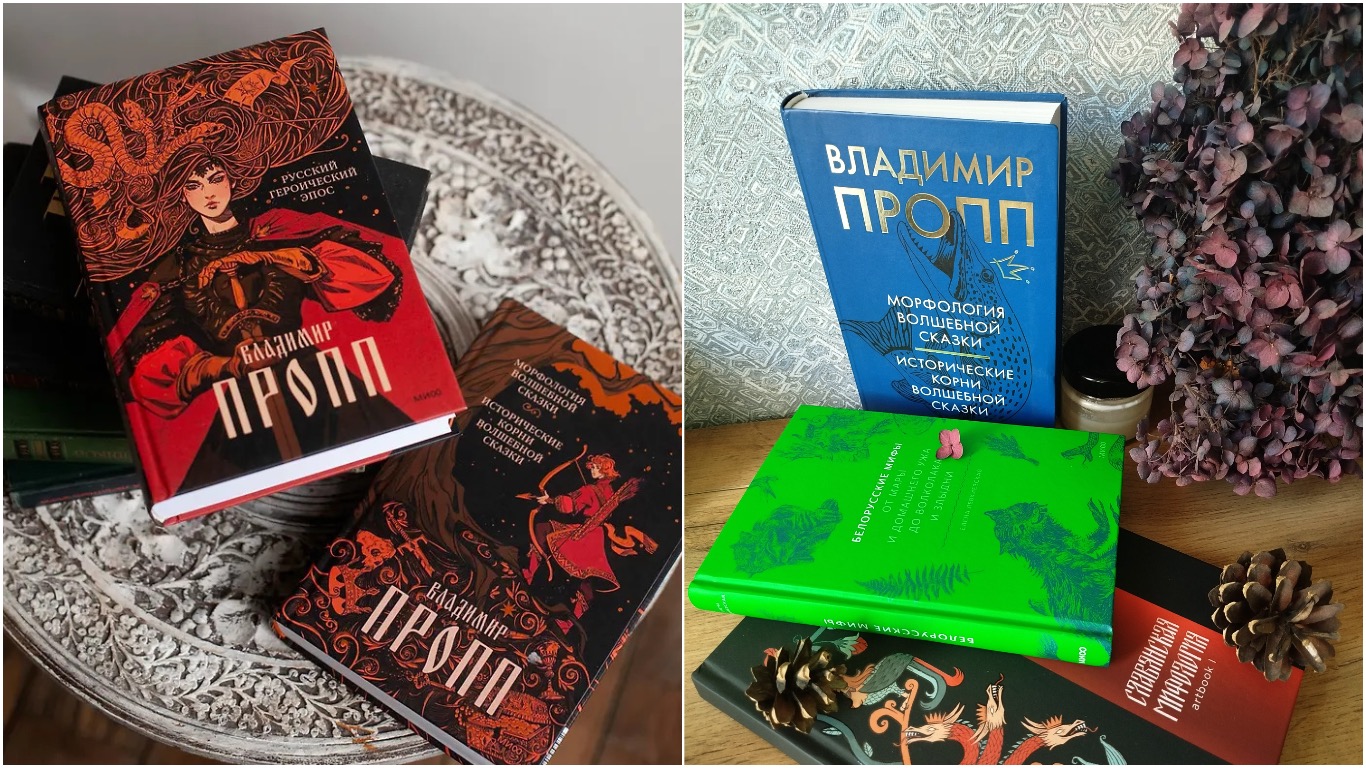
Russian-language editions of Vladimir Propp. Photo: Maria Bobova / book24.ru
As leading editor of "MIF" Olga Nesterova told in an interview with the youth online media YES!, readers have noticed: Propp revealed the universal structure of the plot and in many ways anticipated the recently popular Joseph Campbell with his "The Hero with a Thousand Faces." Moreover, his books also tell about what unites many people both in Russia and in many post-Soviet countries.
The popularity of such niche work once again demonstrates how high the interest in ethnic and folk art is among the modern audience.
This argument can be debated — literature as a whole is more inclined towards folklore, which means it is premature to speak of a widespread fashion for folklore in modern society. But what about other creative industries?
Increasingly often in the online space, musical performers and groups working in folk and ethnic music genres are gaining popularity, although previously the most famous of the niche groups was the band "Melnitsa" (which draws not only from Slavic but also from world folklore).
Musicians blend these directions with more contemporary and mainstream genres, such as electronic music (bands Oligarkh, "Srub"), pop music (Otyken), rock ("Ekspeditsiya Voskhod"), alternative (Green Apelsin), and rap (Drummatix), creating something entirely new. Recently, the band "Bond s Knopkoy" went viral on TikTok; they trended thanks to "Kukhni" – a track about 90s communal apartments in the indie genre. Meanwhile, their discography includes a full-fledged ethno-album "Prazdnik".
READ MORE:

The founder of the Russian folk group Theodor Bastard Alexander Starostin (stage name Fedor Svoloch) explains the interest in folklore by saying that people strive to search for new ideas in familiar material, reinterpret it, and regain their cultural footing. Folklore serves as a source of inspiration, transforms excellently, and integrates into other genres.
Folklore is increasingly being used in the film and series industry. Many recent Russian films — of various levels and genres — have been inspired in one way or another by folklore and its elements: "Vampires of the Middle Zone," "The Magic Plot," "Sergiy vs. the Unclean," "Pishcheblok" (to some extent based on urban folklore), the "The Last Warrior" franchise and its spin-offs.
And in the last couple of years, the theme of folk culture has been very actively used by computer game developers. The folklore-based adventure RPG with elements of a visual novel and CCG "Black Book" received not just decent reviews on the international gaming service Steam, but also a continuation in the form of a board game. Also well-received were the Metroidvania Slavania about the adventures of an unusual bogatyr, the adventures "Vasilisa and Baba Yaga" and The Tales of Bayun, and the meme game "Rus' vs. Lizards".
Similar examples can also be found in Belarus and Ukraine. Belarusian musical groups (the ethno-trio "Troitsa," the folk-rock bands "Bez Bileta" and "Stary Olsa," etc.) continue to release albums and strengthen their fan base. The publishing house "Shufliadka Pysatelia" is already publishing its third collection of stories based on urban folklore. An action game about the Belarusian Middle Ages, Tales Of Meadows, has been announced. Among Ukrainian projects, one recalls the full-length 3D animated film "Mavka: The Forest Song."
What else, besides its flexibility and versatility, attracts creators to folklore?
Russian writer Anastasia Strokina ("Atlas of Russian Fairytale Characters") believes this is how escapism manifests in people. Folklore immerses them in another reality that is somewhat familiar to them and can be analyzed and interpreted from a scientific point of view. Some creators claim that today, globalization and the "general information noise" have reached such a scale that people are striving for something deeper and more unique.
What is happening with the "folklore trend" in Central Asia?
Here the situation differs from the Russian, Belarusian, and Ukrainian contexts. For example, Uzbek folklore has found reflection in the reviving national animation and in the art of ballet.
Uzbek ballet was born in the 20th century alongside the Soviet system. In Tashkent, over time, not merely a copy of Russian-Soviet ballet was formed, but a distinctive fusion of European classical dance and traditional dances. The unique choreography, expression, and plasticity perfectly suited folk legends and tales.
To this day, a hallmark of Uzbekistan is the production "Lazgi. The Dance of Soul and Love," whose premiere took place in 2019. That same year, this traditional Khorezmian dance was inscribed by UNESCO on the Representative List of the Intangible Cultural Heritage of Humanity, further strengthening the international reputation of the Uzbek national theater.
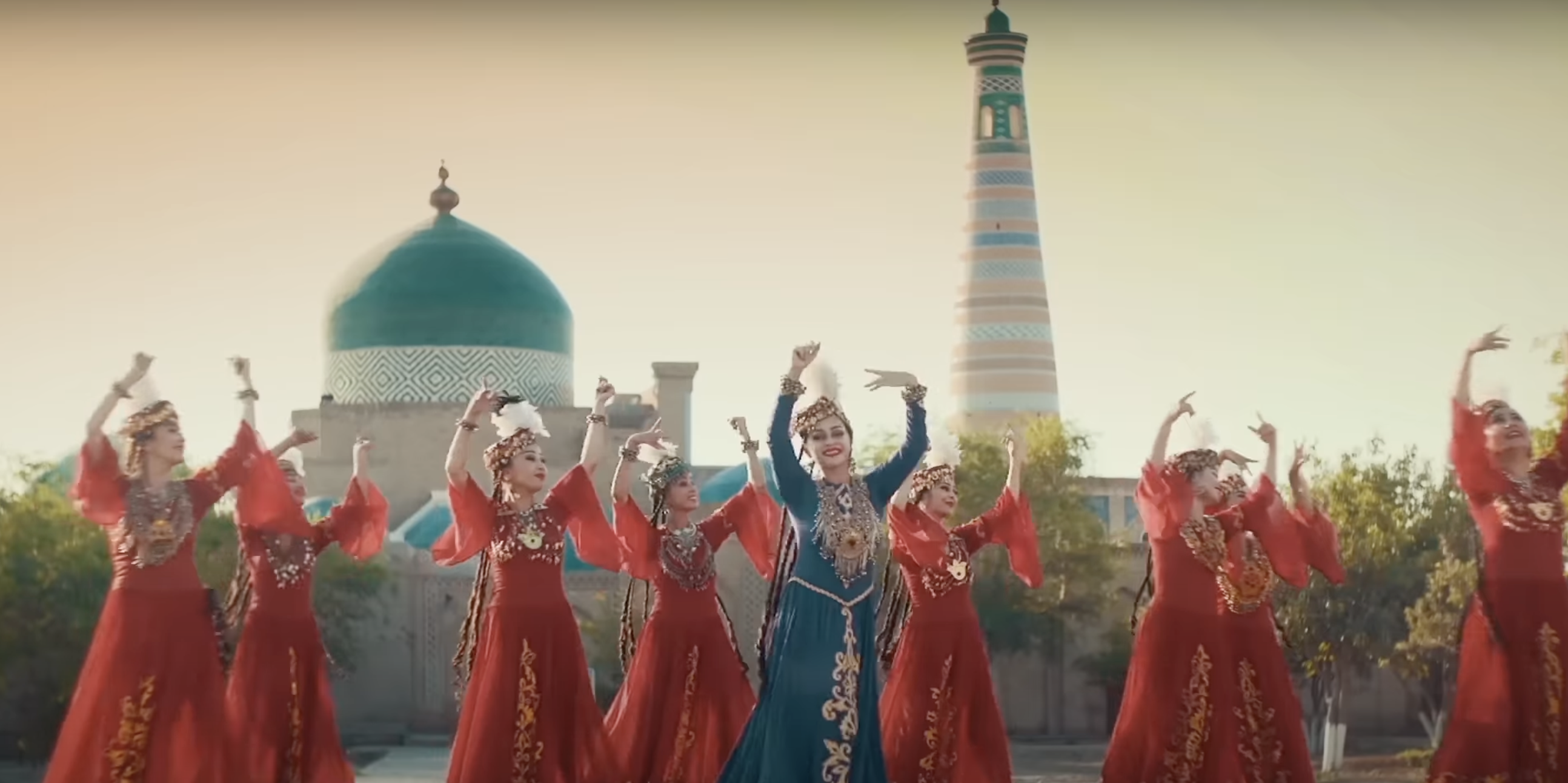
Khorezmian dance Lazgi. Screenshot: Hulkar Abdullaeva / YouTube
What about Uzbek game development?
Since 2023, Doomers Entertainment studio has been developing the action game The Golden Horde, which, however, contains more history than folklore. But over these two years, the studio has transitioned its work to the most modern game engine, Unreal Engine 5. Another epic gaming project — The Rise of Jaloliddin — is being prepared by BlackBox Studio. In this project, the player can take on the role of the warrior Jaloliddin Manguberdi and battle against the army of Genghis Khan.
The trend of using folklore in Uzbekistan is not as prominent as in other post-Soviet countries. Perhaps this is because the country is experiencing a boom in popular American-European culture—people are so eager to absorb the benefits of globalization that everything local may seem archaic, uninteresting, mundane.
Gameplay elements in The Rise of Jaloliddin / YouTube
Similar thoughts wereexpressed by President Shavkat Mirziyoyev at the opening of the first International Bakhshi Art Festival in Termez in 2019:
"In the era of globalization, when show business and 'mass culture,' having turned into a sphere of commerce, often negatively impact the spiritual development of society, unfortunately, attention and interest in folk art are weakening."
Or perhaps the reason lies elsewhere? Maybe Uzbekistan never strayed far from its folkloric roots, unlike many of its neighbors? The country still celebrates Navruz and Mehrjan, unlike Slavic Kolyadki. National costumes and folk musical instruments are still in use. Perhaps that is why this so-called "folklore boom" is not noticeable in Uzbekistan—because it has always been here here?


