
Jadidism and related enlightenment movements have increasingly been present in the public space of Central Asia in recent years. This is particularly noticeable in Uzbekistan: in 2023, construction began in Bukhara for the first museum of Jadidism history, and President Shavkat Mirziyoyev regularly references the legacy of the progressives in his public speeches.
In Kazakhstan, the series «Mіrzhakyp. Oyan, qazaq!» (dir. Murat Eszhan) about one of the leaders of the Kazakh national movement Mirzhakyp Dulatov (1885 – 1935), who largely shared Jadid ideas, became a hit on national television and garnered millions of views online. In Central Asian countries and Azerbaijan, biographies of national enlighteners who lived and worked at the turn of the 19th-20th centuries regularly appear on bookstore shelves. Jadid figures hold a key place in public discussions about historical memory in Russia's republics of Tatarstan and Bashkortostan.
The narratives about enlighteners in different countries of the region are quite similar: heroes of the national liberation movement, proponents of Europeanization, victims of Soviet repressions. Among government officials and historians, there is a fairly widespread opinion that the experience of the Jadids should, to some extent, shape contemporary policy.
However, such a perspective is only one of the possible angles for analyzing such a multifaceted phenomenon as Jadidism.
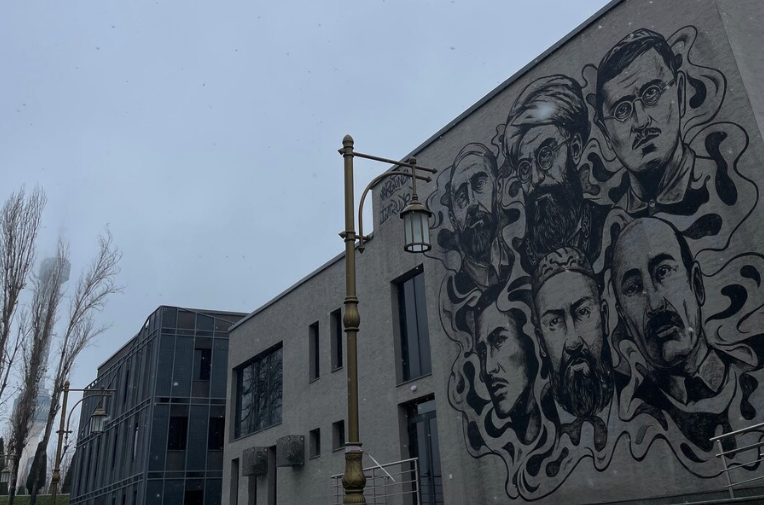
Mural with portraits of Jadids on the wall of the Museum of Victims of Repression in Tashkent. Photo: afisha.uz / Mirzo Zominiy.
Who were the Jadids
The term "Jadidism" itself originates from the Persian-Arabic expression "usul-i jadid" — "new method." It traces back to a new format of school education that included not only a new phonetic method of teaching literacy. In the new-method schools, not only religious but also additional secular subjects were taught, with instruction conducted in native languages instead of Arabic and Persian.
Jadids began to be called intellectuals, creative and political figures who received an education with a secular and national component.
This phenomenon led to the emergence of political parties, national literature, and theater. If we examine Jadid texts through the lens of intellectual history or the history of philosophy, then analyzing them exclusively within separate national projects will largely limit our understanding of the debates relevant at that time.
For the history of Jadidism, not only the national component is initially important, but also transcultural interaction, the exchange of ideas, and solidarity. And at the core of the reformers' political programs is a theory that deserves special attention. Unlike the European context, where philosophical debates developed within the university environment, the polemics between reformers and progressives across a vast geographical region — from the Crimean Peninsula to Central Asia — took place on the pages of periodicals.
Jadidist Press
The author of the new educational method is considered to be the Crimean Tatar activist Ismail Gasprinsky (Gaspraly) (1851–1914). He personally traveled to various, predominantly Muslim regions of the Russian Empire, promoted the innovations, and also trained teachers who worked in the few schools. Gasprinsky popularized his reformist ideas through the first private Turkic-language newspaper of the Russian Empire — "Tercüman" ("The Interpreter"), which he founded himself.
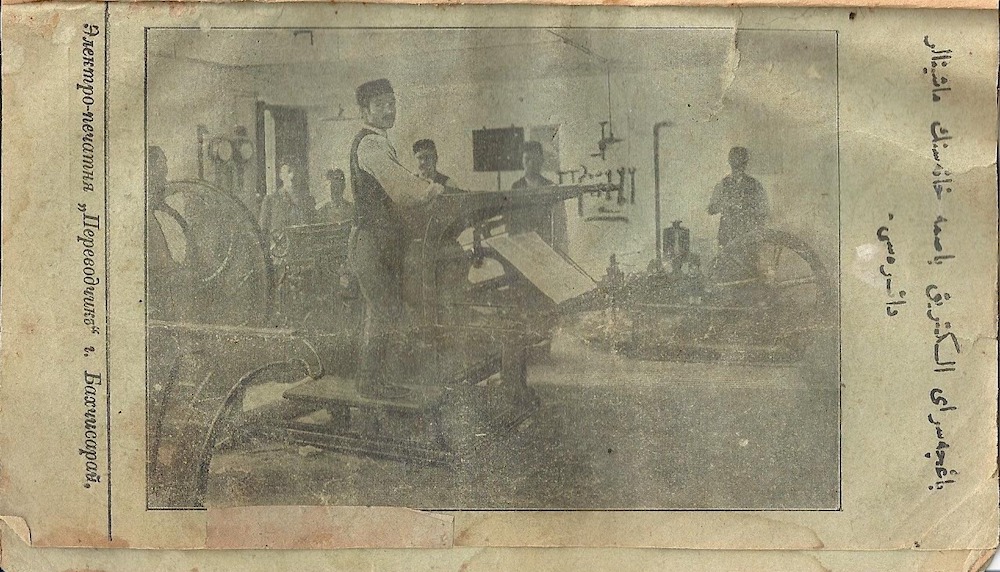
Ismail Gasprinsky in the printing house of the newspaper "Terjiman".
Starting in the 1880s, numerous new periodicals in various languages appeared. It must be acknowledged that many of them were short-lived and had modest circulations. In the Uzbek language alone, so many different newspapers were published that it is difficult to list all the landmark publications. However, even in the very titles, a certain common philosophical program of Jadidist periodical press can be traced: "Taraqqiy" ("Progress"), "Al-Isloh" ("Reform"), "Hurriyat" ("Freedom"), "Tong" ("Dawn"), "Najot" ("Salvation").
Newspapers and magazines promoted not only cultural and educational agendas but also political ones.
Many newspapers, as was customary at the time—including in Europe—served as propaganda platforms for political parties and movements. For example, the newspaper "Qazaq" ("Kazakh"), closely associated with the Alash party, became the main printed organ of the Kazakh national movement in the early 20th century. Jadid newspapers also devoted considerable attention to the role of women in society and the family, as well as to the protection of their rights, particularly girls' rights to education. The first and most famous women's magazine in the Tatar language—"Söembikä" ("Suyumbike")—was named after the legendary ruler of Kazan and published by Fatiha Aitova (1866–1942). Satirical publications also emerged, criticizing social vices, the most iconic of which was the Azerbaijani satirical illustrated magazine "Molla Nasreddin".
The spread of mass printing and new-method education led to reforms of alphabets, adapting them to the needs of local languages. In 1918, members of the philological society "Chigatoy gurungi" ("Chagatai Circle"), under the leadership of one of the prominent representatives of Central Asian Jadidism, Abdurauf Fitrat (1886–1938), initiated a reform of the Arabic alphabet for the Uzbek language. A few years earlier, in 1912, the Kazakh linguist and educator Akhmet Baitursynov (1872-1937) presented an updated and adapted Kazakh alphabet, which became known as "töte jazw" (clear writing). This version of the alphabet was deliberately simplified to favor greater accessibility for the masses.
It is noteworthy that the transition to the Latin alphabet, which was temporarily introduced by the Soviet authorities in the 1930s, was also prepared within the Jadid environment even before the emergence of the USSR. Projects for switching from Arabic to Latin script were discussed in the Turkic-speaking intellectual milieu as early as the 19th century. Some Tatar poets, for example, Sagit Rameev (1880-1926), experimented with the Latin script even before the collapse of the Russian Empire. The pioneer among the Soviet republics to officially introduce the Latin alphabet was Azerbaijan: as early as 1925, the Latin script began to be widely used there alongside the Arabic script. The modern Uzbek Latin alphabet is based on the Turkish one — with Jadid experiments predating Atatürk's reforms.
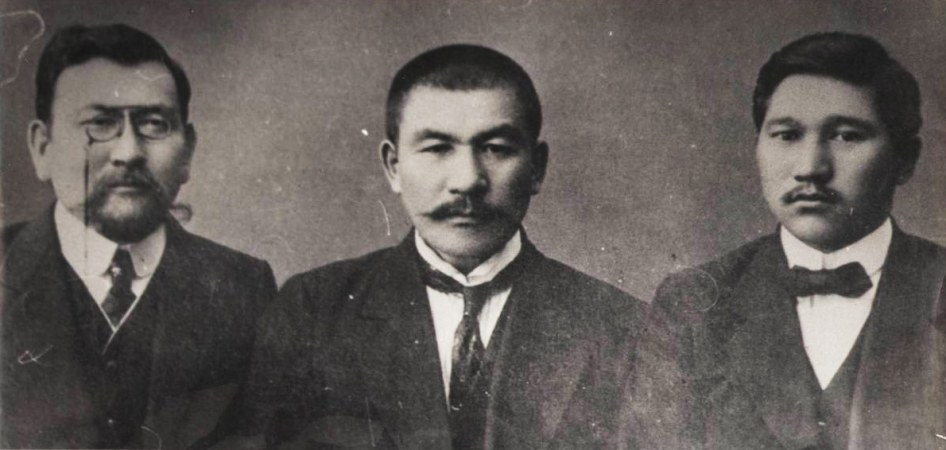
Founders of the newspaper "Qazaq" (from left to right): Akhmet Baitursynov, Alikhan Bukeikhanov, and Mirzhakip Dulatov.
Jadidism and Pan-Turkism
During the repressions of the 1930s, the Jadids were most often accused of Pan-Turkism, however, the new intellectual movement was not limited exclusively to the Turkic-speaking world. In Turkestan, in addition to Uzbek, the Tajik language was also widely spoken, which is why some newspapers were published simultaneously in both languages or only in Tajik: the newspaper "Samarkand" and the magazine "Oyna" ("Mirror"), "Bukhoro-i Sharif" ("The Noble Bukhara").
Mulla Jurabay (1887 – 1937) opened the first Jadid school with instruction in the Tajik language. Sadriddin Ayni (1878–1954), the founder of Soviet Tajik literature, was also a representative of Jadidism. Another interesting example of a Jadid publication that transcended the boundaries of the exclusively Turkic-speaking world was the newspaper "Jaridat Dagistan," which was published in Arabic. This can be explained by the concentrated multilingualism of Dagestan and the entire North Caucasus, which complicated the transition of education and print to local languages.
The dominance of Turkic-speaking cultures among the Jadids undoubtedly facilitated an intensive exchange of ideas with cultural and political figures of the Ottoman Empire. After the 1908 revolution, which was organized by the Young Turk movement — primarily, the Committee of Union and Progress (İttihat ve Terakki Cemiyeti) — Istanbul became a major center of attraction for Muslim progressives from the Russian Empire. The influence of the Turkish intellectual milieu on the Jadids was mutual, as the number of Russian Muslims was comparable to the population of the entire Ottoman Empire.
In Istanbul, for example, the journal "Türk Yurdu" ("Turkish Homeland") was published, with Russian Muslims as its primary audience. It was published by the Tatar and native of the Volga region Yusuf Akçura (1876–1935), and financed by the Orenburg merchant Mahmat-bay Khusainov (1839–1910). Until 1908, censorship in the Ottoman press was significantly stricter than in Jadidist publications — the latter were even banned from being imported into Turkey. After the Young Turk Revolution, Gasprinsky's journal "Tercüman" began to be sold freely in Istanbul, and Turkish journals began listing subscription prices for readers from Russia on their covers. The nascent Turkish nationalism of that time, albeit to varying degrees, turned to the history of the Turkic-speaking peoples of Central Asia and the Volga region.
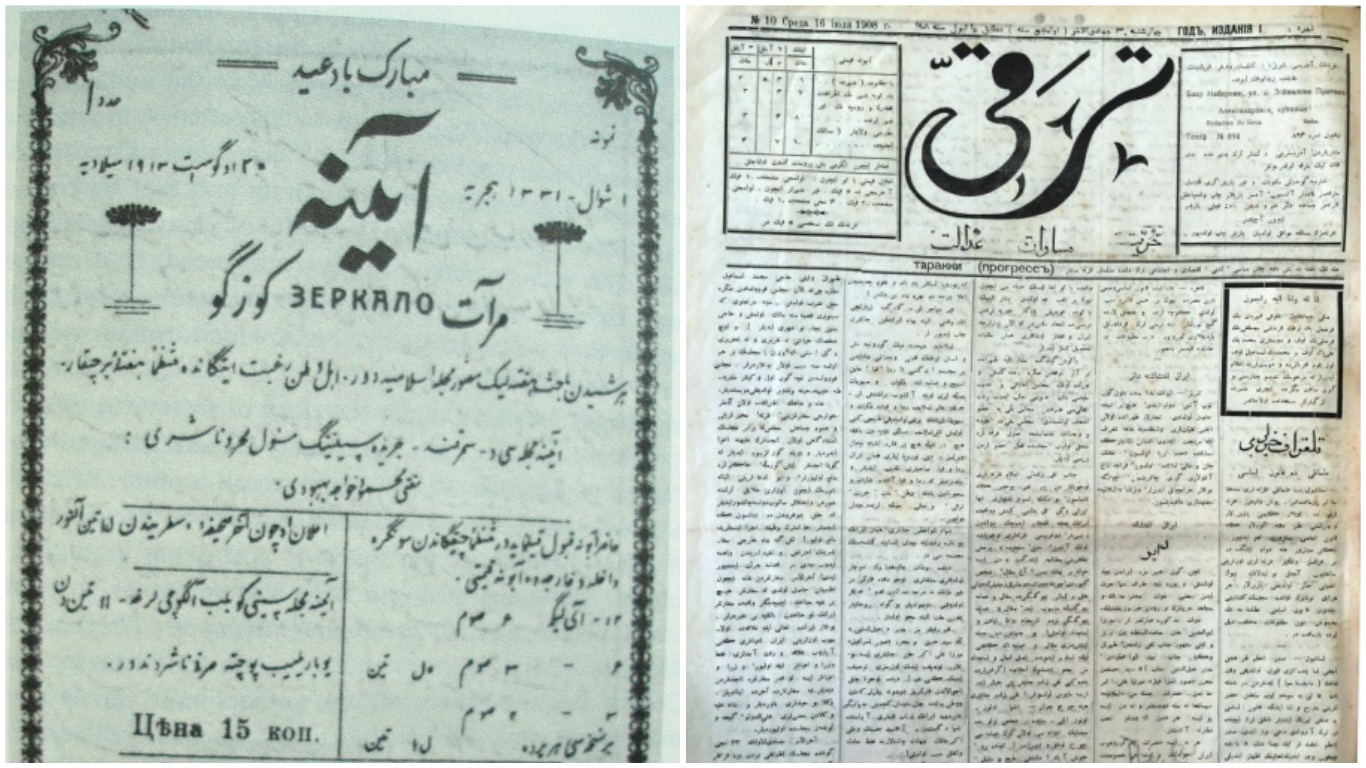
Fragments from the magazine "Oyna" and the newspaper "Taraqqi".
There was also interaction with the Iranian intellectual environment, which was facilitated on the one hand by the kinship of the Tajik and Persian languages, and on the other — by the Shia faith of the Azerbaijanis and their close historical ties with Iran. These connections were widespread both in Turkestan and the Caucasus. The main work of the Iranian writer, educator, and satirist Zayn al-Abidin Maraghai (1837-1910) — "Siyahatname-ye Ibrahim Beg" ("The Travel Diary of Ibrahim Beg") — was quite popular in Turkestan and influenced the journalistic and artistic texts of the Jadids.
Islam and Modernization
A key theme for the Jadids was the relationship between Islam and modernization. While on one hand they advocated for the adoption of European culture and political institutions, on the other, they insisted on the necessity of preserving Islamic religious identity. Finding a balance between these two intentions was not easy, and different representatives of Jadidism leaned towards one side or the other. This paradigm of thought aligns the Jadids with Muslim modernists, intellectuals, and political figures from the Arabic-speaking regions of the Ottoman Empire and the Muslims of British India.
Starting with Napoleon's Egyptian campaign of 1798, European empires — including the Russian Empire — established colonial control over most of the Muslim world. The West's military and scientific triumph did not go unanswered by Muslim intellectuals. The desire to break free from colonial domination and overcome cultural and economic decline drove them to seek ways to revive the Muslim world.
Europeanization, in turn, was perceived as a necessary stage for offering resistance.
It is noteworthy that Arab-speaking authors of the Ottoman Empire hoped to use European colonial expansion to gain independence from the Ottomans, discussing national and pan-Arab projects in their texts. However, alongside pan-Turkist and pan-Arab projects, ideas of creating a pan-Islamic state were also frequently voiced.
And even if the Jadids generally did not share ideas about Pan-Islamism, cooperation and solidarity with the entire Muslim world were of interest to them. In 1907, Gasprinsky announced a "World Muslim Congress," but these plans were never destined to come to fruition. Nevertheless, he traveled to both Egypt and British India, where ideas of Muslim reformation were spreading at the time, and his texts were translated into various languages, including Urdu.
Reformist Ideas in Asia
The discussions of progressives and enlighteners also unfolded among the neighbors of Turkestan, belonging to peoples of completely different religious and linguistic groups. Among the Buryat-Mongols, ideas of national community were also emerging, and debates were held about what role the religious factor should play in the process of nation-building. The various opinions of local intellectuals on this issue were similarly published on the pages of periodicals, thereby shaping the socio-political thought of the Buryats.
There was also the typical balancing act for progressives of that time between Eurocentric ideas and the aspiration to revive their own, sometimes lost traditions. Thus, among Mongolian enlighteners, ideas of synthesizing rationalism and Buddhism emerged. Parallel to the imagining of new nations, there was also an appeal to pan-Mongolian unity. Another typical theme for progressives was alphabet reform and the attempt to move away from the vertical script borrowed from the Uyghurs by transitioning to the Latin alphabet.
The intellectual environment of neighboring China was also torn between faith in Western science and the fear of losing cultural identity in its search for an answer to the West's technical and military superiority. Publicistic writing also became a platform for shaping Chinese modernist thinking, language, and political culture. One of the leading journals of early 20th century China worth mentioning is "New Youth." The publicist and political theorist Liang Qichao (1873-1929), a key figure in the intellectual history of China at that time, was also searching for a balance between Western and Confucian political institutions.
Japan played a special role in the emergence of reformist movements in Asia. Its victory in the Russo-Japanese War of 1905 made an impression on both Muslim modernists and Jadids, serving as an example of Asia's triumph over Europe. Claiming to build an alternative Asian imperial project, Japan offered its own program for liberation from European dominance—Pan-Asianism—which it began to use to justify its own expansion on the continent. Meanwhile, the attempts by philosophers of the Kyoto School to synthesize ideas from Western (especially German) philosophy and Buddhist thought clearly fit into the broader Asian progressivist paradigm.
If we shift our focus from methodological nationalism and look at the place occupied by Jadids in the intellectual space not only of Turkestan or the Turkic-speaking world, but of all Asia, we can better understand their legacy. Moreover, this legacy will become only more relevant to today's local and international discussions.
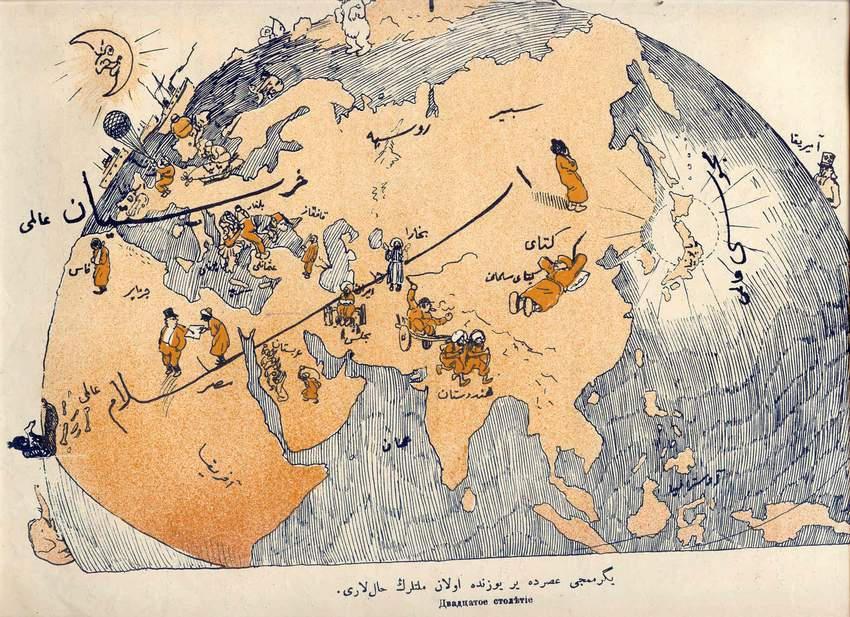
Caricature from the Azerbaijani magazine "Molla Nasraddin".
Over the past century, the Western philosophy with which the reformers were in dialogue has changed; the era of postmodernism has arrived, which rethinks the very idea of progress. At the same time, interest has grown in local philosophies that developed separately from the Western intellectual tradition. Similar projects have already taken place in Latin America, Africa, and Southeast Asia.
Located at the very heart of Asia, the Jadids became a kind of synthesis of ideas from different ends of the Eurasian continent. While proclaiming progress, they contributed to its problematization. It is commonly believed that Gasprinsky's new teaching method was a product of three pedagogical schools: European, Russian, and Turkish. But it was precisely the theoretical works of the Jadids that absorbed an even greater geography of ideas.
The issues they raised remain relevant today: tradition and progress, religiosity and secularity, national projects and regional integration. These topics are primarily of interest to the heirs of the Jadids in modern Central Asia. But it is important to place this intellectual legacy within the broader context of the history of ideas, where it should be given its rightful place.


