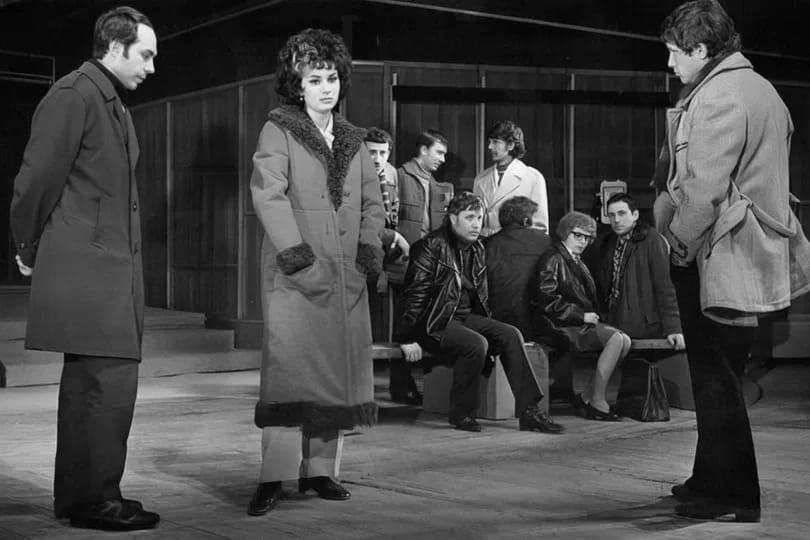
The story "Twenty Days Without War" by Konstantin Simonov is about war correspondent Vasily Lopatin, who spends a short leave in Tashkent. Here he meets colleagues, observes life in the deep rear, even falls in love — and realizes that the war remains close regardless: even in a city where shells aren't bursting, everything is saturated with its presence.
The performance by Alexander Plotnikov lasts about three and a half hours, with the artistic director of "Ilkhom," Boris Gafurov, playing the lead role. The premiere will take place on September 12–13. As the artistic basis, Plotnikov used the film adaptation of the same name by Alexei German, starring Yuri Nikulin and Lyudmila Gurchenko.
Plotnikov is a director and playwright of the new generation, a graduate of the screenwriting course of Rustam Ibragimbekov (VGIK) and the acting and directing course of Kama Ginkas (Konstantin Raikin Higher School of Performing Arts). His productions combine documentary realism and poetic language, addressing themes of memory and collective trauma.
He has long worked with the theme of World War II: in the plays "The Red Book" and "Hiroshima," he explored the experience of the Holocaust and the American atomic bombing of Japan. Audiences at "Ilkhom" know him from the production "The Free Auction Named After Sergei Parajanov" and the monoplay "Alpha Centauri." This experience of working with the fragile fabric of memory became an important context for his new premiere, "Twenty Days Without War."
— How did your collaboration with Ilkhom begin, and why did you decide to stage this play in Tashkent? Let's be honest: our theater scene isn't very well-known outside the region.
— Actually, the stage of Ilkhom is well-known far beyond Uzbekistan. In the theater world, it is a legendary venue. Mark Weil's name is still on everyone's lips: he was the one who created the first independent theater in the Soviet Union and thereby changed the very understanding of what independence in the theatrical process means. His sense of freedom, his striving to break free from the rigid norms of the Soviet aesthetic paradigm, was impossible not to notice.
My collaboration with "Ilkhom" began at the end of 2022, already after the war had started for us. Russian theater found itself in a difficult ethical situation and became a censored institution. I had to refuse some projects in Moscow—simply because I did not understand how one could engage in theater after what Russia had done. And then an opportunity arose to participate in an "Ilkhom" laboratory. For me, it became a return to meaning. Our first work here was a sketch based on Tolstoy's "Sevastopol Sketches." A small work, but very clear—almost a scream. That's how my acquaintance with "Ilkhom" happened.
And then one sentence led to another. First, one play appeared, then a second. Now I love this theater very much.
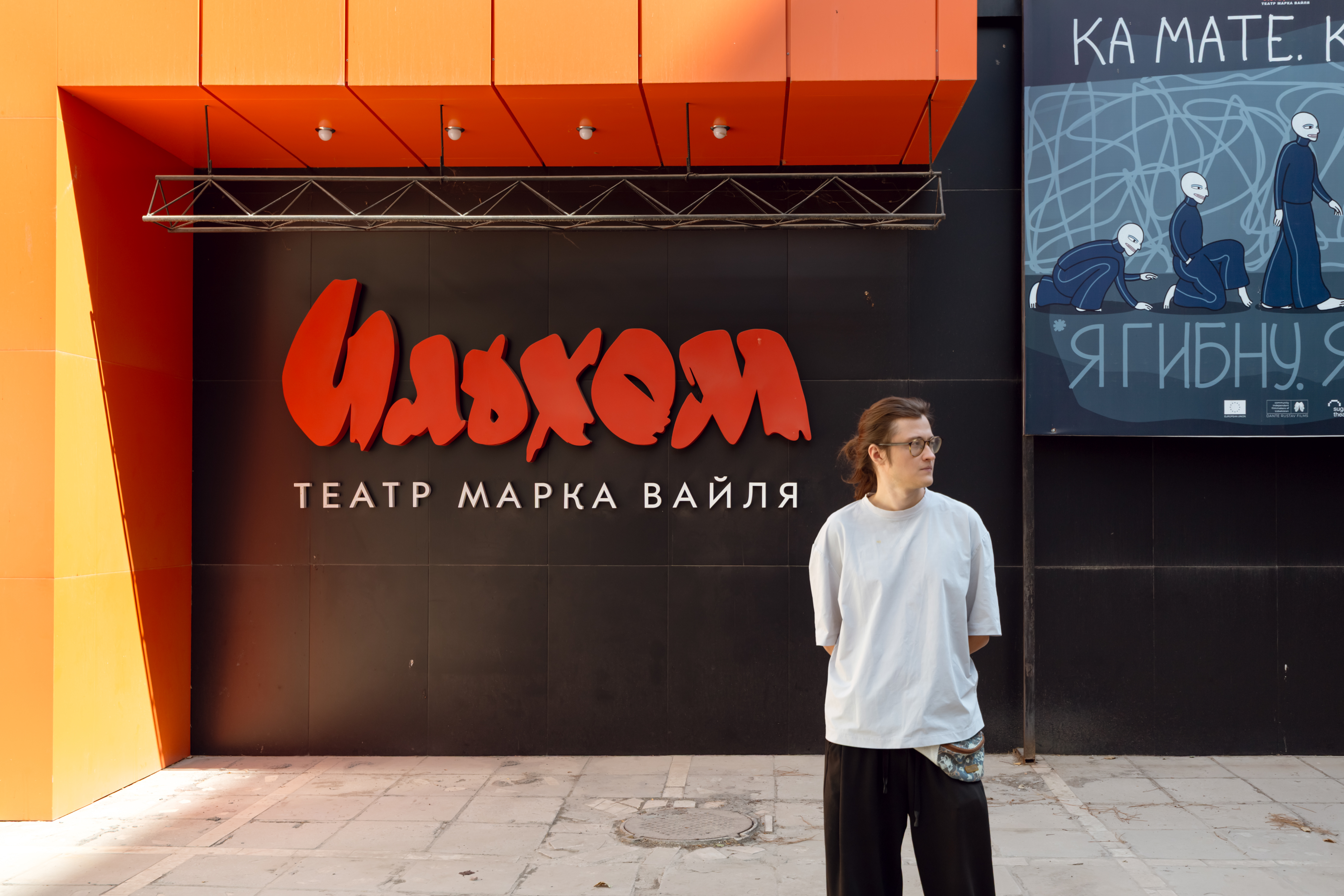
An amazing combination: on one hand, it's an institution — with its own company, building, production; on the other — the atmosphere of an independent space is preserved here. People gather here not for career reasons, but because they believe in a common cause. And that's a great rarity. At "Ilkhom," I feel free and truly happy.
This is not a simple topic — how institutional theater can exist at all. Usually, any institution gives rise to contradictions: struggles for authority, conflicts within the troupe, unequal distribution of roles, financial abuses, pressure from censorship or officials. In Russia, all this has become commonplace. But at Ilkhom, it's different: here, the institution does not kill the atmosphere of freedom but, on the contrary, helps it to exist.
— Have you been here constantly since 2022, or do you leave and come back?
- No, I came and went. First I arrived, then returned to Russia again and stayed there until last summer. I came to Tashkent for two months to stage "Free Auction" based on Sergei Parajanov, and then went back. At the time, it seemed to me that, despite everything that's happening, my place was there, that I needed to find ways to resist: create semi-underground, independent projects, show that Russia is not just a pro-war segment of the population.
But then two of my plays were shut down due to denunciations. My friends Zhenya Berkovich and Sveta Petrychuk were imprisoned for the 'theater case'. I attended the trials, saw the whole process in person—after that, it became completely impossible to make theater in Russia. So I emigrated, but not here, to Yerevan. I currently live in Armenia. But I come here and plan to keep coming.
— You mentioned that your plays were shut down...
— Yes, in 2023, I staged the play "Translation/Tärcemä" at the independent Kazan theater MOÑ. It was one of the plays that had to be closed. I found out that in 2017, a law was signed in Russia stating that the languages of ethnic groups living within its territory cannot be studied. That is, if you are Tatar or your children are Tatars, they do not have a subject like their native language in their school schedule. It was abolished, made optional, which, of course, led to the degradation of culture and language. And this is not only in Tatarstan, but also in Yakutia, Bashkiria, Mordovia. All languages were simply removed from the school curriculum.
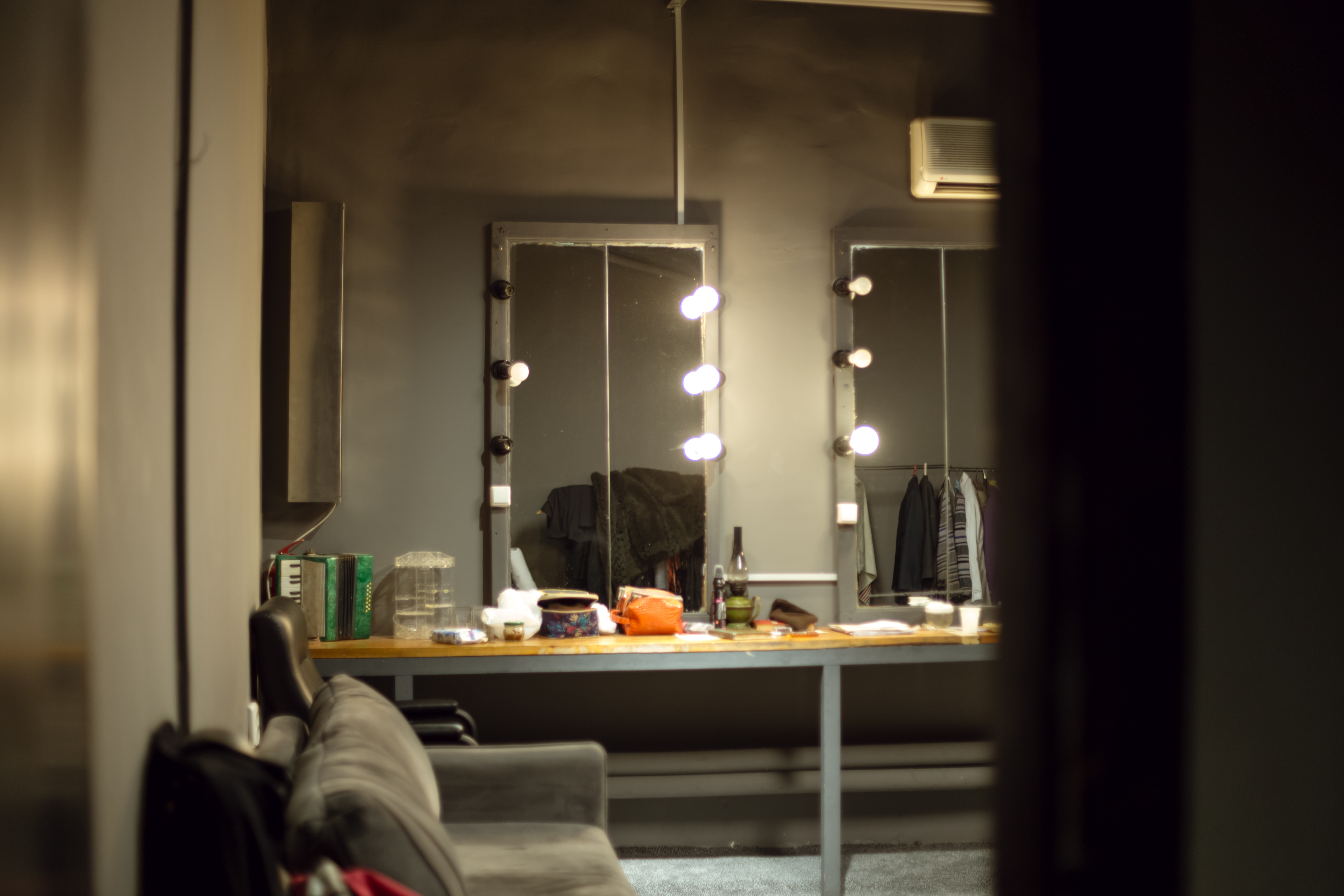
And this, of course, is an absolutely genocidal attitude towards culture. That's why I created this performance art project, within which I learned the Tatar language and performed a play with a call to pick up a dictionary, not an assault rifle. I performed this play only five times—and we received several reports that I wanted to destroy the territorial integrity of the Russian Federation.
— What struck you about Alexei German's film or Konstantin Simonov's story—the quality of the material, something personal, or a resonance with the current moment, such as the war in Ukraine?
— Herman is one of my favorite film directors, and I believe he is one of the greatest directors who has ever worked in cinema and with the language of cinema. He brought something to the language of film comparable to what da Vinci brought to the language of painting. He essentially invented an entire polyphonic plasticity of cinema. And it always seemed to me that this language or this plasticity is underappreciated in theater, that few in theater work with such multi-layered structures: when there is a foreground, middle ground, background, when a great deal happens in parallel. When we, as it were, abandon traditional dramaturgy, when a character develops, goes through certain scenes, events.
Well, and then, of course, after all these technical things, which are very important, comes the understanding of responsibility, the artist's place in today's world. And in this sense, the film "20 Days Without War" becomes a reason for me to talk about the possibility of representing war in art in general. In German's film, this is done on a truly grand scale: there, if you recall, there are three scenes in a row. First, we see them filming a movie about the war — this took place in Tashkent, because a large part of Mosfilm was evacuated to Tashkent, to Almaty.
We see how war movies are filmed — it's such obvious props with some artificial helmets. Then we see a scene where the main character remembers Stalingrad, and there's already a different degree of truth — it's much more truthful than the film shoot, and it's deliberately done that way. And then, as a third episode, he places an interview — a documentary interview with some old woman who tells about how the Germans retreated from Stalingrad. And she suddenly becomes the most truthful, because she's a documentary granny. She has a few fantastic phrases, and the way she smiles, the way she looks into the frame...
These three episodes, when put together, create such a stereoscopic tunnel of truth. And we understand that the first was a lie, the second was a lie, the third is somewhat the truth, but together they create an image of war.
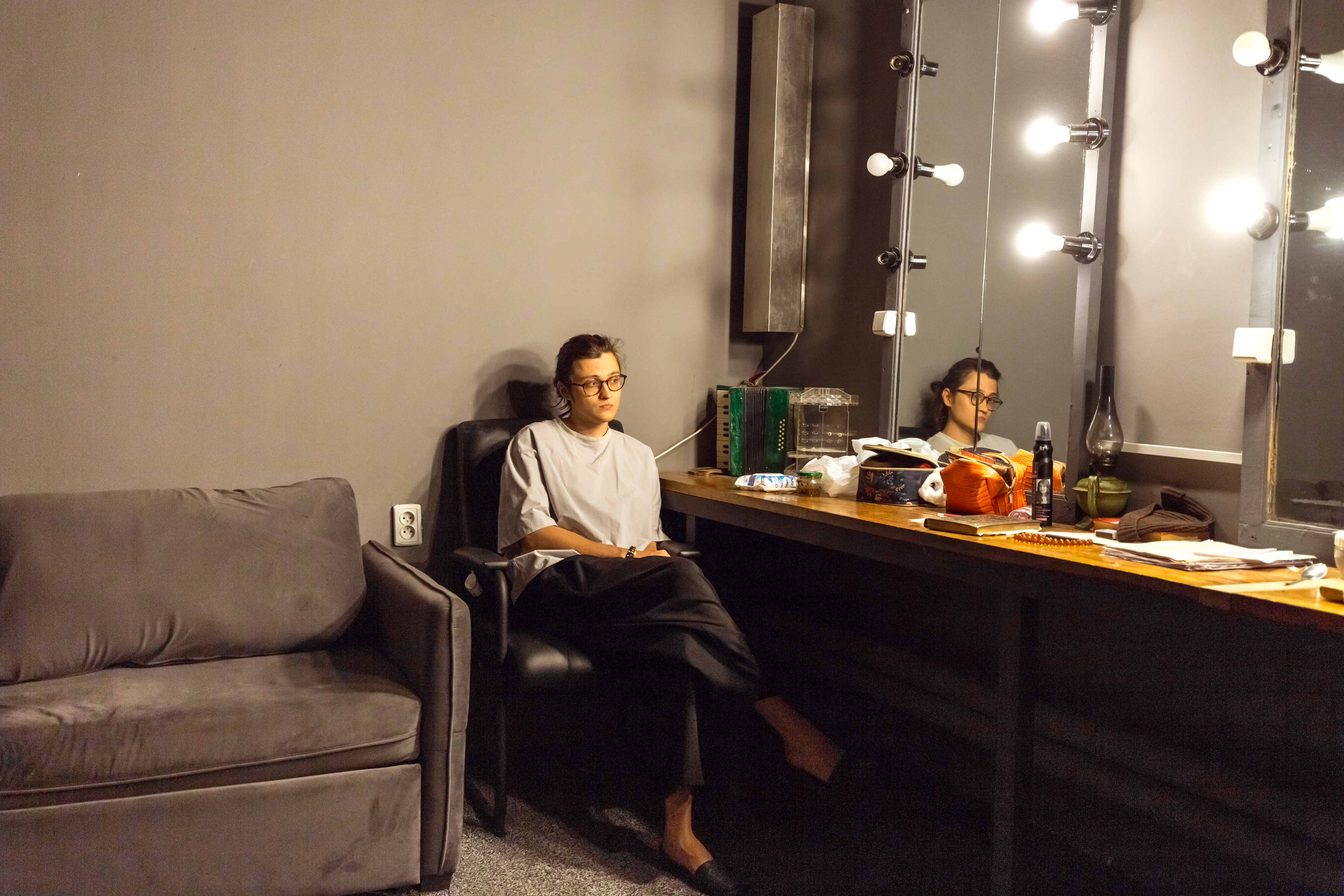
And this is the most interesting part. Today we see it in the news, we see photos of destroyed houses, we somehow interact with this reality. This is not only about Russia's war in Ukraine, but also about the war in Israel, there was recently a war with Iran — war here, there, and everywhere. The world is on fire, and if we want to engage with art, it must somehow be able to deal with this.
It is impossible to know that the whole world is burning and still do "Romeo and Juliet." At least—that is not my strategy. I want art to be capable of responding to the demands of reality, to the challenges of reality, to the pain.
And in this sense, the film "20 Days Without War" strikes right at this knot—at the knot of this problem.
The film takes place in Tashkent, and it's also a wonderful conversation about Tashkent during the evacuation. It wasn't just "Mosfilm" that was here; Anna Akhmatova was here, who features in our play. Nearly a million people were evacuated here. Tashkent in 1942-1943 is very interesting because it's such a peaceful zone where bombs don't fall, but where everything is permeated by the war because factories are working, because supplies and provisions are sent to the front from here, because soldiers are constantly here on leave.
That is, it's a city where there is no war, yet it is still electrified by war. And it seems to me that today, the world has essentially turned into such a Tashkent, into an evacuation zone. I live in Yerevan, there is no war there—at least not now, but there was one recently. There is no war now, but you don't feel like you are outside of war.
As if in today's world, war no longer has borders; it spreads across the entire globe. Yet, at the same time, we do not stop eating, rejoicing, going to the market, cutting melons.
— War correspondent Lopatin had no war for twenty days, but in Uzbekistan, there hasn't been one for almost a century (not counting evacuation and home front work during World War II). Why does a Tashkent audience need a play about war in 2025?
— I think this is extremely important. I can't say about myself that I'm left-wing, but this left-wing idea really appeals to me: there are no "us" and "them." And if there's a problem somewhere out there, then it inevitably means it's our problem, and we can't live as if it doesn't concern us.
In that sense, we are all relatives—any war concerns me simply because I belong to the human race.
At the same time, the representation of war is always constructed as manipulation. Even a good film, like "Schindler's List" — it's not at all about the Holocaust, not about that bottomless, inexpressible horror. The film becomes a melodrama again about Americans liberating, about the war ending. So much ideology, so much of a certain lie is added there that war resists representation.
But we can look at its consequences, at what it does to people, to people's souls. And the play is more about that—about what happens to Lopatin's soul, what happens to Nika's soul, what happens to the soul of the director who tries to film this, even about what happens to the souls of the audience. I am absolutely certain that no matter how far away the war may be, we are all still, as they say, bystanders—witnesses to trauma.
— In the film, Tashkent is one of the silent supporting characters. It is not just the rear, but a space for living with the trauma of a survivor. Are there any directorial decisions in the play dictated precisely by the local memory of modern Tashkent?
- Well, first of all, part of our scenography is Tashkent-based, meaning various objects that could have been here in 1942 keep appearing, which we meticulously searched for in Yangiabod, a place I adore. Plus, of course, conversations about Tashkent, because I read several books, I met with people who work here in museums, and interviewed them.
And the heroes constantly talk about Tashkent. They talk about how Nadezhda Mandelstam arrived, that she teaches English on Zhukovsky Street. They tell where Akhmatova lives, and how her house is arranged, where she reads to the wounded in hospitals. They talk about the bread monopoly, because of which no one has enough bread, about how everyone makes herring soup, which already makes them sick, that there is no alcohol at all except mulberry wine.
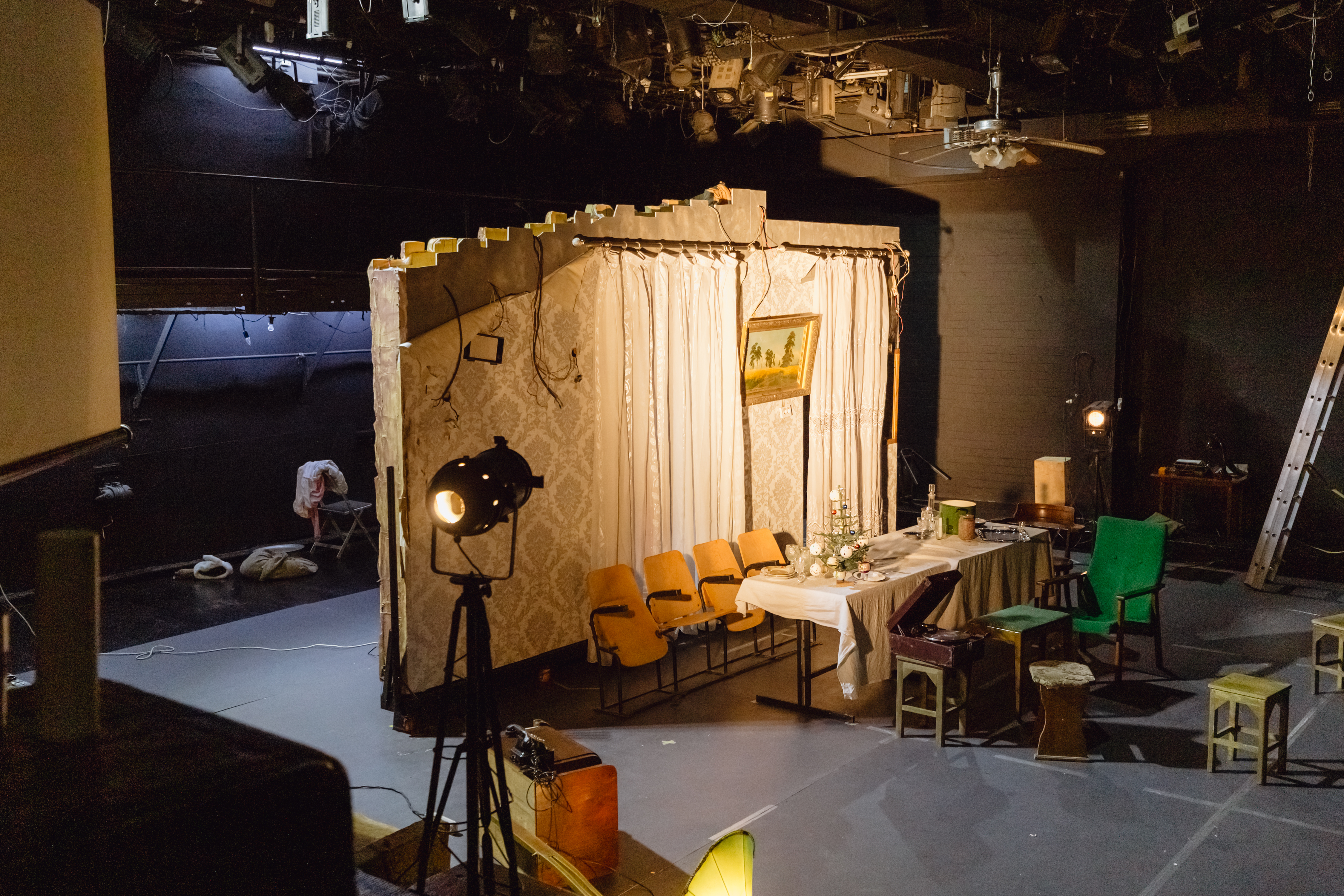
Plus we added something that wasn't in the film or the book. But we made it so that for Nika, Tashkent is her beloved city. And it's such a place because, unlike everyone else, she didn't come here when the war started. Nika came to Tashkent when she was two years old—so, presumably after the formation of Uzbekistan—sometime around the mid-1920s. She sort of grew up with this city, knows every nook and cranny, walks through this Tashkent, and shows it to Lopatin. Yes, we invented quite a bit here so that Tashkent would also be a hero.
— German's film is a kind of road movie that loops back to the front. How did you solve the problem of recreating this movement through space and time on the small stage of the "Ilkhom" theatre?
— Just come and see for yourself.
— Formally, your theater often relies on witness testimony and a static, almost meditative posture. What stage techniques have you used not only to convey facts but also to create an "empathic tunnel" for the audience?
— In our [performance], we have Boris [Gafurov], Gleb [Golender], and Olya Volodina working — not just young people. We constantly remind ourselves that we don't know what war is. It's a very complex question, but it is formative for the performance, because we constantly remind ourselves and the audience that we don't know how to play this.
There are scenes where Borya comes out and says: "Listen, how can I play this and not lie?" And the director tells him: "I don't know". The play constantly exposes the impossibility of talking about this because none of us has been to war, no one has seen it—we can only roughly imagine what it is like. So it's a very significant problem, and we don't shy away from it.
— Why was Boris Gafurov chosen for the main role — because of his resemblance to Nikulin in German's film or for other reasons? Was there a casting?
— Boris has these amazing quiet ranges of very deep silence and very great inner longing. And he uses them quite rarely, because he plays many different roles and is constantly changing. It seems to me that this longing is a kind of key to the conversation.
READ ON TOPIC:
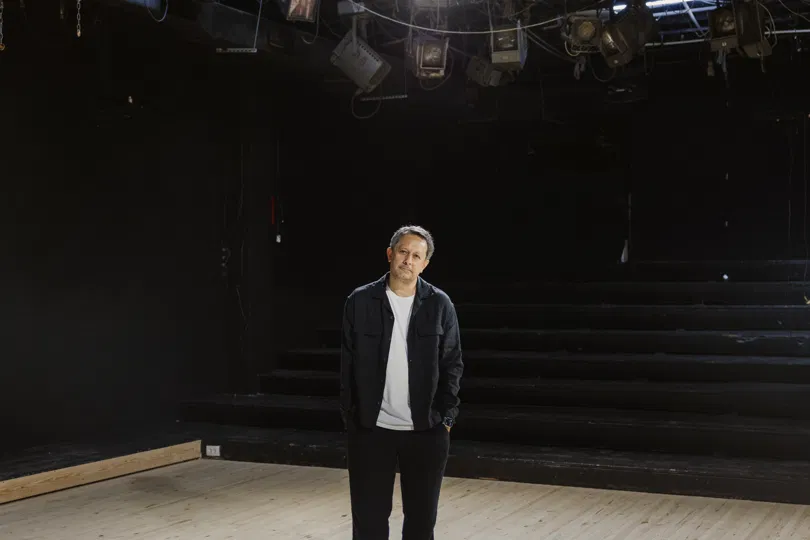
— Your plays — "Hiroshima," "The Red Book" — often address mass trauma. What can theater offer the viewer in working with trauma that, for example, documentary text or a memorial does not?
— I think, to start with — at the very least — we need to stop exploiting the concept of "trauma," because trauma has become some kind of bargaining chip. And when anything can be trauma — nothing is trauma.
First, we need to strip all this away and return to what trauma is. And the Holocaust is, of course, a trauma. Or Stalinism is a trauma. Or the Soviet Union is a trauma. Or you cannot learn the Tatar language—that is a trauma. Or World War II is a trauma. The Great Patriotic War is a trauma. Evacuation, I think, for Tashkent and for those who were here, is also, of course, a trauma.
And it seems to me that we must work through this, make it visible, create opportunities for communication with this trauma, bring it out from the zone of repression into the zone of perception, reaction, and analysis.
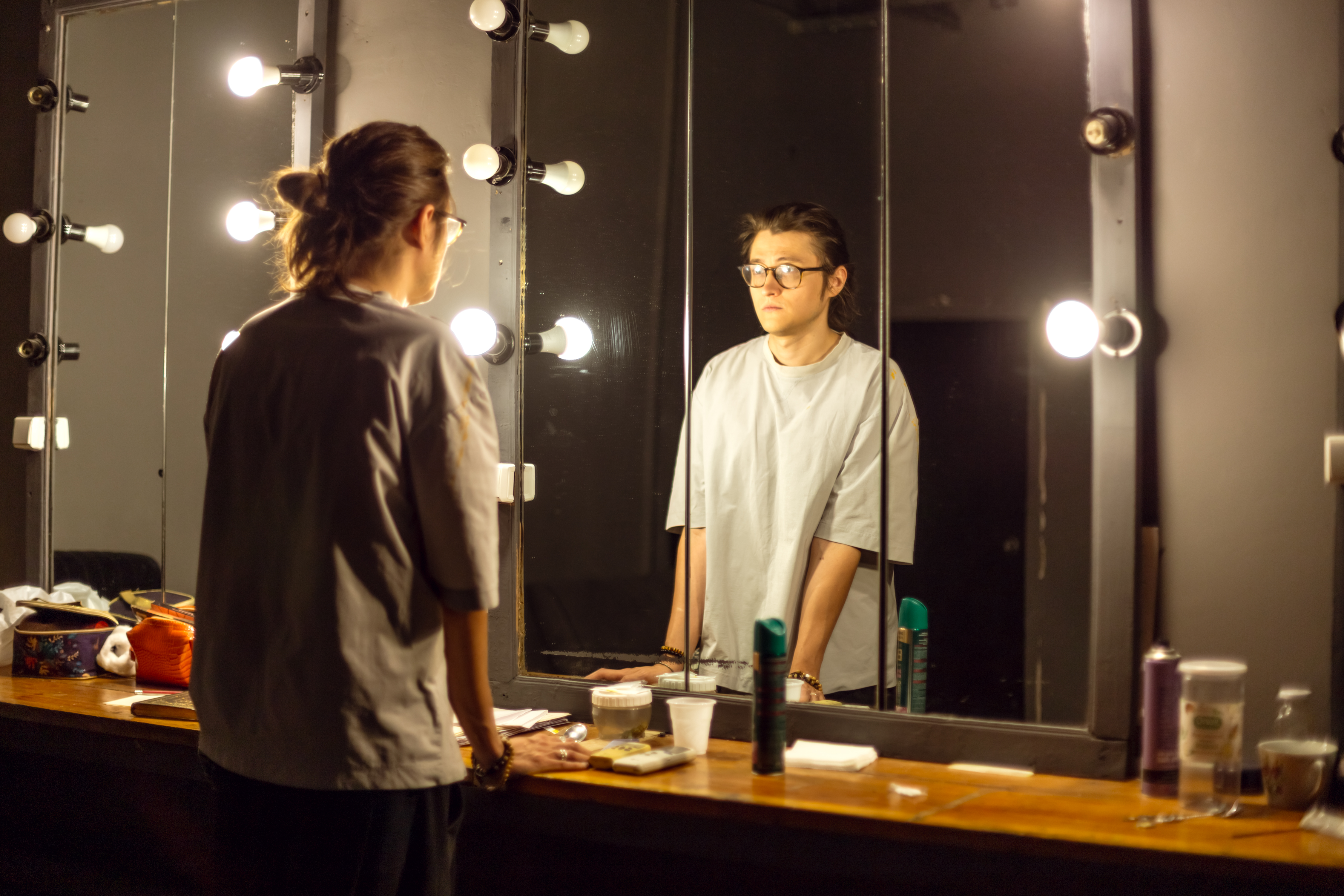
We focus on World War II and consider: did it ever really end? And what begins when a war ends — peace or something worse? What wounds does war leave? When does a war truly end — when the last veteran dies? Or does it never end?
— The final and most important question: what can contemporary theater oppose to the ongoing catastrophe and dehumanization?
— I think nothing. Theater can't do anything.
But this small group of people - me and the artists - we save each other and prevent each other from becoming dehumanized. I know that - our group, our team, my artists, my artists, the workshops - we extend a helping hand to each other in this situation, as if sharing the pain and overcoming it.
We don't let the language of theater—or theater itself—lie. We don't let it fall silent. You see, art, theater—it's a very fragile thing. If you stop taking it seriously for even a second, it becomes garbage. It instantly—especially in the face of the reality of war and the reality of violence—disembodies. And if we don't believe it's a miracle, then nothing remains of it. That's why we try to keep believing.