Literature and Storytelling
Shamshat Abdullaeva's boxwoods. What the leader of the Fergana school of poetry wrote about and mourned.
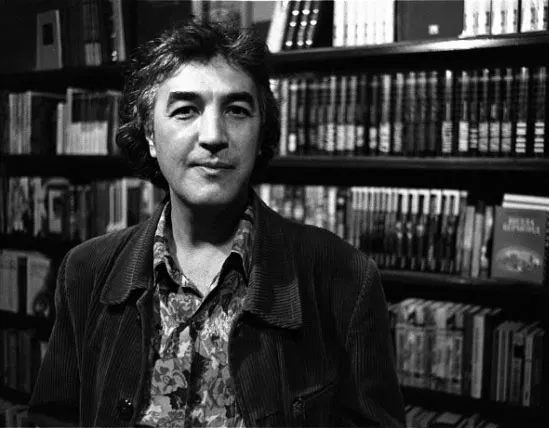
A year ago, Shamshad Abdullaev passed away. A poet, essayist, editor. Laureate of the Andrei Bely Prize, the "Russian Prize," a fellow of the Joseph Brodsky Foundation, and a leader of the Fergana school of poetry. He was better known outside of Uzbekistan. Writer and literary critic Sukhbat Aflatuni explains why.
"Shamshad" translates as "boxwood".
A rare plant in Uzbekistan — although it is being planted more frequently now.
Shamshad likely knew the meaning of his name, "settling" the boxwood in one of his poems — "Three Movements to Serpashot":
Everywhere (back then) the periphery grows,where one can almost for the first time observe the dry boxwood,hoarse, if it could sound—a rusty cantilena in a faded radio play.
And Shamshad's own voice, when he read his poems, was quiet, slightly hoarse. It's hard to imagine them resounding from a large stage in a vast hall. Although Shamshad undoubtedly possessed the "magic of reading" — the ability to induce an almost hypnotic fascination in his listeners.
There were many poetic schools noticed by critics.
Ural school. Minsk school. Smolensk school… Tashkent… Riga…
Some schools were fully aware of themselves as schools. Some were partly invented by critics and literary scholars.
In the case of the"Fergana school", both the first and the second were present.
On one hand, by the mid-1980s, a circle of people writing poetry in a similar manner had formed in Fergana. Besides Shamshad, it includes Abdulla Khaidar, Sergei Alibekov, Daniil Kislov, Hamdam Zakirov, Vyacheslav Useinov, Grigory Kolet (Kaptsan), Renat Taziev, Yusuf Karaev, and sometimes Alexander Gutin and Max Lurie (although they wrote in a somewhat different style). In the early 1990s, Olga Grebennikova and the Tashkent-based poet Yevgeny Olevsky began to be associated with the Fergana School.
On the other hand, Shamshad repeatedly stated that they did not perceive themselves as a school.
"...We never intended, never organized ourselves for the sake of some school. Our friendship, our conversations, our meetings forty—forty-five years ago developed and unfolded on their own, spontaneously, without any plans and without any calculation for the future. The term 'Fergana School' is a privilege belonging to Russian critics."
The last point is not entirely accurate.
The phrase "Fergana school" appeared long before Russian criticism — in an article by Tashkent literary scholar Lydia Levina titled "Is This the Beginning of Change?", published in the May 1988 issue of "Star of the East". The article was dedicated to the Tashkent almanac "Youth", including the poems by Shamshad published there; Levina noted them as very interesting: "He writes in a purely contemporary manner, rejecting not only rhyme and syllabo-tonic meters, but sometimes even the division of the text into lines."
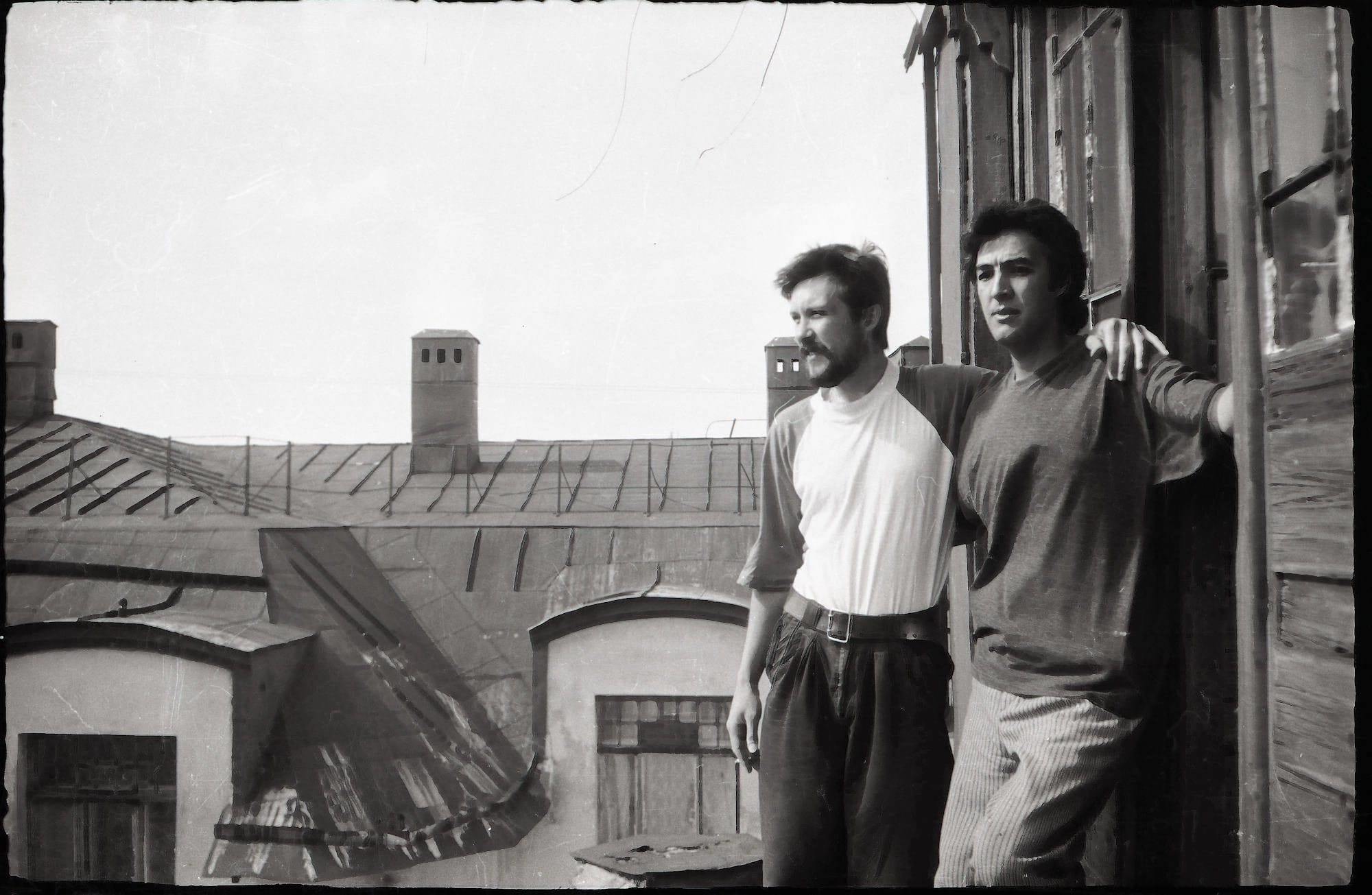
The definition was uttered — "Fergana school".
The actual founder of the "school" was the Fergana poet Alexander Kuprin, who wrote under the pseudonym Abdullah Haydar.
...Oh my old childhood,stuck between the forties and sixties,on the outskirts of town on Melnichnaya Street,in the uneven lines of people and houses,in the "Shanghai" near the station,where black steam locomotives stoodand departed with their eternal whistle and chugging,where in the morning, inside Kolka's coat,the captured sky began with pigeons,and the slingshot sometimes flew higher than it...
This excerpt from Khaydar's 1980 poem contains almost everything that by the early 1990s would be recognized as the hallmarks of the "Fergana School." Both the meditative, "slowed-down" free verse. And the cinematic optics. And the nostalgia. And the outskirts of Fergana as a place of special poetic contemplation... And also the particular mythologization inherent in all the poetry of the "Ferganians," and indeed the Fergana School as a whole.
After heading the poetry department of "Star of the East" in 1991, Shamshad began to use the concept of the "Fergana school" quite actively (again, even before the "Russian critics"). He attempts to identify the defining characteristics of the "Fergana" poets: "They are distinguished by a propensity for meditative, ontological (existential) poetry." Or, introducing the publication of Yusuf Karayev in "Star of the East" in 1992, he notes: "A representative of the 'Fergana school'."
In addition to the "Fergana poets," Shamshad publishes representatives of the Leningrad poetic underground in "Star of the East": Arkady Dragomoshchenko, Dmitry Volchek, Vasily Kondratyev... (Shamshad himself had been published since 1986 in the St. Petersburg — then still samizdat — "Mitin's Journal," which was published by Volchek).
It's hard to imagine today, but in the early 1990s, publication in a Tashkent journal was quite significant for Moscow and St. Petersburg neomodernists who had just emerged from literary underground. The capital's literary journals were in no hurry to publish them, and "Star of the East" (along with Riga's "Rodnik") became one of the first official platforms for these authors. The journal's circulation in 1991 was about 75,000 copies, which is also hard to imagine today.
In 1996, the entire editorial staff of "Star of the East," including Shamshad, was forced to resign. The main reason was a conflict with the Union of Writers of Uzbekistan. Although "Star of the East" was formally no longer an organ of the Union, there was a painful reaction there to the editorial board's reluctance to publish authors from the "Union of Writers."
The number of the magazine's detractors— including influential ones—was growing.
The departure of the previous editorial team has surrounded the name of Shamshad and the entire "Fergana school" with a sacrificial aura. One can even come across the assertion that after the editorial office was "destroyed, ... the poets of the Fergana school were forced to emigrate from the country."
This is also a myth. Most poets associated with the school left Uzbekistan much earlier and not for political reasons. Karayev, Gutin, Kohelet, Lurie, Taziev... There were no repressions against the Fergana school or a ban on publishing their poems; in 2000, a beautifully published anthology "Poetry and Fergana," compiled by Shamsad, was released in Tashkent.
But after leaving "Zvezda Vostoka," Shamsad indeed increasingly distanced himself from the Uzbek literary scene. He openly called modern Uzbek literature "conformistly primitive," existing "in a dead and backwater isolation" (from an interview). For local writers, he became increasingly alien.
In early 2006, Shamsad made another attempt to present his vision of contemporary literature. On the website "Fergana.Ru," edited by one of the "Ferganians," Daniil Kislov, Shamsad started a new project—the online magazine "The Remembered House". It did not last long.
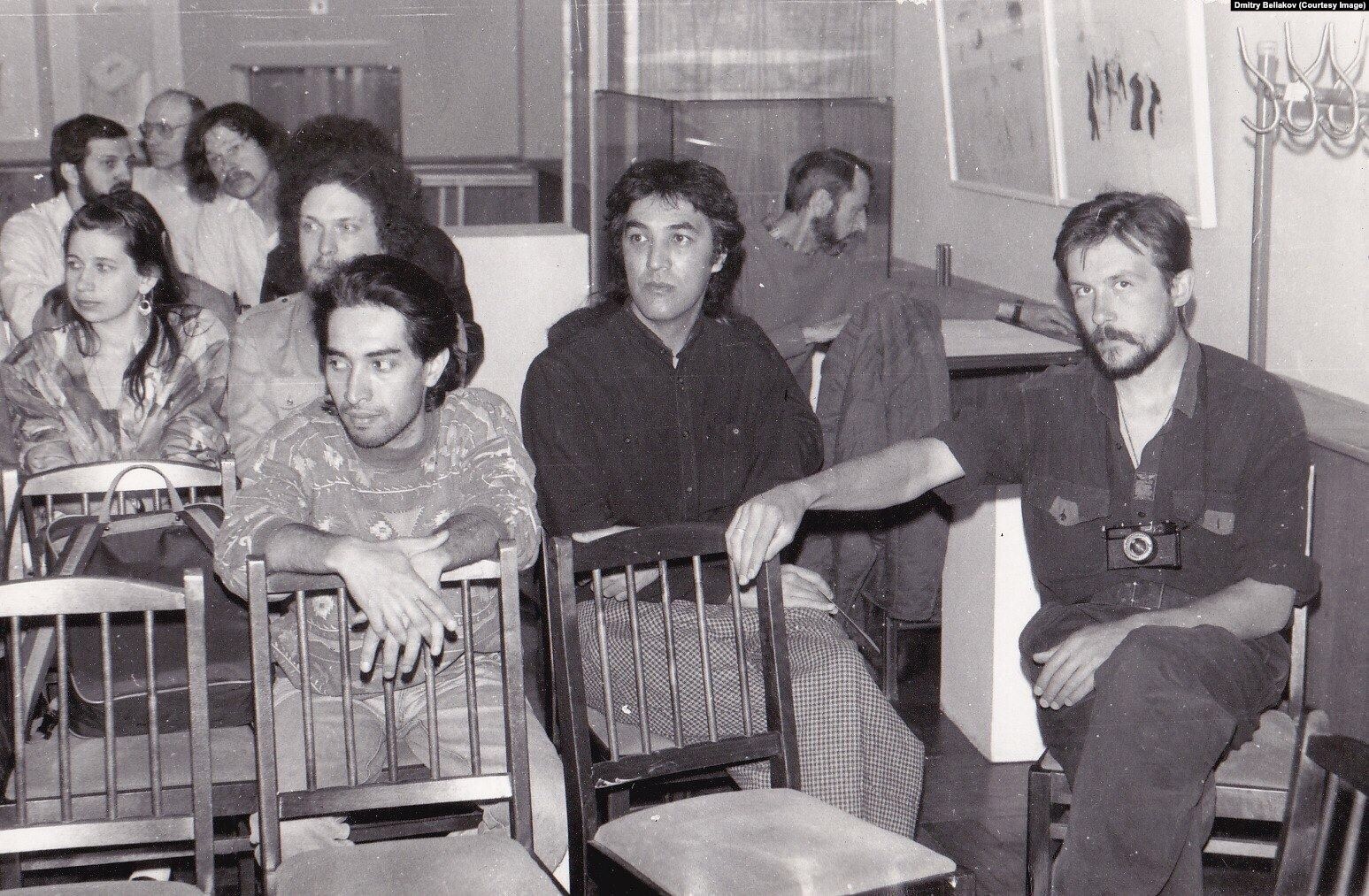
Shamshad himself moved to Almaty in the autumn of 2006. Initially, as planned, for treatment, but he stayed there for a long time.
This change of location in no way affected his texts. Moreover, in all publications relating to his Almaty period, his place of residence was indicated as Fergana.
He truly remained there in his thoughts – in his Fergana.
"...Today's Fergana is not the space we spoke and wrote about with such longing, in such detail and hallucinatory fashion. That space no longer exists. ...They cut down the trees, though the city was once green, famed for its gardens, lushness, and evergreen ghostliness. That is gone now. The antique houses are gone, that very retrospective Modernist architecture characteristic of some countries that became the prey of colonists, like the Maghreb: Algeria or Morocco; they didn't destroy the French architecture but preserved it as part of history. We, on the contrary, have cut everything down..." (from an interview).
The same acute nostalgia for Fergana as a place of loss resonates in one of Shamshad's last poems published during his lifetime, "The Pool. 1901."
The smell of old rags is audible,burning out beyond the windows of the suburbin the shrubby yards of one ofthe Turkestan provinces oppositethe tannery. A slow gestureof the right hand: caballero andante.The rebellion is quelled, as is customary, and in NewMargelan commanded a companyAlexander Petrovich Tchaikovsky; andin the vicinity of the silk-throwing factory up to(in the western part of present-day Fergana)this day gapes an ovalkhauz (in the governor's house then,thirty-eight years before Sadovsky, beforeYevgeny Sadovsky, a young footman fromProskurovsky Uyezd, Mikhail, translated from German the novel"Hyperion" in shreds of phrasesby Hölderlin, struck down by Apollo…
"We are interested in authors who follow the path of outsiderness and escape, the path of writing and solitary imagination," Shamshad wrote in the "Notice" to "The Remembered House."
All of this can be applied to him as well. He himself walked the path of the outsider and the fugitive, the path of writing and solitary imagination.
And he achieved a great deal on this path.
It would be good if at least one or two of Shamshad's poems were included in the school literature curriculum. Yes, they are not easy to comprehend. And what, is "War and Peace" easy?
And one more thing — for there to be a street named after Shamshad Abdullaev in Tashkent, or better yet, in Fergana. A small, quiet street planted with boxwood bushes. At least somewhere in the outskirts, which he so loved and made a fact of Uzbek, Russian, and, overall, world literature.
READ ON THE TOPIC:
Люди уехали, речь осталась: что происходит с русским языком в Узбекистане – и что его ждет?6 июня литературная Россия отмечает день рождения Пушкина, эта же дата объявлена ООН международным днем русского языка. Когда-то пришедший в Ташкент с метафорическим пушкинским караваном, он до сих пор остается важным языком общения в Узбекистане несмотря на смену поколений, демографию и политический контекст. Что делает русский язык частью узбекской повседневности – и надолго ли он здесь?mag.humodoc.com
Did you like the story? Support us on Instagram and Telegram.
Read also
 Literature and Storytelling
Kazakhstan announces a hunt for readers. Read 15 books and get 10 million tenge
Kairat Baltabai
 Literature and Storytelling
"Days Gone By" Today: Cinema, Theatre and the Living Legacy of Abdulla Qadiri
Christina Inyakina
 Literature and Storytelling
The Doctor Who Changed Literature: Anton Chekhov
Christina Inyakina
Newsletter
A letter from the HD editors
Once a week, we send the best stories, events, and cultural discoveries from Central Asia.