
Language is often described as a living organism. This idea reflects, above all, its sensitivity to social change. The Kenyan writer and theorist Ngũgĩ wa Thiong’o viewed language as a repository of collective memory, preserving the experiences of those who speak it. In this sense, language allows us not only to communicate and understand one another, but also to detect the features of different historical periods and to recover forgotten histories of intercultural exchange.
One of the most widely recognised early contacts between Turkic peoples and the Eastern Slavs dates back to the thirteenth century, with the westward expansion of the Ulus of Jochi. However, linguistic analysis suggests that peaceful interaction had begun long before this period. According to Margarita Fomina, the borrowing of Turkic words into Russian can be traced as far back as the era of Kievan Rus. At that time, political, cultural and commercial ties between Slavs and Turkic peoples fostered active linguistic exchange. Given the breadth of these interactions, borrowed words came to belong to a wide range of semantic
groups.
Among the most widely used Turkisms are terms related to trade and governance, such as kazna (treasury), karaul (guard), and dengi (money). According to A. V. Semyonov’s etymological dictionary, the word kazna was borrowed from the Tatar xazna, meaning “treasure”. Its origins are also reflected in the related word kaznachei (treasurer), formed using the suffix -chi, commonly used in Turkic languages to denote professions. One possible explanation for this borrowing lies in the influence of the Ulus of Jochi on the political and financial systems of Rus,
particularly in matters of finance. Thus, the princely department responsible for collecting taxes and tributes, including those owed to the Horde (Ordynskiy Vykhod), was known as the kazna.
Related reading:
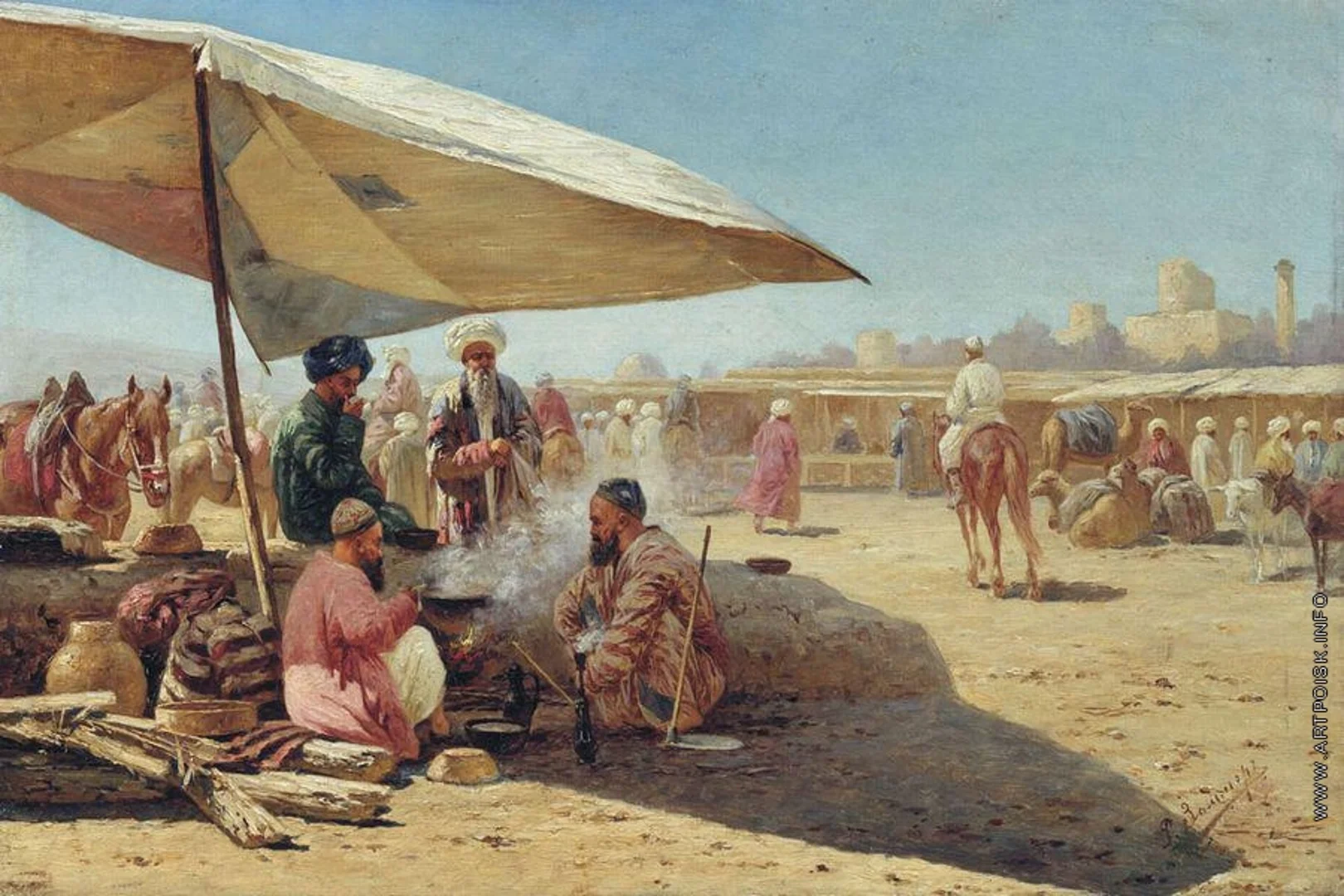
Various Turkisms assimilated into the Russian language and were so frequently used in the early periods of Russian history that some of them are perceived as Old Russian vocabulary. For example, Fyodor Tyutchev wrote:
No mind can fully grasp Russia, Nor can a common arshin measure her; She bears a character all her own, In Russia, one can only believe.*
*(Translated from Russian with minimal adaptation to preserve the integrity of the original text)
The unit of length arshin, mentioned by the poet, is also a Turkism. It remained in active use until the introduction of the metric system in 1918 and corresponded to approximately 71 centimetres. Its Turkic origin is suggested by the fact that the measure appeared in Russia only in the sixteenth century, whereas in Central Asian states it had been widely used as early as the ninth century. Some terms for clothing, such as sarafan and kaftan, are also mistakenly perceived as Old Russian. Sarafan derives from the Turkic sarapa, meaning ceremonial or honourable dress. Kaftan, according to the Oxford Dictionary, may have been borrowed from several Turkic languages, including Turkish (kaftān). The spread of these terms was facilitated by the advanced textile production and high-quality garments of Turkic peoples .
At the same time, Russian adopted so-called exoticisms, words used to describe phenomena perceived as specifically Turkic, such as ataman, basurman, and orda. In later periods, this category expanded with terms that entered Russian through closer contact with the Ottoman Empire, including pasha and harem.
A significant number of Turkic loanwords also entered the English language, including sultan, Ottoman, and vizier. Alongside well-developed Anglo-Ottoman political and economic relations, their adoption was
was facilitated by the great interest of English society in the wealthy and successful Ottoman Empire, especially during the reign of Elizabeth I.
The word turban, for example, derives from the Turkish tülbent and refers to a form of headwear once popular among Muslim men, including Ottoman sultans. Exaggerated in scale, the turban became a key feature in European portraits of Ottoman rulers. These images both celebrated the sultans’ wealth and subtly mocked their appearance by emphasising their “otherness”. This tradition is often traced back to a portrait of a sultan, believed to be Suleiman the Magnificent, painted in London by the Netherlandish artist Hans Eworth in 1549. Like many who followed him, Eworth had almost certainly never seen an Ottoman ruler in person.
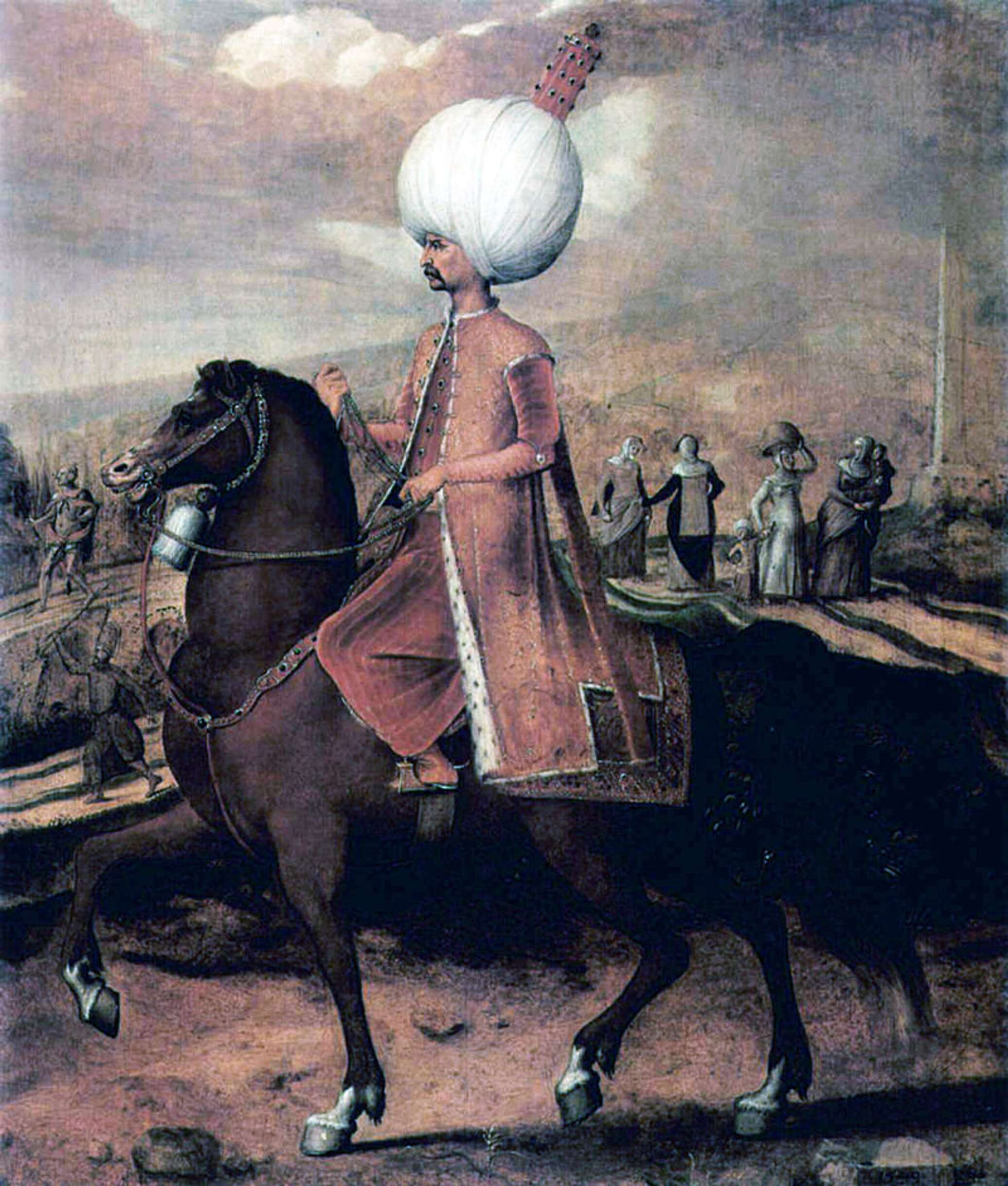 Source: The English Encounter the Ottoman World by Gerald Maclean
Alongside such exoticisms, English also includes fully assimilated Turkic loanwords used in everyday speech,
particularly in relation to food, such as yogurt, sherbet and coffee. The word coffee comes from the Turkish kahveh, although the drink itself originated in East Africa. Despite this, it was in the Ottoman Empire, as well as across the Arab world and the Mediterranean, that coffee houses became immensely popular in the fifteenth and sixteenth centuries, playing a crucial role in spreading coffee culture worldwide.
Numerous travellers and merchants visiting Istanbul, Cairo, Aleppo and Baghdad returned home with enthusiastic accounts of what they called “the wine of the Arab world”.
Some Turkic-derived words entered English in altered forms. For a long time, the word Tatar was spelled Tartar and used broadly to refer not only to Tatars, but also to various Turkic peoples of Central Asia and even to the Mongols. The term also appears in the idiom to catch a Tartar, meaning to encounter someone formidable or troublesome. Charles Dickens, in Barnaby Rudge, wrote of “a poor good-natured creature who went out fishing for a wife one day and caught a Tartar”.
Beyond direct borrowings, English contains many fixed expressions involving the words Turkish and turkey which are no longer perceived as having any real connection to Türkiye (Turkey) or the Ottoman Empire. The bird known as turkey, for example, was originally referred to as turkey-cock, a name first applied to the guinea fowl imported into England from West Africa via Ottoman trade routes. In the early sixteenth century, however, European colonists brought the American turkey to Europe. The new and popular bird inherited the name turkey, while the original species came to be known as guinea fowl.
Thus, Turkic languages have had a significant impact on both English and Russian through loanwords that remain in use today. Many of
them are so deeply embedded in everyday speech that they are no longer perceived as foreign. While not all borrowings are immediately recognisable, a closer look at linguistic history reveals just how extensive the presence of Turkic elements is in both European and Slavic languages.


