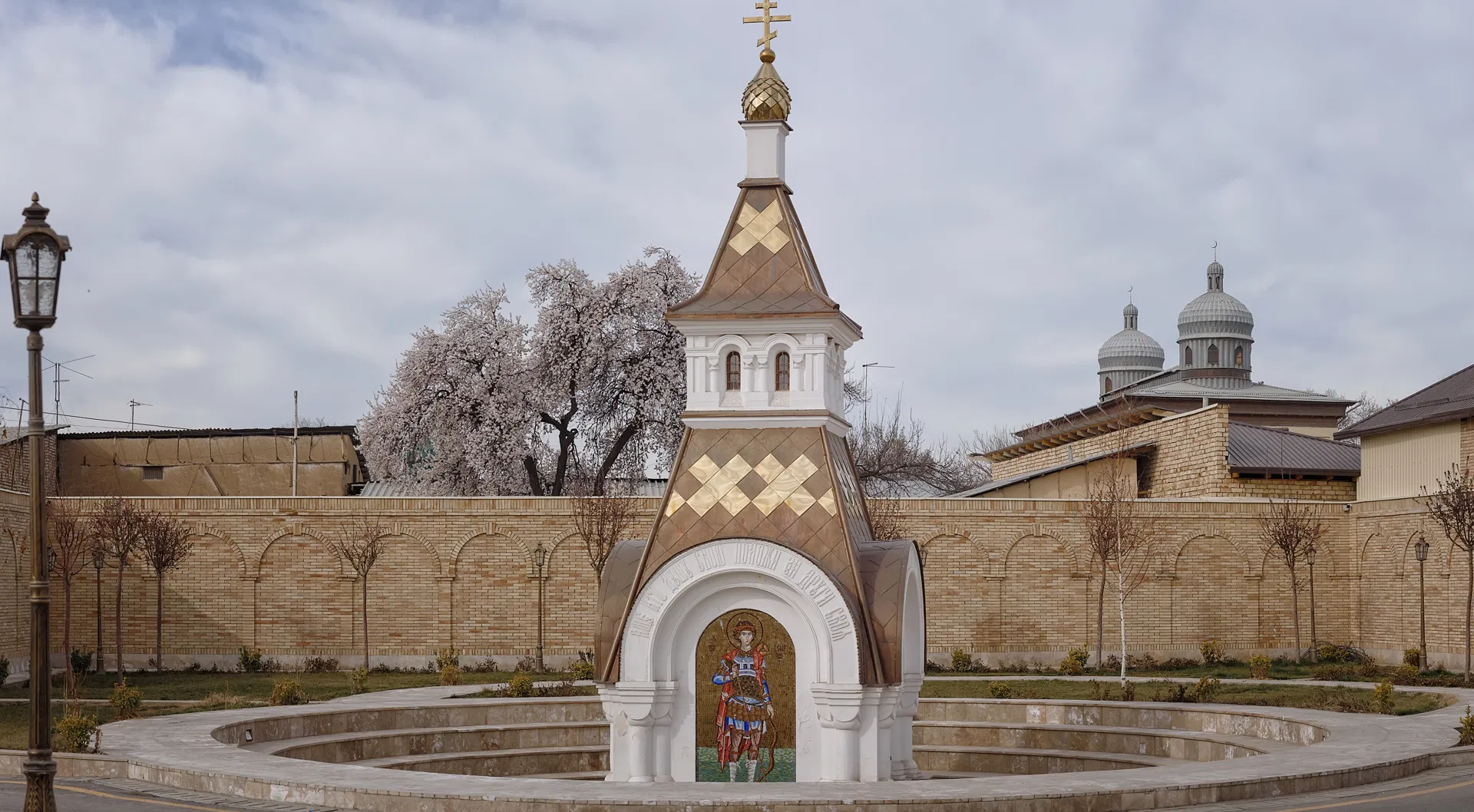
The First Church of the City
Every city has had and still has its own symbols, its own shrines. Some are gone, others have been rebuilt. But even those that no longer exist are, in one way or another, preserved in the people's memory. The first church built in Tashkent was the Joseph-George Church. It was erected next to what would become one of the city's central avenues and a future metro station. It was built in less than a year—construction and consecration took place in 1868. It was built hastily, without much attention to any particular design features, which is why the building looked rather mediocre. As a result, in 1874, a decision was made to rebuild the church.
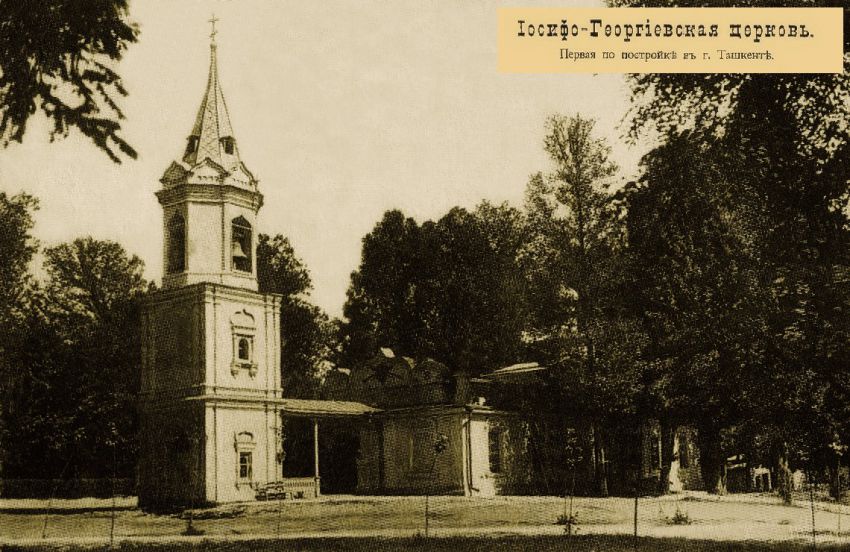
Three years later, a neat, low bell tower was erected next to the church. It was built from fired Turkestan brick and connected to the main building by a covered canopy. All the work was carried out according to the designs of the architect and designer of the city park, N. F. Ulyanov, who was already a well-known professional in his field at the time. The little church could hold only about eighty people. Because the church stood directly opposite the palace of Grand Duke N. K. Romanov — a relative of the Russian emperor exiled to our city — it was mistakenly believed to be the "private chapel" of Nikolai Konstantinovich.
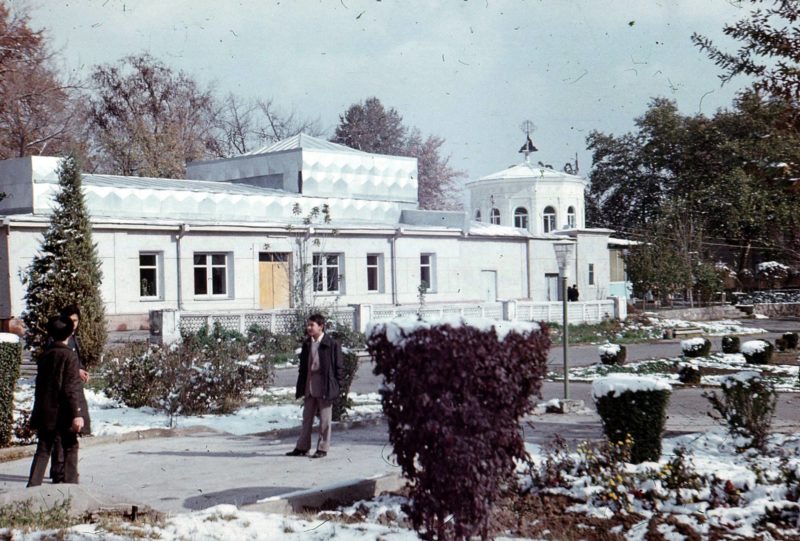
However, the church never belonged to the prince in any way. Although His Highness's own "hunting" castle (which still stands in its original location) was only decided to be built here twenty-three years later. Until 1893, the church was under the jurisdiction of the Military Department, when it was transferred to the Central Asian Diocese, becoming an ordinary city church. It retained its significance until the 1920s, when, in the heat of the struggle "against religious prejudices," the building was handed over to secular authorities.
Later, the building served various purposes. It was both a puppet theater and a dumpling house with ice cream on the menu. In 1995, this fine building was gone, leaving only a small square opposite the building of one of the law enforcement agencies, which has also since been demolished.
Business Card
Literally next to this small temple stood another structure that effectively served as the city's landmark. This was the Transfiguration of the Savior Military Cathedral, built in the beautiful "Byzantine" style. It was constructed by craftsmen "contracted" for this work from the European part of Russia. The cathedral was founded on July 22, 1871. However, the original construction schedule could not be met, and the consecration of the cathedral took place only on July 14, 1888.
Wilhelm Solomonovich Geintselman, already a well-known architect in Turkestan at the time, had a hand in the construction of the Cathedral. However, in this case, not all of his decisions proved correct. For instance, covering the dome with a lead roof was a mistake in itself, as it was extremely labor-intensive. Moreover, the architect failed to account for the effects of the weather and the low melting point of lead in our hot climate, so it quickly cracked and had to be replaced with ordinary roofing iron.
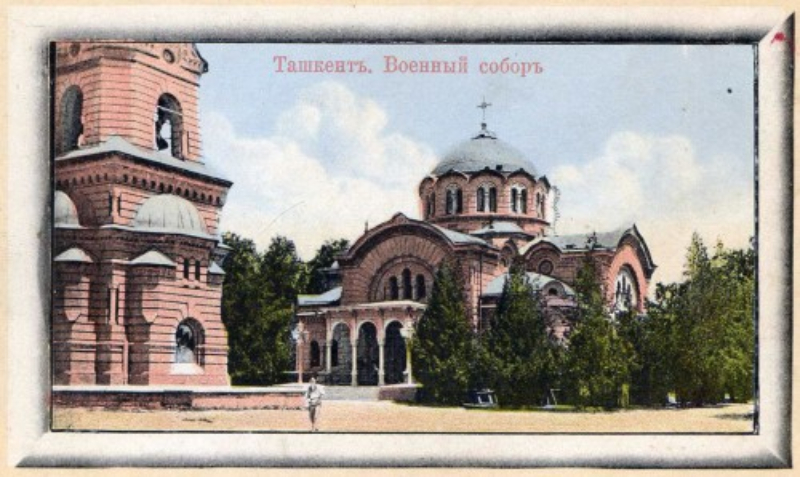
The cost of the Cathedral amounted to an astronomical sum for that time — about three hundred thousand rubles. Next to the Cathedral stood a bell tower, which had ten bells, all cast in Tashkent from old bronze artillery pieces that had been decommissioned. Inside the cathedral, as was customary, there was an iconostasis and all the other furnishings befitting a temple. This structure was also notable for the fact that in its various chapels were buried the first rector of the church, Archpriest A. E. Malov, Lieutenant General K. P. von Kaufman, and Lieutenant General N. A. Ivanov.
The Cathedral itself had a very short life. In the 1930s, it was barbarically destroyed by explosions and artillery fire. The former location of one of the city's landmarks is quite easy to find — it is the very same air-conditioning fountain and the platform above it on Independence Square, recently returned to Tashkent residents, albeit in a "truncated" form.
Here is the English translation of the provided text, following all specified rules: St. Panteleimon's Church
Now, on our virtual tour bus, we will drive past the "Cosmonauts Square" metro station and descend along the wide avenue toward the old, beloved Hospital Market.
Next to it are still located the grounds of the first military hospital and the main Dormition Cathedral of the Central Asian Metropolitan District. Their history began on April 27, 1868, when, for the construction of a military infirmary, it became necessary to purchase gardens from local residents located along the Salar Canal. The acquisition of the land plot alone cost over three thousand rubles—a considerable sum for that time.
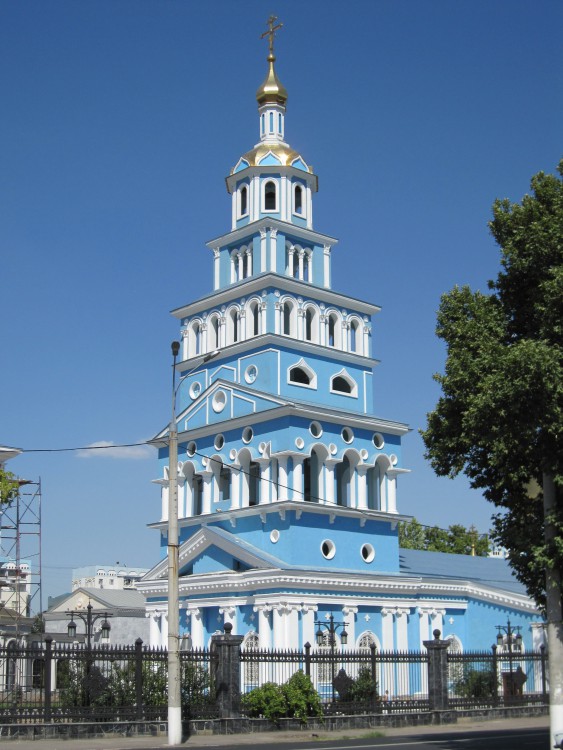
The hospital itself opened its doors in 1870. The following year, a temporary church was built next to it. It was constructed primarily with funds from military personnel (officers and soldiers), but donations also came from private individuals. It was built from adobe brick, then covered on the outside with "asphalted felt." On September 30, 1871, it was consecrated in the name of the Holy Great Martyr and Healer Panteleimon, to whom the faithful prayed for the recovery of their relatives and loved ones.
Unfortunately, it is unlikely that any photographs of it can be found — they either have not survived, or it was simply never photographed. After its expansion, it was reconsecrated under the same name of the saint on January 31, 1879. In 1890 — primarily with funds from the local merchant Dmitry Nikolaevich Zakho — a bell tower was built next to it.
This temple was blessed with an unusually fortunate fate. It was both closed and, for a brief period (from 1933 to 1945), handed over to serve as a sanitary warehouse for the military department, and even underwent reconstruction.
What is BEHIND Chauli
Driving along Nukus Street and then along Abdulla Qadiri Avenue, we emerge onto Independence Avenue (also known as Lager Avenue or Pushkin Street) and head toward Asaka Street and its intersection with Pushkinskaya Street. It was at this very point in the city, right where the modern overpass now stands, that a magnificent church once stood—a rival to another one located within direct line of sight from here.
Few people know that this new part of the city was once called Zachaulinskaya, meaning located on the other side of the Chauli Canal. Officers, civil servants, bank employees, and even generals used to settle in the local residential neighborhoods. It is no wonder that old-timers still refer to the ancient toponym — "the noble nest."
It was here that they decided to erect a new Orthodox church, the project of which was approved on June 5, 1893, and the first foundation stone was laid as early as July 22. For the "construction" of the walls, a contract was signed with a Tashkent construction firm owned by the sons of the famous merchant Seyid Azimbay Muhammadbayev — Seyid Karim and Seyid Gani. And how skilled the masons of this enterprise were was well known far beyond Tashkent.
The authors of the project were Academician I. I. Shaposhnikov (father-in-law of Nicholas Roerich) and the slightly less renowned architect N. Latyshev. The interior stucco work was carried out according to the drawings of engineer-colonel L. Kiselyov. Overall supervision remained with A. A. Burmeister, then still a colonel. The construction of the church was completed in three years. Situated on a hill, the structure, according to G. N. Chabrov in the "Guide to Tashkent," resembled "the figure of a priest in a chasuble, in a prayerful pose, with arms raised upward." V. A. Nielsen noted the "expressive silhouette and important urban planning significance" of this remarkable building.
The unplastered walls were built from fired Turkestan brick, laid on lime mortar with natural additives — chicken eggs (apparently, this made it quite difficult to demolish the temples even by means of explosives). The church could hold six hundred people, although one might assume that at least twice that number could fit in its main hall.
The interior of the church amazed with its elegance and splendor — ganch decorations, an abundance of light streaming through the windows, and a custom parquet floor made of mulberry and walnut. The church's iconostasis was specially brought directly from the Trinity Lavra of St. Sergius. Unlike the first two churches, the bell tower of this church was integrated with the church itself, and the main entrance to the church was located within it. The church had ten bells — ranging from the largest, weighing nearly 5 tons, to the smallest, weighing about 9 kilograms.
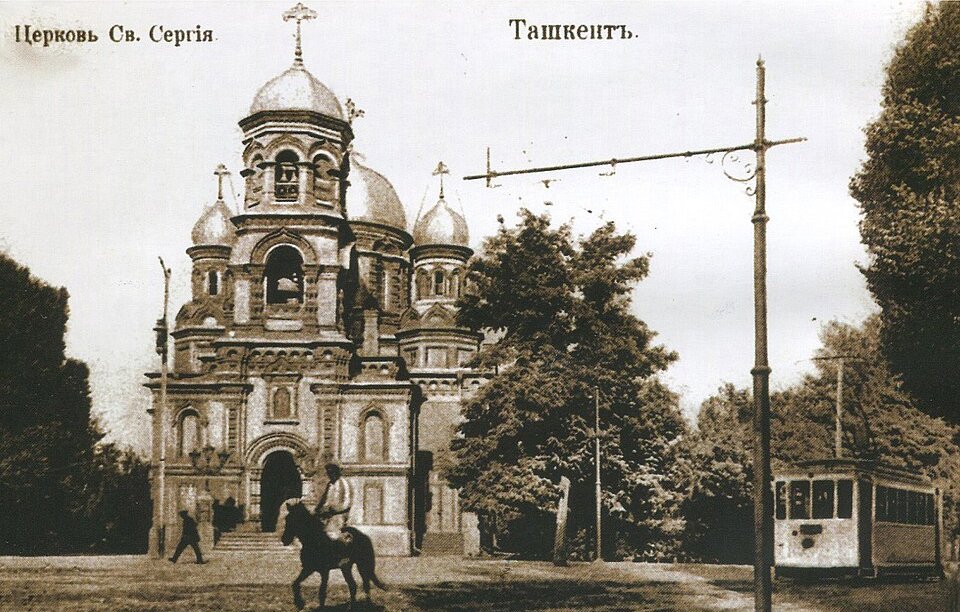
The rite of consecration of the church in the name of St. Sergius was performed on April 24 (May 9, New Style), 1897, by His Grace Nikon, Bishop of Turkestan. A solemn religious procession proceeded from the Transfiguration Military Cathedral, carrying the relics of St. Sergius and a copy of the saint's icon. When a tram line was later launched in the city, its route along the street curved around the right side of the church building, with the final stop located behind the church. Another notable fact about this church is that the renowned Turkestan surgeon and bishop Luke (secular name Valentin Feliksovich Voino-Yasenetsky) served there; a monument to him now stands on the grounds of the Holy Dormition Cathedral. He rented two rooms nearby in a house on Uchitelskaya Street (present-day Kary Niyazov Street).
Unfortunately, the historical events of the early 20th century greatly shortened the life of this beautiful structure. First, the church was closed, then a Metallurgists' Club began operating in the building with its crosses knocked off. By 1932, the Trinity-St. Sergius Church had been destroyed.
Alexander Nevsky Church
Nearby, on the southwestern side of the city's central square, the foundation of a five-domed church was laid on May 5, 1896. It was built in just one year and, upon completion, was consecrated in the name of the holy noble prince Alexander Nevsky. The consecration ceremony took place on November 22, 1897. Notably, it was part of the complex of buildings of the Tashkent Teachers' Seminary, an educational institution that trained teachers.
The church was built according to the design of the independent artist Alexei Leontievich Benois. Advisor Nikolai Ivanovich Ivanov took part in the construction of this building, which was so necessary for the seminary: at his own expense, he purchased and donated "for the needs of the church" fifty thousand pieces of fired brick, as well as church utensils, bells, and an iconostasis, all totaling more than six thousand rubles.
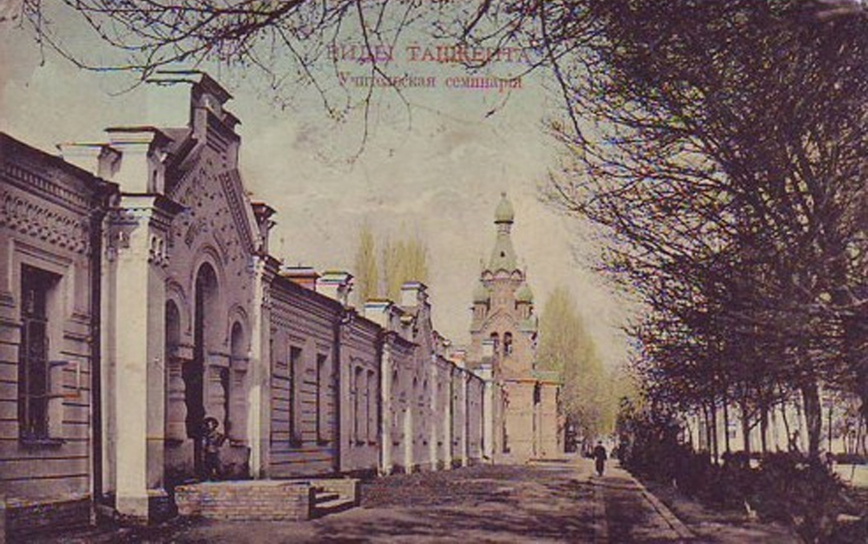
During the period of persecution of the church, the structure was classified as "harmful and unnecessary": first, the crosses were knocked down, and then the domes. After some time, the upper tiers of the building were also demolished, leaving only the first floor. It remained in this state until quite recently, when it was finally torn down.
Church of the Intercession of the Most Holy Mother of God
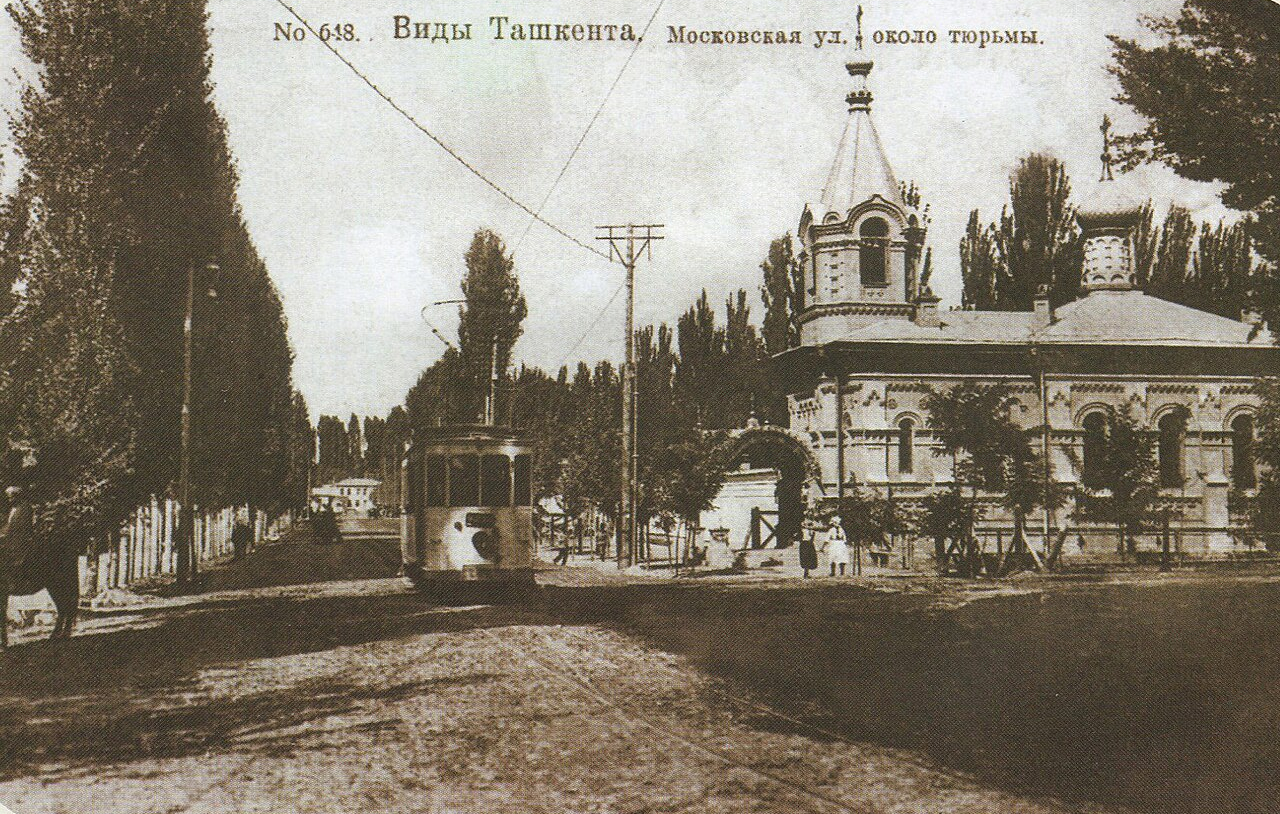
On the site of the former Yulduz garment factory, to the left of the Alai Bazaar, there was once another church. In the past, a so-called "correctional" house was built there, and on December 22, 1879, a church in the name of the Intercession of the Most Holy Theotokos was consecrated within it. Services were held there only on Sundays and feast days. It was also a place where "lost" souls could repent of their sins and receive absolution from a priest.
In 1906, the church was rebuilt and reconsecrated, this time in the name of Saints Peter and Paul. Like many other similar structures, it remained in existence until the mid-1930s.
Church of the Annunciation
At the intersection of Abdulla Qadiri and Amir Temur avenues, we find ourselves at the entrance to the Railway Technology Museum — this is where the fifth Orthodox church, designed by the renowned Tashkent architect Georgy Mikhailovich Svarichevsky, once stood. This church is notable because neither the state, represented by the military department, nor any other ministry was involved in funding the construction of this beautiful structure. It was built solely with money collected by railway workers and employees.
The proximity to the railway played only a positive role for the new church — even during construction, it was connected to electric lighting, unlike other churches that primarily used candle lighting. The new church was built from beautiful imported white brick, and the interior spaces were decorated by the entire community — for example, the icons of the iconostasis were hand-painted by the sisters of the Moscow Novodevichy Convent. The bell tower was equipped with eight bells, cast at the main railway workshops. The largest of them, the alarm bell, weighed six tons, and its sound could be heard in the very center of the city.
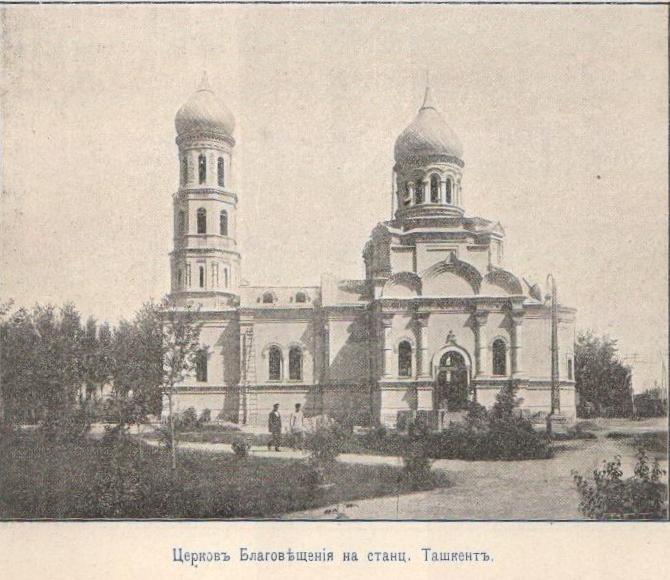
The temple was built under the supervision of one of the finest civil engineers in the Turkestan region, Alexander Ivanovich Ursati, who left us the Ursatyevskaya railway station — now the city of Khavast — as a legacy.
A new church was consecrated in honor of the Feast of the Annunciation of the Blessed Virgin Mary on November 23, 1899. Archpriest Mikhail Andreev was appointed rector of the new church, whose fate later turned out to be quite tragic. The church was a distinctive architectural landmark of the city, visible even from the center of Tashkent, and it is said that panoramic photographs of its immediate surroundings exist, though I have not yet been able to find them.
The Annunciation Church managed to survive all the historical upheavals of 1905 and 1917, but in the early 1920s it was demolished while the project's author was still alive. Today, the entrance arch to the "Locomotive Museum," as children often call it, stands proudly in its place.
"Lost" Temple
Near the former site of the Annunciation Church, specifically behind the station along Kushkuprik Street, once called Cossack Street, stood the barracks of the 5th Regiment named after Ataman Moguty. Nothing remains of these beautiful barracks — at times the military forbade photographing them, and at other times newly emerged developers prevented the preservation of the views of these late 19th-century military structures for history.
However, according to the leadership of the district's "Vatanparvar" organization, a church was located in their building. This claim was corroborated by the wall decorations still preserved under the roof of the structure, as well as the configuration of the now bricked-up window openings, which directly indicated that the building belonged to a church.
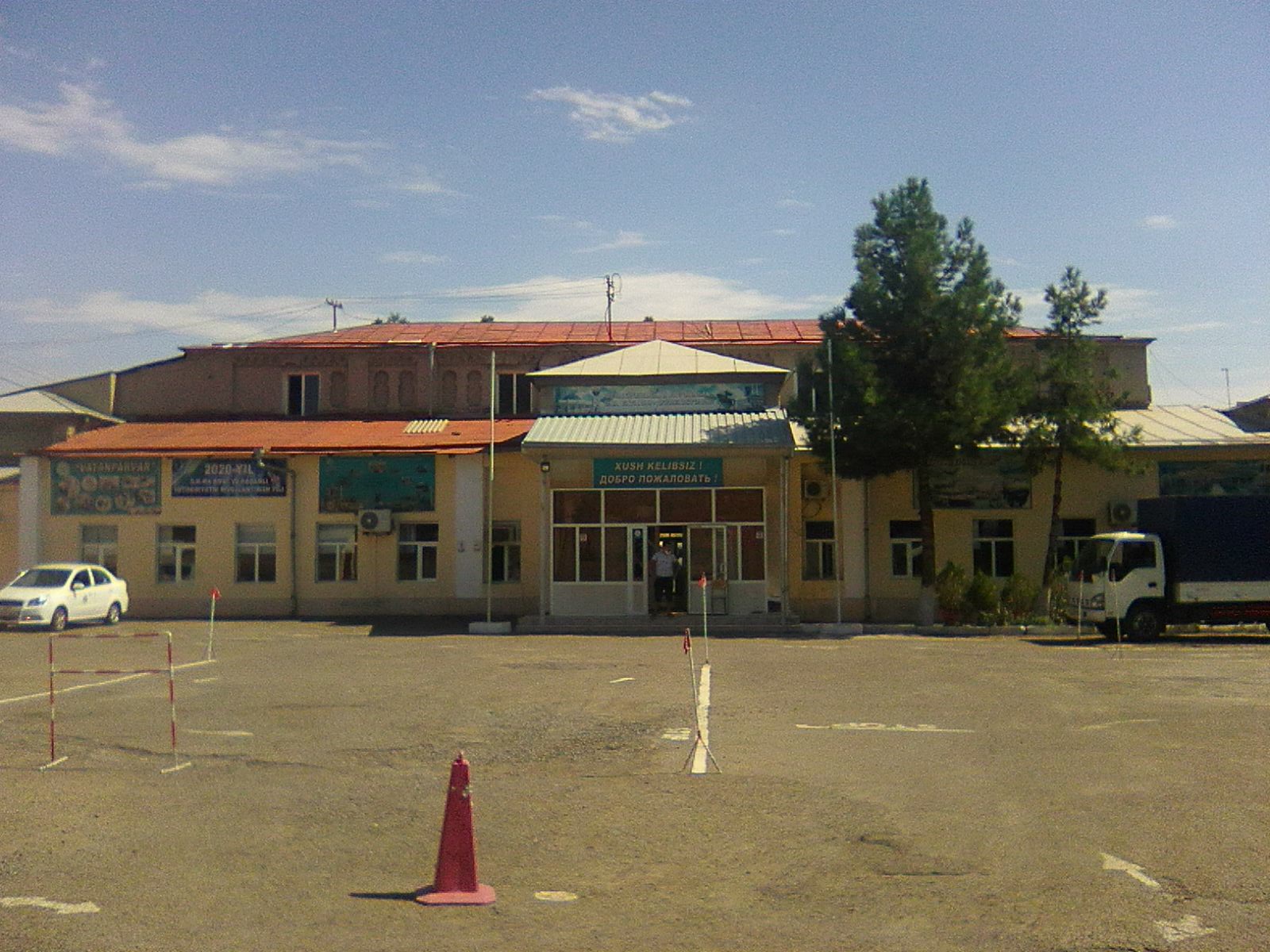
Upon learning this, I wondered — could this be the "lost" temple of Alexander Nevsky that people talk about? I have not yet found any information about this building, only assumptions that even the Metropolitan District office can neither confirm nor deny.
As it turned out, the name of Alexander Nevsky was originally borne by a tent-church dating back to 1865. That one is clear — tents don't last long. But there were more churches after that. The first dates to 1884 and was located in one of the camp barracks on the outskirts of Tashkent.
Another church bearing the name of Saint Prince Alexander Nevsky was consecrated on August 23, 1885, and was located on what is now Yakub Kolas Street, opposite Secondary School No. 110. It was in that very area that the barracks of the 2nd, 3rd, and 4th Turkestan Rifle Battalions stood, and in one of them this religious institution was housed.
So where did the other Church of St. Alexander Nevsky disappear to, given that its description clearly states — the 12th Turkestan Line Battalion, the 5th Regiment of the Orenburg Cossack Host, and the 7th West Siberian Line Battalion, along with the number of parishioners of "both sexes"? Could this be the very church on the site of which the "Vatanparvar" branch is now located? There is no definitive answer yet, so we will have to continue searching in the city's archives.
The Temple of the Future General
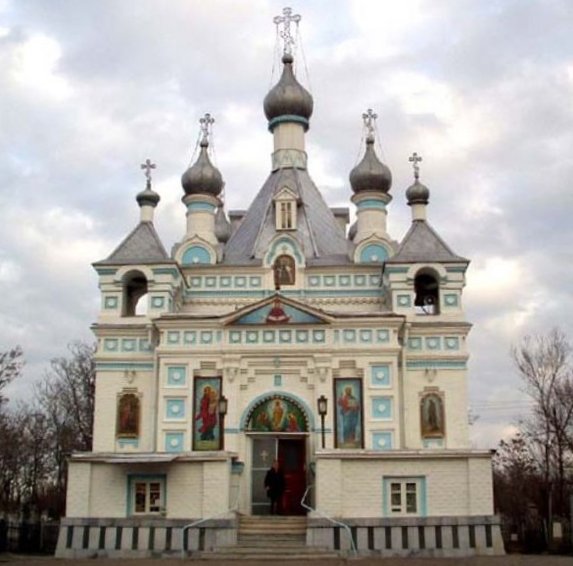
The eponymous Alexander Nevsky chapel-church is indeed the only one in the city. It is located at the sixth Orthodox cemetery, the Botkin Cemetery. The foundation of the new church was laid on November 23, 1902, and the first stone was set and consecrated on December 6 of the same year. Construction took over two years, and the church was consecrated on May 8, 1905, by Dean Archpriest Konstantin Bogoroditsky in the presence of regional and city authorities. On the front facade of the chapel-church, two bell towers were built, and the bells for them were cast right here in Tashkent.
True, the temple soon had to be urgently repaired — apparently, the ground had settled excessively. In modern times, the temple has undergone two restorations, but now it looks as good as new.
This concludes our brief excursion into the history of Tashkent's temples, and we will mention the youngest currently active religious institutions in Tashkent. There are two churches — one consecrated in the name of Saint Hermogenes, which began construction in 1954 and was consecrated only on December 11, 1957. It is located at 1st Dead End, 3, Oishakhonum Street. The second is located at the Dombrabad Orthodox Cemetery of Saint Equal-to-the-Apostles Prince Vladimir. The original structure dates back to 1970, built as a hall for civil funeral services; the Tashkent City Executive Committee transferred the abandoned building to the Orthodox Church on August 23, 1991. Renovation work lasted several years, as a result of which Archbishop of Tashkent and Central Asia (as the position was then called) Vladimir conducted the rite of consecration of the new church on November 18, 1999.
A Look Back at the Century Before Last
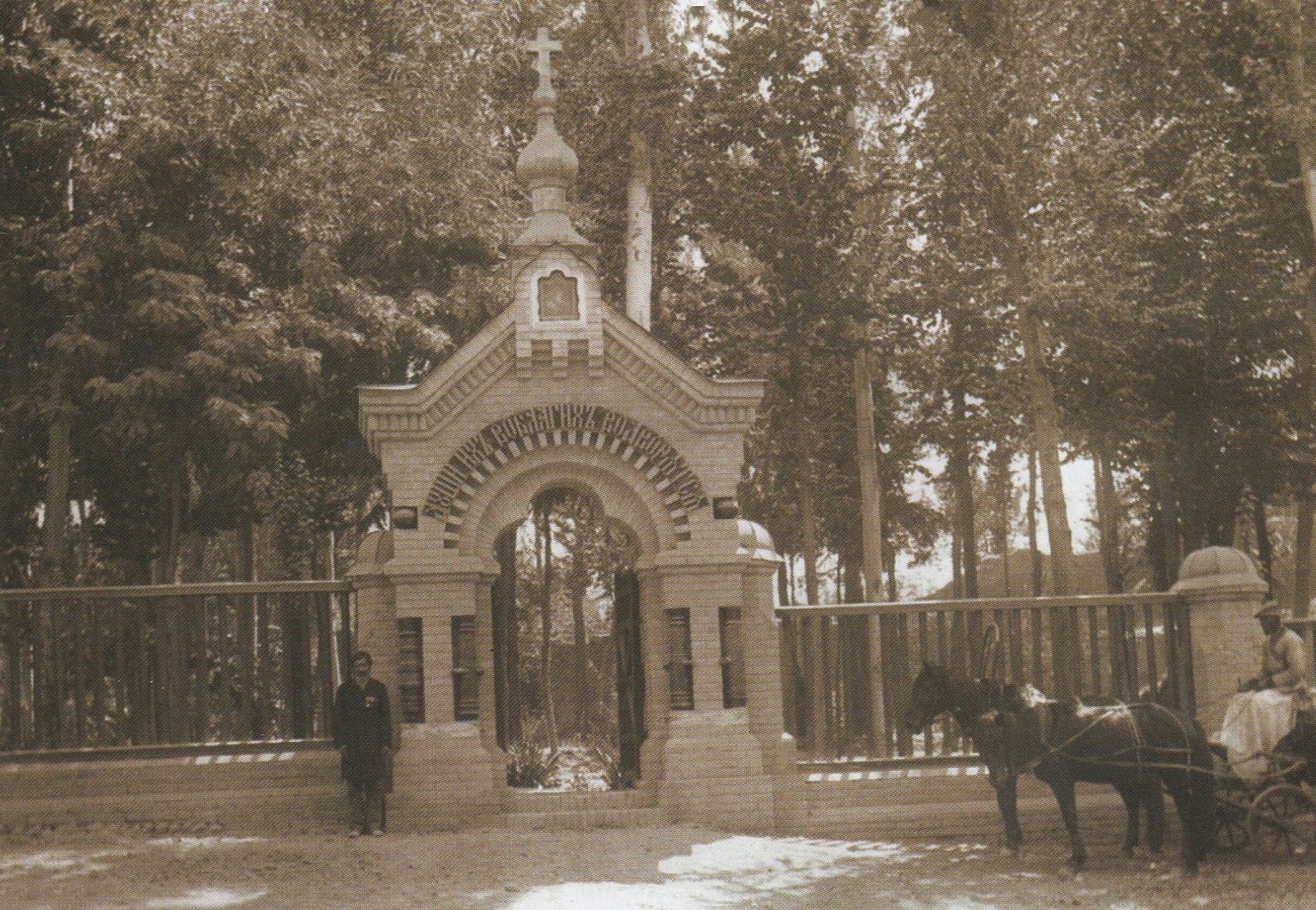
In the Kamolon mahalla, a tiny chapel consecrated in the name of Saint George the Victorious in June 1865 was restored six years ago. Originally, it featured a tombstone inscribed with the names of soldiers who fell in the battle for the capture of Tashkent, as well as a monument shaped like a pyramid of cannonballs. There was also a small park with a beautiful cast-iron fence. Alas, all this beauty faded into oblivion over time, and it was only by Easter 2020 that this structure was restored.
Disciplinary Temple
In the past, there existed so-called disciplinary companies and battalions. And there was such a unit on the very spot where five-story brick buildings now stand, in the area of the Elektroapparat plant. To pacify the soldiers assigned to this unit, a church was built in the name of Saint Nicholas the Wonderworker.
On November 30, 1901, the newly built church was consecrated. The church building was one-story, with only a dome rising above it. The church was notable for having a gallery-style (ascending, tiered) enclosure at the rear of the prayer hall, fitted with vertically placed wooden boxes, each as tall as a person. Prisoners stood one per box during prayer. This was in addition to a sturdy iron grate, which made escape from the company's premises impossible.
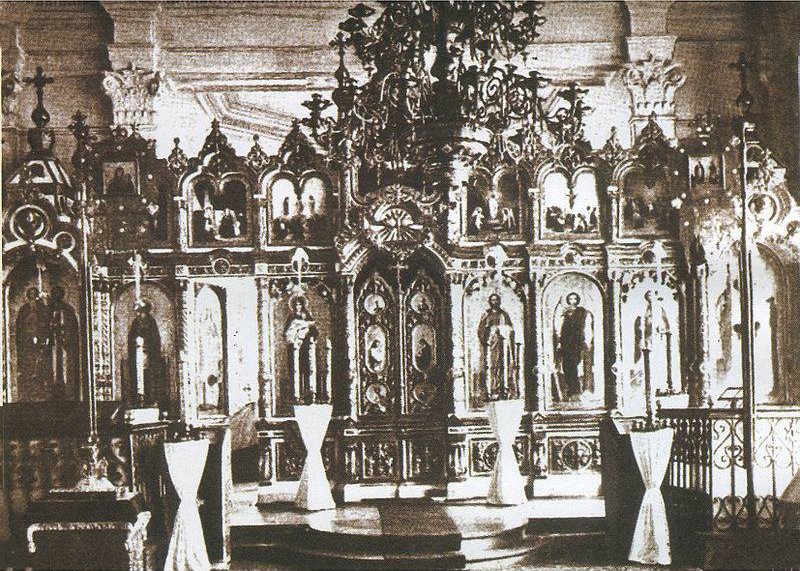
Amazingly, the remains of this structure could still be seen about 15 years ago. It housed a penitentiary facility intended for women who had broken the law. But relatively recently, it was relocated somewhere outside the city, and the remnants of both the prison and the church were demolished. Now, there is a group of residential buildings there, almost entirely occupied.