
A mural is a large-scale artistic image created directly on a building wall, façade or another architectural surface. Unlike ordinary graffiti, a mural is more often conceived as an artwork in its own right, connected to a particular place and the urban environment. It can tell the story of a neighbourhood, reflect cultural traditions, honour famous people or simply change the atmosphere of a familiar urban space. Almaty’s murals have become an important part of the city’s contemporary culture. They turn blank walls into open-air galleries and make art accessible to everyone. There is no need to seek it out in a museum or gallery; you only have to step outside.
Murals as a form of wall painting have existed since ancient times. Wall images can be found in cave art and the art of ancient civilisations, but the modern understanding of the mural as a large-scale work of public art on the walls of urban buildings emerged primarily in Mexico in the 1920s. After the Mexican Revolution, the government began supporting an ambitious programme of public art. In 1921, Minister of Education José Vasconcelos invited artists to paint the walls of government buildings, using art to tell people about the country’s history, culture and social ideas.
This was when the famous Mexican muralists Diego Rivera, José Clemente Orozco and David Alfaro Siqueiros emerged. Their works turned mural painting into a fully fledged means of expressing public opinion. The Mexican experience subsequently had an enormous influence on the development of contemporary street art around the world.
Here are 10 of the best-known murals on buildings in Almaty:
1. Berkutchi
 Photo: Talgat Asanov
The Berkutchi mural appeared on the façade of the building at 111 Rozybakiev Street as part of the international MURAL FEST of monumental and decorative art in 2017. The work was created by Ukrainian artist Andriy Palval, who is known primarily for his portraits of people and depictions of birds. The choice of a berkutchi, or eagle hunter, as the subject reflects the importance of the golden eagle and the tradition of hunting with birds of prey in nomadic culture and Kazakh tradition. The work became one of the notable examples of Almaty street art and one of the murals that helped shape the city’s open-air gallery. Today, Berkutchi is also interesting as an example of how international artists interpret Kazakh culture.
2. Snow Leopard 2.0
 Photo: Talgat Asanov
The mural featuring a snow leopard appeared at 59 Abylai Khan Avenue in 2017 to mark Almaty City Day. It was created by the Kazakh art team Neon & Shaman, which worked predominantly in a realistic style. The central image is a snow leopard set against a mountain landscape, bringing together two symbols closely associated with Almaty. Here, the leopard is more than a depiction of a rare animal. It also acts as a kind of urban emblem, symbolising strength, freedom and the region’s native wildlife. Today, the mural is known as Snow Leopard 2.0 and remains one of the most recognisable works of Almaty street art.
3. Father of Apples
 Photo: Talgat Asanov
Father of Apples is one of Almaty’s oldest and best-known murals. The work appeared at 160 Nazarbayev Avenue in 2013 as part of the Artbat Fest, whose theme that year was “The City as Canvas”. Created in a pop-art style, the mural draws on one of Almaty’s most important natural symbols, the apple, and the legend that the apple tree originated in this region. The title Father of Apples turns the depicted figure into a kind of mythological forefather of the city’s identity. The work stands at the intersection of Nazarbayev Avenue and Kurmangazy Street and, thanks to its location, has long been part of the familiar urban landscape. More broadly, the mural is an example of how contemporary art can transform a city’s natural symbol into an element of its visual identity.
And about Tashkent’s murals, read our article:
Tashkent — the New Home of MuralsEight years ago, unsuspecting Tashkent residents, quietly going about their everyday lives, were suddenly baffled by a new word: “mural”. No one knew what it meant. Someone I know even thought it was some kind of deer, the word unfamiliar to both Uzbek and Russian ears. Everyone rushed to Google it, and before long people were talking about this new phenomenon as casually as if it had been growing here for 400 years.mag.humodoc.com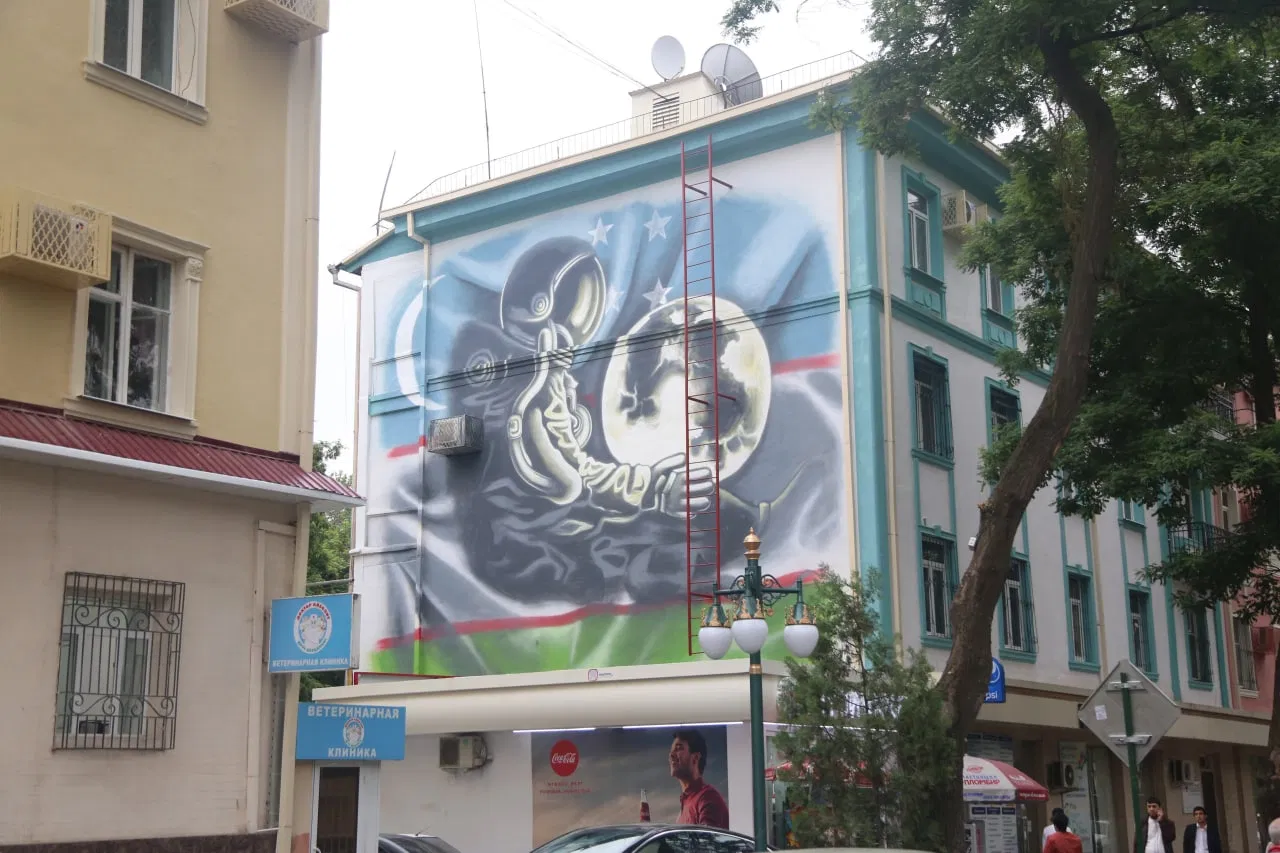
4. Girl with Petroglyphs
 Photo: Talgat Asanov
Girl with Petroglyphs is located at 31 Kurmangazy Street, at the intersection with Tulebaev Street. The work was created by Belarusian artist Alexander Blagiy. At the centre of the composition is a girl surrounded by images reminiscent of the famous petroglyphs of the Tamgaly archaeological landscape. In this way, the mural literally connects a contemporary person with the ancient history of the steppe, creating an image of continuity between generations. Art manager Dilda Ramazan saw the work as an expression of the continuity of traditions and the way they are perceived by young people.
5. Cosmos/ Starry Night
 Photo: Talgat Asanov
Another notable work can be found on the same building at 31 Kurmangazy Street, the mural Cosmos, also known as Starry Night. It features in city guides to Almaty street art and is marked on maps as a separate attraction. The work is built around cosmic imagery and contrasts the vastness of the universe with the dense urban landscape. For Almaty, a city with a strong Soviet-era space and scientific heritage, the theme feels entirely natural. The result is a rather interesting juxtaposition: on one façade, the ancient history of the steppe in Girl with Petroglyphs, and beside it, a vision of the future and outer space in Cosmos. Together, the two works turn this part of Kurmangazy Street into a small open-air cluster of monumental art.
6. Mukaghali Makatayev
 Photo: Talgat Asanov
A portrait of Mukagali Makatayev appeared on the façade of an apartment building at 186 Makatayev Street. The work was created at a time when Kazakhstan was widely celebrating the poet’s legacy and a range of cultural projects were being held to mark his life and work. The choice of location is particularly symbolic: the mural honours a man whose name the street itself now bears. The portrait turns urban architecture into a kind of memorial page and makes the poet part of the everyday routes of city residents. Makatayev thus ceases to be a distant literary classic and begins to feel literally present in the city. Large-scale portrait painting also creates a new kind of urban monument, neither bronze nor confined to a museum, but living and accessible to everyone.
7. Roza Baglanova
 Photo: Talgat Asanov
A mural featuring a portrait of Roza Baglanova appeared in Almaty in May 2026 on the façade of a building at No. 21 in the Samal-3 microdistrict. The famous Kazakh singer once lived in this very building. The initiative came from the residents themselves, who had previously approached the city authorities with a request to create the mural. Roza Baglanova’s daughter-in-law, Maral Baglanova, was involved in the project. It is therefore more than simply a portrait of a famous performer. It is also a kind of memorial associated with a specific place in her life. The mural shows how contemporary urban art can emerge at the initiative of residents who want to preserve the memory of someone connected to their home and neighbourhood.
8. Gorillaz
 Photo: Talgat Asanov
This mural appeared quite recently, in August 2026, ahead of British virtual band Gorillaz’s performance in Almaty. It is located on the façade of the Tau Samal residential complex at 72 Navoi Street. The artists behind the work are illustrators @dammit.art, @gray_one1 and @uno.raf. Its appearance was linked to the band’s concert at the Park Live 2026 festival, making it one of the clearest examples of an international cultural event leaving a visual mark on the urban environment. Gorillaz was created in 1998 by musician Damon Albarn and artist Jamie Hewlett and is known for its fictional universe and animated characters. Unlike many Almaty murals that focus on national history or local nature, this project connects the city with global pop culture.
9. Waiting
 Photo: Talgat Asanov
Waiting is a work by Kazakh artists Saule Suleimenova and Kuanysh Bazargaliyev (KuBa). The mural appeared in 2019 at 565 Seifullin Avenue as part of the fourth International MURAL FEST. The composition is based on an actual photograph from the late 1970s or early 1980s, making the work a reflection of everyday life in Soviet Almaty. Suleimenova is known for her interest in documentary imagery and human stories. The mural became so significant to the city that after it was damaged during façade repairs in 2022, a decision was made to restore it under the supervision of the artists. Today, Waiting can be seen as a kind of photograph of the past, enlarged to the scale of a city wall.
10. Cyclists
 Photo: Talgat Asanov
The Cyclists mural is located at 127 Tole Bi Street and focuses on urban mobility and cycling culture in Almaty. The work was created as part of the Murals of Almaty project and was timed to coincide with City Day. Its subject reflects a relatively new urban habit in Almaty in recent decades, using bicycles not only for sport but also as a means of transport. The work reflects Almaty’s enthusiasm for cycling and its many cycling events. The mural promotes the image of a modern city dweller who is active and open to alternative forms of transport.
Newsletter
A letter from the HD editors
Once a week, we send the best stories, events, and cultural discoveries from Central Asia.