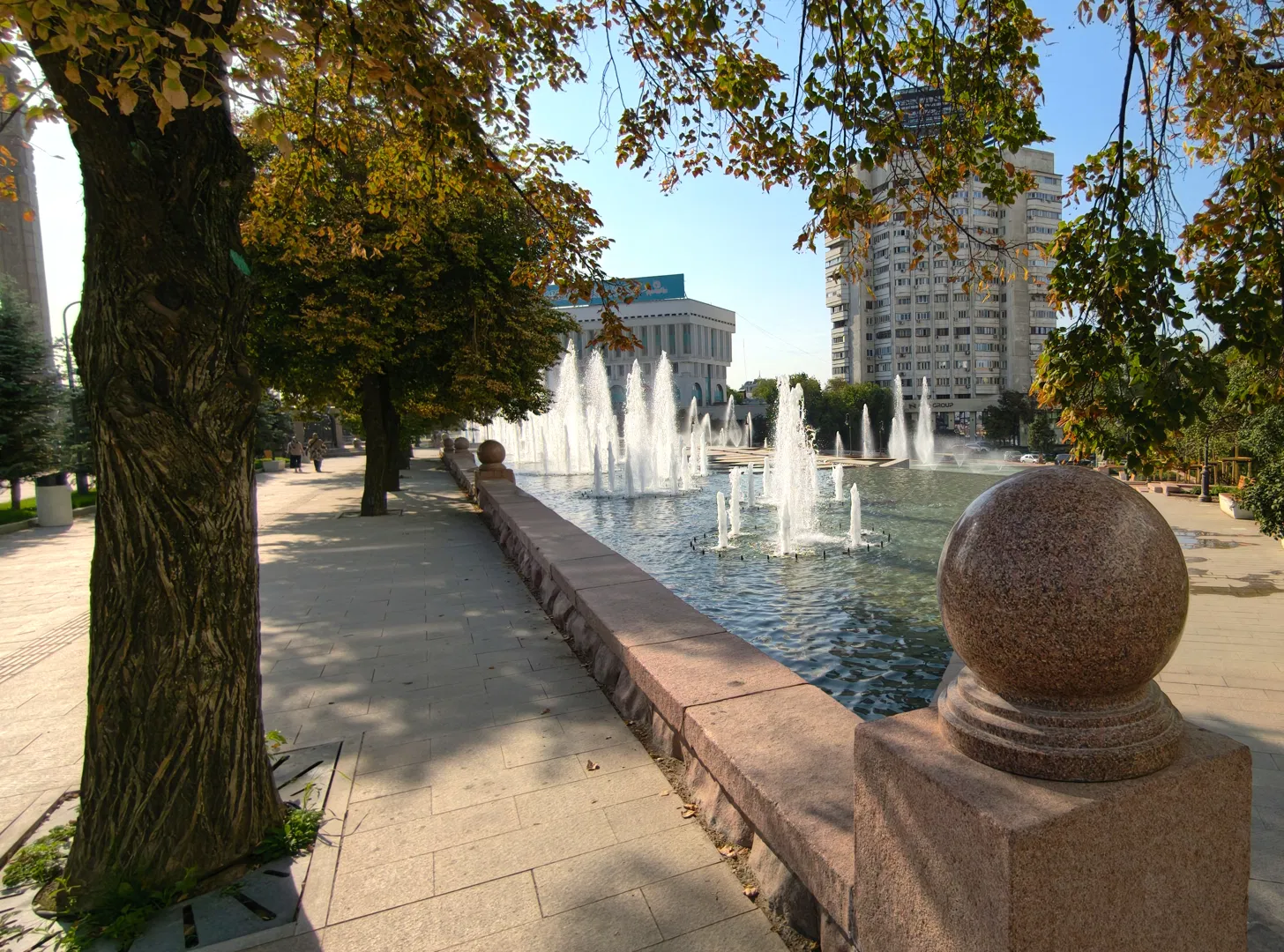
In hot Almaty, water has always been part of city life. Fountains here are something more than a decoration for squares and parks — they are a distinctive mark of the city and its summer mood. They refresh the air, draw people together and add a sense of coolness and calm to the bustling metropolis. Today Almaty has around 150 fountains, and each has its own place in the city's history. The fountains operate on a single schedule — from 25 May daily, from 10 am to 2 am. The fountains finish their work in October.
We have compiled a TOP 10 fountains of Almaty that are worth seeing not only for their beautiful appearance and cool water, but also for their architecture, history and the atmosphere of the city.
1. "Nedelka"
Baiseitova St, 1, by the Abai State Academic Theatre of Opera and Ballet.
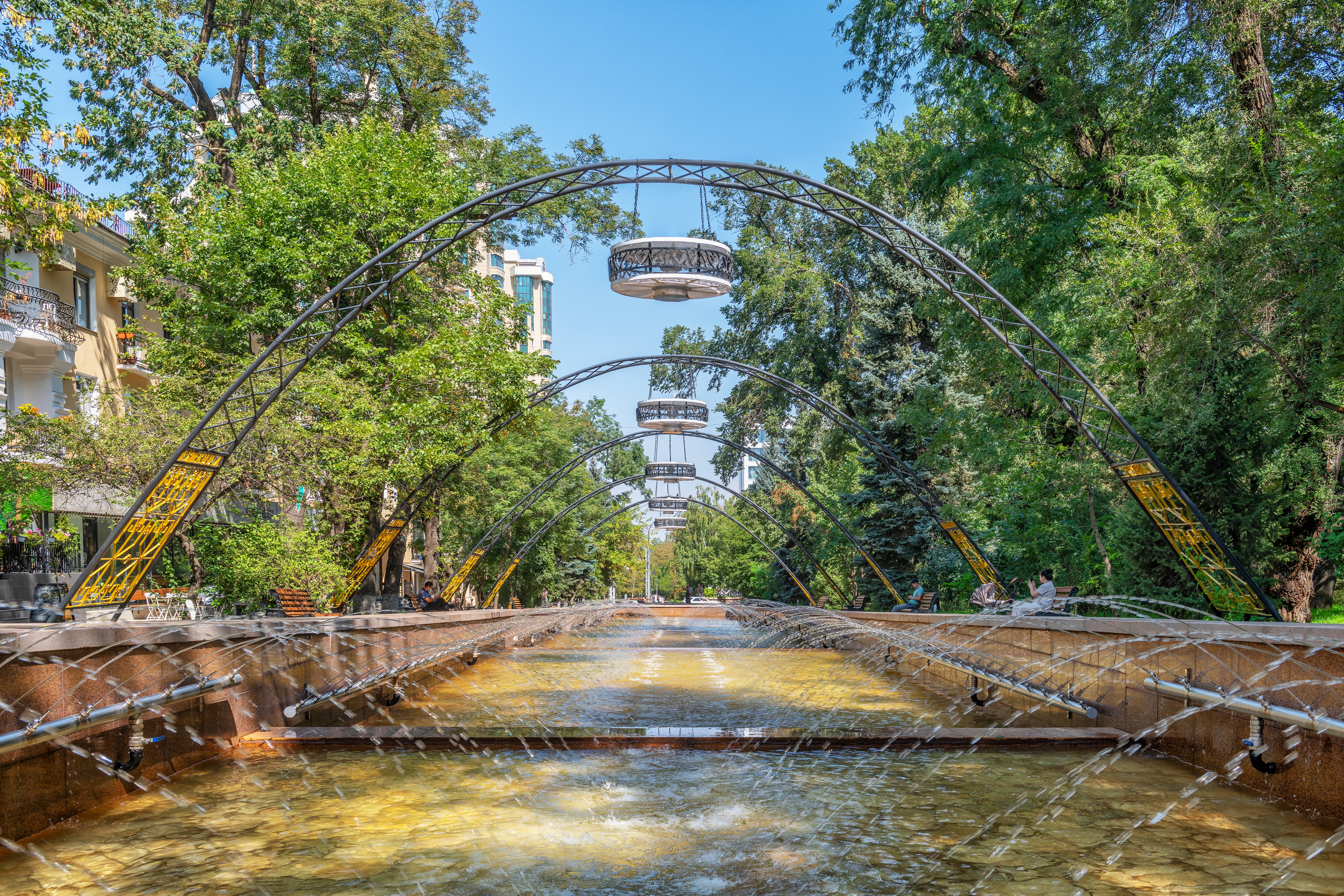 Photo: Maxim Zolotukhin
"Nedelka" is one of the most recognisable and beloved historic fountains of Almaty, located in the square next to the Abai Kazakh National Theatre of Opera and Ballet. Its composition is built on seven arches, which gave the fountain its popular name: they symbolise the seven days of the week. Curiously, according to some sources, the architect Mels Safin originally envisioned a more ambitious composition with 12 arches symbolising the months of the year, but the space did not allow this idea to be fully realised.
After many years of use, the fountain was restored in 2021 as part of the reconstruction of the adjacent square. During the restoration, the city authorities specifically emphasised the task of preserving the historic appearance: the arches, light fixtures, granite elements and engineering system were restored. Today "Nedelka" looks especially striking in the evening, when the water, lighting and architecture of the theatre quarter create one of the most atmospheric urban scenes. The fountain is also interesting as an example of how seemingly ordinary objects of the urban environment can become such an important part of Almaty's cultural memory.
2. "Eastern Calendar" / "Signs of the Zodiac"
corner of Pushkin and Shevchenko Streets, in front of the Academy of Sciences. 1960s-1970s.
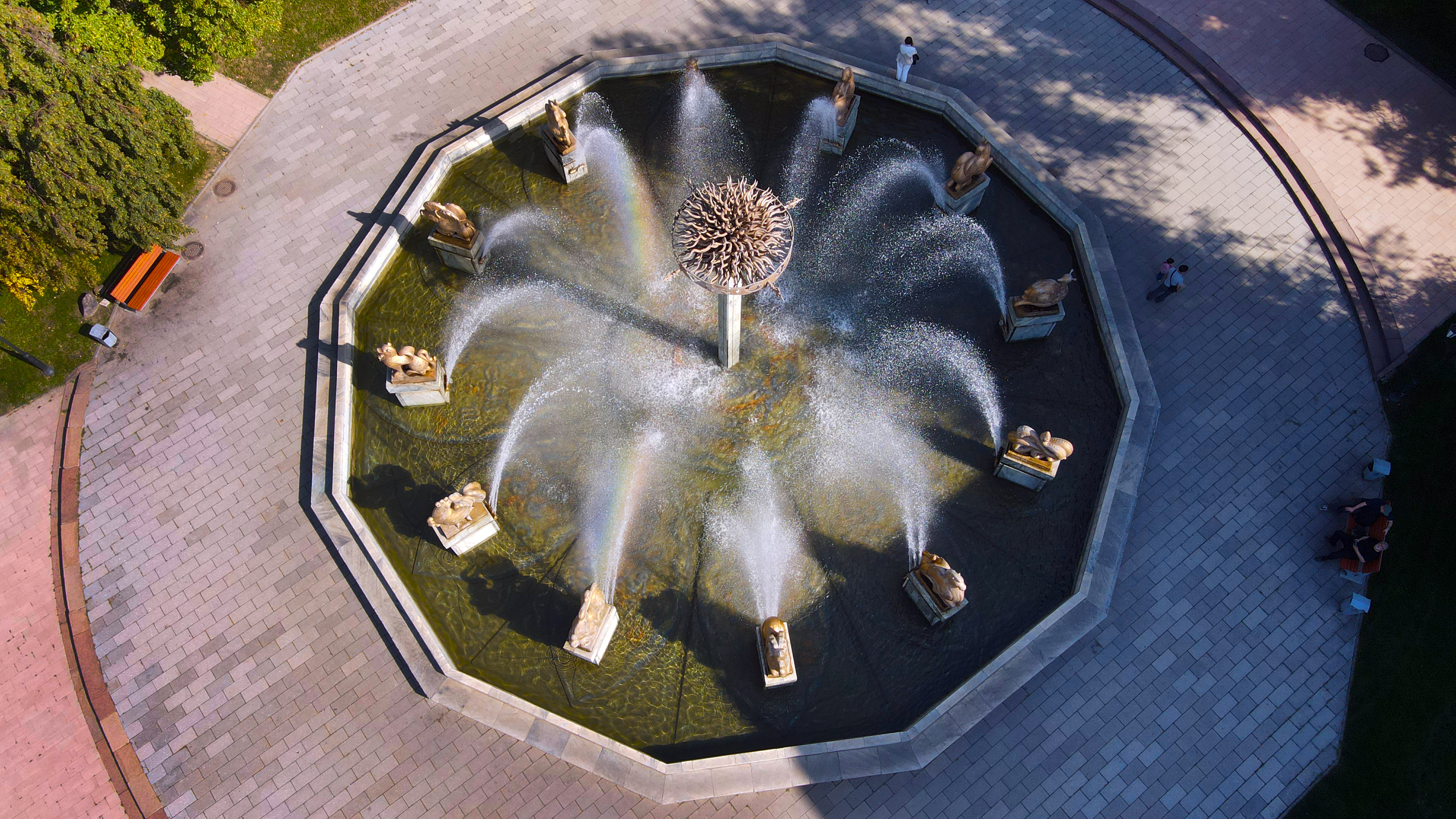 Photo: Talgat Asanov
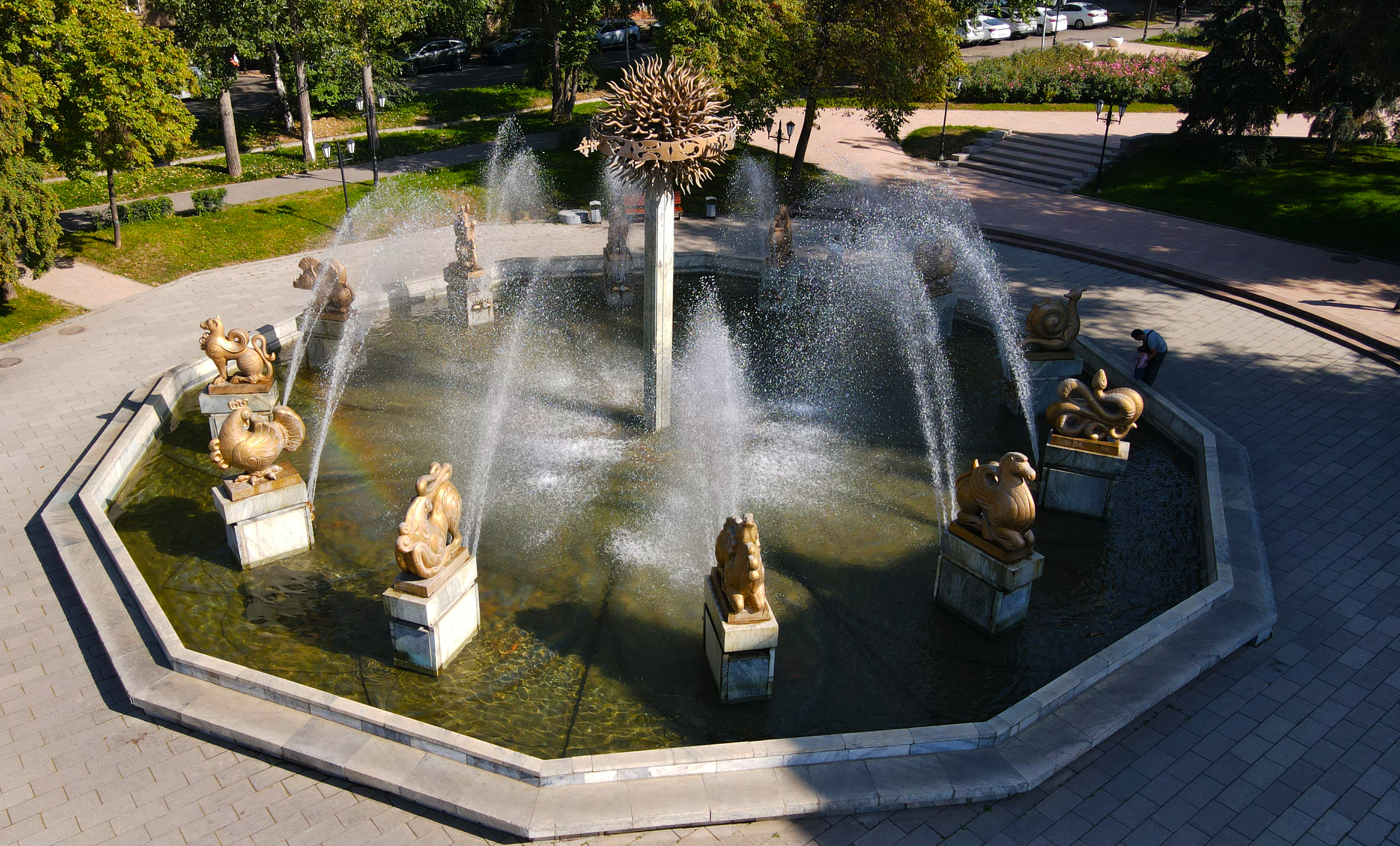
The "Eastern Calendar" fountain, located in front of the building of the Academy of Sciences of Kazakhstan, is one of the most unusual Almaty fountains in terms of its artistic concept. Its composition is built around a central solar disc, from which numerous rays radiate, and around the circumference are placed the 12 animals of the Eastern calendar. That is why the fountain is often also called "Signs of the Zodiac", although its figurative system is connected specifically with the Eastern tradition of chronology.
The fountain was created at the turn of the 1970s-1980s. This decorative design has an unusual artistic idea linking time, cosmic order and the cyclical nature of life. This object demonstrates a combination of the Soviet monumental tradition with motifs of ancient Eastern symbolism.
3. "Zhetysu"
Tulebaev St, at the intersection with Abai Ave.
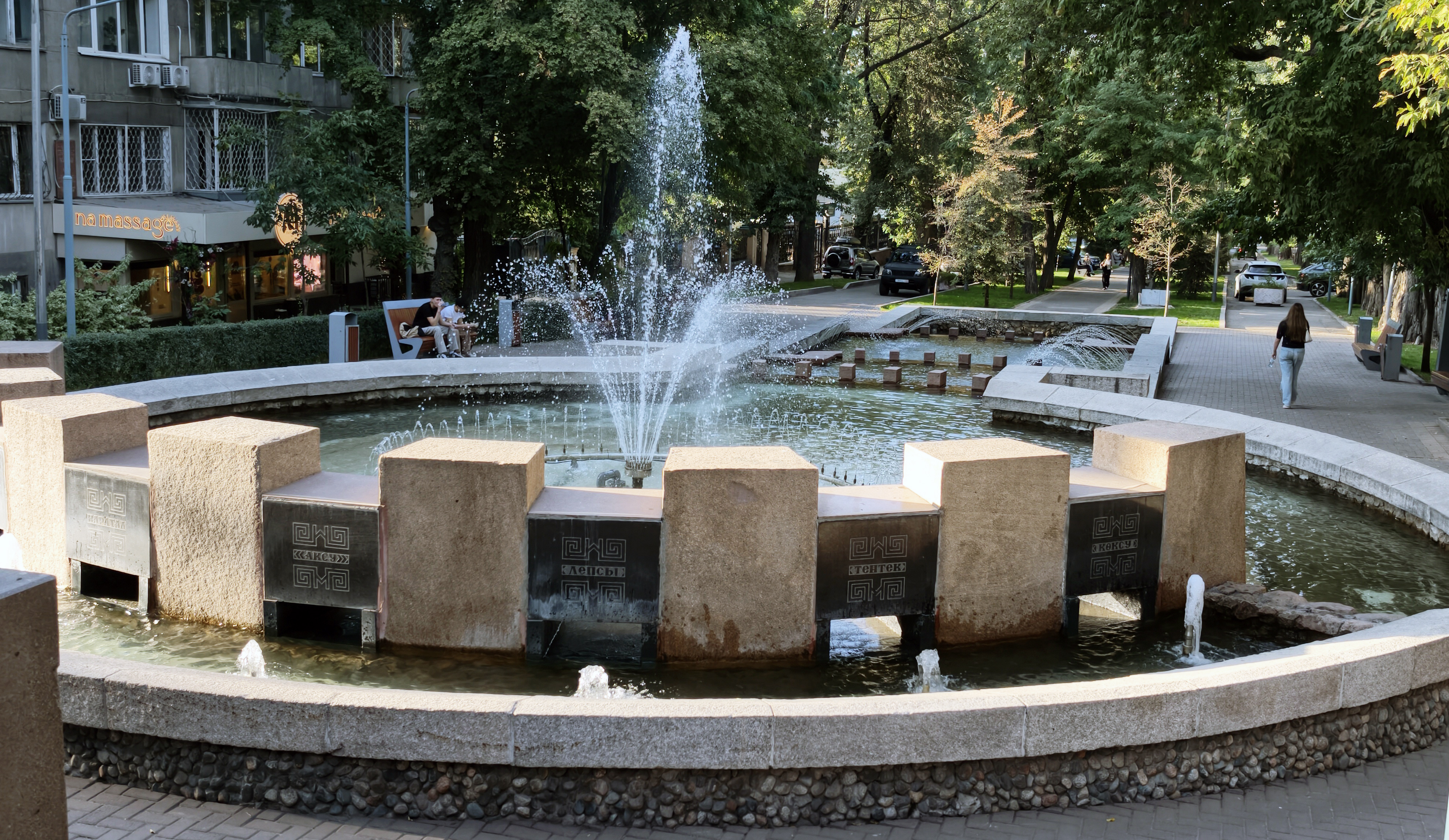 Photo: Talgat Asanov
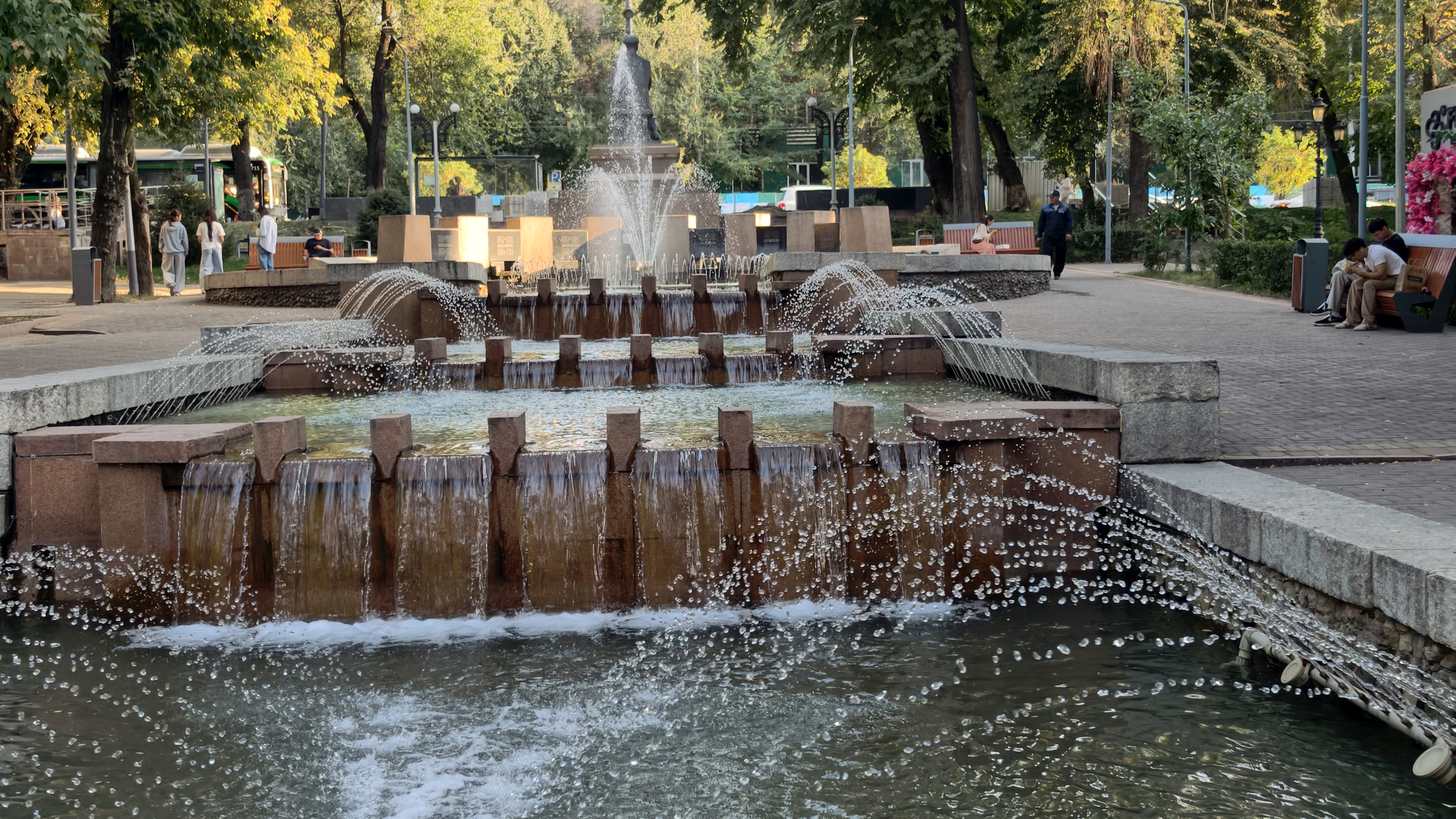
The "Zhetysu" fountain, formerly known as "Semirechye", is one of the most symbolically rich historic fountains of Almaty. It was created in 1970 to the design of an architectural group led by Mels Safin and became the compositional dominant of the green boulevard on Tulebaev Street. The fountain is built as a cascade of three water mirrors, so it really resembles not a ceremonial square but the movement of a mountain stream.
The main artistic element is a composition of pink and black granite with elements of Kazakh ornament. Seven springs symbolise Semirechye, and around the central part are placed the names of rivers associated with this historic region: Ili, Lepsi, Koksu, Tentek, Karatal, Aksu and Chu. Interestingly, the fountain's basin is also interpreted as an image of Lake Balkhash, which turns the entire composition into a kind of geographical map of the region. After reconstructions, the fountain has retained its original figurative system.
4. Fountains on Republic Square
Satpaev Ave, Republic Square
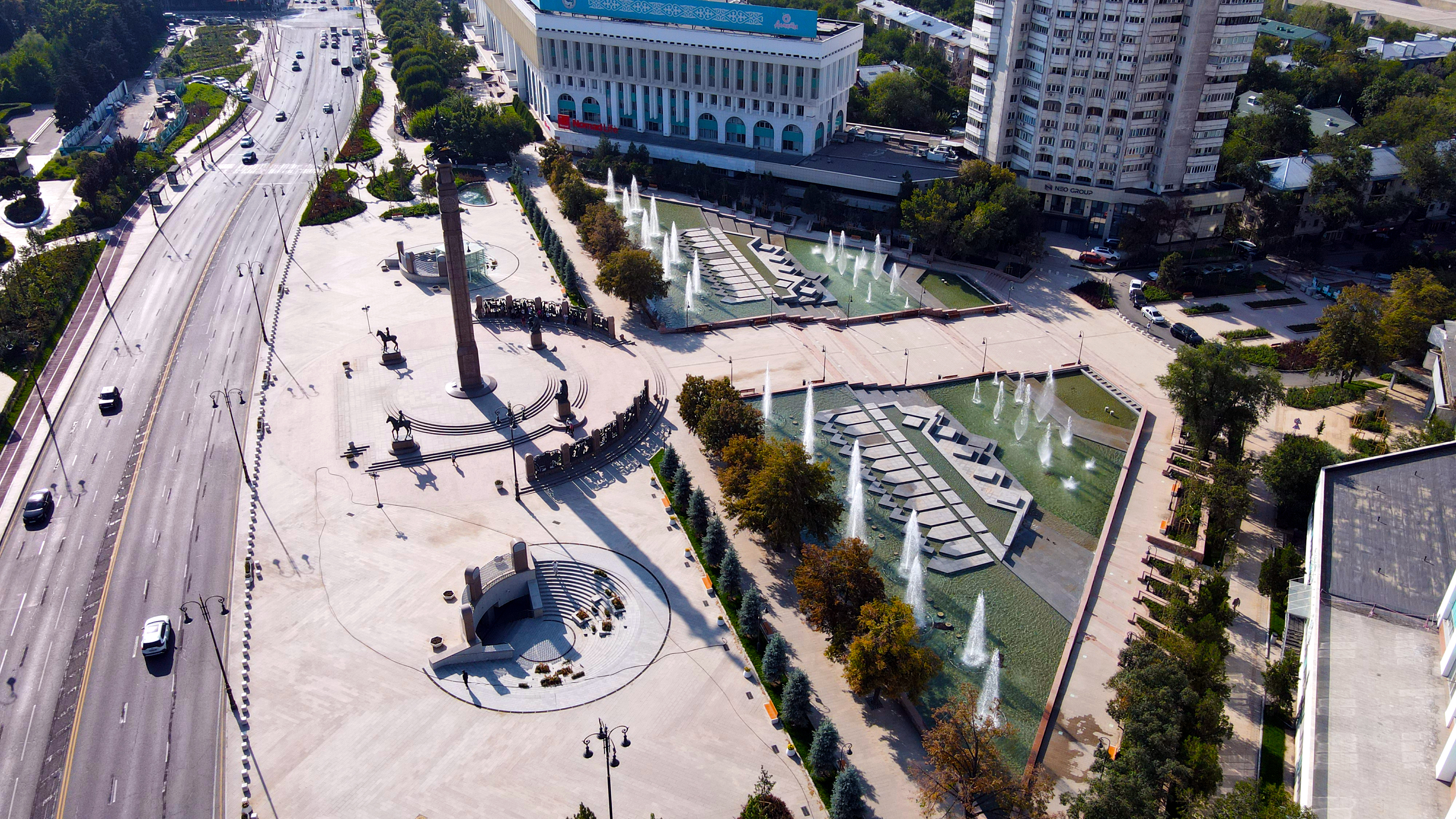 Photo: Talgat Asanov
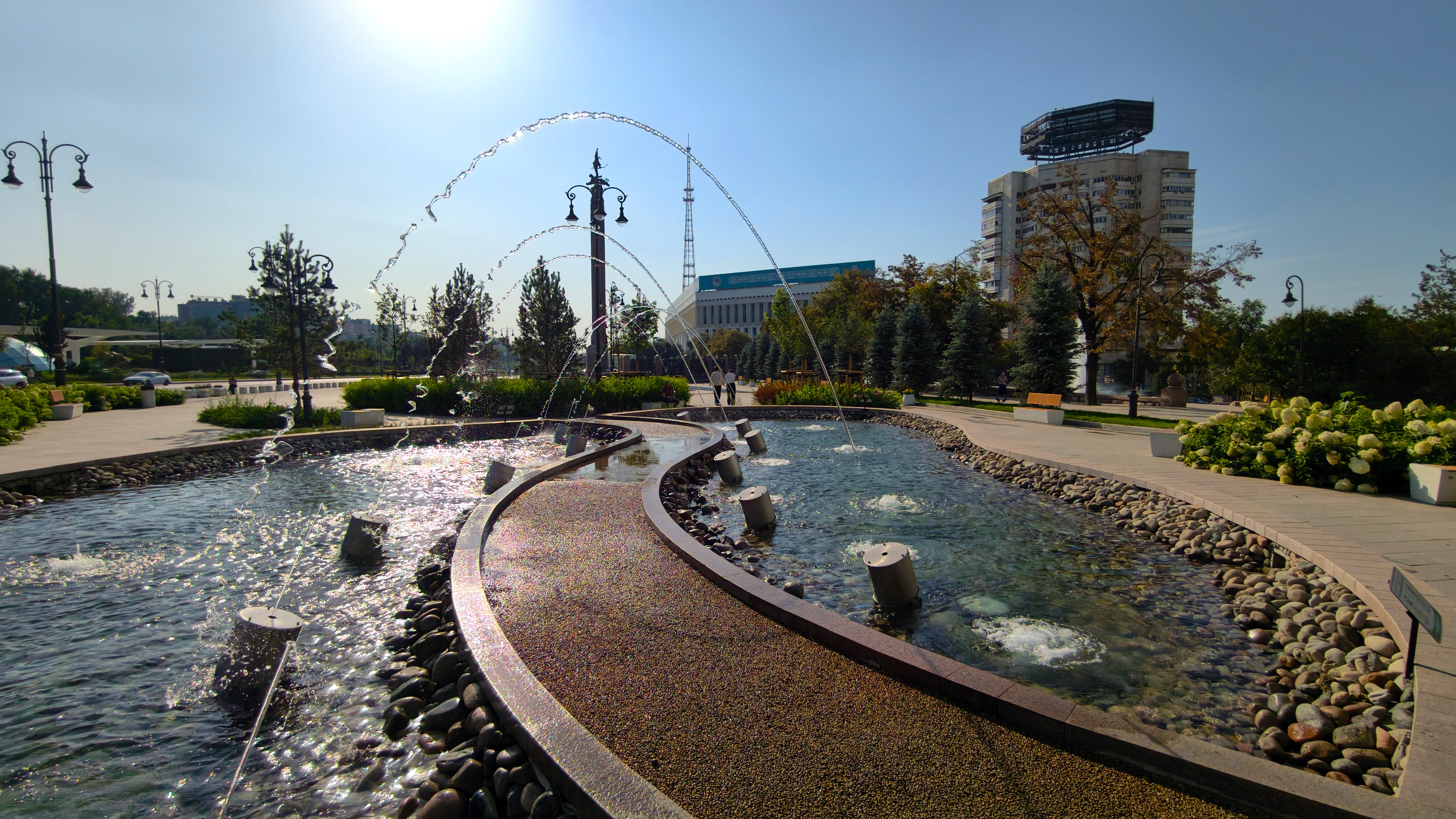
Republic Square is currently undergoing one of the largest renewals of recent years, and water has become an important part of its new public space. After reconstruction, eight decorative water features were created here, and the existing fountains were restored and supplemented with new modern fountain complexes. There are also interactive kinetic fountains here, which have already become a popular place to relax during the hot season.
New landscaping elements, recreation areas, bicycle parking and other urban infrastructure have appeared around the water features. Today this is one of the most modern fountain complexes in central Almaty and a good example of how a historic public space is being adapted to new scenarios of urban life.
5. Fountains in front of the Abai State Academic Theatre of Opera and Ballet
Kabanbai Batyr St, the oldest fountain complex in front of the theatre, created in 1948.
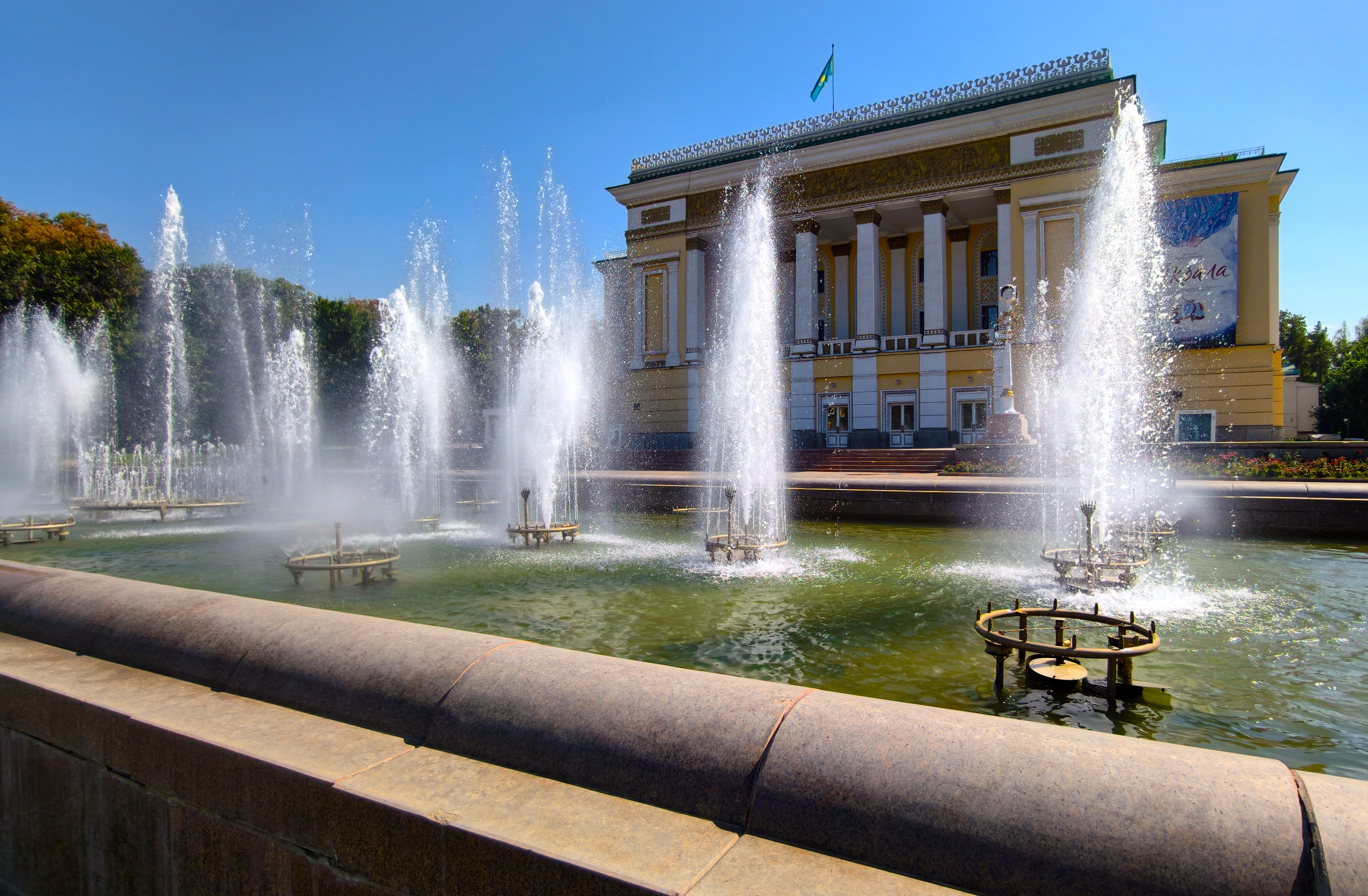 Photo: Talgat Asanov
The fountains in front of the Abai Theatre of Opera and Ballet form a single ensemble with one of the most famous historic buildings of Almaty. Unlike more conceptual objects such as "Zhetysu" or the "Eastern Calendar", these fountains above all create a solemn and harmonious urban atmosphere.
The theatre district is especially beautiful in the evening, when the lighting of the facade and fountains makes the square one of the most photogenic spots in the city. In 2021, the adjacent squares and historic elements of the fountain complex underwent improvement and restoration as part of the renewal of the theatre quarter. That is why today this place is interesting to consider as an example of preserving a coherent historic urban ensemble, rather than simply as a separate fountain.
6. The "Misty" fountain opposite the Kazakhstan Hotel
Dostyk Ave / Abai Ave, by the Kazakhstan Hotel.
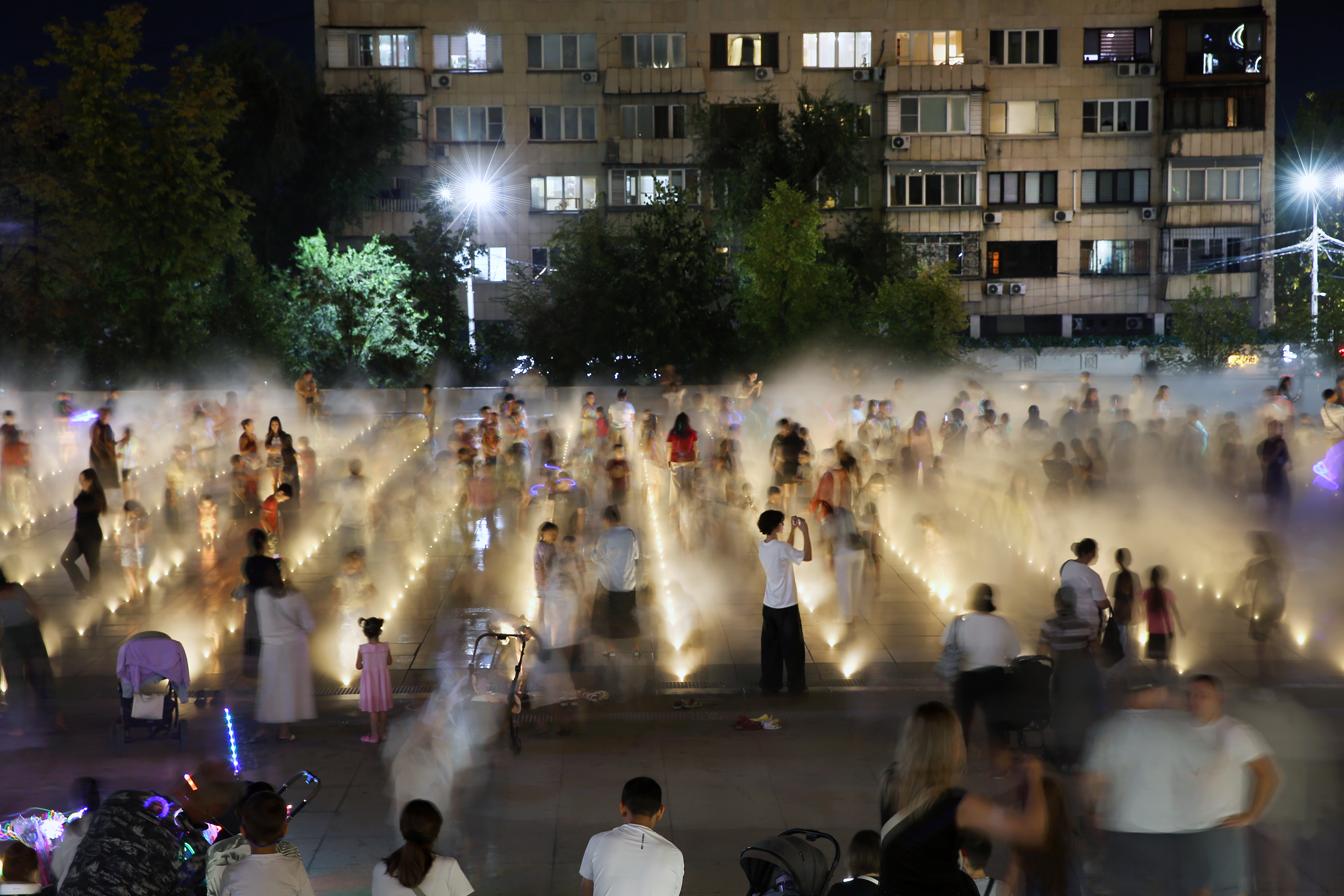 Photo: Talgat Asanov
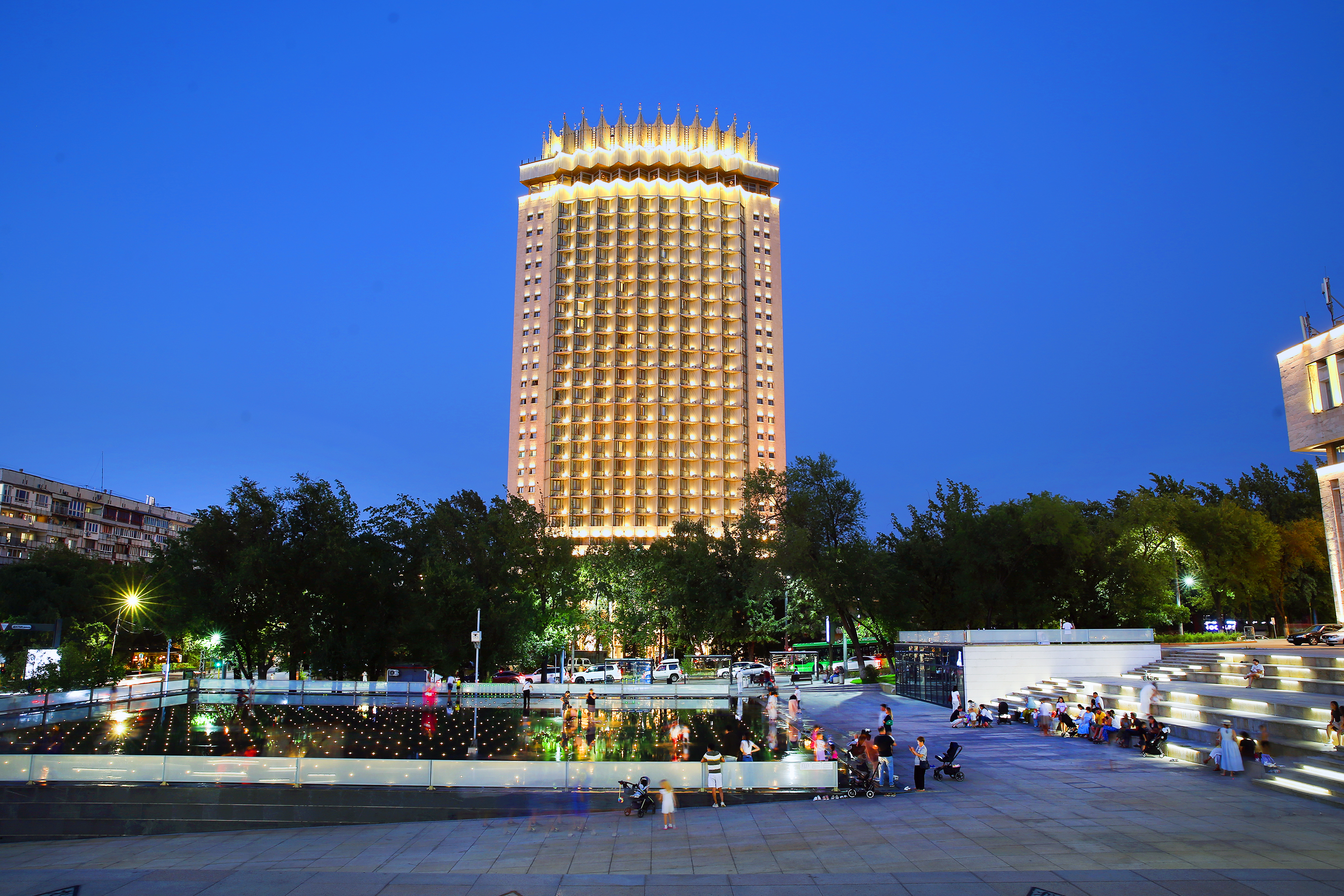
The fountain complex by the Hotel Kazakhstan is one of the most photogenic features in central Almaty, thanks to the unusual effect of its finely atomised water. At certain moments the jets and spray create a light mist around the space, which is why the fountain has earned the unofficial name "the misty one". Its setting creates a particularly striking impression: behind the veil of water rises the famous Hotel Kazakhstan building, one of the city's principal architectural symbols.
The area around Abay and Dostyk Avenues has traditionally featured on lists of central walking and tourist routes. The fountains by the Hotel Kazakhstan have long been part of this urban landscape and are especially appealing in the warmer months. For the article, one could focus precisely on their visual effect: this is one of the finest examples of how a fountain can do more than simply adorn a space — it can create an almost cinematic atmosphere around itself.
7. The fountain in front of the Palace of the Republic
the intersection of Abay and Dostyk Avenues.
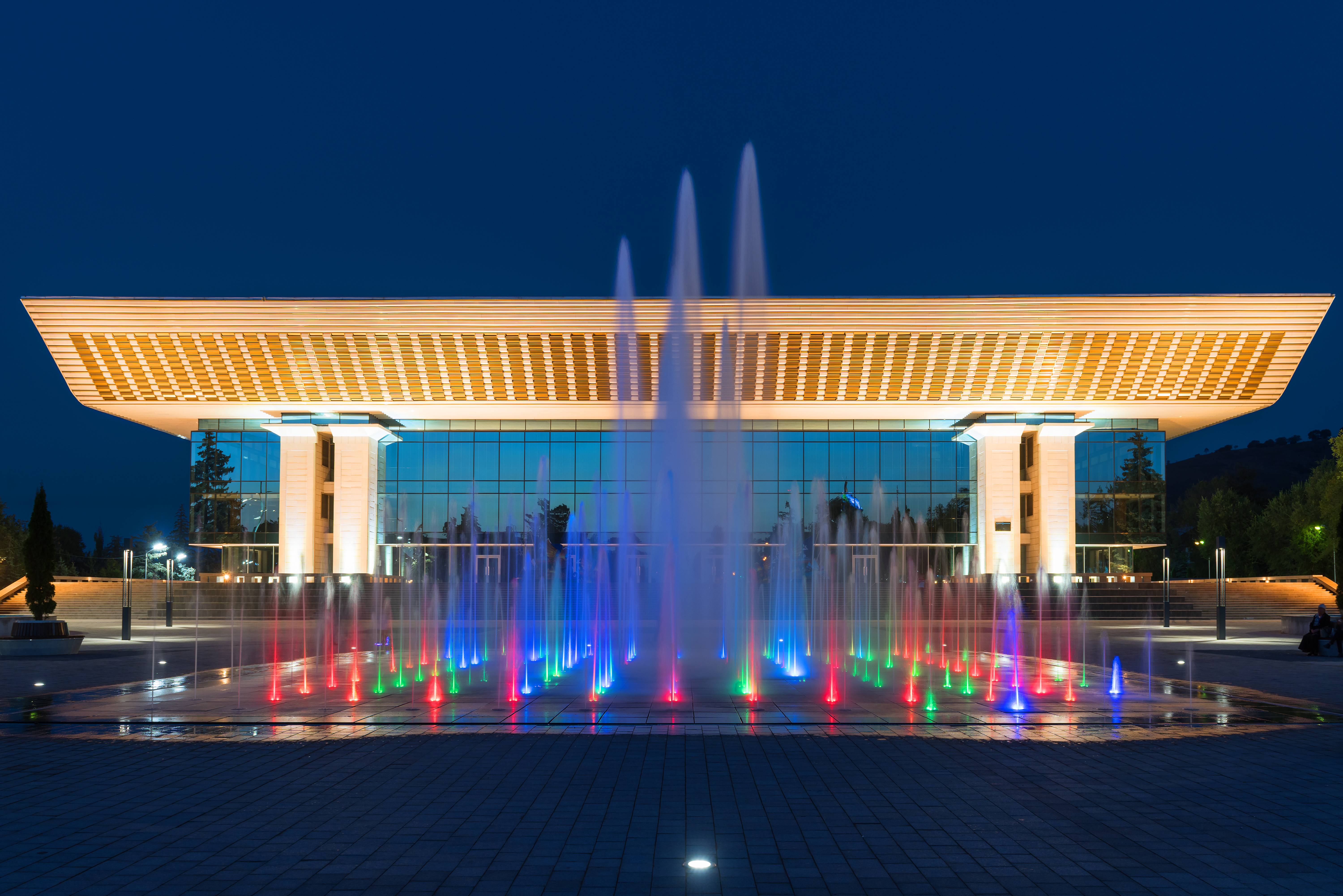 Photo: Maxim Zolotukhin
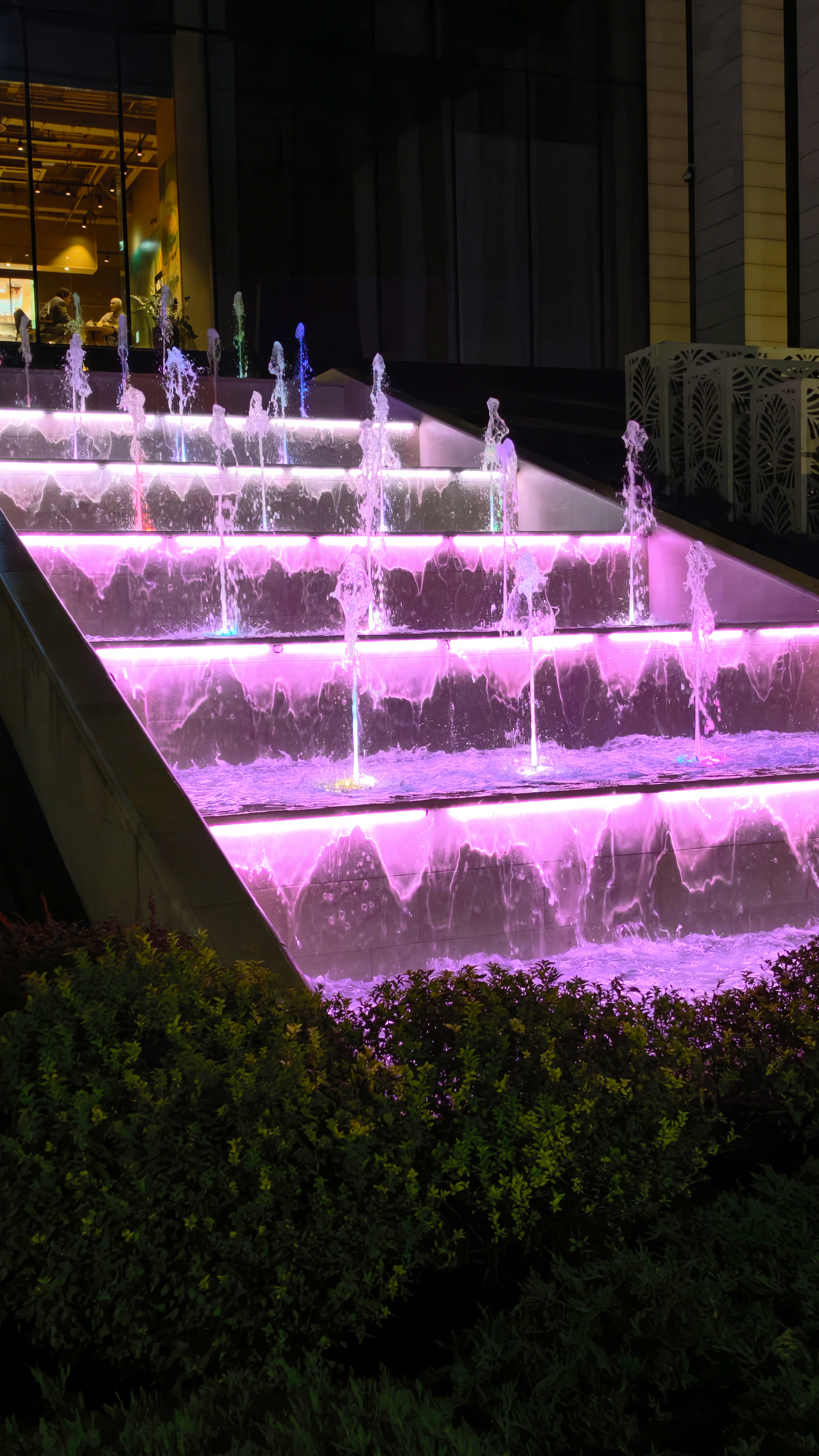
The fountain ensemble in front of the Palace of the Republic is closely tied to the architecture of the building itself, constructed by 1970. The space was designed with the complex terrain in mind: the architects made use of the changes in elevation, creating a system of water and stone cascades. The original composition included a large body of water filled via stone cascades, with a pedestrian island set within the water's surface. Over the following decades the space was repeatedly altered, and some of the fountain structures went through periods of neglect and reconstruction.
The Palace of the Republic itself is one of the most important monuments of Soviet modernist architecture in Almaty, and today the site is interesting above all as an example of how a fountain and architecture can form a single urban ensemble encompassing the Palace of the Republic, Abay Square and the mountain route to Kok-Tobe.
8. The fountains on Panfilov Street
the Panfilov pedestrian street.
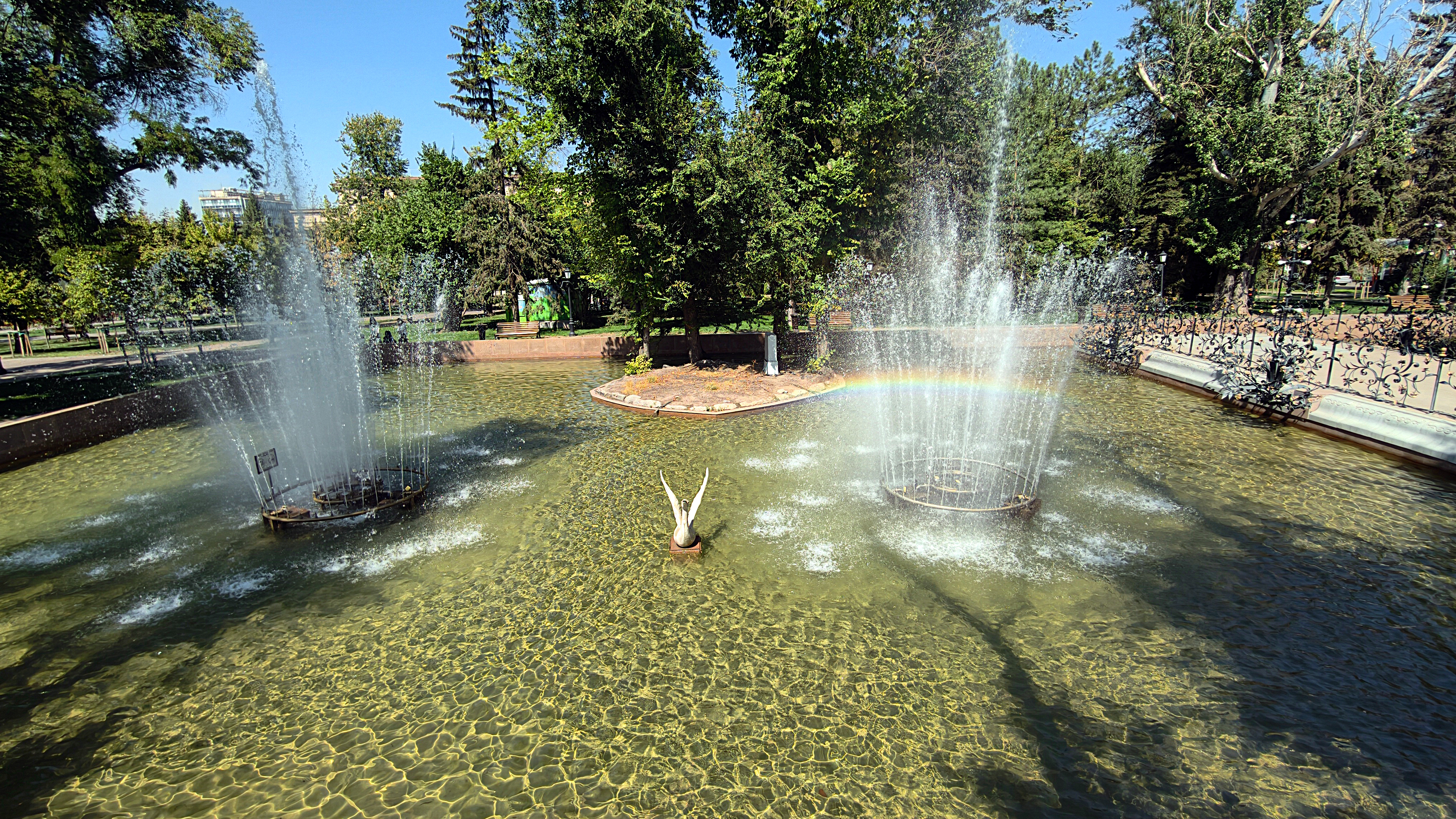 Photo: Talgat Asanov
On Panfilov, what is of interest is not so much one specific fountain as the entire system of the urban environment. Following a large-scale reconstruction, the pedestrian street opened in its contemporary form in 2017 and has become one of Almaty's principal urban promenades: fountains sit alongside trees, street cafés, sculptures, musicians and the historic architecture of the centre.
A stroll along Panfilov is experienced rather as a sequence of small urban scenes than as a visit to a single landmark. It is a good example of a contemporary approach to public spaces, in which the fountain is part of the pedestrian infrastructure and of city life.
9. The fountains of the First President's Park
Al-Farabi Avenue / Navoi Street.
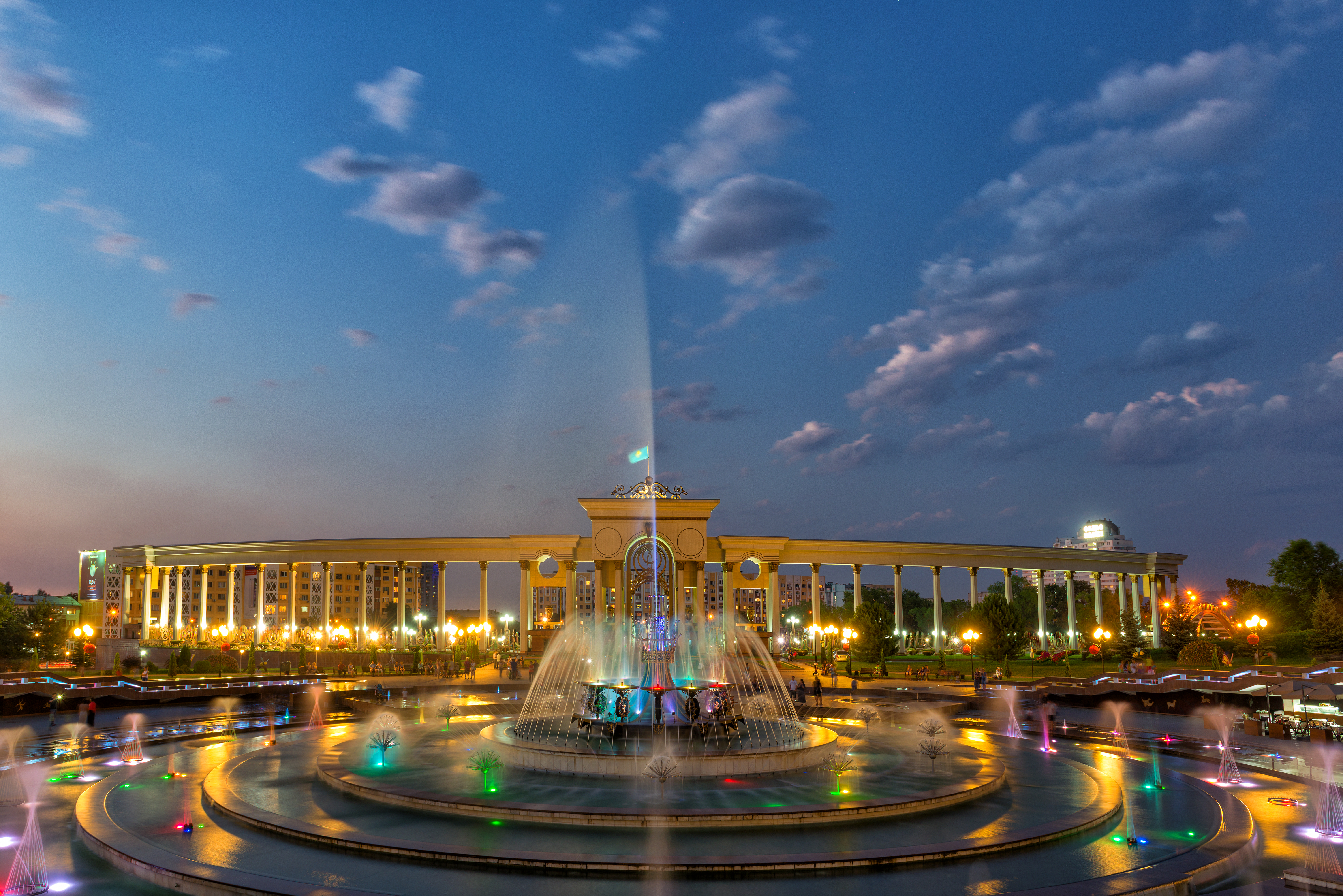 Photo: Maxim Zolotukhin
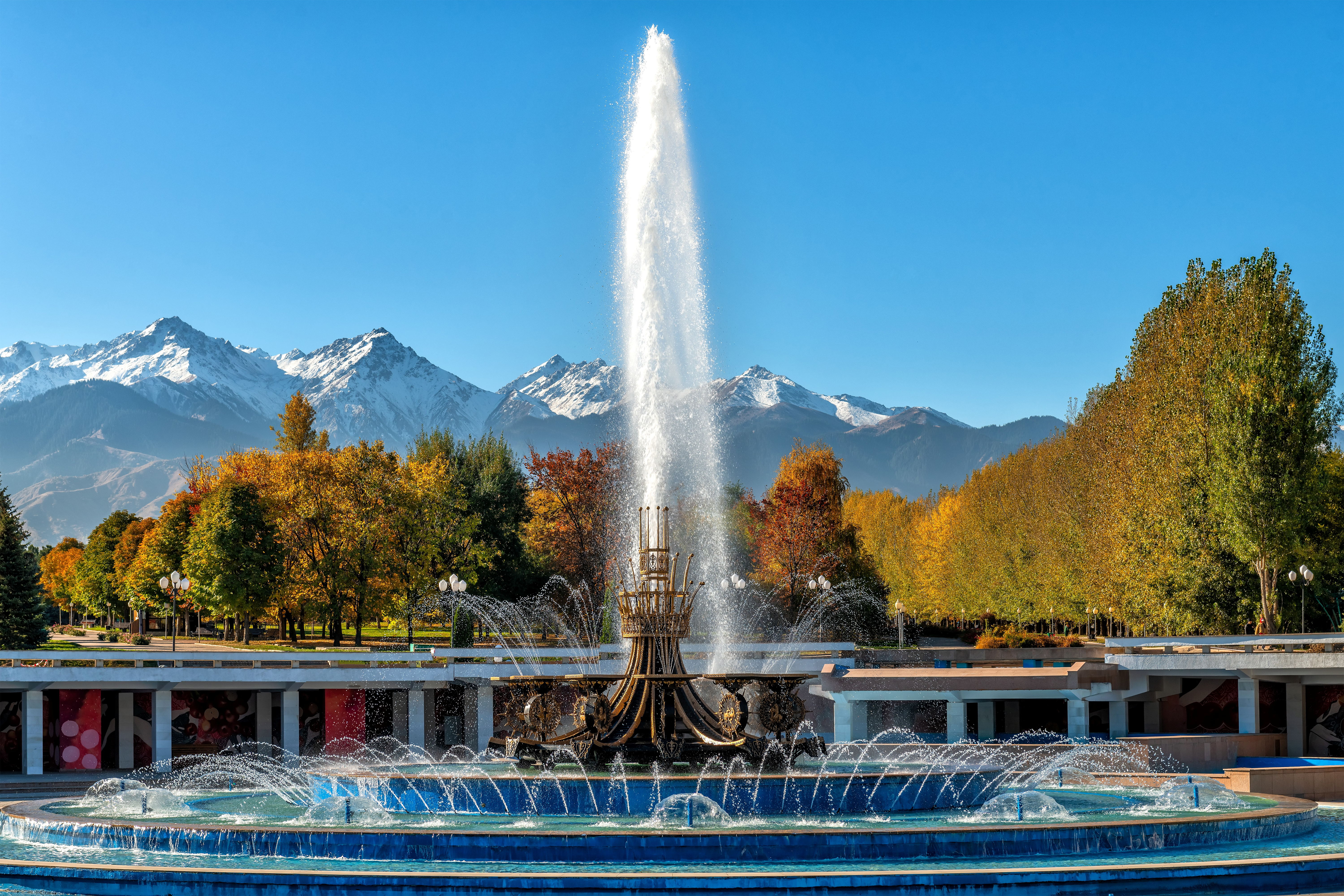
The fountains of the First President's Park were long considered among the most large-scale in Almaty, thanks to the vast open territory and the possibility of staging light and water shows. The park covers more than 62 hectares and includes a central avenue, a fountain complex, an amphitheatre, promenade areas and spaces with views of the Trans-Ili Alatau. Unlike the intimate historic fountains of the centre, here the principal effect is created precisely by scale: a broad perspective, a great volume of water and the mountains in the background.
Today, however, the park is entirely closed to visitors for the duration of its reconstruction, so including it in a route now requires an appropriate caveat. The city is carrying out a comprehensive renewal of its engineering and path infrastructure, along with improvements and planting across the territory.
10. "A Thousand Jets"
A relatively new fountain on Astana Square in front of KBTU.
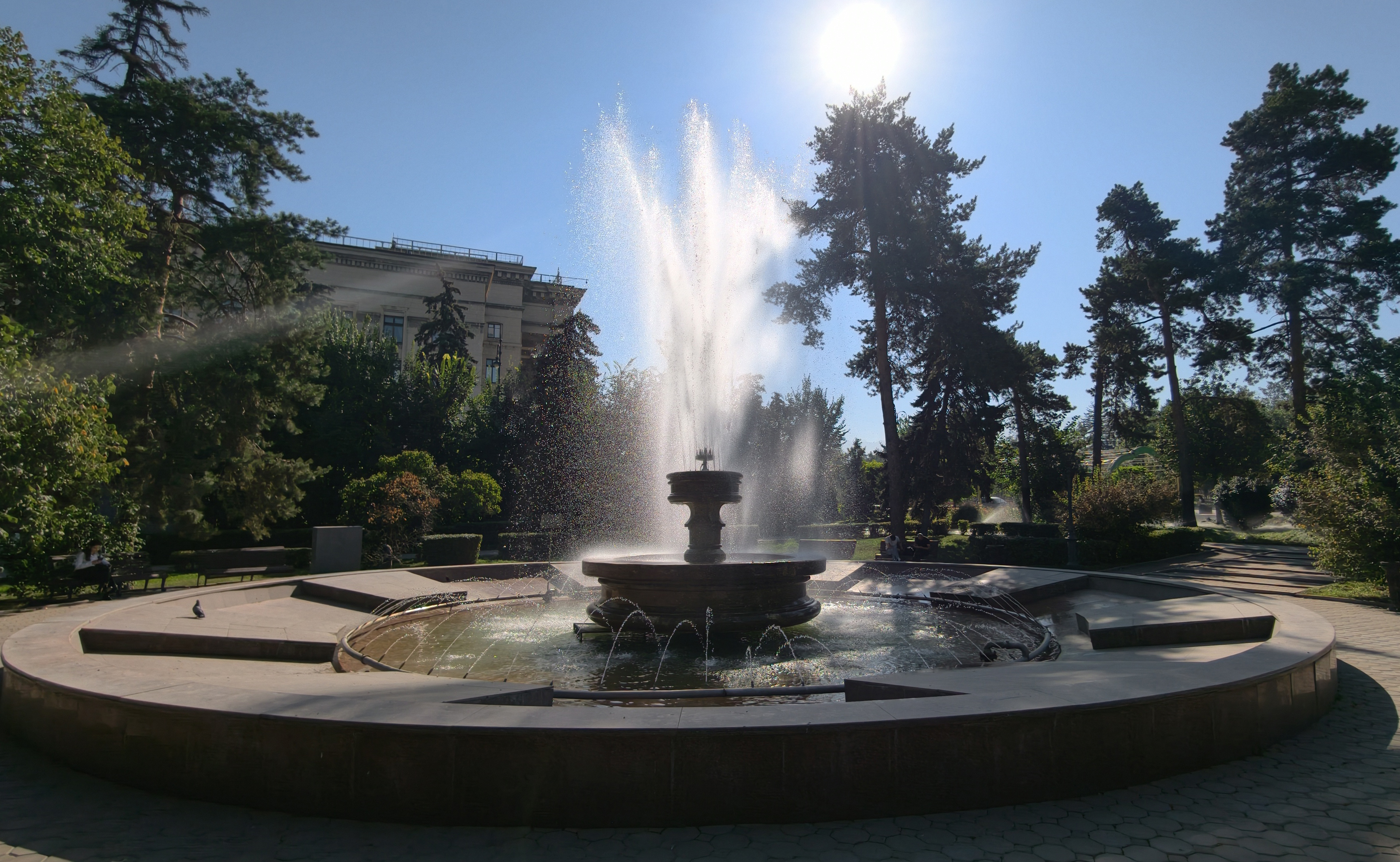 Photo: Talgat Asanov
Created during the reconstruction of the square in 2017.
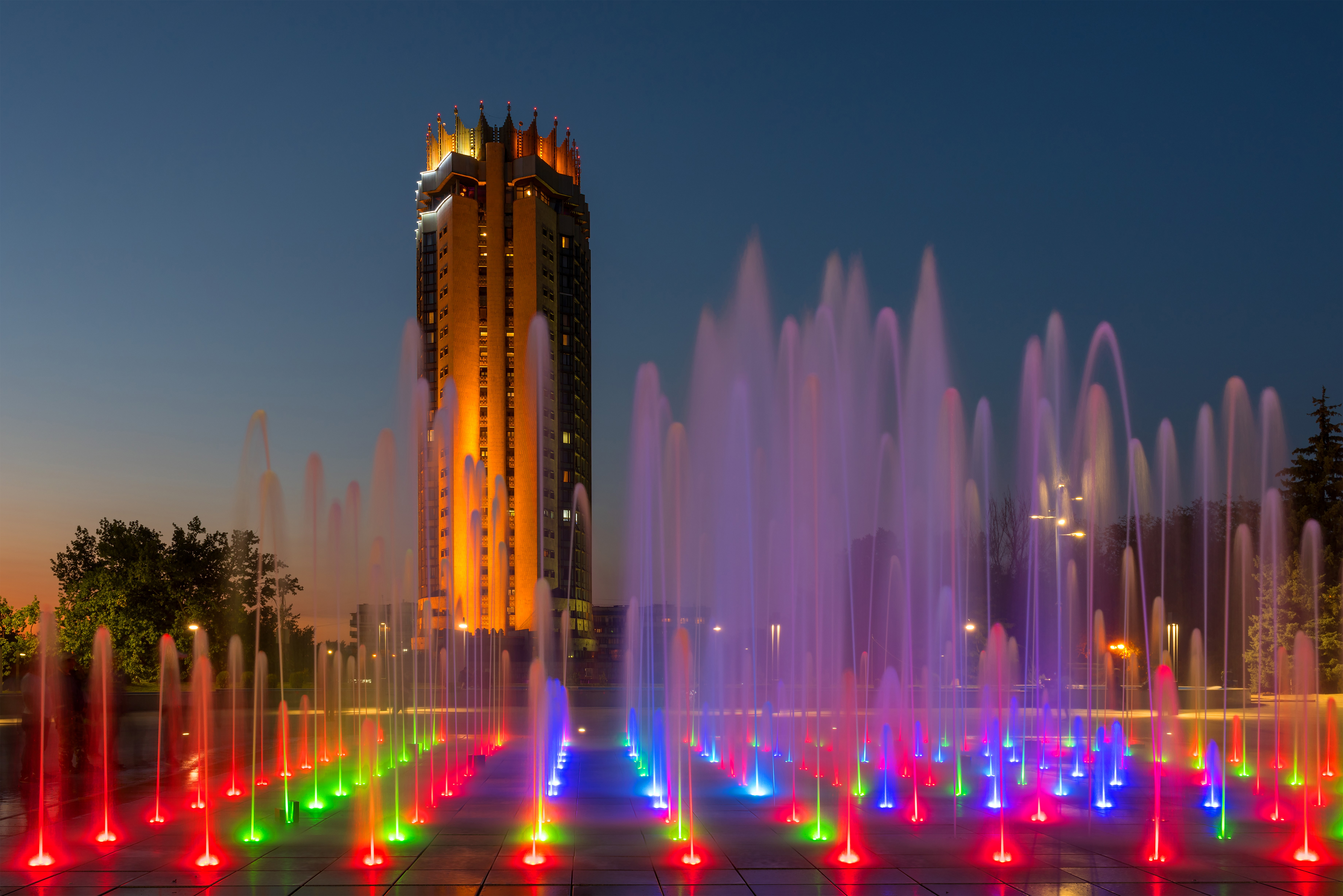
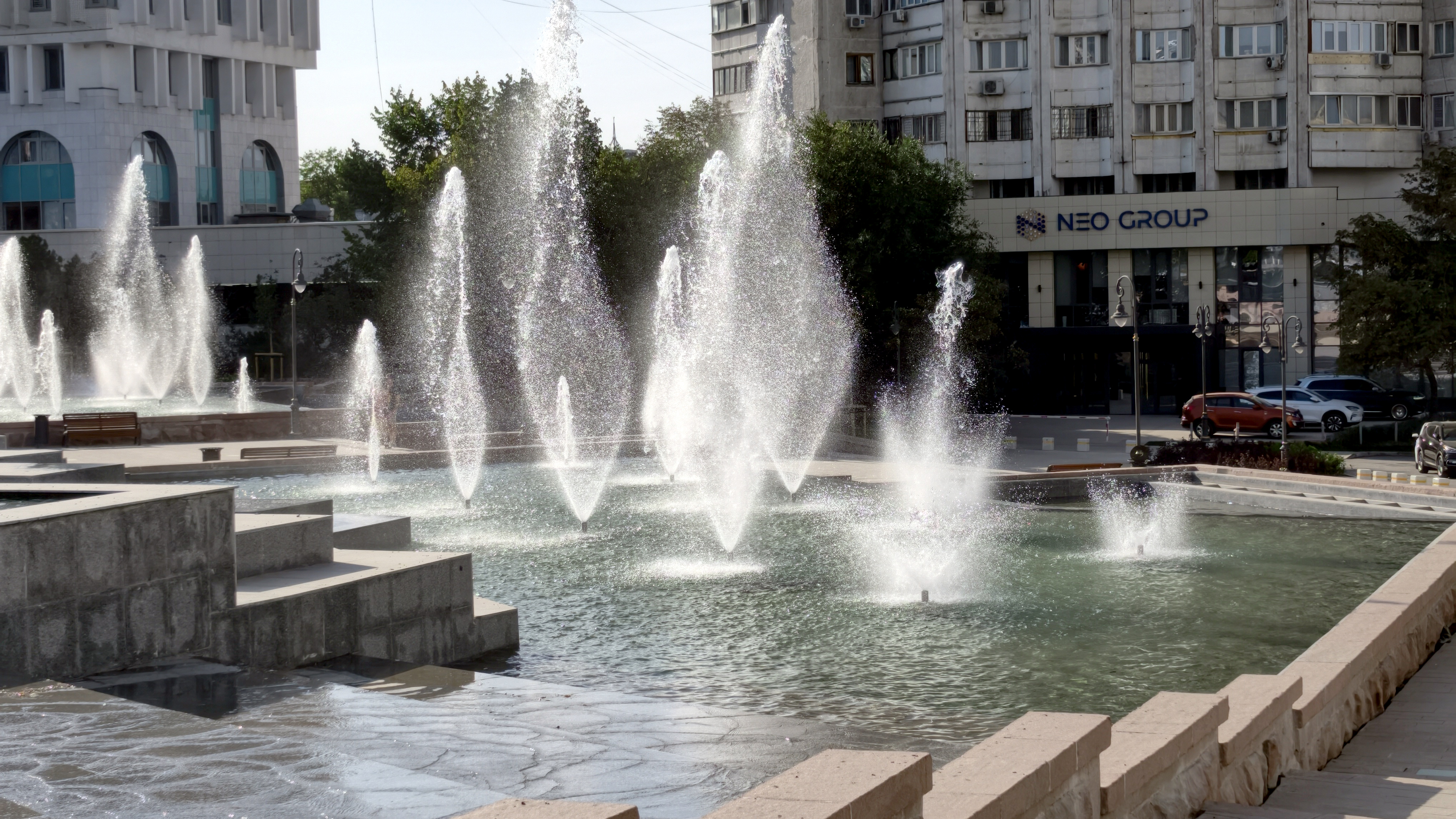
One of the relatively new fountain features in central Almaty, located in front of the Kazakh-British Technical University building. Unlike the city's older Soviet fountains, where sculpture, symbolism and monumental composition played a major role, here the principal artistic effect is created by the water itself. A multitude of vertical jets forms a dynamic surface that constantly changes depending on the operation of the pumps and the direction of the light.
The name conveys well the basic principle of the composition — it is not a single dominant jet but a multitude of water streams operating simultaneously. For a route through the city centre this is a convenient point that can be combined with a stroll along Panfilov and Arbat. There are also 4 historic fountains here — two on each side of the enormous colonnaded building. The architect of the fountains was A. Levinson, 1958-1968. In 2012 and 2023 they were fully restored, including the engineering system.



Newsletter
A letter from the HD editors
Once a week, we send the best stories, events, and cultural discoveries from Central Asia.