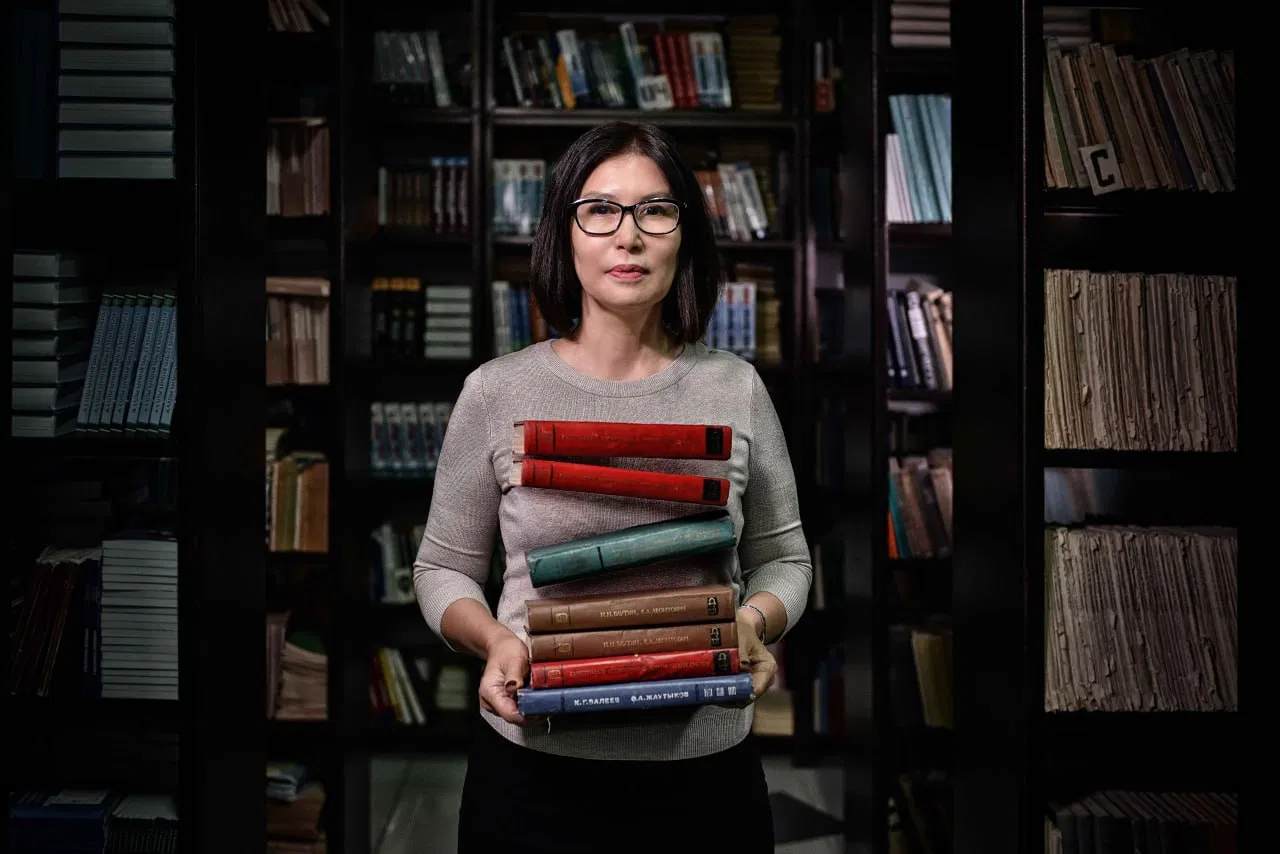
Kazakhstani literature is experiencing a moment when the old literary canon can no longer keep pace with the new reality. While some authors are gathering millions of readers online, others are publishing books in the US and Europe, and still others are transforming Kazakh mythology into fantasy and horror. Who are they — the writers of Kazakhstan who are read today, and not merely studied at school? We have compiled a TOP-10 of contemporary authors through whom the country can be read anew.
There is a simple way to gauge how much a country has changed: look at what it reads.
Not long ago, any conversation about Kazakh literature would almost inevitably begin with the classics. The names of Abai, Mukhtar Auezov, Olzhas Suleimenov were not merely part of the cultural heritage — they largely defined the very direction of any discussion about Kazakhstan. But between the classical library and today's reader, a new literary landscape has gradually emerged.
In it, the boundary between 'high' and mass literature no longer matters as much. A novel can be born on a literary platform and gain millions of readers. Kazakh mythology can become the basis for horror. The story of several generations of women can turn into a novel that resonates with readers in Spain. And poetry written in Almaty can be published as a separate book in the United States.
This does not negate the classics. It is simply that alongside them there has appeared another Kazakhstan — modern, urban, multilingual, digitalised and far less inclined to fit itself into a single cultural formula.
We have chosen ten authors through whom it is especially interesting to observe this new literature. Not the most 'correct' ones, and not necessarily the best-selling. Those who today are shaping reader interest, the literary environment and — perhaps most importantly — new ways of telling their own stories.
 Photo: Talgatbek Asanov
1. Daniyar Sugralinov
The writer who turned a book into a global product
If one were to look for an author who differs most radically from the familiar image of a Kazakh writer, it would arguably be Daniyar Sugralinov. His literary career began on the internet, and today his books are read far beyond Kazakhstan. He writes science fiction, fantasy and LitRPG — a genre that grew at the intersection of literature and video games.
For the traditional literary world, this long remained the territory of 'unserious' literature. Sugralinov proved otherwise: a genre author can have a huge audience, international translations and commercial success. His series Disgardium, Level Up and other cycles have attracted a readership in the millions, and the books are published in foreign markets.
The writer's own path is particularly telling. He did not wait for a traditional publishing house to discover his talent. First came the internet, then readers, then publishers and the international market. Today this is already a fully fledged model of a literary career.
Sugralinov is interesting not only as a science fiction author. His story forces us to reconsider the very question of what constitutes popular literature in the twenty-first century and where the boundary lies between a writer and a media brand.
2. Maria Omar
Kazakh history told through a woman
Maria Omar came to literature with themes that are at once deeply local and universal. Family, origins, memory, relations between generations, love, motherhood, the attempt to understand one's own identity — all of this becomes, in her books, a way of speaking about contemporary Kazakhstan.
The novel Honey and a Little Wormwood brought the writer wide recognition, while Rumiya became one of the notable new releases on the Kazakh book market. At the centre of the novel is the story of a girl with Kazakh-Tatar roots, but gradually a personal fate turns into a conversation about several generations of women and about what is passed down from one era to the next.
This is precisely Omar's strength: she does not explain Kazakhstan to the reader through historical references. She shows it through the family table, the conversations of loved ones, the relationship between daughter and mother, through the way a person tries to make sense of their own past.
Her books are already beginning to have a life beyond the country — in particular, Rumiya has been published in Spanish. And this is an important sign of the new Kazakh literature: a local story proves capable of travelling if at its centre stands not geography but a human being.
 Photo: Talgatbek Asanov
3. Ilya Odegov
Almaty without a postcard
Ilya Odegov is one of those authors for whom Kazakhstan is not a literary theme but a natural environment. He does not need to prove specifically that his prose is 'about Kazakhstan'. The country is simply present in it — in the city, the landscape, memory, language, human relationships.
Odegov works with contemporary prose, translations and literary projects. His books have been published in several languages, and in 2025 came Nomadic Tales — three stories in which realistic narration sits alongside parable, mythology and the mystical.
But what is especially interesting is the way the writer works with the image of the city.
Odegov's Almaty is not a collection of recognisable landmarks. It is a city of memory: with disappearing places, chance encounters, people who leave for somewhere else, return, or stay in the city forever. Such an Almaty is hard to photograph for a tourist brochure, yet easy for someone who lives here to recognise.
Odegov is also important as a participant in the literary process. He works with young authors, translations, literary initiatives. He can therefore be seen not only as a writer but also as someone who helps Kazakhstan's contemporary literary scene become an environment.
4. Aigerim Tazhi
The poet who did not have to explain Kazakhstan to the world
Aigerim Tazhi is one of the most interesting examples of an international career for a Kazakh author.
Her poetry has been published abroad, and the book Paper-Thin Skin was released in the United States in Russian and English. Tazhi received support from the American National Endowment for the Arts, and her poems have been translated and have appeared in international literary publications.
But something else is especially important: Tazhi hardly engages in what could be called the "export of national colour".
She writes about the body, nature, memory, consciousness, loneliness, fear — about things that are understandable to a person anywhere in the world. Kazakhstan is present in her biography, cultural experience and language, but the poem does not require a footnote explaining to a foreign reader where Almaty is.
There is an important lesson here for contemporary literature. A Kazakh author does not have to become a guide to their own country. Sometimes the best way to present it to the world is simply to speak in the universal language of art.
5. Aigul Kemelbayeva
When the past continues to live in the present
Aigul Kemelbayeva belongs to a generation that has already established its own literary reputation, yet continues to participate actively in contemporary cultural life.
A writer, essayist, literary critic and screenwriter, a laureate of the state youth prize "Daryn" and many other awards, Kemelbayeva remains one of the distinctive voices of contemporary Kazakh literature.
 Photo: Talgatbek Asanov
Her prose often turns to memory, history, mythology and cultural heritage. But in her work the past does not look like a museum exhibit. It continues to act upon modern man — shaping his fears, his ideas about family, love, duty and his own fate.
Kemelbayeva is not an author for a quick read between two stops. Her texts demand engagement and time. But that is precisely why her place in contemporary literature is determined not by the number of followers, but by literary influence.
Against the backdrop of a rapidly accelerating digital culture, this is especially interesting. While one part of literature fights for the reader's attention on a smartphone, another reminds us: a book still has the right to be "slow".
6. Akberen Yelgezek
From personal memory to the history of a generation
Akberen Yelgezek is a prominent name in contemporary Kazakh-language literature. A laureate of the state youth prize "Daryn" and other literary awards, he began as a poet and then turned increasingly to prose.
One of his best-known books is "Bolmağan balalyq shaq" ("A Childhood That Never Was"). It is a deeply personal story, but it is precisely through the personal that the author arrives at a larger conversation about family, growing up, a generation and the time in which the modern Kazakh was formed.
Yelgezek is also interesting in that his activity is not limited to his own books. He takes part in literary and cultural projects, works as a translator and supports young authors.
His story shows how self-sufficient the Kazakh-language literary environment has become today. It has its own readership, its own themes and its own authors, who do not need to pass through a Russian-language cultural filter in order to be heard.
And perhaps this is where one of the most important shifts is taking place: contemporary Kazakh literature increasingly speaks not about national identity as a problem, but from within that identity — about a perfectly ordinary human life.
7. Yuri Serebryansky
A city that remembers more than a person
Yuri Serebryansky is a writer, poet and cultural scholar, one of the notable representatives of contemporary Russian-language literature in Kazakhstan.
His distinguishing quality is his ability to turn space into a protagonist. This is especially true of Almaty. In his texts the city exists not as a backdrop but as a living organism with its own memory, vanishing places and cultural layers.
 Photo: Talgatbek Asanov
Serebryansky is a laureate of Russian and Kazakh literary prizes. His works have been translated into several languages, which is telling in itself: a local urban experience turns out to be of interest to a reader who has never been to Almaty.
In his prose Kazakhstan appears not as a single picture but as a complex interweaving of histories and cultures. Here the Soviet past coexists with an independent present, and different languages with different ways of perceiving the city.
For Almaty this is especially valuable. Cities change faster than books about them can appear. That is why literature sometimes becomes an archive of what only yesterday seemed like ordinary everyday life.
8. Lilia Kalaus
An author who shapes the reader of the future
When people talk about literature, they rarely remember those who are only just becoming readers. Yet it is the children's book that largely determines whether a person will read in ten or twenty years' time.
Lilia Kalaus is a writer, philologist, screenwriter and author of books for children and adults, and a laureate of literary prizes. Her books talk to children about family, school, friendship, growing up and contemporary city life without a didactic tone.
This seems simple only at first glance. To write a text that a child will genuinely want to finish, rather than merely be obliged to read as part of the school curriculum, is an art in itself.
Kalaus works precisely within this space. Her characters live in contemporary reality, recognise themselves in books and need no explanation of why Kazakh history should be interesting to them.
In this sense her work has a long-term effect. Every child who, thanks to a contemporary Kazakh book, discovers the pleasure of reading is a potential reader of the next generation of national literature.
 Photo: Talgatbek Asanov
9. Anuar Koshkarbayev
What happens if Kazakh mythology becomes horror?
Contemporary literature is gradually abandoning the idea of national heritage as something exclusively serious, canonical and untouchable.
Anuar Koshkarbayev works with science fiction, fantasy and horror, drawing on Kazakh folklore and mythology. And this is precisely where a curious cultural experiment emerges: ancient narratives begin to live in genres that are especially appealing to a young audience.
Why shouldn't a spirit from a Kazakh legend become the protagonist of a horror story? Why must a national myth exist only in a school anthology?
Young readers do not divide culture into strict categories at all. For them, a book, a series, a game, a comic and social media are parts of a single information space. That is why genre literature may prove to be an unexpected way of reviving interest in one's own cultural heritage.
Koshkarbayev is not yet among authors with million-strong audiences. But his generation matters precisely as a territory of the future.
If new Kazakhstani literature learns to connect its own mythology with contemporary genres, it will have a chance to interest not only local readers but also an international audience.
10. Ainur Karim
When a Book Goes Beyond Its Own Limits
Ainur Karim works at the intersection of prose, drama and theatre — and that is precisely why she is especially interesting to consider in the context of Kazakhstan's new cultural scene.
She is drawn to family, memory, the female experience, personal freedom and social change. But it is not only the themes that matter. Karim belongs to a generation of authors for whom the boundaries between literature and other arts are becoming increasingly conditional.
Her texts are receiving international attention, and in 2026 chapters of the novel The Girl from the Camp were published in the literary journal SØZDAY.
Such authors are changing the very profession of the writer. Today a literary figure can work simultaneously on a novel, a play, a screenplay, a translation, theatre and international cultural projects. The book ceases to be the end point — it becomes one of the ways of telling a story.
This is perhaps one of the most notable trends in new Kazakhstani literature: the author is no longer obliged to choose between a book and other forms of art.
 Photo: Talgatbek Asanov
Literature in Which Kazakhstan Recognises Itself
Contemporary Kazakhstani literature does not yet have a single voice. And perhaps that is its greatest strength.
It speaks in several languages and in several registers at once. Here science fiction and the family saga sit side by side, poetry and horror, urban prose and mythology. Some authors seek readers in Almaty and Astana, others step straight onto the international stage. Some build careers through literary prizes, others through the internet, others simply write books that readers pass from hand to hand.
But behind all this diversity one common thing is visible: Kazakhstan is beginning to tell its story not only through the past but also through the present.
Through a woman trying to understand her family's history. Through a person who lives in a big city and feels like a stranger in it. Through a child opening for the first time a book about a world resembling their own. Through a mythological character who unexpectedly turns out to be the protagonist of a contemporary horror story. Through an author who writes in Russian or in Kazakh but counts on readers far beyond the country's borders.
So today the question is no longer whether new writers have appeared in Kazakhstan who are capable of one day becoming classics.
Far more interesting is something else: what kind of Kazakhstan they will leave in their books for those who will read them in twenty or thirty years.
Perhaps it is precisely now that this literature is becoming history — it is just that for the time being we still call it contemporary.

Newsletter
A letter from the HD editors
Once a week, we send the best stories, events, and cultural discoveries from Central Asia.