History and Cultural Heritage
Тұскиіз: The Art of Keeping Memories Alive
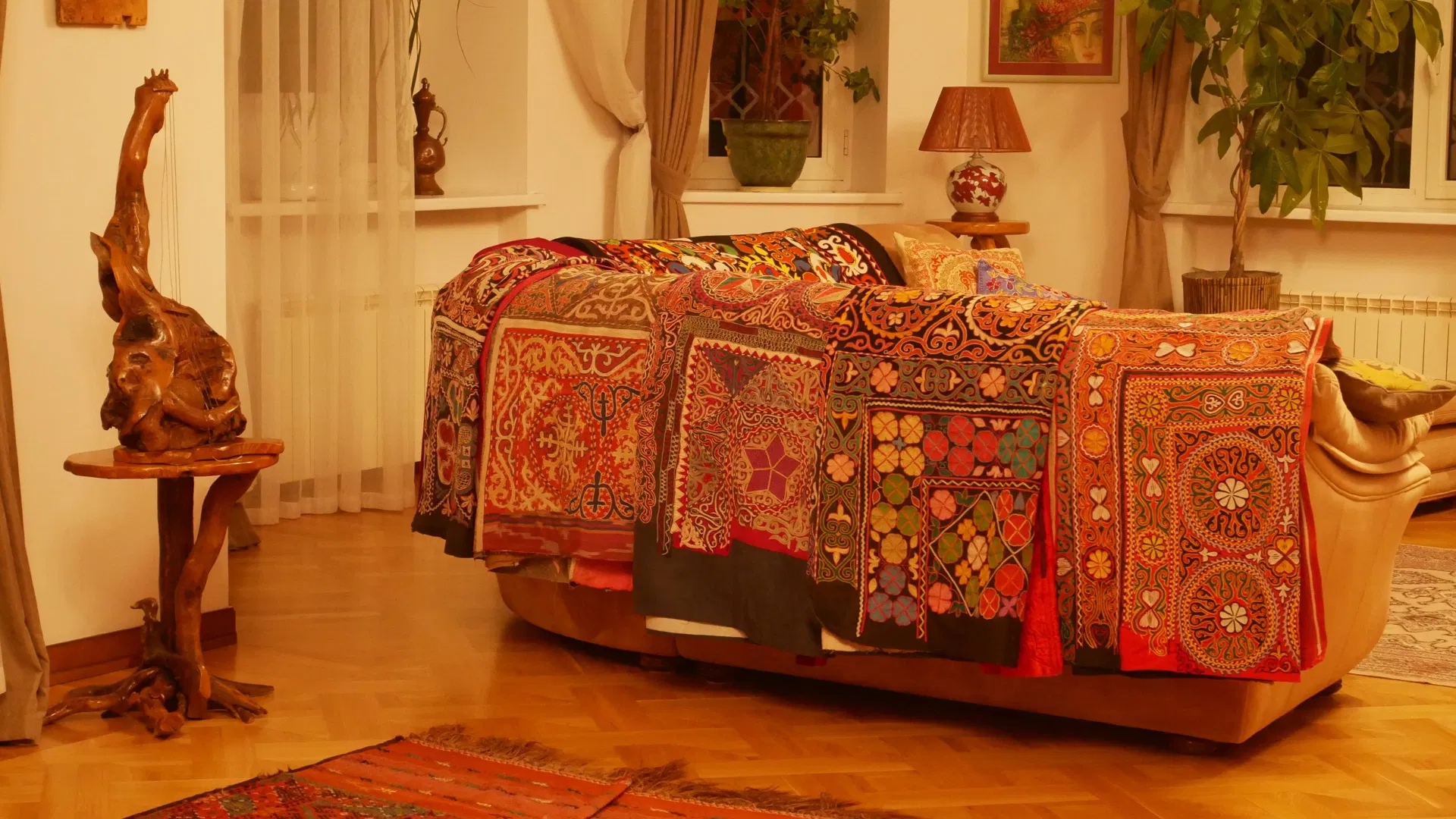
Natalya Krivets is a textile artist, art historian and collector of vintage Central Asian textiles. Her main interest lies in Kazakh tұskiiz - embroidered wall panels that combine artistic craftsmanship, family history and the memory of generations. While building her collection, Natalya studies not only the composition and embroidery technique but also the lives of the women who created these works.
Traditional textiles are often seen as part of a decorative heritage, although behind every item stands a specific person, years of labour and a family history. Natalya Krivets is convinced that the tuskiiz deserves attention not only as an ethnographic artefact but also as a work of art in its own right. We spoke with her about female authorship, artistic freedom within tradition, the value of handwork and how to give an ancient art a place in the modern home.
At some point you stop in front of an object.
- If you could show only one tuskiiz to introduce your collection, which would you choose? What should one know about it to see more than a beautiful embroidery?
There is one tuskiiz in front of which I involuntarily stopped every time I entered the room where it hung: it draws the eye so strongly. It is made delicately, in a very harmonious colour palette and beautifully composed, so that I saw it anew each time. It seems to me that this is exactly how we distinguish a work of art from a merely beautiful thing: it makes you stop, as if pausing in time, and look at it again and again.
This panel also has a very touching story. By all appearances, it was embroidered by a mother for her daughter as a wedding gift: the maker's signature has survived on the fabric - Umitkhan, and next to it in small letters it says: for Yerkezhan. The item is in excellent condition, and it is clear that it was cherished. For me this is not just an embroidery but evidence of love and a wish for happiness that a person managed to express through handwork.
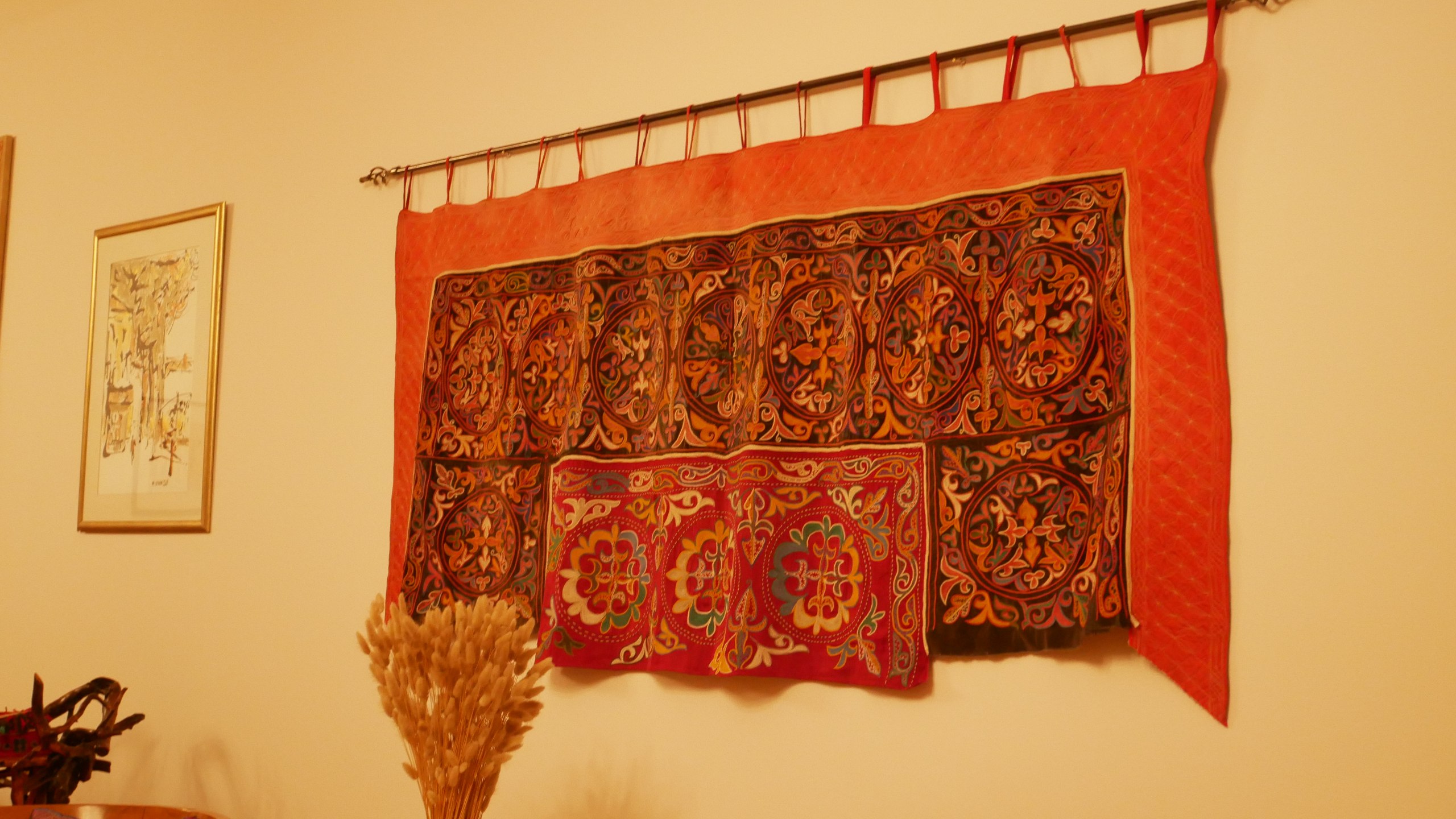
Behind every tuskiiz stands a woman maker.
- On some tuskiizs the names of the makers have survived. Have you managed to reconstruct the fate of at least one of these women?
When I began collecting textiles, I was drawn above all to the beauty of the items. I started thinking about the authors later, when I began showing the collection to the wider public. It is not always possible to learn the name of the maker: many items are sold through intermediaries, and the history of their creation is lost, but sometimes one learns astonishing details. For example, a friend of mine from Kyrgyzstan told me about her grandmother, who created incredibly delicate embroideries. One of her tuskiizs of amazing beauty (in Kyrgyz, "tush-kiyiz") is today kept in the National History Museum in Bishkek. During the war this woman embroidered it and prayed that her two sons would come back alive. It seems to me that this story contains a great deal: faith, maternal love and the hope that a person put into her work.
Tradition does not exclude artistic freedom.
- How do you recognise the individual hand of a maker?
Above all through "having seen a lot". I do not consider myself a specialist who can infallibly determine the authorship of every item, but over time you begin to notice differences in composition, colour, and the fineness and density of the embroidery.
It is especially interesting to observe how the tuskiiz changed over the decades. Works of the 1940s to 1960s often stand out for very fine embroidery. In the 1970s a bolder colour palette appears, and by the 1980s the pattern becomes larger and the density of the stitches changes. In the 1990s works feature brighter threads and shiny materials.
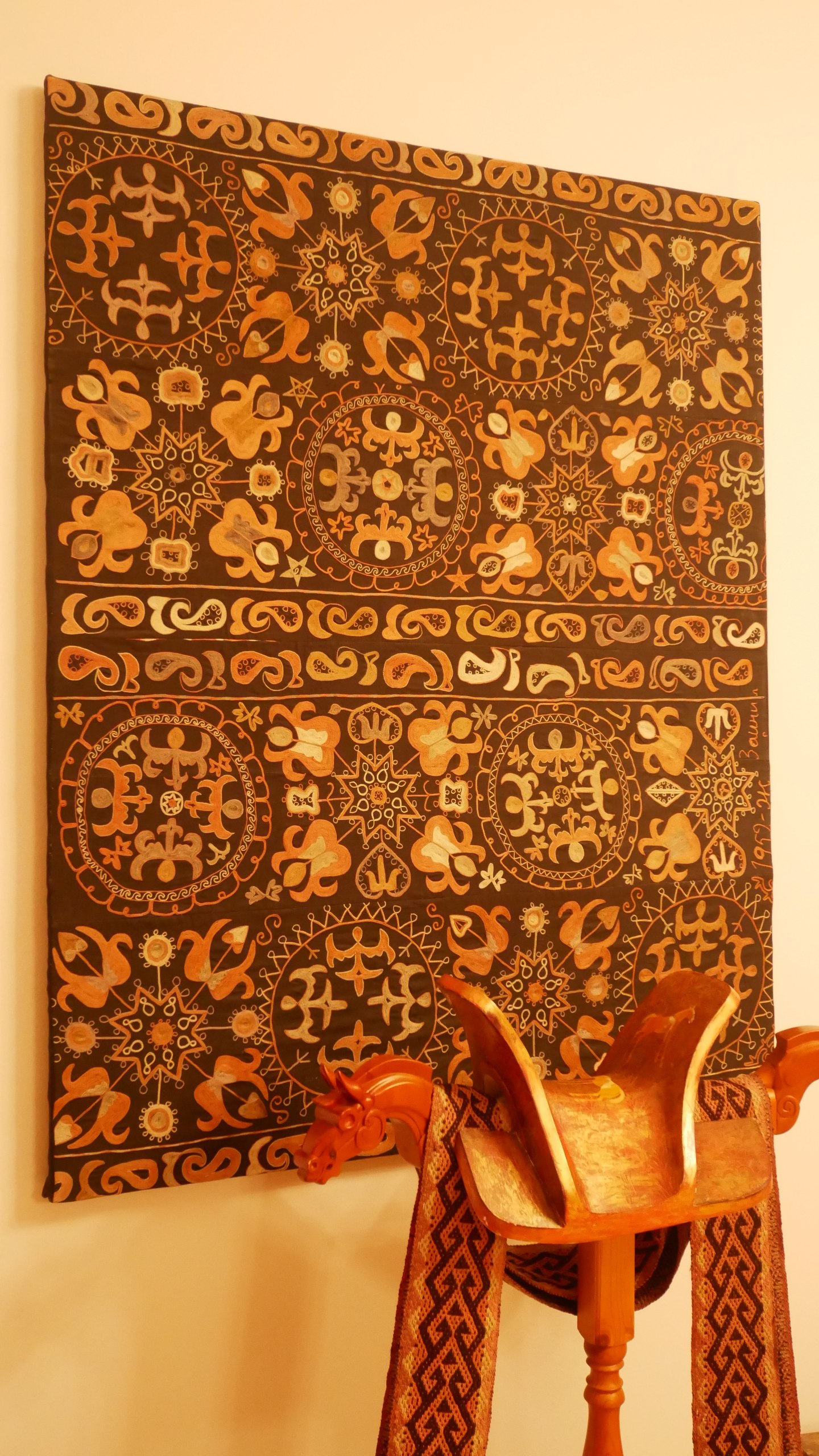
Sometimes the makers went far beyond the usual ornamental motifs. I have, for example, a tuskiiz embroidered in cross-stitch with four little hares on a sledge. The subject was probably inspired by a cartoon the maker had seen. But why should we treat it with less respect? It is a reflection of an era, evidence of its time. Traditional art does not exist outside life - it changes together with people.
The main thing was to pass the skill on to the next generation.
- What can a tuskiiz tell us about a woman's life and her position in the family?
Above all, about the colossal creative potential of women. They created astonishing works, often without any formal art education. That means there was a strong tradition of upbringing within the family, thanks to which the craft was passed on.
I am especially struck by how much labour such art required in the conditions of nomadic life. Materials had to be transported, one had to make do with minimal tools, sometimes embroider by candlelight, and yet items of incredible beauty were created.
There is another important detail: the ornaments at the lower edge of tuskiizs were usually left unfinished, and the last knot was not made. This is believed to have symbolised the continuation of the art, the passing of the skill to the next generations. For me this is a very precise image of tradition itself: what mattered was to preserve not only the item but the very ability to create it.
The Kazakhs of Mongolia have preserved a distinctive aesthetic.
- You have collected textiles in different countries, including among the Kazakhs of Mongolia. What distinguishes these tuskiizs?
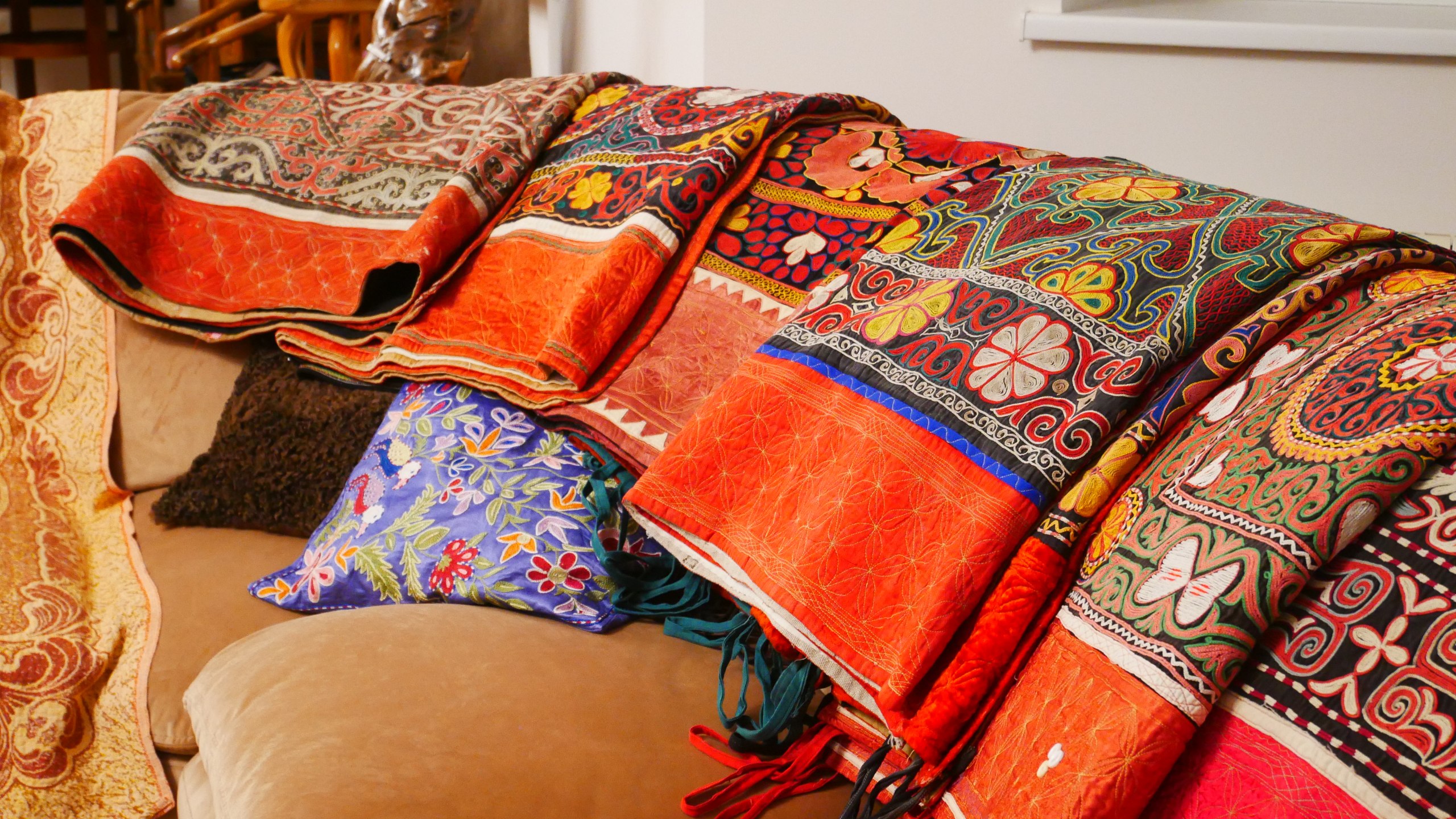
My collection has especially many items from East Kazakhstan and western Mongolia, including from Bayan-Olgii. I am drawn to their restrained colour palette, the fineness of the embroidery and at the same time the expressiveness of colour.
In other regions tuskiizs were often made of felt or in the patchwork technique - kurak. In East Kazakhstan, western Mongolia and some areas of the Altai, including territories in China, it was wall-carpet embroidery in particular that flourished.
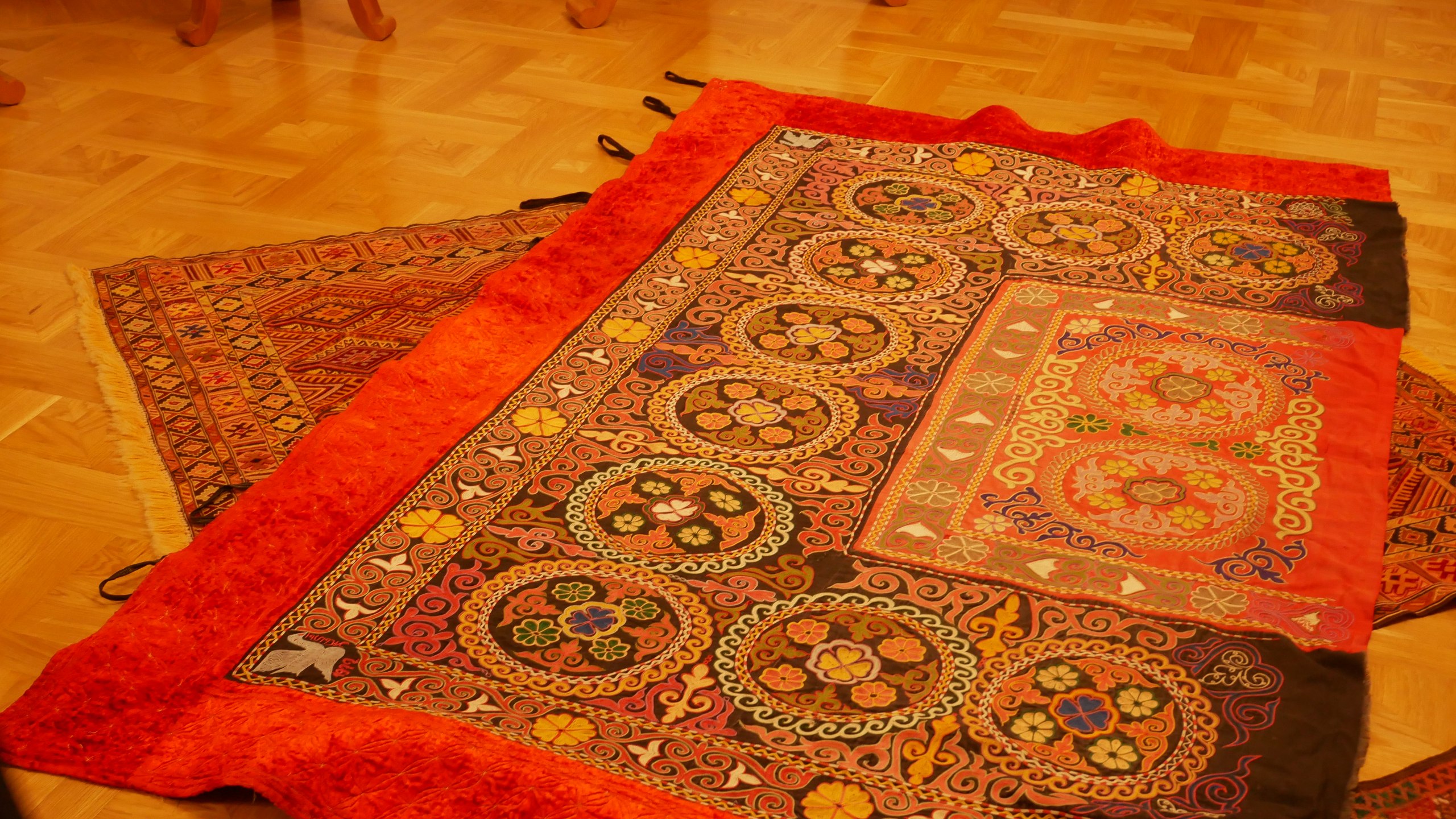
At the same time, not everything can be explained by geography alone. Within a single tradition, craftswomen found their own solutions. For example, one of the craftswomen devised an unusual way of finishing the edges of the cloth: she folded the white fabric so that a complex protective ornament was formed. I have not come across similar techniques among other craftswomen. It is precisely such details that allow one to see individual craftsmanship and imagination behind a shared tradition. In general, these pieces, while fully observing certain traditional canons, are marked by an extraordinary creative diversity. And that is probably why they are so appealing.
I am cautious about interpreting ornaments.
— How do you verify the stories that accompany old objects?
I try not to attribute meanings to ornaments that I am not sure about. The same motif may be called different things, and its interpretation may change depending on the region and the source. So there is a risk of over-interpretation.
Even the name of the object itself left me in doubt. I came across various explanations of how such carpets are best called. In the end I turned to Kazakh craftswomen from Mongolia who continue to embroider them. They called them tuskiiz. Later I found an explanation according to which embroidered panels used to be sewn onto a felt base, since they served not only as decoration but also as extra protection for the wall against the cold.
This case convinced me of the importance of living tradition. If we want to understand an object, we need to turn not only to books but also to the people who keep the relevant craft alive.
I would like to know the story of every piece.
— What is it important for you to learn and preserve along with a tuskiiz you have acquired?
At one time it seemed to me that one day I would be able to reconstruct the history of every item in the collection. Now I understand that for many of them this is no longer possible. But I keep looking for information.
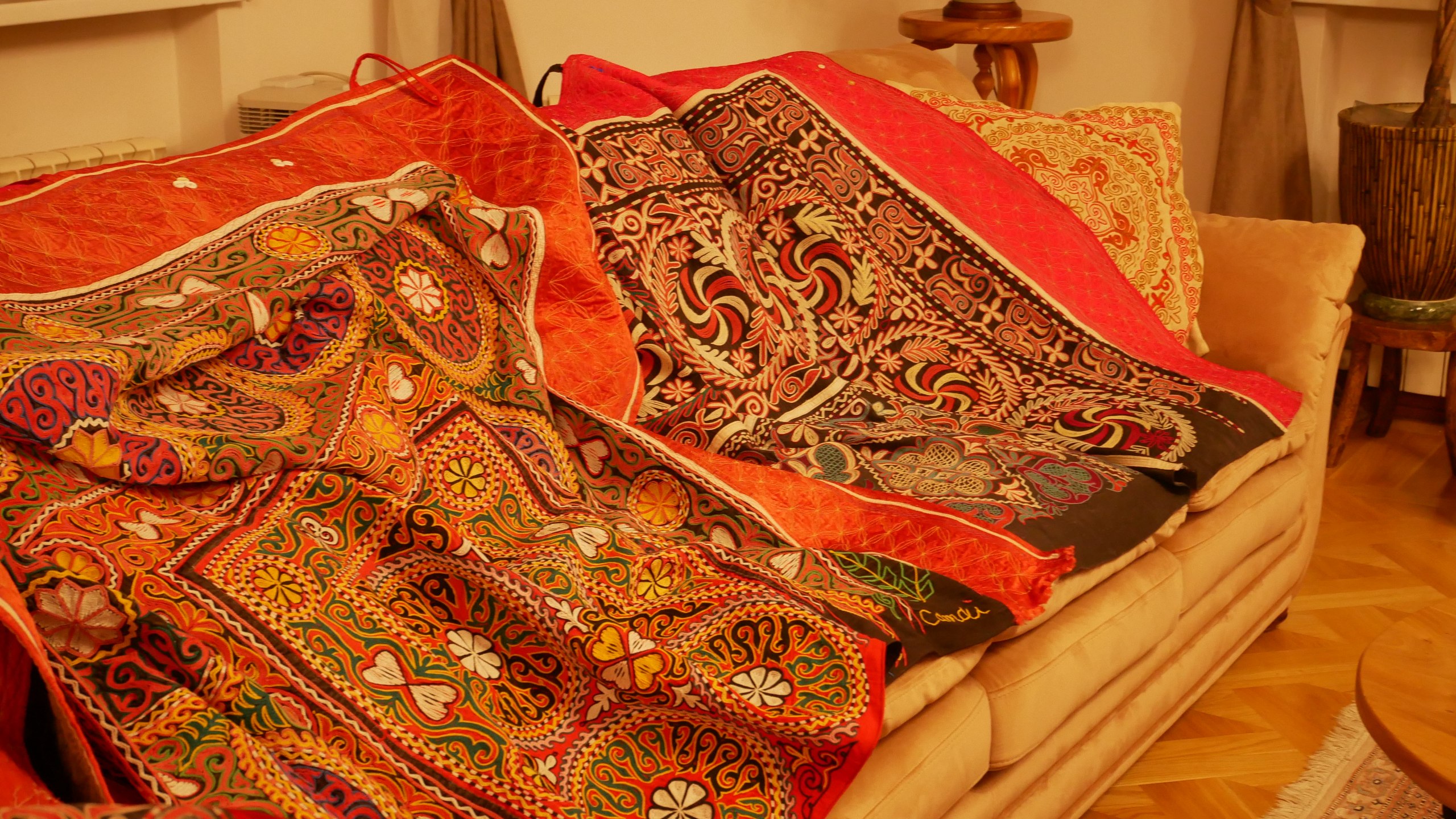
Recently I acquired a tuskiiz about two and a half metres wide, which is larger than the usual size. I suggested that it was made not as a bedside carpet but to decorate the place of honour in a yurt. And indeed it turned out that it was embroidered for a respected elder brother named Khalyk. Its composition is fairly classical, but what interested me were the peculiarities of the embroidery: I had the feeling that two craftswomen had worked on it. And separate dates have survived on different parts of it.
Today it is no longer possible to establish whether it was definitely embroidered by two pairs of hands, but it turned out that this family did indeed have two sisters and both were craftswomen. So my version is not groundless, and yet it was based simply on the manner of embroidery.
And the size of the carpet, the solemnity of the style and the inscription itself dedicated to Khalyk seemed to give it additional meaning: it is not simply an object for a particular person but a kind of dedication to the family and to the Kazakh people.
Value is not necessarily determined by age.
— What determines the value of a tuskiiz for you as a collector?
I have no goal of collecting as many items as possible. I am a private collector, not a museum, so I prefer a small collection in which each piece has its own distinctive feature.
It may be an unusual composition, a rare combination of colours, the fineness of the embroidery or the story of its creation. Age is not the main criterion for me. Far more important is the quality of the work and the impression it makes.
Sometimes a first glance is enough to understand that you are looking at a work of art. You may not know the exact meaning of the ornaments, but you feel the beauty. It seems to me that it is precisely this feeling that makes such things universal - understandable to people from different cultures.
A tuskiiz can transform a modern interior.
— How do you place antique panels in a modern flat?
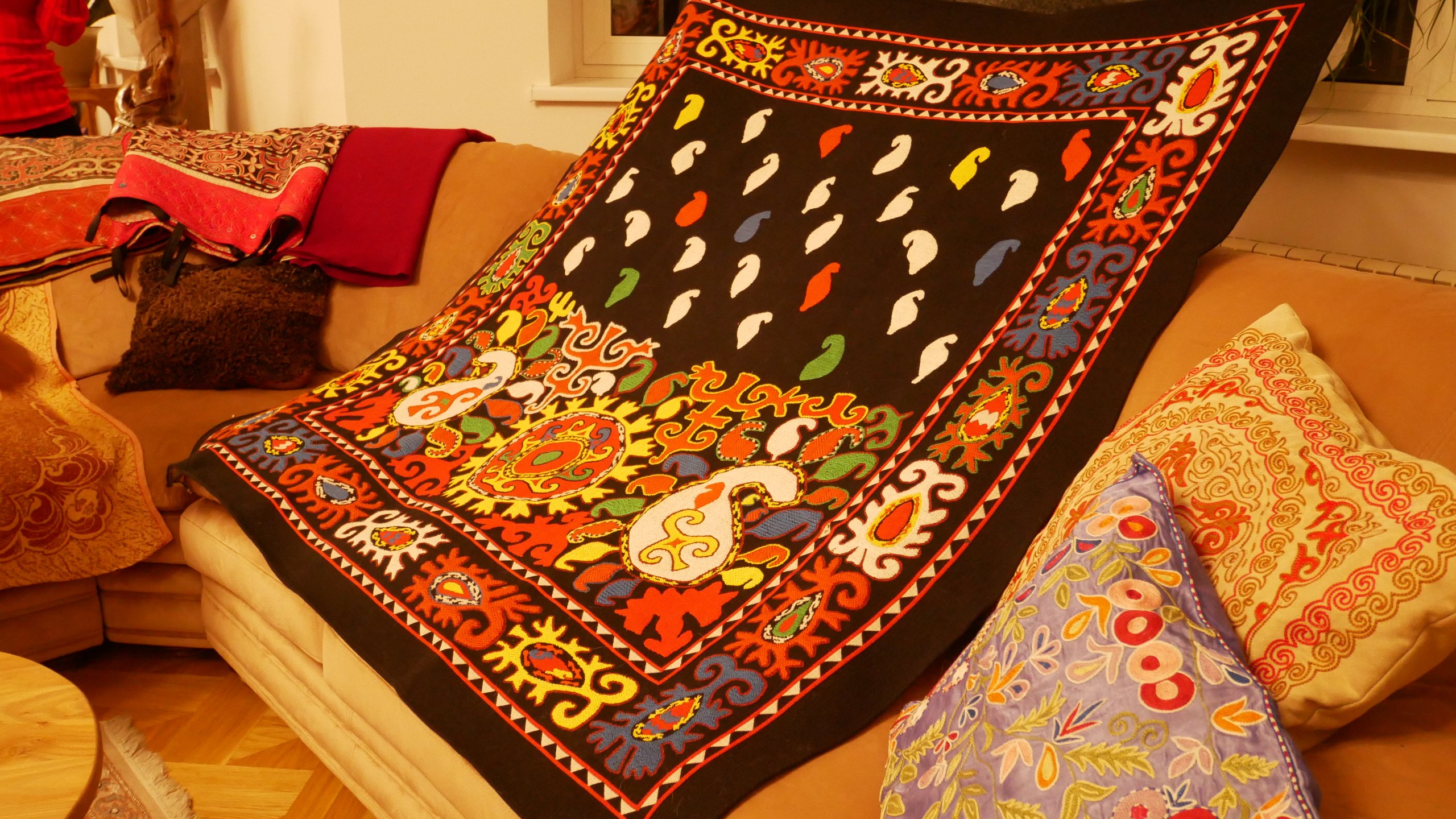
At home I usually have two or three tuskiiz hanging. They are quite large - often more than two metres wide - so they look best on a free wall of a neutral colour.
Such a panel can completely change the perception of a room. Our family often has to move into rented housing, where we cannot radically change the interior, and then a bright tuskiiz becomes the main accent of the space. It gives the room character and a sense of home. But there is one important rule here: the textile must be protected from direct sunlight, otherwise the threads may fade.
An antique piece can quite well live in a modern interior if it is treated with care.
Tradition should not be copied but continued.
— How can you tell a meaningful engagement with heritage from superficial borrowing?
For me everything begins with the quality of the materials and the execution. True craftsmanship is felt in the details: in the precision of the stitches, the harmony of colour, the durability of the fabric. Such things do not look accidental.
I like it when traditional materials and techniques continue to be used in contemporary projects. For example, I have long been familiar with the products of the company Aigul Line, which works with felt. I bought some items about twelve years ago and still use them: they keep their colour and quality even after washing.
This is a good example of how a traditional material can exist organically in modern life. It is important not simply to reproduce an ornament but to understand the aesthetics and principles of the craft that lie behind it.
A beautiful piece should come back into life.
— What needs to change so that young craftswomen can earn a living by creating new tuskiiz?
It seems to me that interest in traditional art is already growing. One visitor to my exhibition called it an ethnic renaissance. I am especially glad that young people are showing interest.
Young craftswomen need access to knowledge, quality materials and high-level examples. At the same time, there is no need to fear new solutions. Tradition should not remain solely a museum treasure - it needs a place in modern homes and interiors.
Ремесло в кадре: как фотография показывает работу мастераКуратор выставки «Живые традиции» Хусниддин Ато о критериях отбора, уважении к героям снимков и судьбе фотографий после фестиваля.mag.humodoc.com
Of course, a tuskiiz is a large and labour-intensive piece of work. A craftswoman must know that there will be a buyer willing to pay for months of handwork. But it seems to me that much can begin with a simple gesture: if someone gives their daughter a new, quality-embroidered tuskiiz as a dowry, that example could inspire others. That is how the tradition will gradually return to everyday life.
I want Kazakh textiles to be known throughout the world.
- What continuation would you like for your collection?
First of all, I would like to study the history of specific items better and establish the authorship of those whose names are still unknown. I also dream of creating a beautiful photo album about my collection - not an academic ethnographic work, but a book that will tell the stories of these things and introduce them to a wide audience.
I would like Kazakh textiles to be written about more in foreign publications. In world literature on textiles, tuskiizs receive comparatively little attention.
Last year I was able to present ten tuskiizs at a major textile festival in France. Over four days it was visited by around 17,000 people. Many saw such items for the first time and were surprised they had not known of their existence. For me this is very important: to show the collection, tell people about it and reveal to them the beauty of Kazakh textiles.
I want these things not to lie folded in trunks, but to continue living. To be of interest, to be studied, to see new craftswomen emerge. After all, preserving a tradition means not only protecting antique objects, but also giving the art the chance to continue.
Newsletter
A letter from the HD editors
Once a week, we send the best stories, events, and cultural discoveries from Central Asia.