Art
Zhamilya Taken: “I Want to Make the World a Little Kinder and More Beautiful”
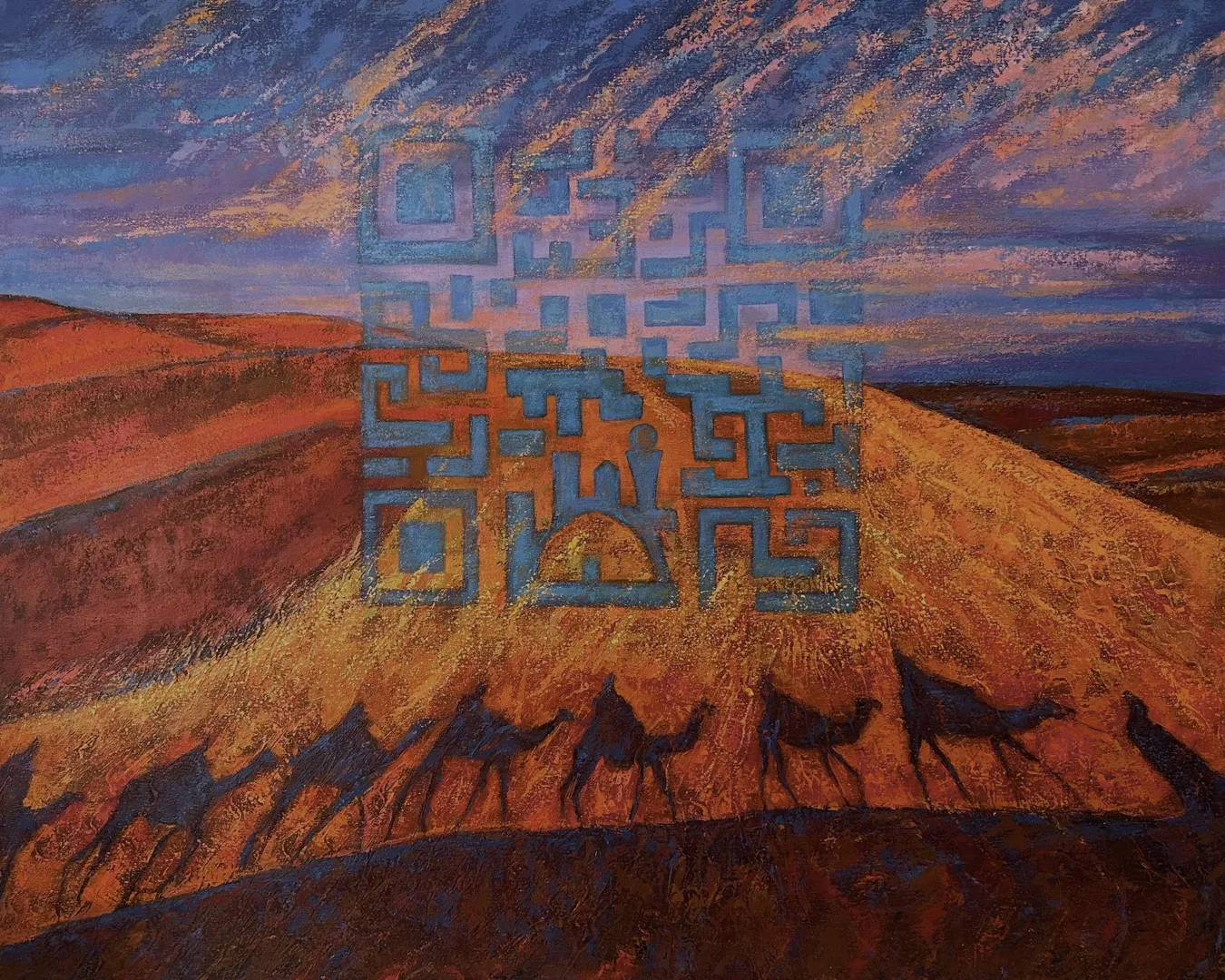
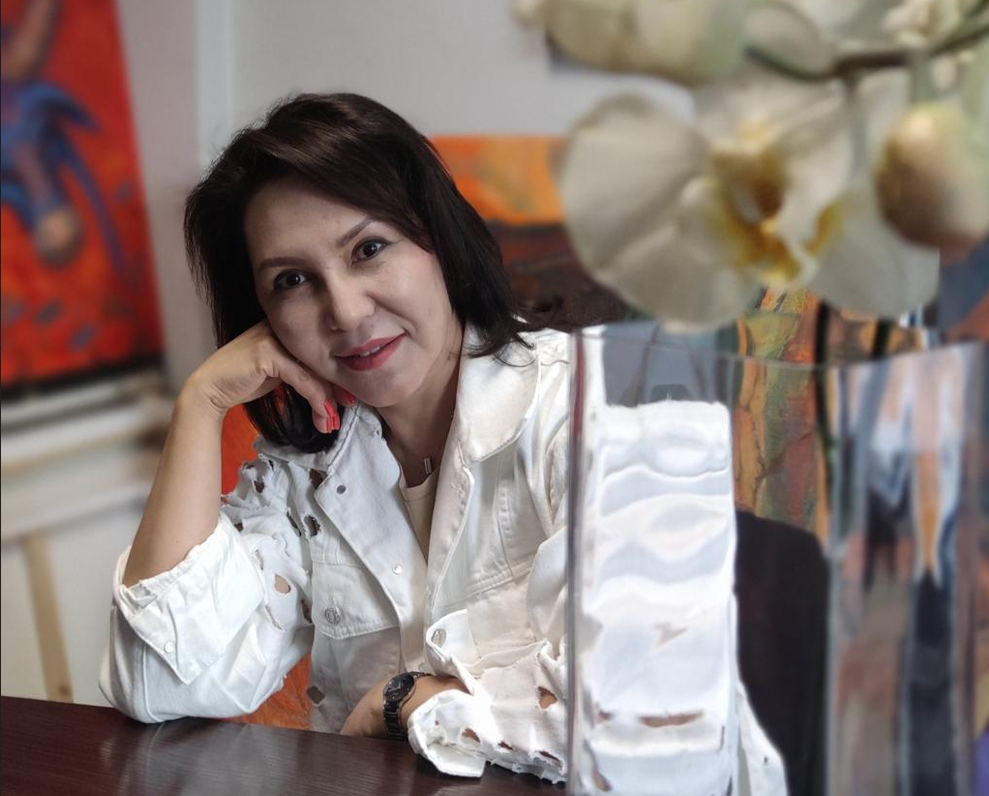
The artist and founder of the International Independent Women Artists’ Fund “Tań-Sholpan” talks to HD magazine about the evolution of her art, why it is particularly difficult for women artists to balance creative work and family life, how access to the international art scene is opening up new opportunities for artists from Kazakhstan, and why artificial intelligence can never replace a living artist.
You started out as an artist back in Soviet times. What shaped your early professional years?
In Soviet times, the expectations placed on artists were somewhat different from what they are today. Socialist Realism was the prevailing approach: artists were expected to depict workers, peasants and industrial production, reflecting the world around them in an academic realist style. We painted outdoors and in the studio, produced portraits and genre scenes. But I was also interested in the Peredvizhniki, the great masters of world art, the Impressionists and Post-Impressionists. I absorbed all of this like a sponge. I was particularly drawn to figurative painting and composition.
Today, everything has changed: the styles, the subject matter and the very concept of what it means to be an artist. But one thing remains constant: we must keep creating, keep working and portray the reality around us without simply copying it. We must convey the artist’s inner perception of the world.
Today, as major geopolitical shifts and natural disasters unfold, art is changing too. We are becoming increasingly interested in deeper processes, in the emotional and spiritual dimensions of life, and in people’s inner psychological states.
The female figure occupies an important place in your work. What continues to draw you to this subject?
The modern woman is different from the woman of Soviet times. Yet one thing remains unchanged: first and foremost, a woman is a mother and the one who carries on the family line. A woman is a pillar on which so much rests, despite her seemingly fragile shoulders. Raising children and keeping the family home are still, to a great extent, associated with women.
I have always been interested in a woman’s inner state and spiritual world. How does she experience the world around her? What does she want to express? How can that state be conveyed through form, line and colour? To me, a woman is above all a creator: a woman as artist, mother and maker.
What comes first when you begin a painting: an image, a feeling, a colour or an idea?
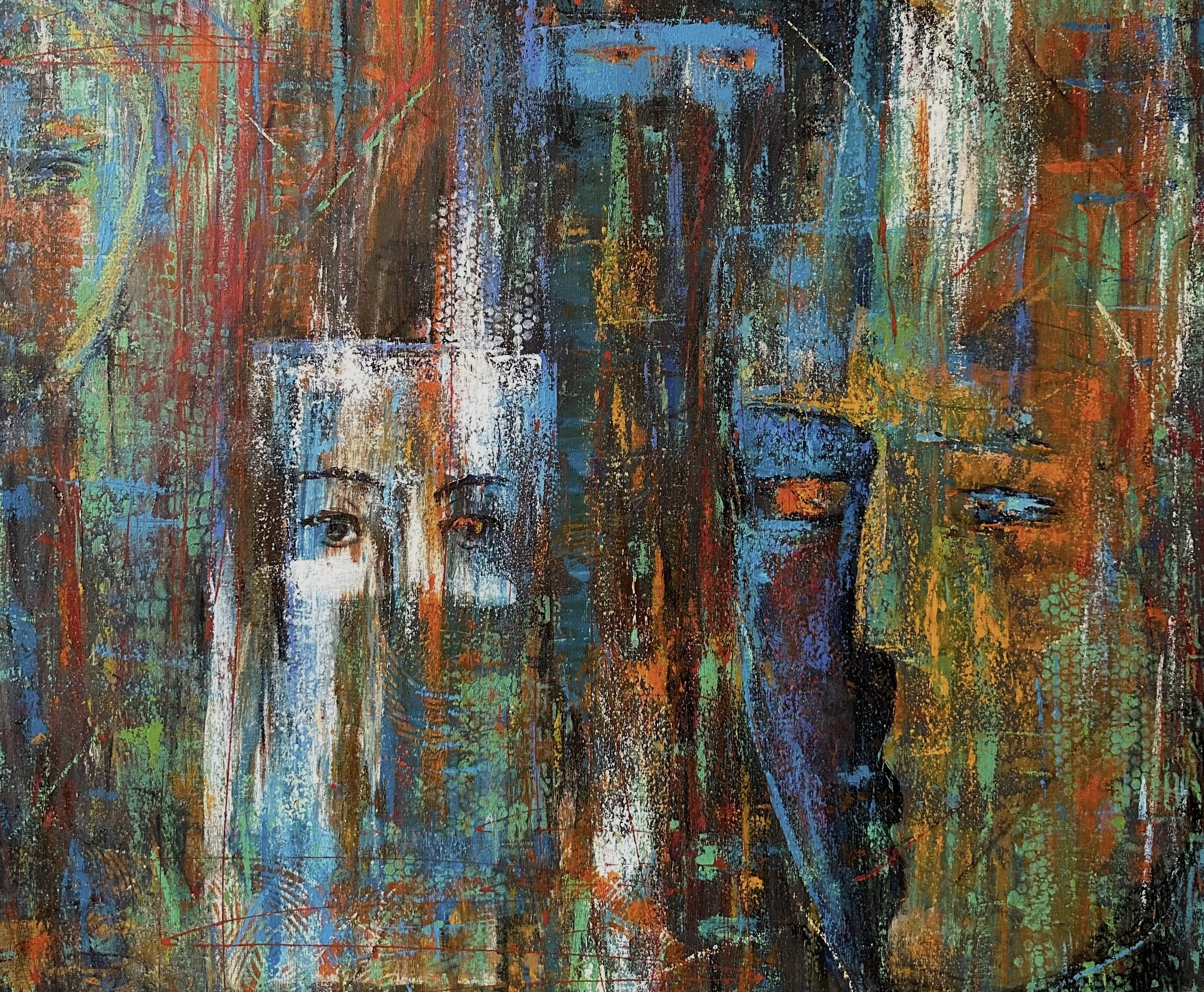
It is different every time. Sometimes a feeling suddenly stirs something in me, and I want to express it through colour. I have a painting called Smyateniye Chuvstv (Confusion of Feelings), for example.
Red often dominates my palette. I love this colour because it represents passion, love and fire. It can evoke both positive and negative emotions. It is also the colour of youth and beauty.
I have always wanted to explore red and reveal its energy. Sometimes I use it to convey intense passions, the energy bubbling up inside me. At other times, a thought takes shape and I want to express it. I take a canvas and a brush, and then my hand seems to guide itself. Gradually, a composition, an idea, a whole concept begins to emerge from a single small brushstroke.
What does the landscape of Kazakhstan mean to you personally?
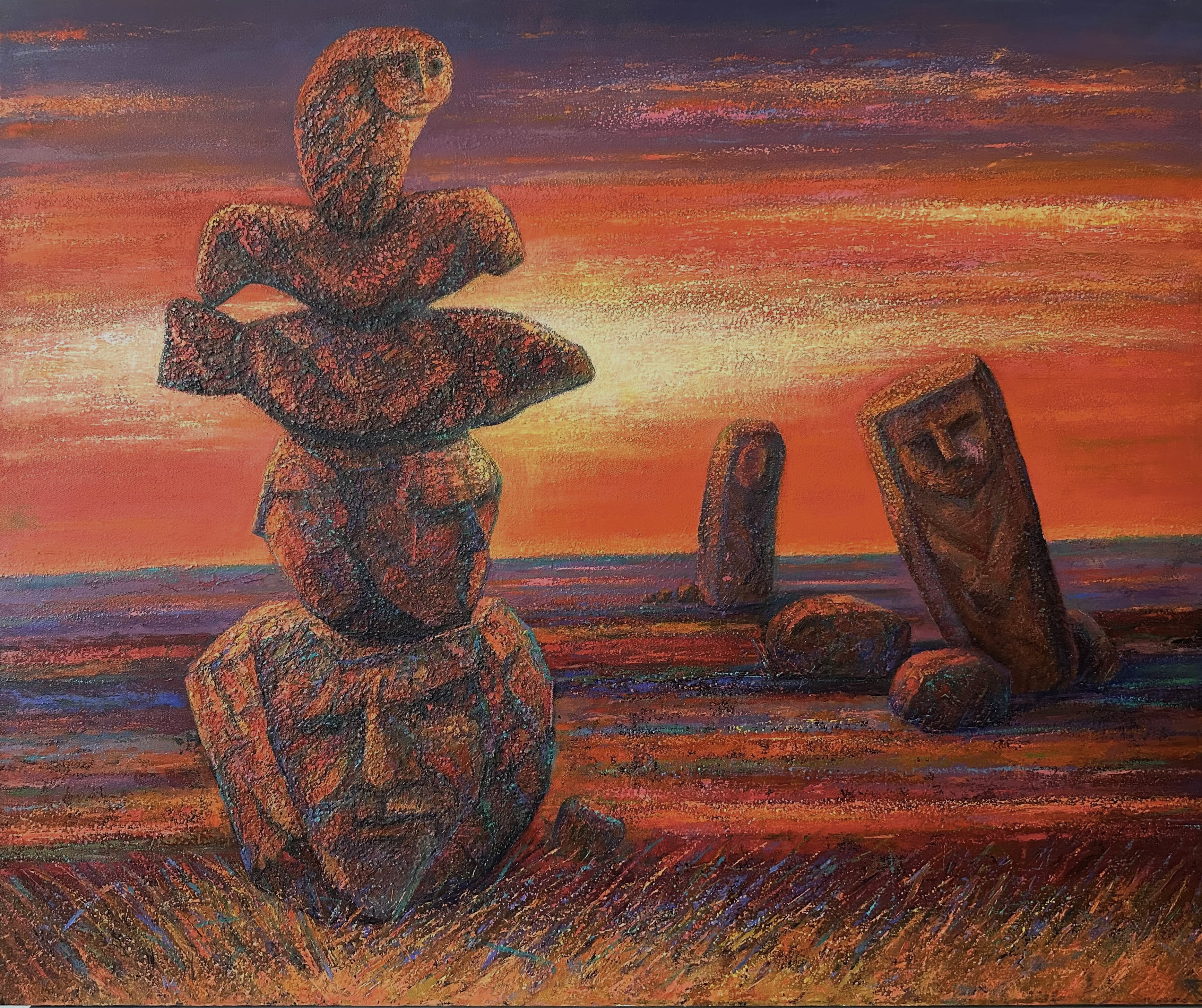
Kazakhstan’s landscape is incredibly rich. We have steppes, mountains, lakes and forests. It is extraordinarily picturesque, which is why artists return to it so often.
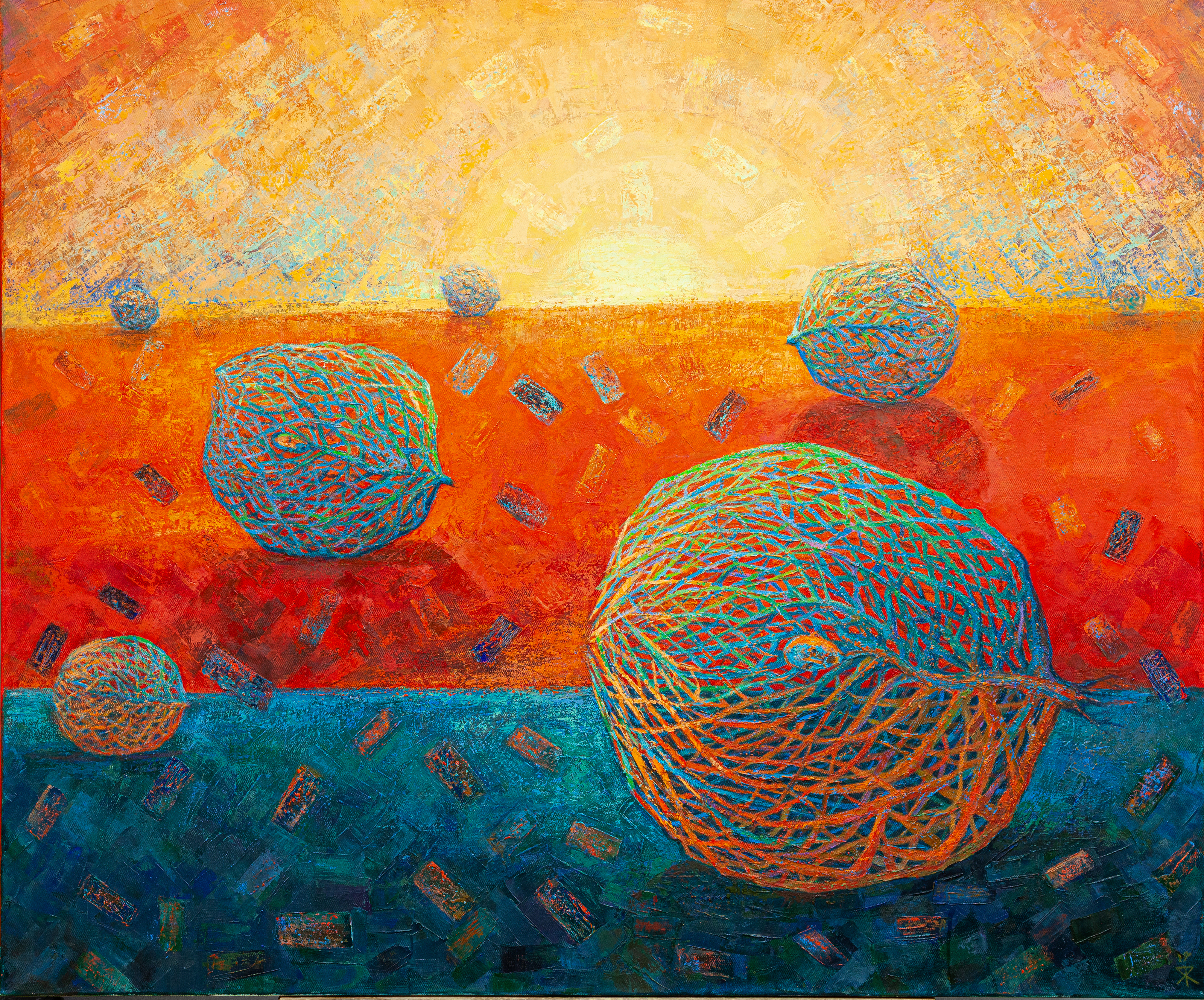
We are nomads, children of the steppe. Since childhood, I used to visit my grandparents, who lived in Semirechye. I remember those open steppe fields and the tumbleweed rolling across them. This image has become a symbol of our lives in many of my works.
In Kazakh, tumbleweed is called қаңбақ (qańbaq). I even held a solo exhibition under that name. Human life is rather like the movement of tumbleweed: we keep rolling along, never knowing where the future will take us. I have always been drawn to distant horizons, open spaces, the sky and the steppe.
Recently, we travelled to the Aral Sea, to Lake Zhaksykylysh, where salt is extracted. It is a beautiful place, and I saw extraordinary shades in the earth there. We passed through Baikonur, and at last I understood the meaning of the name baikoңyr (Baıqońyr) and why it is translated as “rich valley” or “rich land”. The earth there, with all its shades of brown, red and ochre, is so picturesque and full of energy that I felt compelled to capture it in a painting. I have not yet decided what to call the work, but I am working on it.
I think it is important for artists from Kazakhstan to show our steppes and vast open spaces, to convey this breadth and the full spirit of our identity: freedom, the desire to embrace the new and the drive to explore what lies beyond the horizon. To me, this is part of our genetic code.
You founded the Tań-Sholpan fund in 1998. Why did you choose to create an organisation specifically for women?
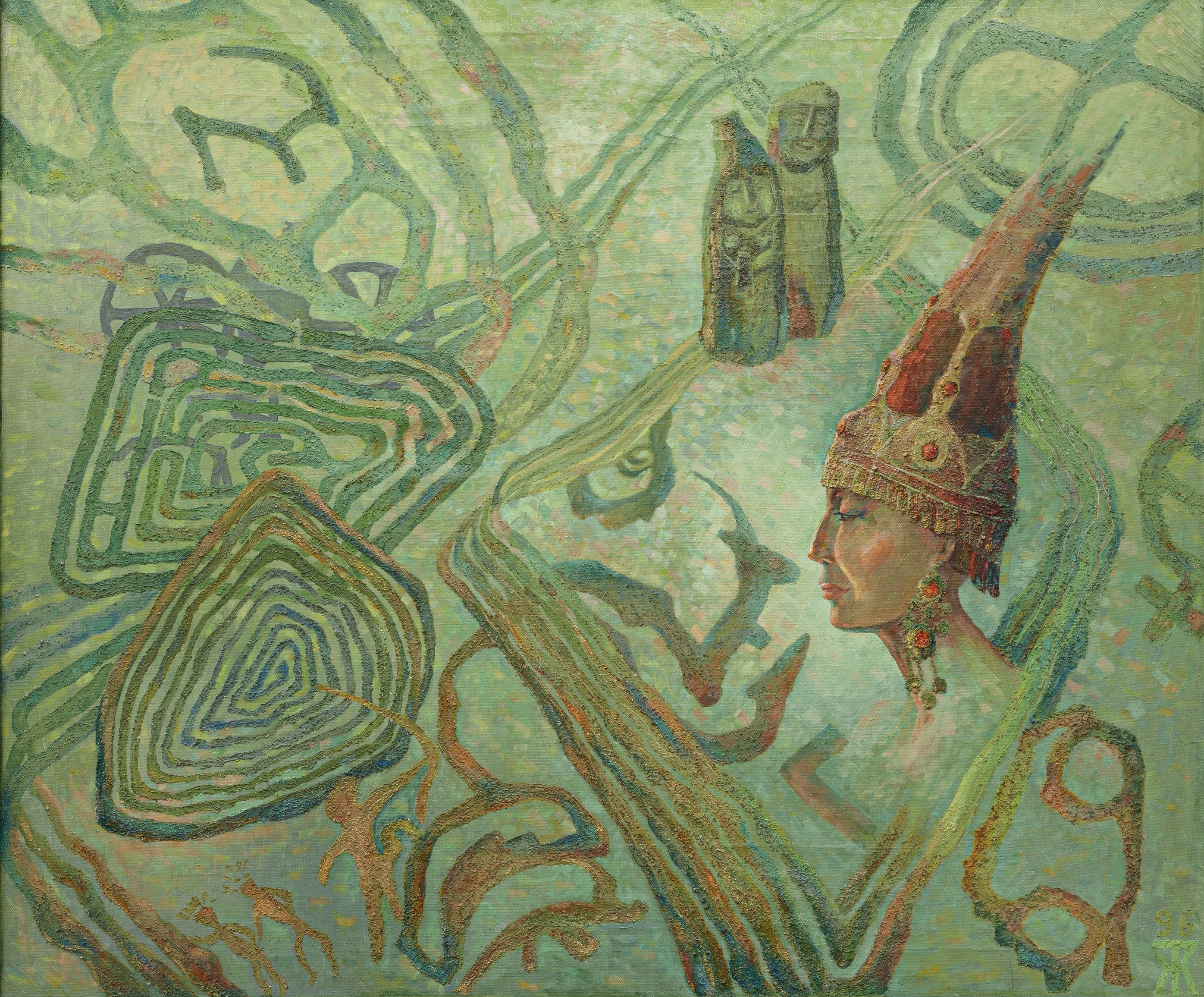
I had been a member of the Artists’ Union since 1996 and was teaching at the Republican Art College at the time. We worked extensively with young women, and I wanted to give them more opportunities to exhibit their work. But when you have small children, it is very difficult to devote yourself fully to your art. To put on a solo exhibition, you need at least 50 works, and then you still have to select the best ones. That is not always possible. So, in 1998, I came up with the idea of establishing a women’s fund where we could exhibit together.
People often asked me: why women? Why not create an organisation for both men and women? But the Artists’ Union already existed, and we were all members. What I wanted was to bring together women artists who found it difficult to put on a solo exhibition because of their family and childcare responsibilities.
If we joined forces, each artist could contribute five or six works, and together we would have a substantial exhibition. We could do this much more often. It can take five to ten years to put together a solo exhibition, whereas a group exhibition allows artists to present new work every year.
For a woman artist, this is a tremendous source of motivation, giving her an incentive to work and establish herself.
We held our first exhibition in 1998. After a long break, we resumed our activities in 2020 and have held exhibitions every year since, sometimes several times a year. We have exhibited not only in Almaty but also in Astana, including at the National Museum, and in Shymkent. We have also taken part in international symposia.
I can see how much our artists have grown over the years.
You are an artist, a teacher and an organiser of the art scene. Which of these roles has been the most challenging?
I have enjoyed them all. Each simply had its own time.
I first established myself as a teacher. I loved teaching and watching my students develop. I grew and developed alongside them. At a certain point, however, I realised that I had outgrown that path and needed to devote myself to my own creative work. I spent 20 years in education, heading the Department of Painting, Sculpture and Graphics at the Republican Art College. But eventually I understood that I needed to become an artist first and foremost, to bring my own ideas and visions to life and to experiment.
I travelled extensively and visited exhibitions, where I had the opportunity to see original works by great artists from around the world. This experience of looking closely at art helped me find my own subject matter. Even so, I continue to experiment. I enjoy discovering new forms and styles. For me, this process has no end.
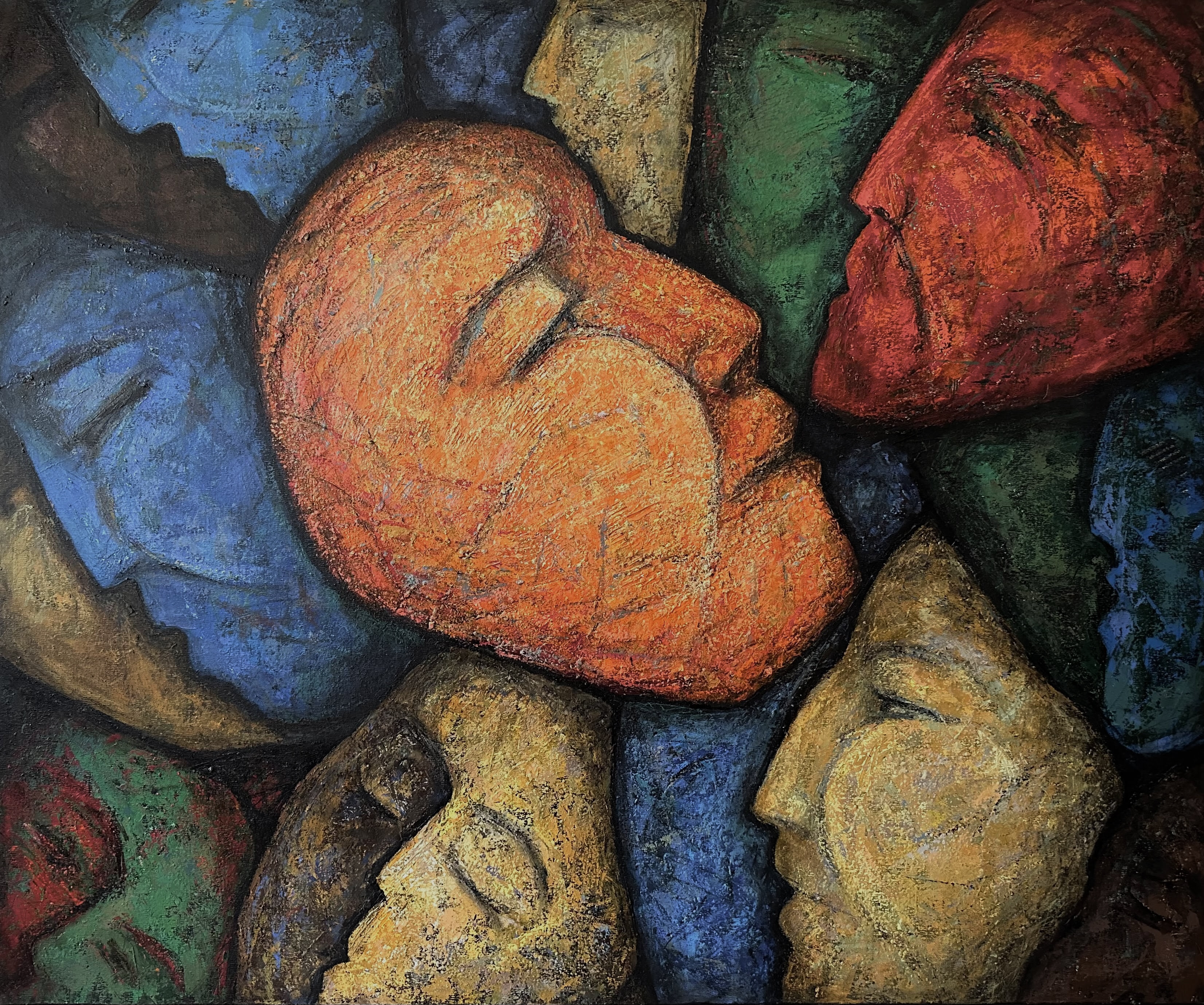
In 2021, your exhibition was titled I Closed My Eyes to See. What does this inner vision mean to you?
With our eyes wide open, we often see only the ordinary things around us. When we turn inwards, we can feel and perceive the subtle world more deeply, sensing how elusive and fragile it is. I wanted to express my understanding of the world, my perceptions and my inner life.
Kamilla Lee on Zhamilya Taken:
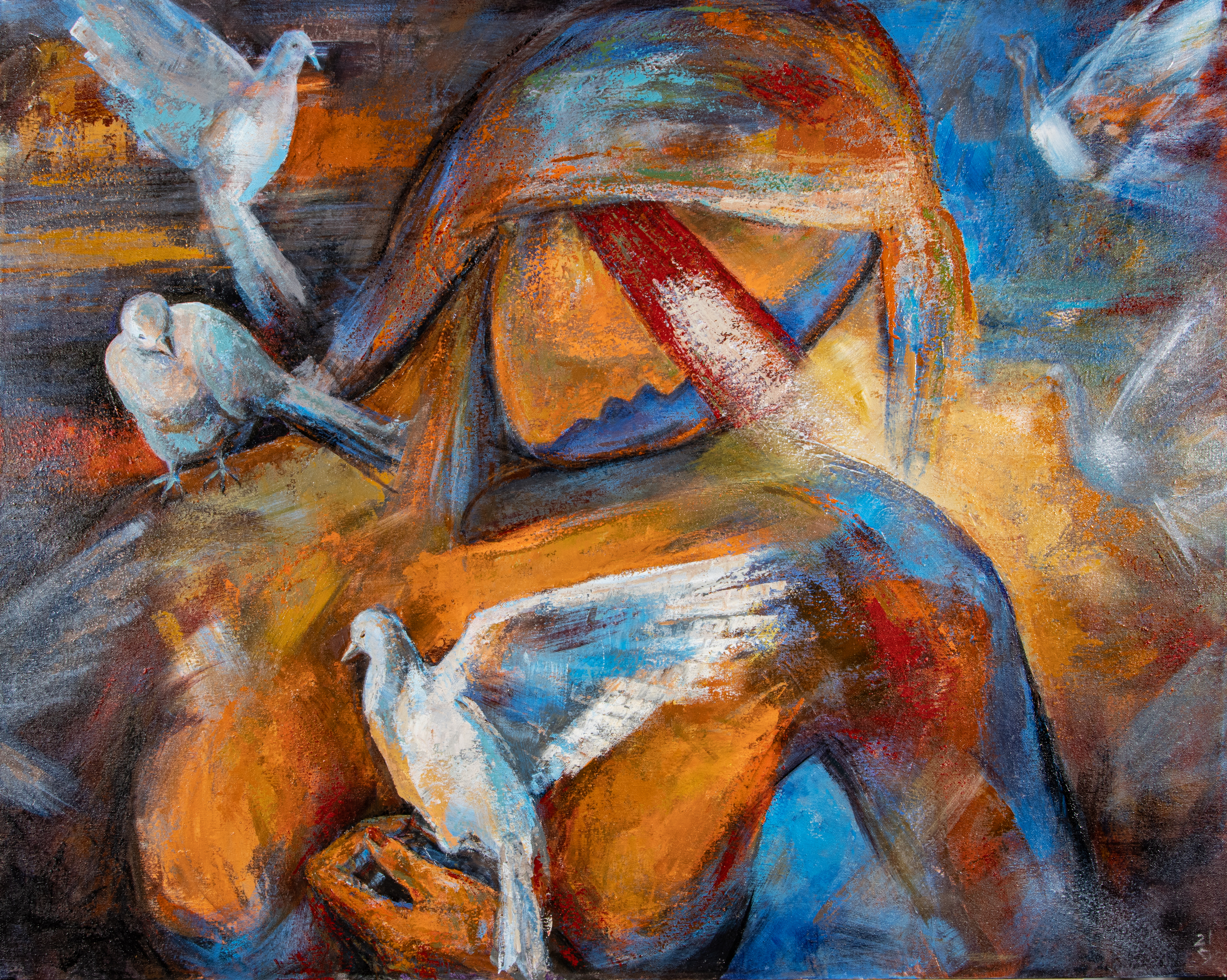
Zhamilya Taken is a special phenomenon in contemporary Kazakhstani art, a vivid, independent and highly recognisable creative personality. She has not only developed her own artistic practice but has also become the leader of the Tań-Sholpan community of women artists, creating an international platform for them. For me, my introduction to her work began with pieces from the Qańbaq series. In the image of the tumbleweed, familiar to every inhabitant of the Kazakh steppe, I suddenly saw human faces. This became a powerful metaphor for me, as though we are all being swept along by the winds of change. Her works convey this sense of a complex transitional time, a moment when the old is already passing away, the new is only taking shape, and it is not yet entirely clear what it will become. At the same time, each of Zhamilya's works has a very personal, almost confessional quality, addressed to the viewer: the artist seems to invite us to find something of our own in these creative messages. Her painting is distinguished by its density, complex colouristic texture and powerful energy. It is difficult to walk past such works; they make you stop, look closely and ask yourself what exactly is happening before us, what the artist is conveying, and what matters so much to her and to us.
What distinguishes an artist from Kazakhstan today from artists of previous generations?
Opportunities have become completely different. Thanks to social media, we can show our work to the whole world. I have been invited to take part in online exhibitions in New York, London, Türkiye and China. This expands the boundaries enormously.
In Soviet times, we lived in a fairly closed world. Now the horizons are vast. Artists from Kazakhstan take part in international exhibitions and symposia and send their work abroad, but difficulties remain. These are primarily the financial circumstances of artists and their professional status.
We keep talking about the need to restore the artist's full professional status. An important event took place this year: the title of "Honoured Artist of Kazakhstan" was reinstated, and we are very pleased about that.
You speak about nature, humanity and the future of the planet. To what extent has the environmental theme become part of your art?
Nature, humanity and the future have always occupied an important place in my work. Even when I work abstractly, through colours, patches and lines, I am still trying to express something. Sometimes it becomes like a puzzle that the viewer has yet to solve.
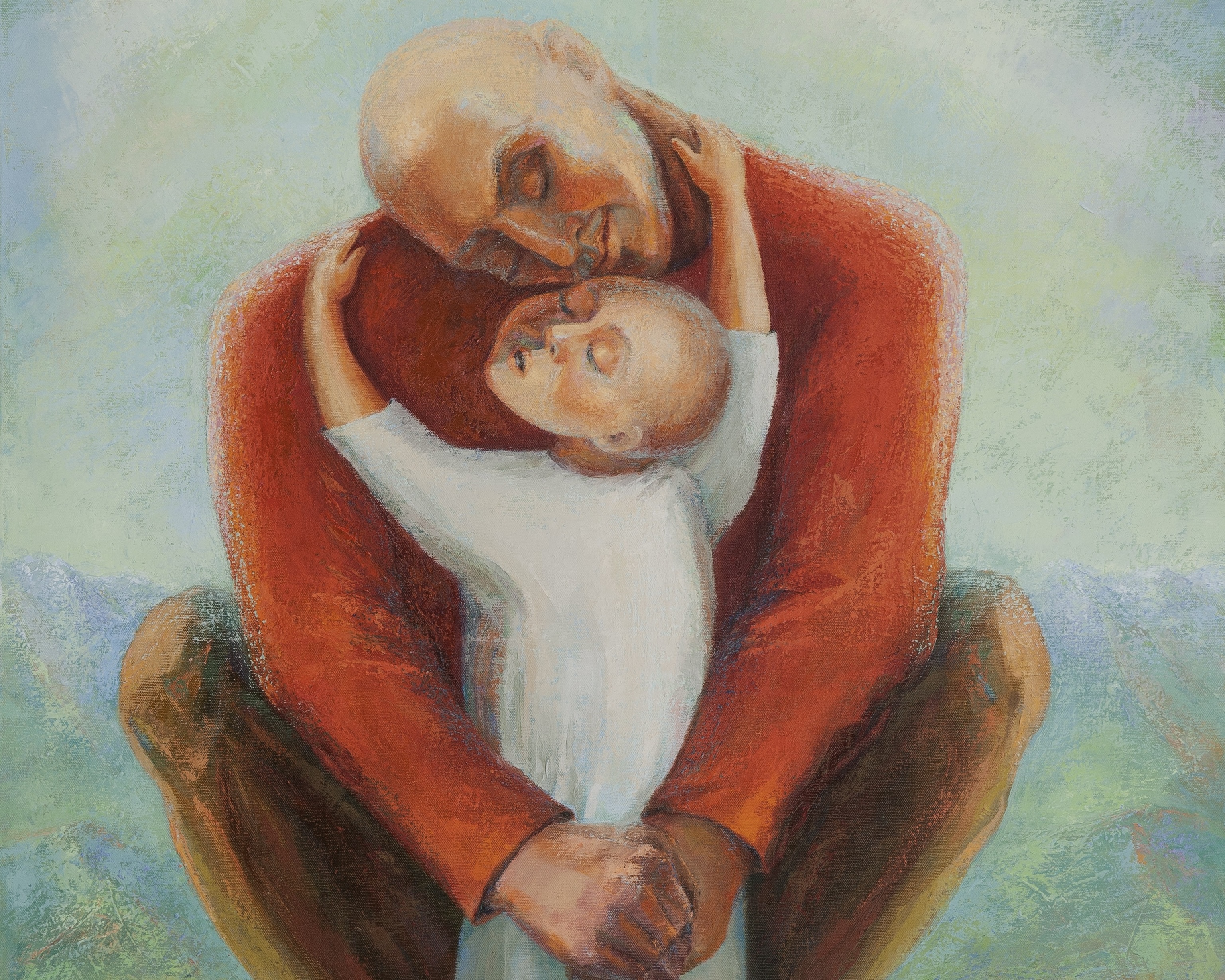
The same Қаңбақ is connected, for me, with people and the times we live in today, a time that is so uncertain, when there is no certainty about the future. I am deeply concerned about the current state of our country. I am a patriot, and I worry about its future. I have children and grandchildren, and it matters to me what their future will be like. Sometimes I try to convey this through images, too.
Do digital art and artificial intelligence pose a threat to painting?
For some, new technologies certainly expand opportunities. For example, for designers, artists working with book illustration? but for an artist who creates a painting, artificial intelligence, in my view, cannot replace creativity. I am not afraid of it.
Yes, artificial intelligence can create a perfect drawing, but it will be work without a soul. And an artist can draw a crooked line, make a nervous brushstroke - but this brushstroke was made by his hand, it comes from the heart, from his feelings.
Emotion, warmth, the artist's state of mind - artificial intelligence is not capable of conveying these. Therefore we should not fear it, but I would not want artists to pass off images created by artificial intelligence as their own works. It is immediately noticeable.
Is there among your works one that speaks especially accurately about you today?
My "Blue Cow" is close to me. I am a Taurus myself, and the cow has a QR code on its forehead and is pregnant. For me, it combines modern technology and what remains unchanged: I am a woman, I am a mother, I am the backbone that holds my family together. And I love life, despite any hardships.
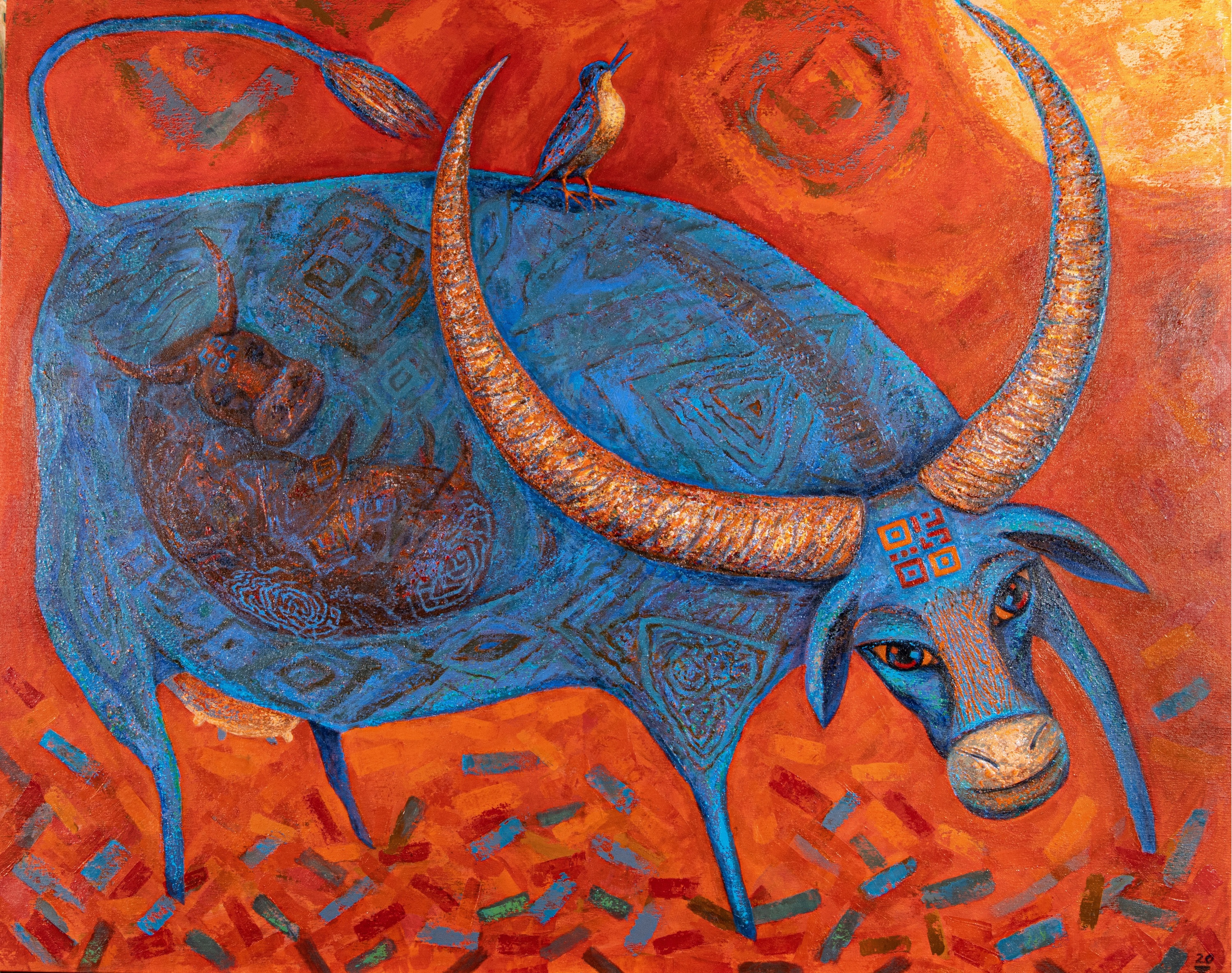
This blue cow has huge horns pointing to the sky, and a bird sits on its back. It stands firmly on its feet, it has faith in a bright future. But I don't want to repeat myself, I like to constantly revive myself, seek new solutions, ideas, plans, develop, move forward, do something new, surprise people and, perhaps, inspire my fellow members of the "Tan-Sholpan" foundation.
The creative process is always constructive. It helps a person develop. For me, as an artist, it is sometimes easier to show than to say. That is probably why I continue to paint.
Newsletter
A letter from the HD editors
Once a week, we send the best stories, events, and cultural discoveries from Central Asia.