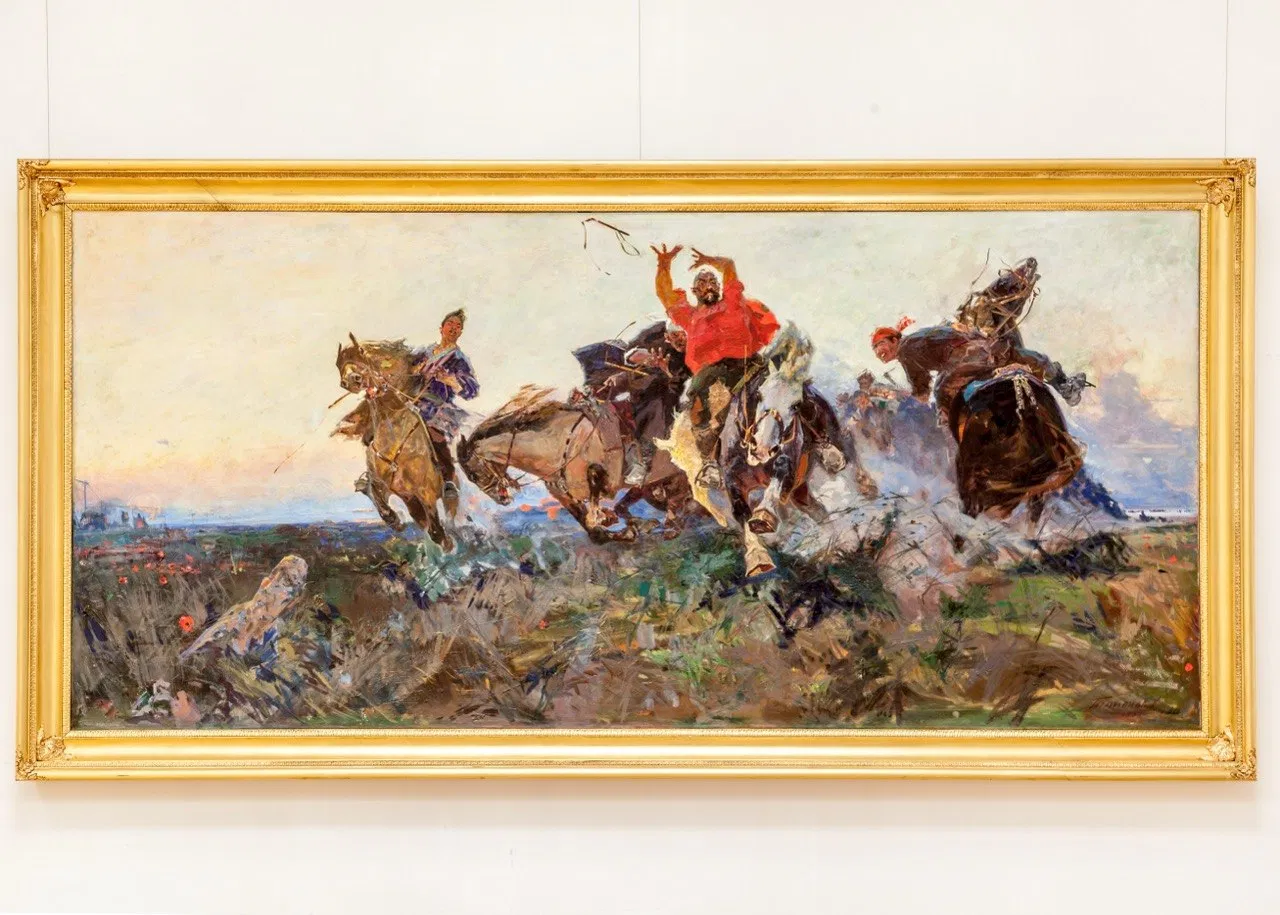
The Kazakh school of fine art seems today a natural part of the national culture. However, professional painting, graphic art and art education in the sense we understand them have a comparatively recent history here. How did a country that had no classical artistic tradition of the European type of its own form a professional art and its own artistic language within a few decades?
An Art Form That Did Not Exist in Traditional Culture
The history of professional fine art in Kazakhstan is paradoxical. Unlike many European countries, there was no centuries-old tradition of classical fine art here, nor were there art academies. One might assume that in nomadic culture, the very necessity of creating a static image of the world was fundamentally paradoxical.
Our national school of fine art is an untraditional phenomenon for the culture of Kazakhstan, for nomadic culture. It is a European tradition, to a significant extent also a Russian one
European fine art took shape over centuries: from antiquity to the Renaissance, the development of painting with religious and mythological themes, then secular and everyday subjects. It emerged within a different cultural and social environment - settled, urban, connected with architecture, temples, palaces, collections and artistic institutions.
Nomadic culture was structured differently. The yurt embodied a temple - a dome of sky on the plane of the earth, while at the same time being a family home and a kind of museum with hand-made ornamented utensils. It could be assembled and disassembled, personal space was not tied to one place, and a person perceived themselves as part of a vast, constantly changing world.
Murat Auezov wrote about the nomad as a point from which space pulsates to infinity and returns back ( “The Connecting Thread of Times”. Zhazushy Publishing House, 1972). This image contains an important difference between nomadic culture and the European tradition: the world is not so much depicted as lived through.
Therefore the emergence of professional fine art in Kazakhstan in the 20th century was not a continuation of its own tradition, but a process of cultural assimilation of new artistic tools for its development at a new historical stage.
The First Artists and the Outside View
Among the first professional artists who systematically turned to the Kazakh theme were representatives of the Russian artistic and scholarly milieu who found themselves in the Steppe in the late 19th and early 20th centuries.
A special place among them belongs to Nikolai Khludov, who came to the Turkestan region as an artist-ethnographer together with an expedition of the Russian Geographical Society as an artist-ethnographer and later settled in Verny. He worked extensively from life, turning to the life of the local population, the landscape and everyday scenes.
His gaze was, of course, the gaze of a person from a different cultural tradition. This is important to bear in mind, since the early depiction of Kazakh life in professional painting did not always coincide with how that life was perceived by the representatives of the local culture themselves.
But Khludov's significance lies not only in the works he created. He became one of the first teachers to pass on the foundations of professional drawing and painting to those who subsequently formed the Kazakhstan art school.
It was in his studio that Abylkhan Kasteyev began.
This is one of the key moments of history: professional art ceased to be exclusively an external view of Kazakhstan and gradually began to take shape from within the national environment itself.
From Khludov's Studio - to Kasteyev
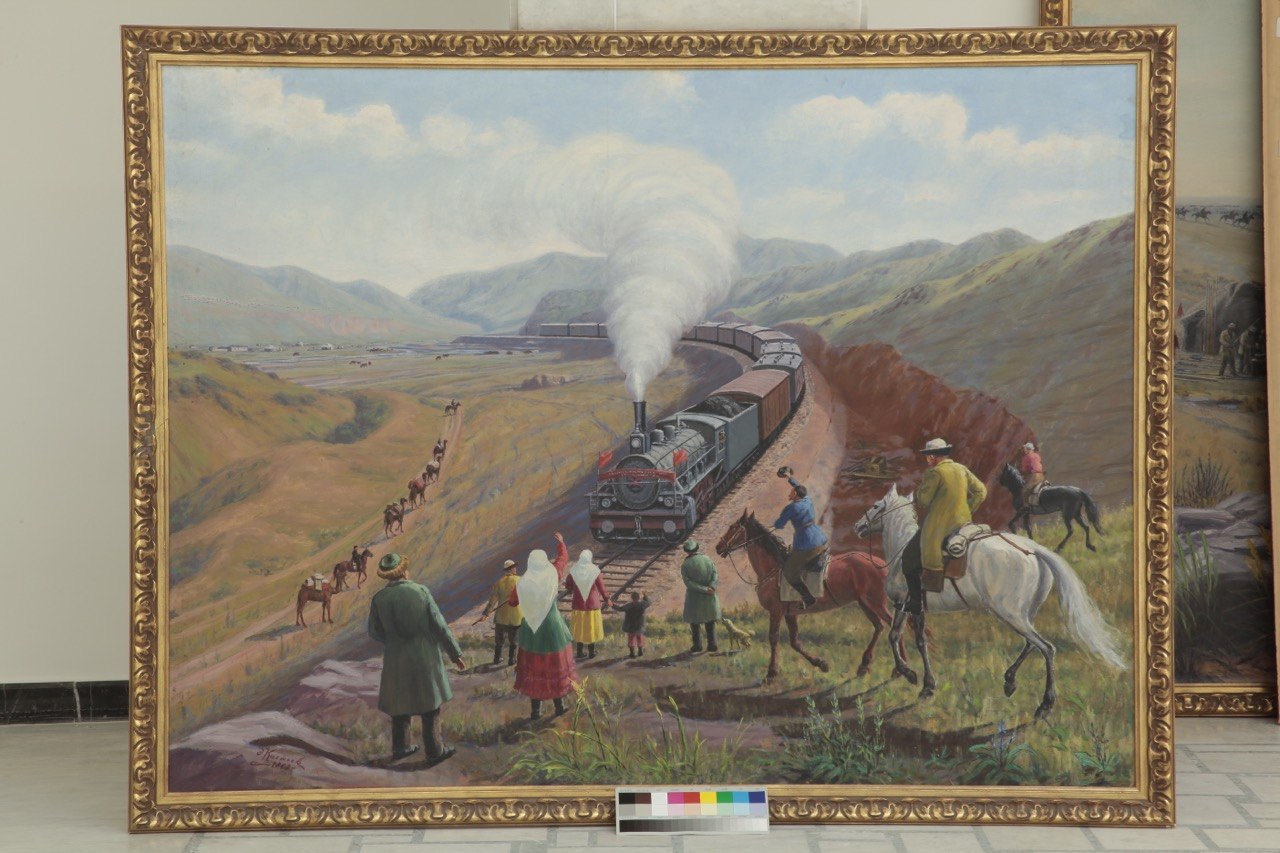 Photo provided by the Abylkhan Kasteyev National Museum of Arts of the Republic of Kazakhstan
Abylkhan Kasteyev came from a simple family and worked as a shepherd in his youth. His artistic gift manifested very early. Having entered Khludov's art studio, he received his first systematic knowledge of drawing and painting, but professional skills were only part of the future school. Far more important was that Kasteyev began to translate his personal life experience into a new artistic language.
His heroes, the steppe, labour, everyday life, changes, the emergence of new cities and technologies became the subject of painting not as exotic material, but as the artist's own reality.
Therefore Kasteyev's work is difficult to reduce solely to the concept of socialist realism.
You look at Kasteyev - and he is so sincere, so deeply feels everything that happens around him, that his admiration for what is happening involuntarily passes to the viewer
A telling example is his famous painting “Turksib”. For the artist, the appearance of the railway in the steppe was not an abstract symbol of industrialisation. It was a collision of two worlds: the familiar steppe space and a completely new technical phenomenon.
The painting contains not only an ideological subject, but also human astonishment before change. People gather to look at the train that has appeared in the steppe - and it is precisely this immediate feeling that makes the work convincing.
We wrote about the 50th anniversary of the A. Kasteyev Museum here:
Almaty’s Leading Art Museum Marks 50 Years with “The Living Body of Architecture” ExhibitionTo mark the building’s fiftieth anniversary, the Abilkhan Kasteev National Museum of Arts in Almaty is opening an exhibition that brings to light works the public has never seen before.mag.humodoc.com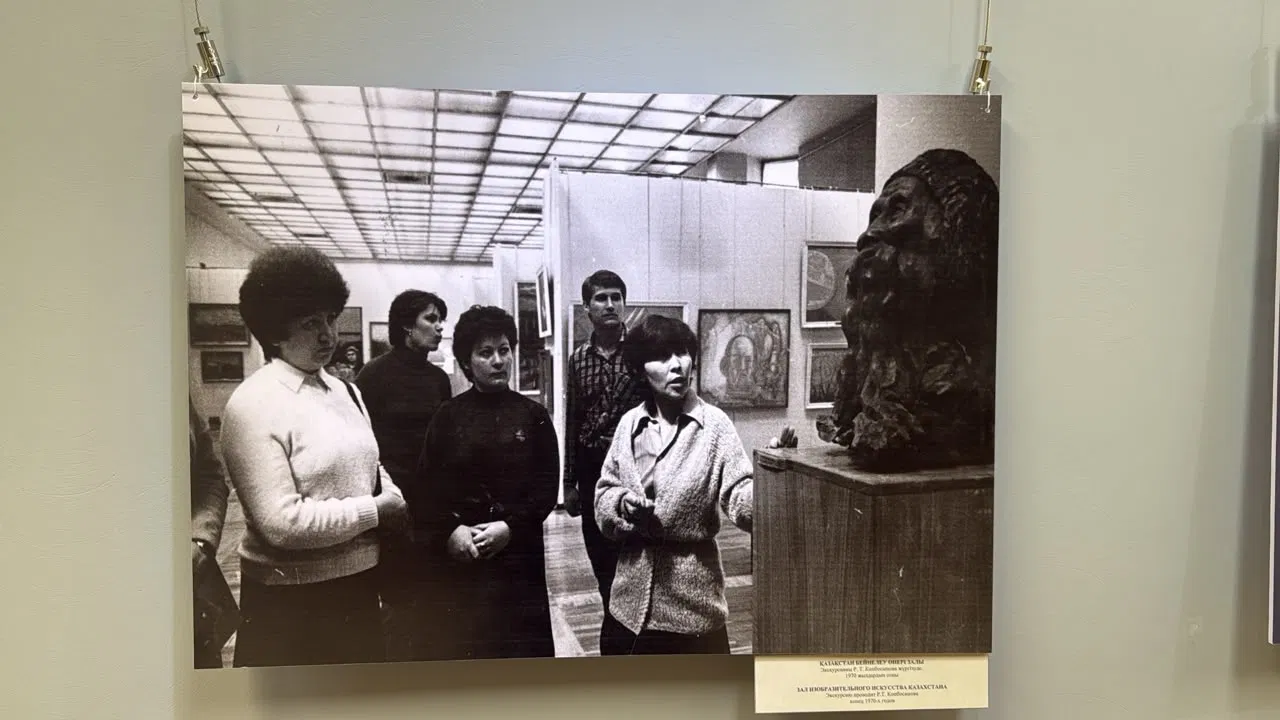
An Artistic “Caravan”
The formation of the artistic environment did not take place only in Almaty.
In the second half of the 1920s, artists began to unite, exhibit and seek opportunities to show their works in various regions of the republic. One of the unusual episodes of this period was a travelling exhibition that moved across Kazakhstan almost like a real caravan.
Artists set out from Ridder with their works, other participants joined them along the way, then the route continued through Ust-Kamenogorsk, Karaganda and further to Kyzylorda - the then capital of the republic.
It was a symbolic moment: art was for the first time beginning to move towards the viewer, going beyond individual workshops and city centres.
It was precisely during this period that the understanding took shape that an artist could be not merely a lone master, but part of a professional community.
Art associations, cooperatives, exhibition activities, and then a system of art education gradually emerged.
How the Art Infrastructure Was Created
By the late 1930s, a professional art environment was already taking shape in Kazakhstan. In 1933, the organising committee of the future Union of Artists of Kazakhstan was registered. Regional associations were created, exhibitions were held, and studios and art institutions appeared. It was then that the Art Fund was established — the production base of the Union of Artists, the only market structure in the economy of that time, through which commissions for creative work began to arrive.
Art education was of particular importance.
That is why the development of the art college in Almaty became a major event. It became one of the institutions through which the European academic tradition gradually adapted to the local cultural environment.
In 1940, the first congress of artists of Kazakhstan was held, and the republic's artistic community received organisational form as the Union of Artists of the Kazakh SSR.
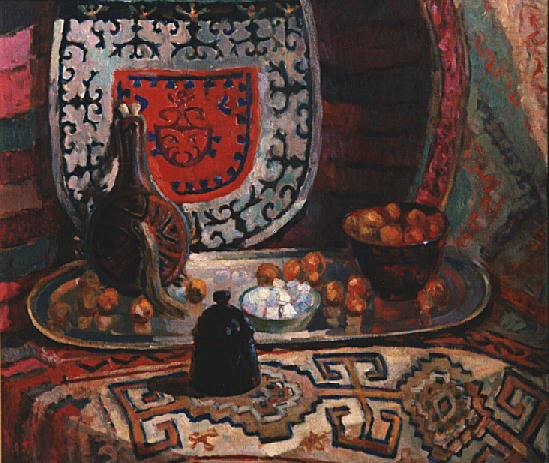 Photo courtesy of the Abilkhan Kasteyev State Museum of Arts of the Republic of Kazakhstan
An art school does not emerge thanks to talented creators alone. It needs infrastructure: teachers, studios, exhibition spaces, professional associations and the opportunity to continue one's education.
Thus, by the early 1940s, Kazakhstan already had the main elements of a professional art system: artists, education, exhibition activity, a professional organisation and state support.
And then the war began - and the art history of Kazakhstan unexpectedly received a new impetus.
Evacuation: When Almaty Became an Art Centre
During the Great Patriotic War, artists, teachers, filmmakers and representatives of other cultural fields were evacuated to Kazakhstan from Moscow, Leningrad, Kyiv, Lviv and other cities.
For the young art school, this was of enormous importance.
High-level professionals came to the republic. Among them was the painting professor Abram Cherkassky, who influenced the development of art education. Kazakhstan became home to representatives of various art movements, including artists associated with the avant-garde tradition.
At the same time, major cultural and film institutions were evacuated to Alma-Ata. Sergei Eisenstein worked here. VGIK moved to the city.
During the war years, artistic life did not come to a halt. On the contrary, in a certain sense it became more intense: exhibitions were held, lectures were given, and issues of graphics, fresco painting, composition and art history were discussed.
For young Kazakh artists, this was an opportunity to come into contact with a professional environment whose formation in Europe and Russia had taken decades and centuries.
National Cadres
One of the features of Soviet cultural policy was the system of training national cadres. The best young artists from the republics were given the opportunity to continue their education at the largest art institutes in Moscow and Leningrad.
For Kazakhstan, this became a fundamental resource.
After the war, future masters went to study at the Surikov Moscow Art Institute, the Repin Leningrad Institute of Painting, Sculpture and Architecture and other leading educational institutions.
Returning to Kazakhstan, they became not only artists but also teachers, organisers of artistic life and mentors to the next generation.
This is how the chain of continuity took shape: teacher - student - new school.
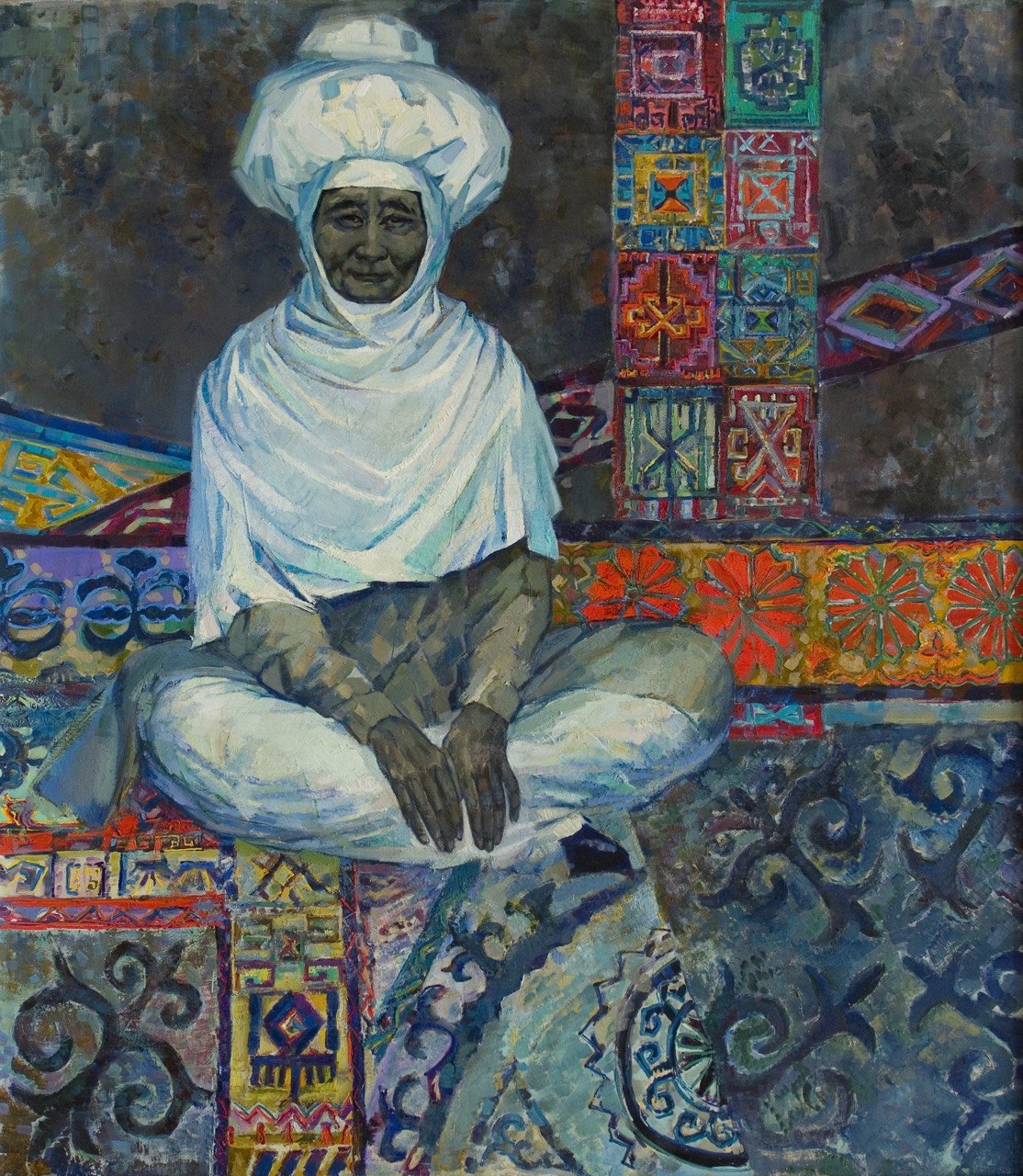 Photo courtesy of the Abilkhan Kasteyev State Museum of Arts of the Republic of Kazakhstan
During this period, names emerged without which it is now impossible to imagine the history of Kazakh art: Abilkhan Kasteyev, Sabur Mambeyev, Kanafiya Telzhanov, Uke Azhiyev and many others.
It was they who gradually transformed the professional artistic language acquired in the academic system into the language of their own culture.
Socialist Realism and the National Language
The art history of Soviet Kazakhstan is today often viewed exclusively through the prism of ideological pressure. However, such an assessment oversimplifies the real picture.
Yes, socialist realism was the official artistic method. But within it there was space for an individual artistic language.
One cannot say that socialist realism suppressed everything
Kasteyev's work, for example, shows how free works formally belonging to the same socialist realism could be.
This is even more evident in the works of Sabur Mambeyev. His yurts, nomadic camps and steppe motifs do not look like illustrations of ideological slogans. They convey something entirely different - an interest in colour, rhythm, space and the plasticity of the national world, its poeticisation.
From the first professional artists in a form of creativity new to the country — the visual arts — a national identity began to take shape.
The academic school gave artists a professional tool, but the content and imagery developed as a modern national awareness of the past and present.
This is probably where the main paradox of the formation of the Kazakh school lies: it came from the European artistic tradition, but over time ceased to be merely its continuation.
Read also:
Jamila Taken: “I want to make the world a little kinder and more beautiful”Artist and founder of the International Women’s Independent Artists’ Fund “Taң-Sholpan” told HD magazine how her art has changed, why it is especially hard for a woman artist to combine creativity and family, what going international gives artists of Kazakhstan, and why artificial intelligence cannot replace a living author.mag.humodoc.com
A School Formed in One Generation
In European countries, art schools took shape over centuries. Kazakhstan travelled this path far more quickly.
Within a few decades, professional artists, an education system, exhibition institutions, art criticism, the Union of Artists, studios and a state support system all emerged.
In Soviet times, membership of the Union of Artists gave an artist the chance to work professionally: there were studios, creative residencies, trips, commissions and exhibitions.
The result was not simply a group of individual talented authors, but a professional artistic community capable of reproducing itself from generation to generation.
In 2023, the Union of Artists of Kazakhstan marked its 90th anniversary. Its history almost coincides with the history of professional fine art in the republic.
From a Borrowed Instrument to a Language of Its Own
The main outcome of this process is not that Kazakhstan mastered European painting.
Far more important is something else: the European artistic toolkit was claimed by a different historical and cultural experience.
Nomadic culture, the steppe expanse, the yurt, migration, the bond between people and nature, traditional daily life - all of this gradually ceased to be ethnographic material in artists' work. It became part of a contemporary artistic statement.
That is why the history of Kazakh art cannot be described only as a history of borrowing.
It was a history of transformation.
The European academic system gave Kazakh artists the language of drawing, painting, composition and professional education. But artists of different generations in Kazakhstan filled that language with their own content.
So within less than a century a national art school emerged, with its own masters, institutions, teaching tradition and, above all, its own way of seeing and depicting the world.
That is why today, when looking at works by Kasteyev, Mambeyev, Telzhanov, Azhiyev and other masters, it is important to see not only the Soviet artistic system behind them. Behind them stands a far more complex process: the meeting of two cultural models, which produced a new art.
And perhaps this is the main phenomenon of the Kazakh art school: it was born from the European tradition, but learned to speak the language of the steppe.
In the next feature, HD magazine will continue its conversation with Kamilla Li about the history of fine art in Kazakhstan. The expert will talk about the artists of the sixties, a generation that largely shaped the further development of the national art school.
Read also
ArtAlmaty’s Leading Art Museum Marks 50 Years with "The Living Body of Architecture" Exhibition
Alyona Timofeyeva
 Art
ArtBehind the Scenes and Lobbying at the Savitsky Museum
Marinika Babanazarova
 Art
Art"Photos on the internet are not ownerless": what you need to know about copyright in Kazakhstan
Gulsara Kenbaeva
Newsletter
A letter from the HD editors
Once a week, we send the best stories, events, and cultural discoveries from Central Asia.