Guide
Contemplation, humility, existence, or what can children's books teach us?
How long has it been since you picked up a children's book as an adult? I think it has been a while, because it is assumed that the readership of children's literature is strictly defined and includes the younger generation and their parents (who often act more as a medium whose task is to help the child perceive the text, rather than as recipients themselves).
Children's literature is often perceived as straightforward reading with a clear plot, understandable emotions, transparent characters, and a text that is light, devoid of metaphors and allegories.
However, it is children's literature that often speaks to the reader about fundamental, even existential matters in the most fitting way, using an accessible yet poetic language. And in moments of despair and total confusion, in moments of fatigue from complex, tangled narratives, that very directness attributed to children's literature becomes a breath of fresh air. It seems to allow one to shed all the "adult" settings and superstructures and return to a pure, somewhat naive perception of life.
And so, this small selection of children's picture books was born, which more closely resemble philosophical parables about the cyclical nature of life, the finiteness of existence, and the need to return to quiet contemplation.
1. "The Little Fox and the Maple" by Chen Yanling, 2021.
"Their colors never matched. But they were always together and never parted for a moment."
Chen Yanling, a children's author and illustrator from China, released a poignant story full of quiet sorrow in 2021 titled "The Little Fox and the Maple Tree." It resembles a philosophical parable about friendship, patience, and the cyclical nature of life.
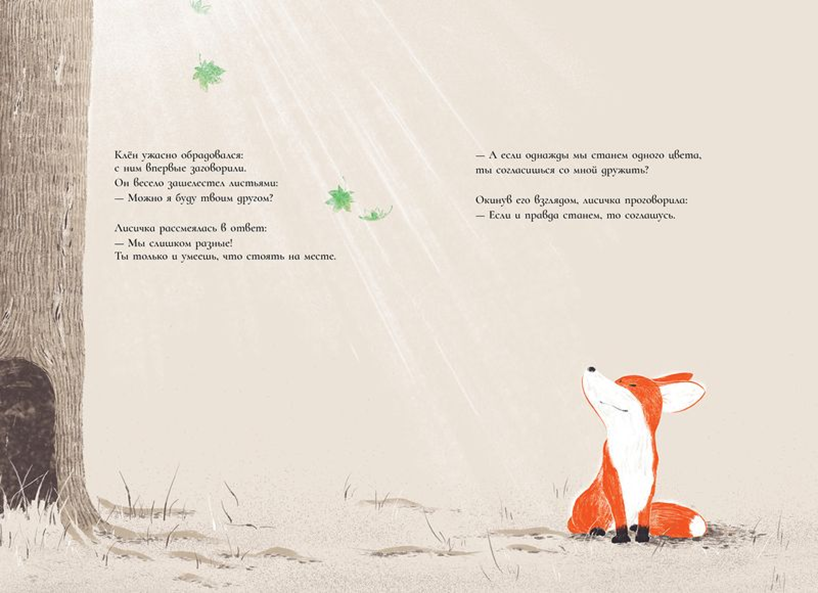
The plot is beautiful in its simplicity: a little fox comes across an old maple tree growing alone on a hill. The maple keeps trying to befriend her, but his requests only amuse the fox, for they are so different: he has no claws, no bushy red tail either, and besides, the old maple is immobile, standing on the hill, while the fox freely runs through the forest. She will only be friends with him if he turns the same fiery red color as she is.
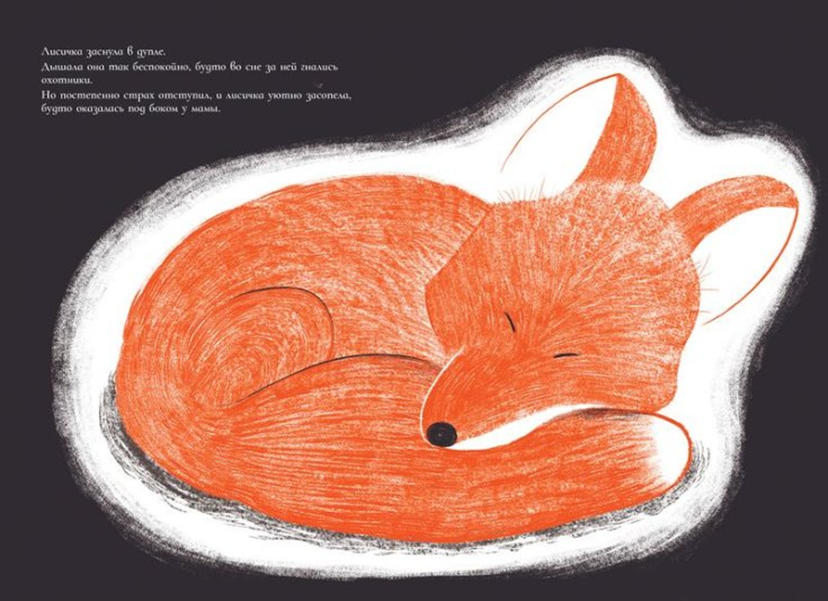
Nevertheless, the little fox's mockery does not unsettle him; the maple is not afraid of its vulnerability, its weakness before her claws, and even less does it fear rejection. He waits patiently. And then one day, struggling through a snowy blizzard, the little fox, barely alive, trembling and weakened, emerges onto the hill, and the old maple offers her shelter in its hollow. He shields her from the cold, wind, snow, rain, and once, climbing out of the hollow in early autumn, the little fox saw that the maple was now just like her, fiery red-red. The little fox kept her promise and, although she would disappear somewhere for months at a time, she returned to her friend every autumn.
The story itself is slow-paced and meditative: the plot focuses not on physical action, but on emotional maturation and acceptance. There is no distinct climax as such, which very effectively emphasizes the cyclical nature of life, the changing seasons, repetition, and the inevitability of that repetition. The author's style is minimalist, devoid of minute details, and the text is not overloaded with dialogue, which only heightens the sense of resignation, waiting, and acceptance. At the same time, while being so quiet and contemplative, the story perfectly conveys the naturalness of loss, the paradox of friendship, the passage of time, a gentle sadness, and anticipation—a spectrum of complex human emotions, integral and inseparable from human existence, which we so often and fruitlessly try to rid ourselves of.
2. "First Snow" by Elham Asadi, illustrations by Sylvie Bello, 2021.
Elham Asadi, an author of Iranian origin, in her book "The First Snow," refers to the old Persian legend of Nane Sarma and her eternal, yet unattainable beloved, Nowruz, who personifies spring. According to this legend, far, far away on a high hill, somewhere beyond the clouds, lives Nane Sarma, Lady Winter. One day, she heard of a man who comes to their village every year, bringing with him warmth, birdsong, joy, and the spirit of spring.
 Первый снег / Эльхам Асади ; перевод с итальянского: Екатерина Даровская ; иллюстрации: Сильви Белло. — Санкт-Петербург : Поляндрия Принт, 2025. — 32 с. : ил.
Nane Sarma falls in love with him and — in anticipation of the meeting, hoping that on his next visit he will pass by her house — begins to tidy up. She beats the carpets, and the dust from them falls on the village like snow. She waters the plants, and the drops from the watering can become rain. One day she accidentally touches her pearl necklace, it breaks, and the heavy pearls shower down on the village as hail. For a whole year, Nane Sarma tirelessly cleans the house, and by spring's arrival, exhausted, she falls asleep on the sofa. And Nowruz does indeed stop by her place, but he is afraid to disturb her deep sleep. Leaving a flower by her head, Nowruz moves on, for so many people are waiting for him with the news of spring. Waking up, Nane Sarma understands from the flower that she has missed her beloved, but instead of falling into despair, she again takes up cleaning in the hope of meeting Nowruz once more. And so their love story continues year after year: each time she falls asleep too early, and Nowruz arrives too late, but each time they patiently wait for each other.
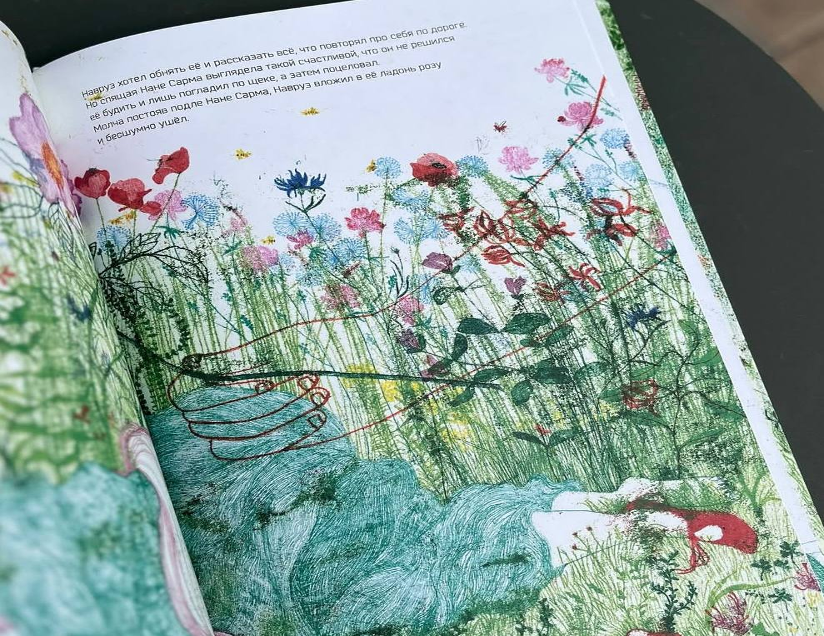 Первый снег / Эльхам Асади ; перевод с итальянского: Екатерина Даровская ; иллюстрации: Сильви Белло. — Санкт-Петербург : Поляндрия Принт, 2025. — 32 с. : ил.
However, the legend of Nana Sarme and Nowruz is only part of the narrative. The story itself begins with the memory of the first snow, which the main character has carefully preserved for many years. To a large extent, "The First Snow" is an autobiographical book, a recreation of those special winter nights in Mashhad, the hometown of Elham Asadi, when the whole family gathered together in front of the stove, and Asadi's grandmother told legends and tales from Persian folklore.
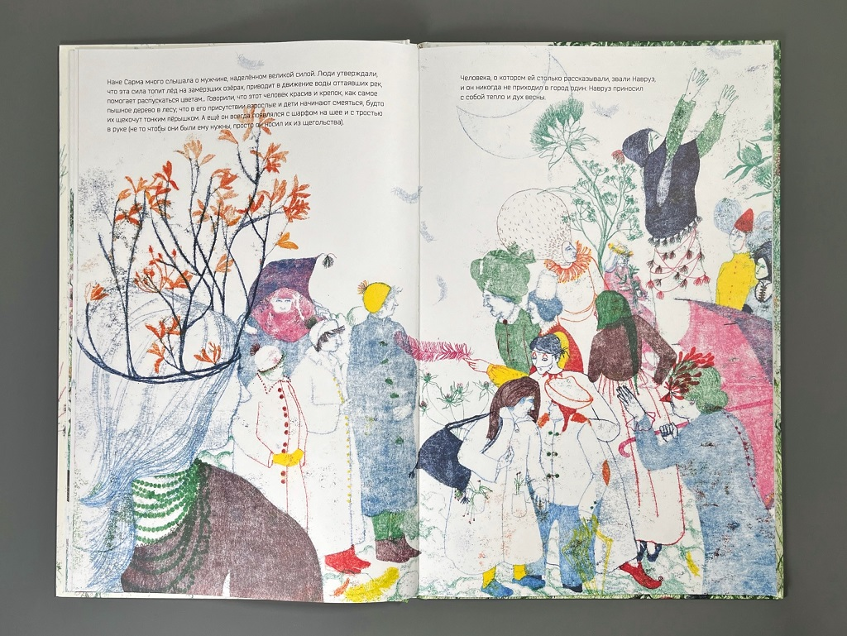
The illustrations by Sylvie Bello, executed in the monotype technique, deserve special mention. This illustration method involves the artist first painting, for example, on glass, and only then pressing a sheet of paper against the glass, essentially printing the paint. As a result, the contours become slightly blurred, the lines soft, with inevitable random translucent spots, and the drawing itself becomes unique and irreproducible, as the print cannot be repeated exactly. And it is monotype that is perfectly suited for "The First Snow," creating the necessary emotional field for perceiving the text. Colors overlay each other, in some places there is only an outline delineating emptiness, the characters are sometimes larger, sometimes significantly smaller relative to the overall perspective. Everything is slightly unsteady, slightly elusive, which emphasizes the nature of memory.
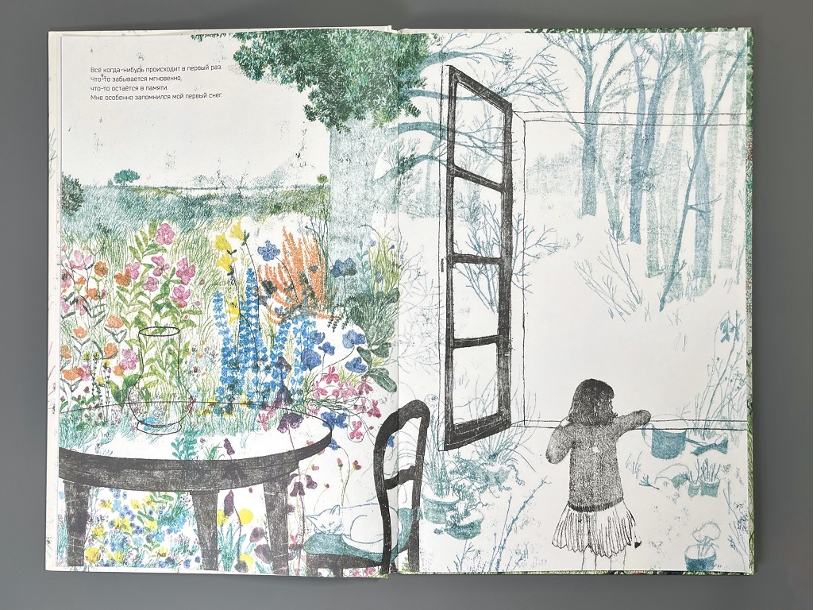 Первый снег / Эльхам Асади ; перевод с итальянского: Екатерина Даровская ; иллюстрации: Сильви Белло. — Санкт-Петербург : Поляндрия Принт, 2025. — 32 с. : ил.
3. "My Name is Life" by Elisabeth Helland Larsen, illustrations by Marine Schneider, 2021.
"I am in everyone who breathes and in whom a heart beats. A heart that pounds with fear and rejoices with joy. A heart that strives to give love and to be loved."
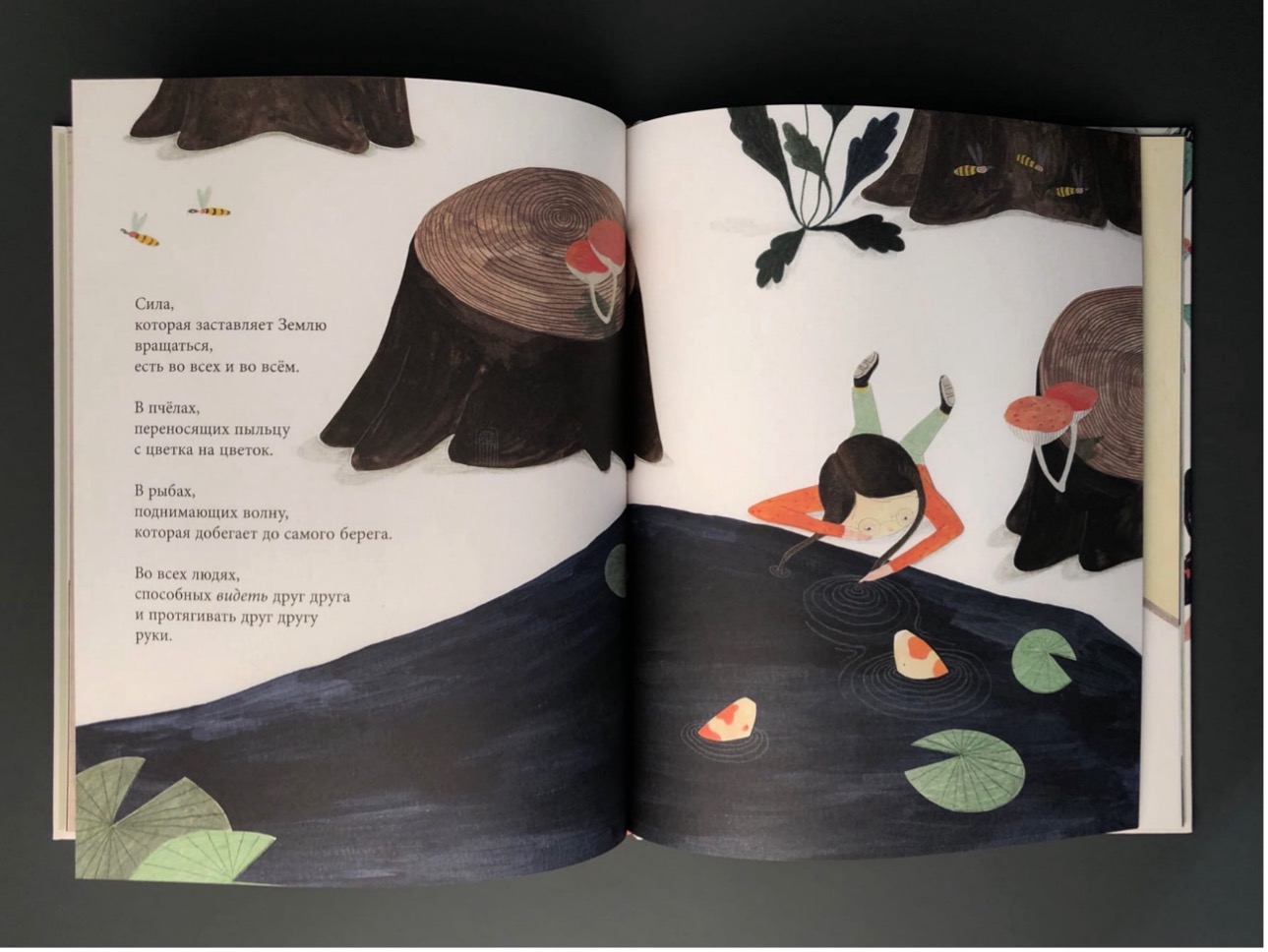 Первый снег / Эльхам Асади ; перевод с итальянского: Екатерина Даровская ; иллюстрации: Сильви Белло. — Санкт-Петербург : Поляндрия Принт, 2025. — 32 с. : ил.
The books "My Name is Life" and "My Name is Death" (next in our selection) are inseparable in their meaning. This is a tender and unobtrusive story about life and death precisely from an existential point of view. They do not explain biological processes but metaphorically and poetically represent two fundamental concepts that are so often contrasted with each other.
The book is structured as an introduction to a personified Life — a kind, attentive being that offers hope and strength. The work lacks a conventional linear plot with a beginning and an end: it is more of a poetic, contemplative piece. Through text and illustrations, various facets of existence are presented as a sequence of images and observations on interacting with people, animals, and nature.
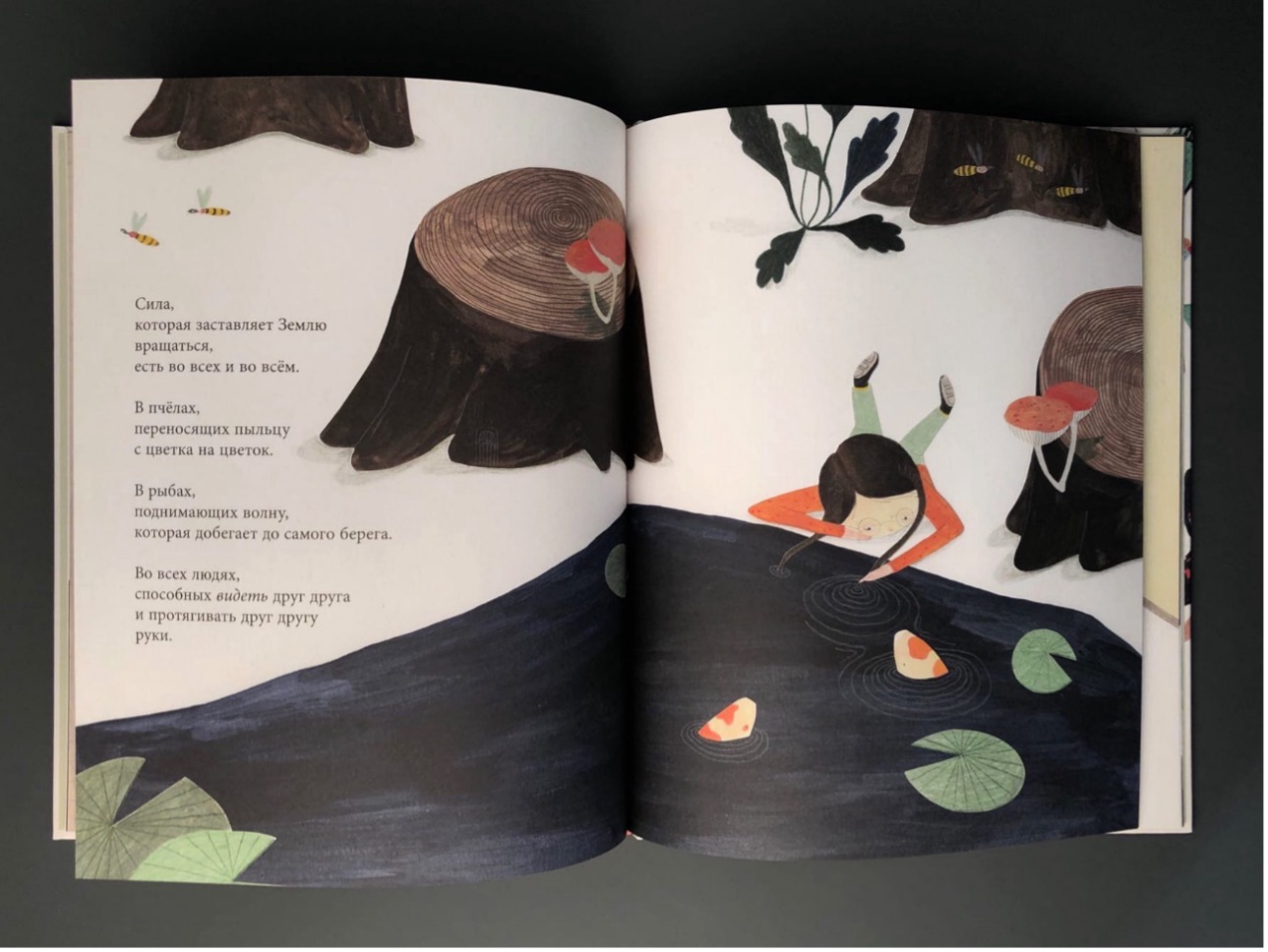
Life appears as a warm being that envelops the entire world. It is in plants, people, animals, even in feelings. Everything is set in motion by life, everything changes, grows, takes form. Life is shown as a continuous and inevitable process: a flow that never stands still and hardly ever slows down. It is an eternal slipping away.
 Первый снег / Эльхам Асади ; перевод с итальянского: Екатерина Даровская ; иллюстрации: Сильви Белло. — Санкт-Петербург : Поляндрия Принт, 2025. — 32 с. : ил.
At the same time, life in the book is not idealized: it makes room for loneliness, grief, fear, and many other complex, heavy emotions. Nevertheless, difficulties are not opposed to life but are carefully woven into it. Life does not promise permanent happiness, but it offers hope for change. That loneliness will be replaced by love, fear by confidence, grief by great joy. And it is precisely in this complexity and contradiction, precisely in this mutability, that its true value lies.
4. "My Name is Death," Elisabeth Helland Larsen, illustrations by Marine Schneider, 2021.
"My name is Death. I am part of life, love, and you."
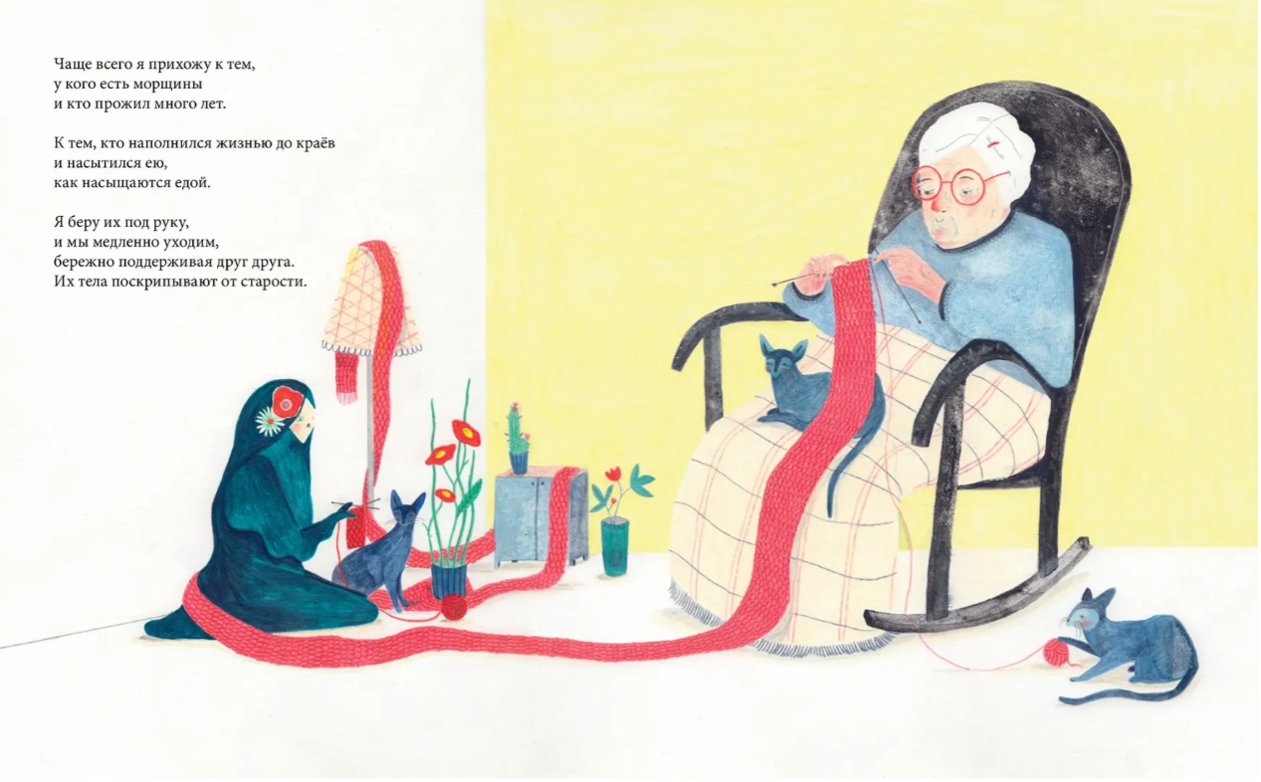 Ларсен Элизабет Хелланд Издательство Поляндрия, 2024
The cultural antithesis of life is usually death, but Lansens in his book rethinks it and places it alongside life. As a result, as a logical conclusion, without which life loses its power, and man and all living things lose their meaning. In Lansens' work, life and death go hand in hand, and one is impossible without the other. Death is not demonized and does not frighten. It is a quiet being that observes everything around, gently accepts, and naturally concludes.
Here, too, there is no plot in the conventional sense. It is noteworthy that significant attention is paid to the fear of death, but it is also reinterpreted in the book. In Lansen's interpretation, Death gently makes us understand that often we are not afraid of death itself, but of an unlived life: we fear oblivion, we fear not having enough time, not speaking, not doing. Death seems to be trying to draw our attention to that eternal slipping away of life, which we so often forget, mired in our doubts and fears. Yet, it is precisely the awareness of finitude, the acceptance of death and all the complexities accompanying a person, that intensifies the love for life. Furthermore, in Lansen's interpretation, the end of one is always the beginning of another, for death gives space for new life.
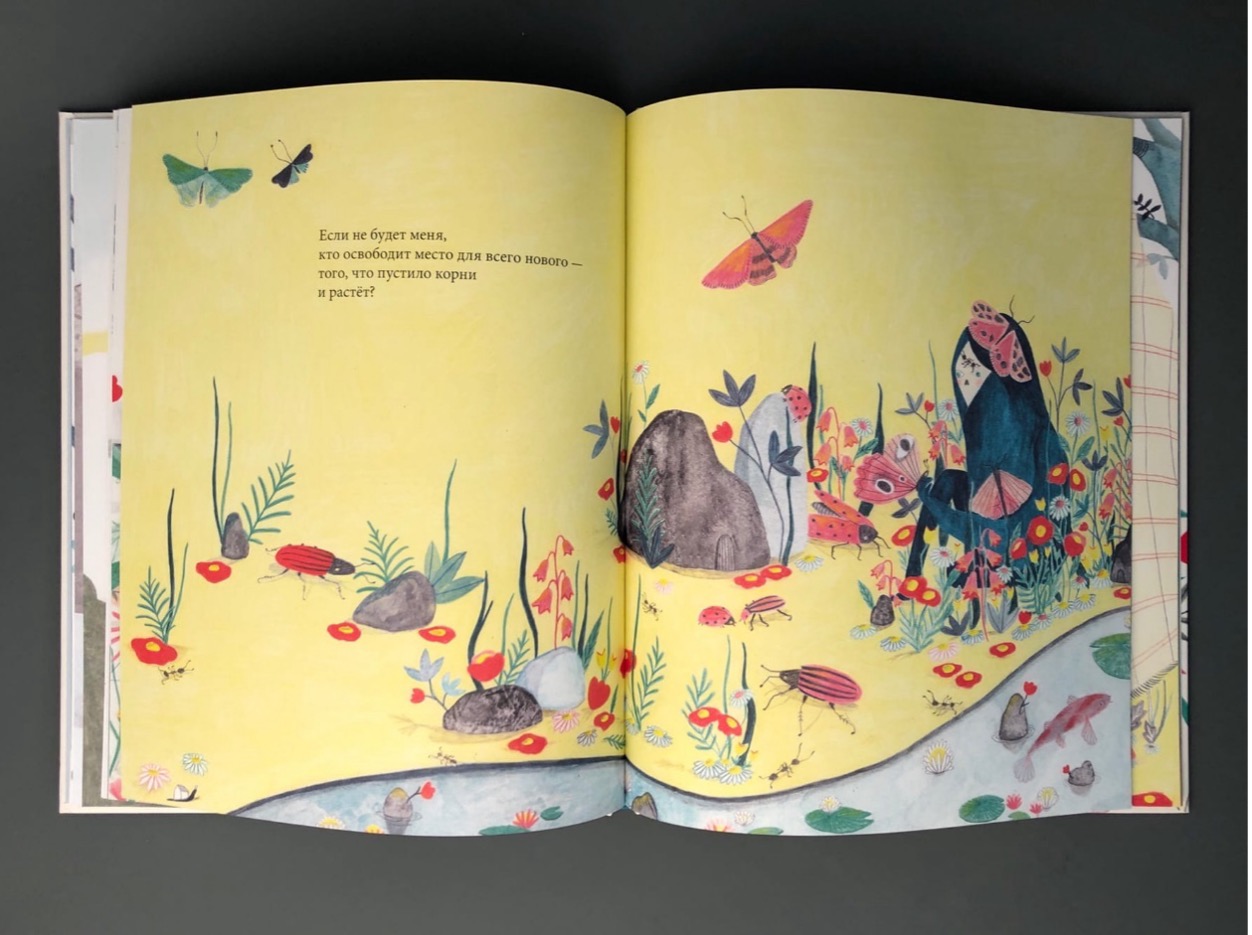 Ларсен Элизабет Хелланд Издательство Поляндрия, 2024
I would also like to note the language of the text itself. Despite all its simplicity, directness, and transparency, it remains extremely poetic, somewhat meditative and calming, while the form of monologues by life and death about themselves gives the books an emotionally profound, even confessional character.
5. "Duck, Death and the Tulip" by Wolf Erlbruch
Erlbruch's book "Duck, Death and the Tulip", published in 2007 and almost immediately becoming a modern classic, is already out of print. Nevertheless, mentioning it is essential in such a conceptual selection where we talk about finitude, the life cycle, repetition, and contemplation.
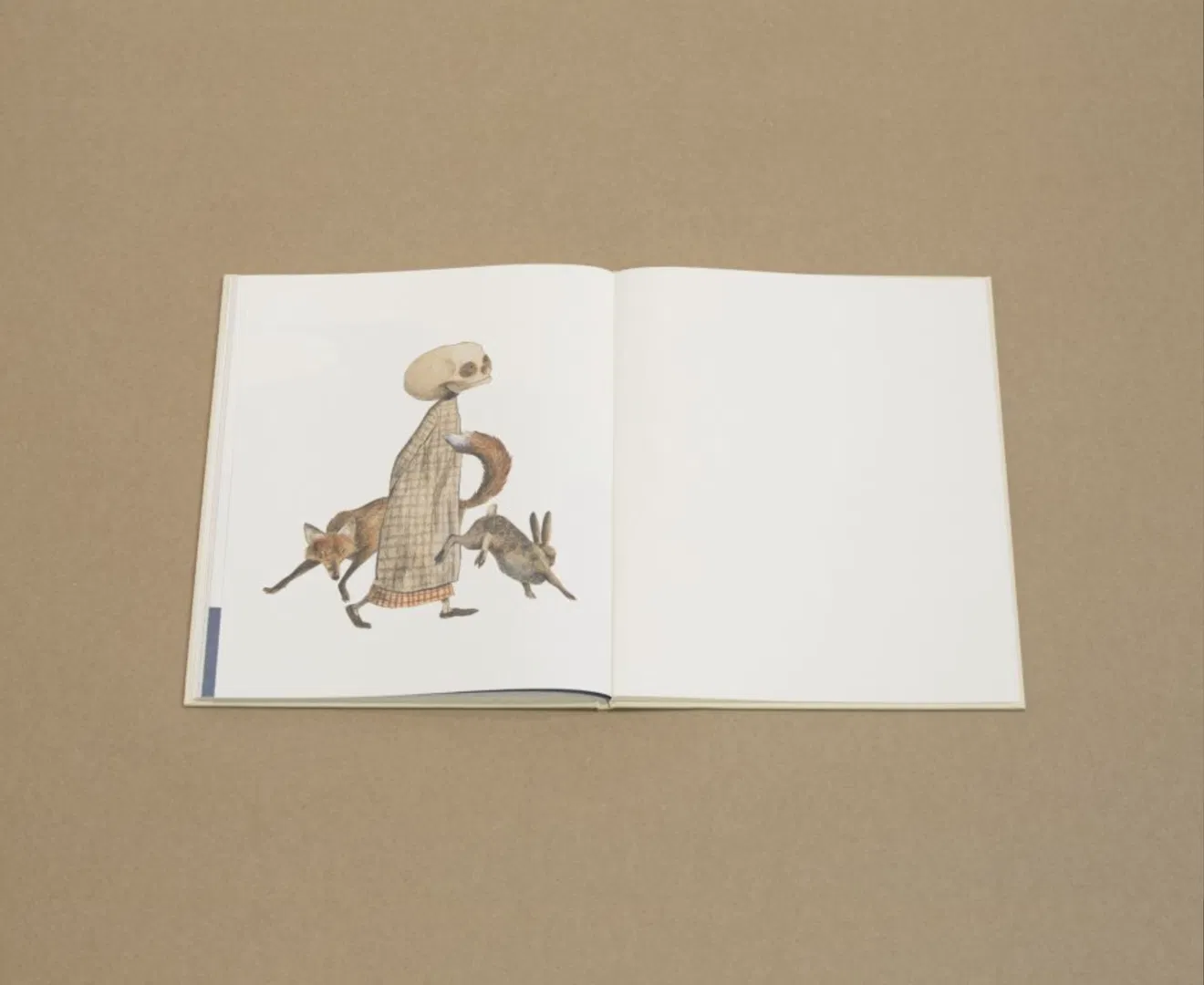
"Duck, Death and the Tulip" (like the other books on this list) is a philosophical reflection on the nature of life and the omnipresence of the end. The plot is simple and transparent: at some point, a duck notices that death is following closely behind her. Inevitably, the duck gets scared, but death, a modest personified skeleton in a checkered robe, explains to her that it has always been nearby, always keeping an eye on the duck, just in case. Death has no intention of intentionally harming the duck, for it, like life, is not a freely acting subject, but simply a part of nature, part of the natural order.
At first, the duck bombards Death with questions: what happens after death? Does heaven or hell exist? Where does the world around you go when you die? Death answers slowly, even a bit reluctantly, but honestly admits that it doesn't know the answers to many questions itself, for it is not a demiurge, but only a quiet companion to life. Over time, the questions become fewer, the duck and Death fall silent more often, but their emotional bond grows stronger.
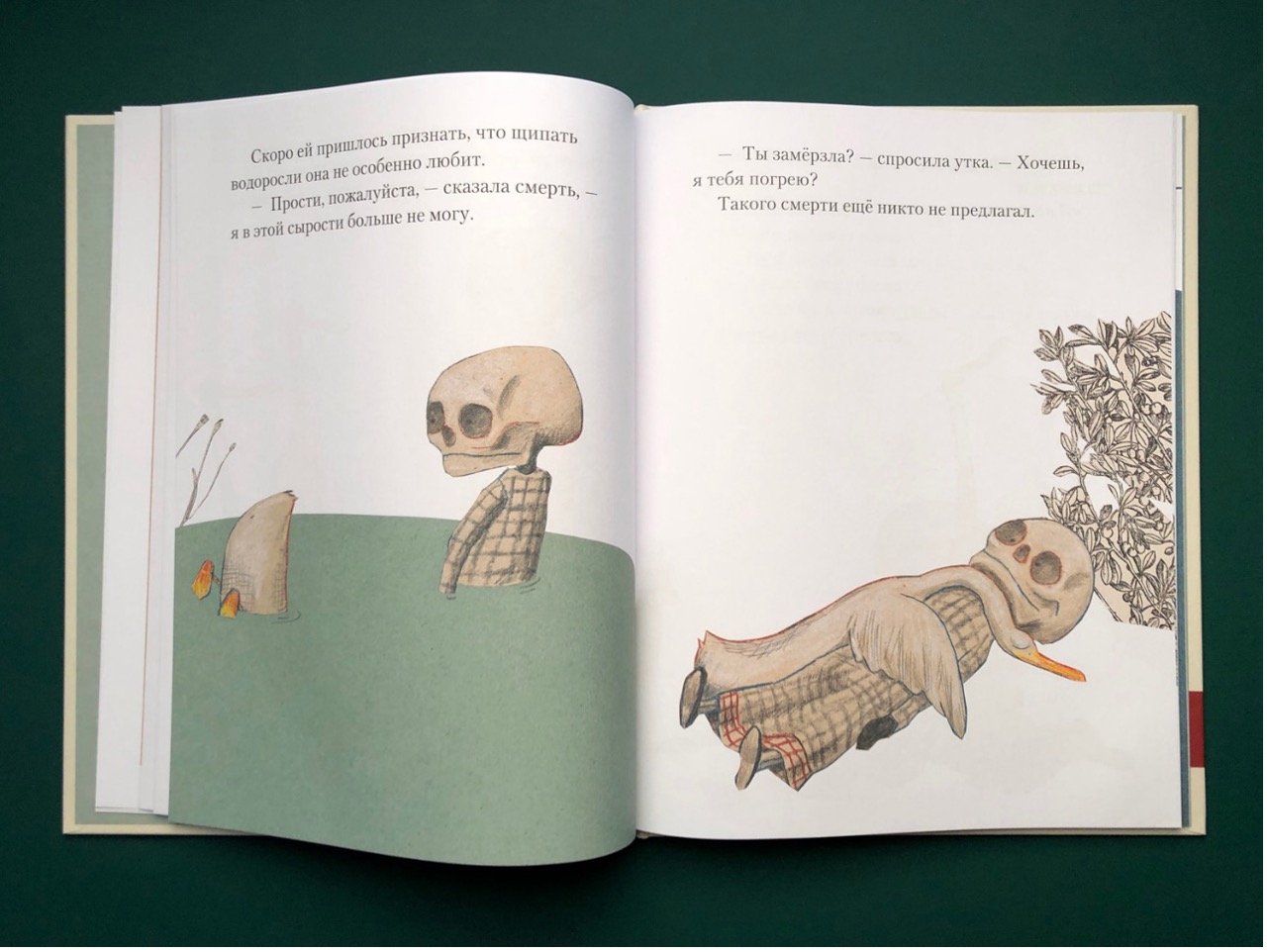 Изд. Самокат, 2023. Серия Легенды иллюстрации
 The duck weakens, Death observes its decline: does not hasten it, but cannot help either, no matter how much it might wish to, because "such is life." In the end, the duck peacefully falls asleep and does not open its eyes again, and Death gently catches its body, carefully places it on the water, and sends it on its final journey, leaving a tulip as a farewell gift. Thus, Death in the book is portrayed as a quiet craftsman, performing its work with great respect and capable of such profound manifestations as friendship and compassion. Death does not frighten, punish, or drag away, but peacefully accompanies on life's path, and the tulip, which Death always carries behind it, only emphasizes the tenderness of its image and becomes an allegory for the entire book: all that is beautiful strives to fade, and in the place of all that has faded, sprouts of something new, yet just as beautiful, appear again.
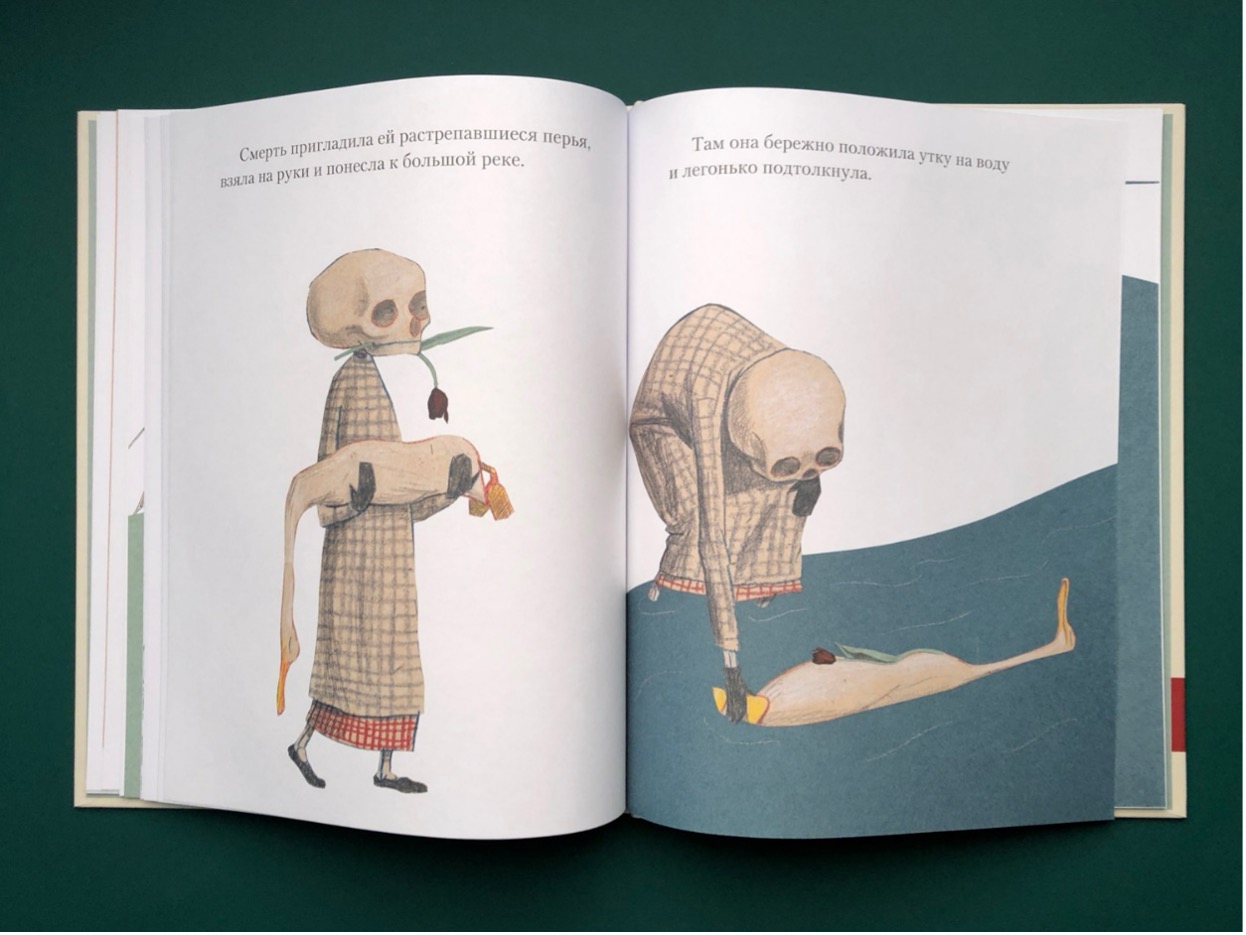 Изд. Самокат, 2023. Серия Легенды иллюстрации
 Thus, all texts in the selection appeal to contemplation in one way or another. They do not instruct, do not instill "correct" behavior; there is nothing didactic in them, only an exceptional space for reflection on the cyclical order of things. A gentle reminder that every death is not a negation of life, but only its continuation. Finitude is inevitable, but it is not a frightening inevitability; on the contrary, it emphasizes the value and fragility of life and gives hope that every end is always a new beginning.



Newsletter
A letter from the HD editors
Once a week, we send the best stories, events, and cultural discoveries from Central Asia.