
Koryo-saram (in Russian tradition) or koryoin (in Korean) is how the descendants of relocated Koreans
within the post-Soviet space identify themselves.
In her article, Olga Khan argues that Koryo-saram in the former USSR developed into a distinct community whose culture emerged at the intersection of Korean, Russian, Soviet, Central Asian, and European influences, and therefore cannot be understood through the simple notion of “Koreans outside Korea”. In this sense, Khan’s work is significant not only as an analysis of visual culture but also as an effort to speak more precisely about diaspora, memory, and belonging through the lens of art.
Until relatively recently, there was no Koryo-saram cinema, not in the Soviet period, nor in the 1990s. More broadly, Koryo-saram self-awareness and identity formation remain fluid, not yet fixed, and often characterised by uncertainty. Koryo-saram cinema is, firstly, a new phenomenon, and secondly, distinct from other art forms such as painting, literature, and music, in which Koryo-saram have long been represented across a wide range of genres and styles.
Olga Khan
 Identity and Belonging in Uzbekistan Films// The Diplomat
This idea directly relates to a key thesis of the article: in literature, song, painting, and other artistic practices, the layered identity of the Koryo-saram has already found forms of expression, whereas in cinema their experience has long been underrepresented, especially when compared to other Korean diasporas. Olga Khan emphasises that Koryo-saram cinema is historically belated: the first notable film by an Uzbek Koryo-saram director was Hanaan (2011) by Ruslan Pak, and it took roughly another decade for subsequent films to appear that further develop this cinematic strand.
First, funding. National agencies in the USSR and post-Soviet states primarily finance films reflecting the life of titular ethnic groups. Second, assembling a significant number of professional Korean actors is not so easy. Third, a small audience affects box office potential, often requiring charitable sponsorship. Fourth, themes such as the 1937 resettlement, survival under new conditions, restrictions on rights, and existence as an ethnic minority are politically sensitive, placing constraints on creative freedom. To this day, such films can only be made within a framework of political loyalty.
Olga Khan
 Korean Uzbeks in Brooklyn// New East Digital Archive
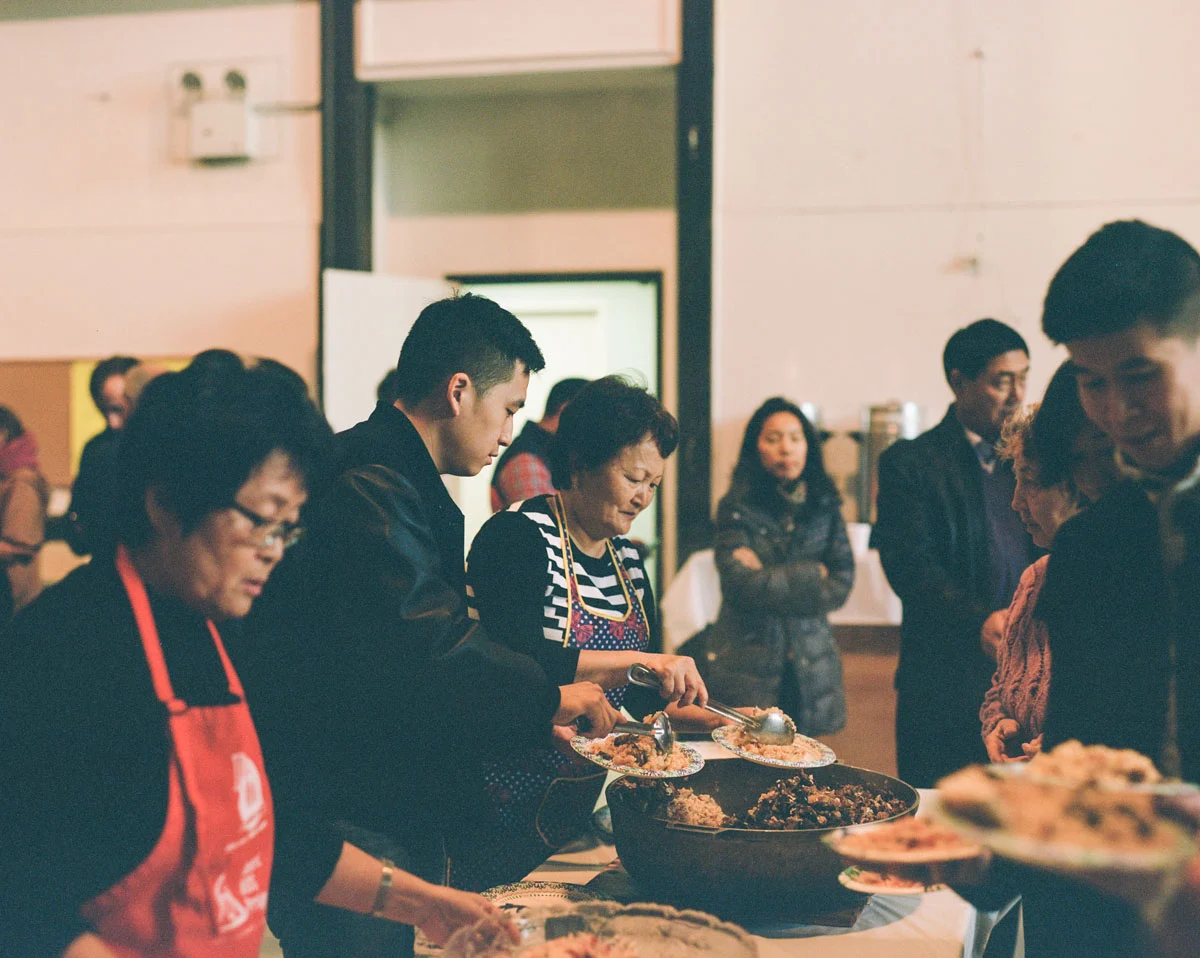
A central strength of Khan’s article is her attention to how the hybrid nature of Koryo-saram culture manifests on screen. She demonstrates that their multilayered identity is expressed through specific details: languages, food, clothing, domestic rituals, music, collective memory, and the Soviet and post-Soviet urban or rural landscape.
It seems to me that these elements appear in roughly equal measure, and cinema conveys them through language (the use of multiple languages, such as Uzbek, Russian, and Koryo-mal), food and tableware (Korean, Uzbek, and Russian cuisine on screen), hobbies (Western films watched by the characters or the music they listen to), and, of course, cultural traditions such as birthdays, memorials, and other occasions are not carried out in purely Korean forms; the rituals and organisation of events often incorporate references to multiple cultures.
Olga Khan
Khan’s article highlights Hanaan (2011) by Ruslan Pak as a film about self-identification, loss, and striving toward an ideal. The protagonist, Stas, a young Koryo-saram, lives in post-Soviet Tashkent during the 1990s amid devastation, drugs, crime, and a general sense of aimlessness. According to Khan, the film is suffused with despair and a feeling of lost orientation. Importantly, Hanaan does not reduce Korea to a simple solution for the character’s problems: even when Stas eventually reaches Korea, the film maintains a distance between the myth of the “promised land” and the reality of returning.
 Hanaan // Kinopoisk
Khan shows that for the characters, the “historical homeland” no longer serves as an unconditional emotional centre. The dialogue exchange — “What does Korea have that we don’t?” — “The sea” — becomes a key interpretive lens for the film. Korea is presented more as a vague image of another space, one that does not resolve the internal sense of (non)belonging. Consequently, Khan interprets Stas’s final shot by the sea not as a homecoming but as an affirmation that the protagonist’s true “home” lies somewhere beyond both his ancestral homeland and the country of his everyday life.
 Hanaan // Kinopoisk
I think it's a sense of self that the characters experience, a feeling of belonging to a culture or a specific place (a kolkhoz, for example), which can also manifest through language, familiar traditions, relationships (family and friends), or memory. Defining "home" is a pressing question for many diaspora members, and expressing this through cinematic language is also not easy. Both in film and in life, many people feel stuck in the middle. I will soon be speaking at an international conference, where I will talk about the cinema of Uzbekistani Koryo-saram. The theme is Cinema from the In-Between: Multilayered Identity and the Heterogenous Aesthetics in Films of Uzbekistani Koryo-saram — this concept of in-between often reflects the condition of Koryo-saram and the search/experience of establishing a new home.
Olga Khan
This “in-between” state makes Khan’s study particularly compelling. She rejects the traditional diasporic model, where the narrative revolves solely around longing for a lost homeland. Instead, she presents a more complex picture: the characters of these films often do not return but attempt to understand where and from what their sense of home is constructed today.
If Hanaan explores the gap between dream and reality, Rita Pak’s Kogda Cvetut Maki (When the Poppies Bloom) (2019) addresses memory, daily life, and the internal organisation of the Soviet Koryo-saram world. Khan analyses the story of Roma, a young man raised by his grandparents in a Korean kolkhoz after his parents’ departure, as a lens for the broader experience of adaptation, maturation, and integration into Soviet reality. The kolkhoz becomes a “place of memory,” reconstructing Koryo-saram life through collective existence.

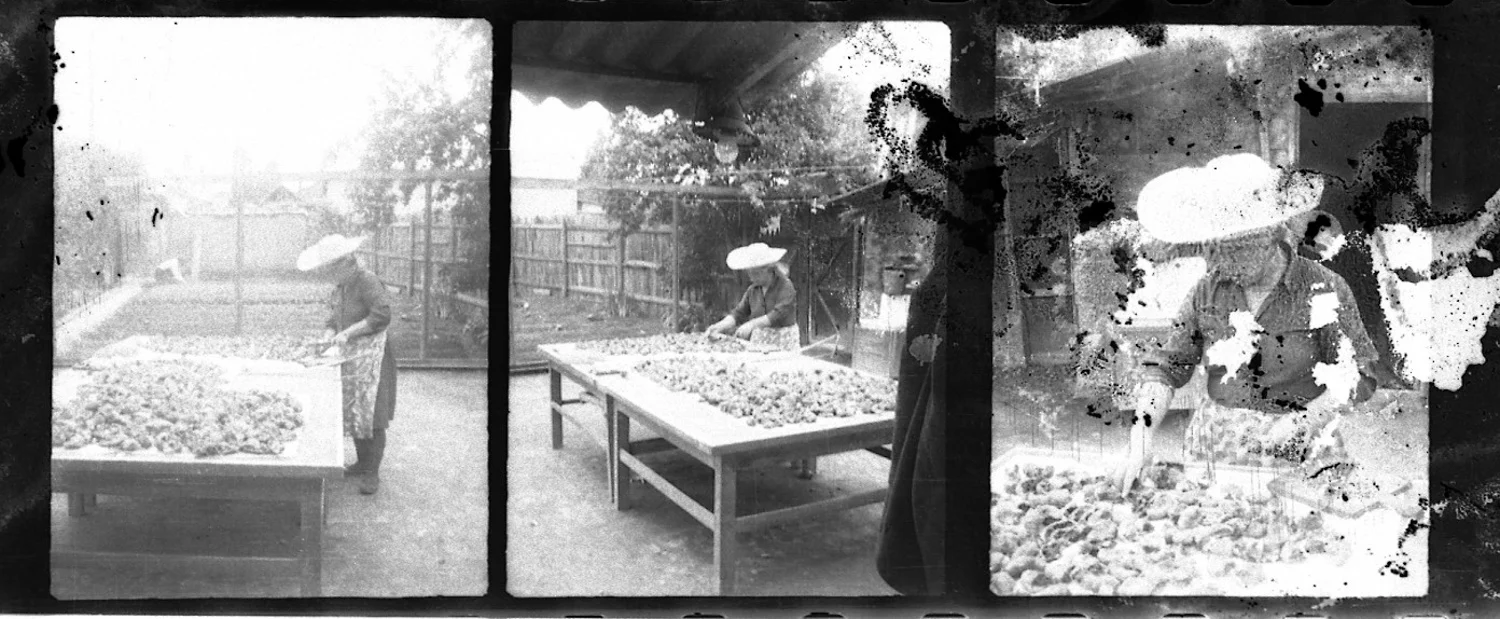
Khan emphasises that nostalgia in this film serves to preserve the fleeting experience of an entire community. Scenes feature traditional game hwatu, preparation of rice cakes, celebrations, and daily routines, alongside two models of Koryo-saram life: those who remain in the kolkhoz and those who move to the city once travel restrictions are lifted.
A key focus in Kogda Cvetut Maki is Koryo-mal, the Koryo-saram dialect. Khan shows that its use in certain scenes is not merely a marker of authenticity, but also a way of rethinking Koryo-saram identity: what once symbolised provinciality or shame is now regarded as part of cultural heritage. It is precisely here that the article points to a desire to conceal one’s “otherness”, while at the same time revealing an urge to preserve its traces.
If we are speaking specifically about Koryo-mal, rather than the Korean language as a whole, which many now seek to study in its South Korean standard form, it holds value as a cultural phenomenon, although it is now used primarily by the older generation and will, regrettably, disappear with them. At the very least, it is important to document it at a professional linguistic and ethnographic level. Discussions of its revival, however, remain largely utopian. Koryo-mal once functioned as a marker of shame, particularly during the period when Koreans were unable to speak Russian or spoke it poorly. This was followed by a complete shift to Russian as a native language, and the practical need for Koryo-mal largely disappeared. It should therefore be preserved as a form of cultural heritage, rather than as a language of everyday communication or professional use.
Olga Khan
The article also examines
two films by Larisa Ligai, Choir (2019) and Kamushki (Stones) (2023), where the theme of disappearance is central. Khan quotes the director, who calls her characters representatives of a “vanishing world”: the older generation tied to the kolkhoz past, Koryo-mal, and cultural practices fading with their bearers.
In Choir , Khan highlights the interplay of Russian, Uzbek, and Korean elements, from Soviet song rehearsals and festing to women dressing in hanbok and the final performance of “Arirang,” signifying not nostalgia for the homeland but the fading of Koryo-saram’s original culture.
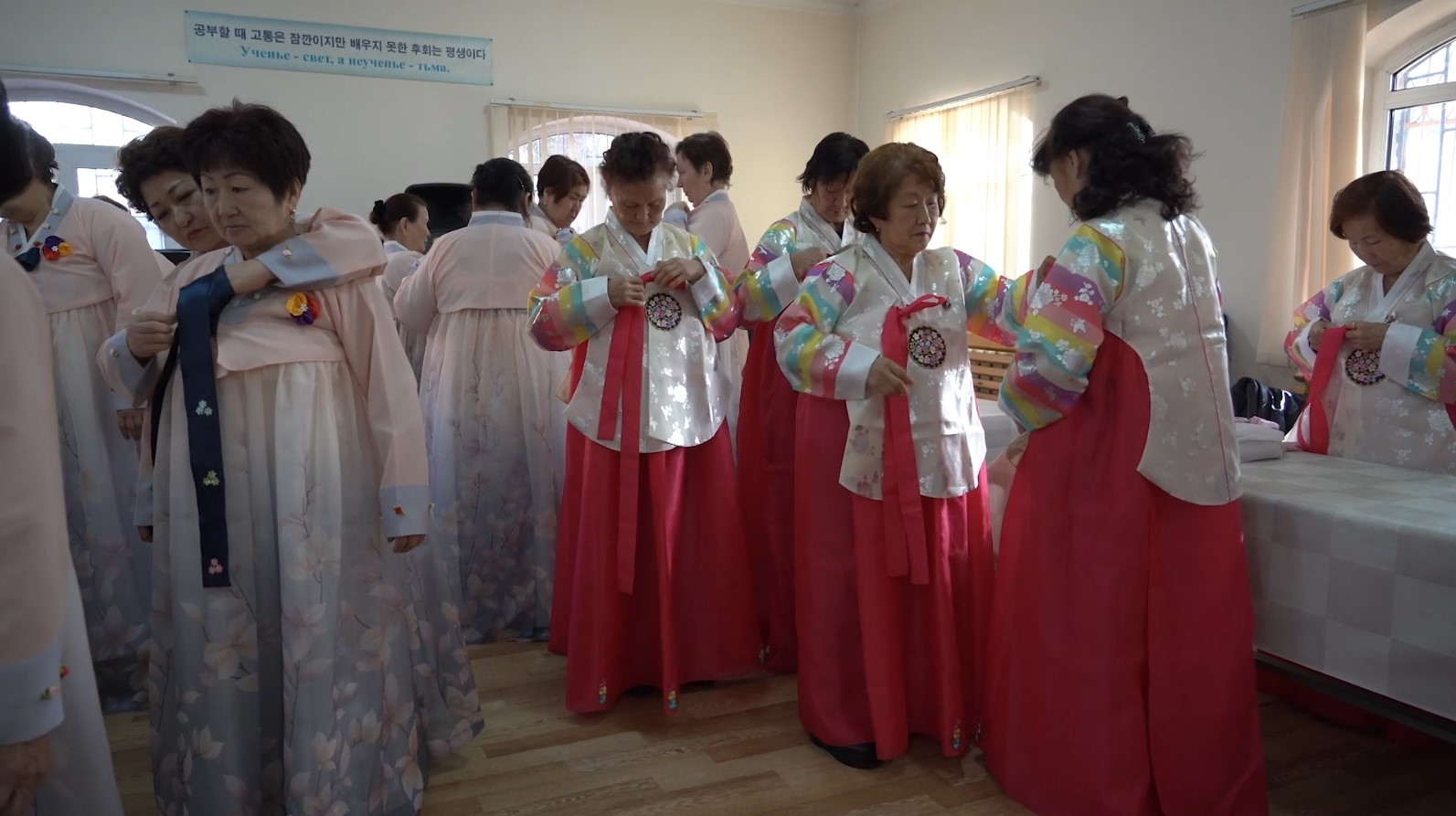 Choir (Director: Larisa Ligai, 2019)
In Kamyshki, this line continues through the story of an elderly man living in a kolkhoz as he mourns the death of his wife from the local Korean choir. Khan notes that the film portrays funeral culture of Uzbek Koryo-saram as a space of mixed practices: Russian funeral music, mourning rituals, grave-side bows, and white headscarves become visible markers of composite identity. The closing text recalls the 1937 deportation, the establishment of Korean kolkhozes, and notes that around 200,000 Koreans in Uzbekistan today consider the country their home.
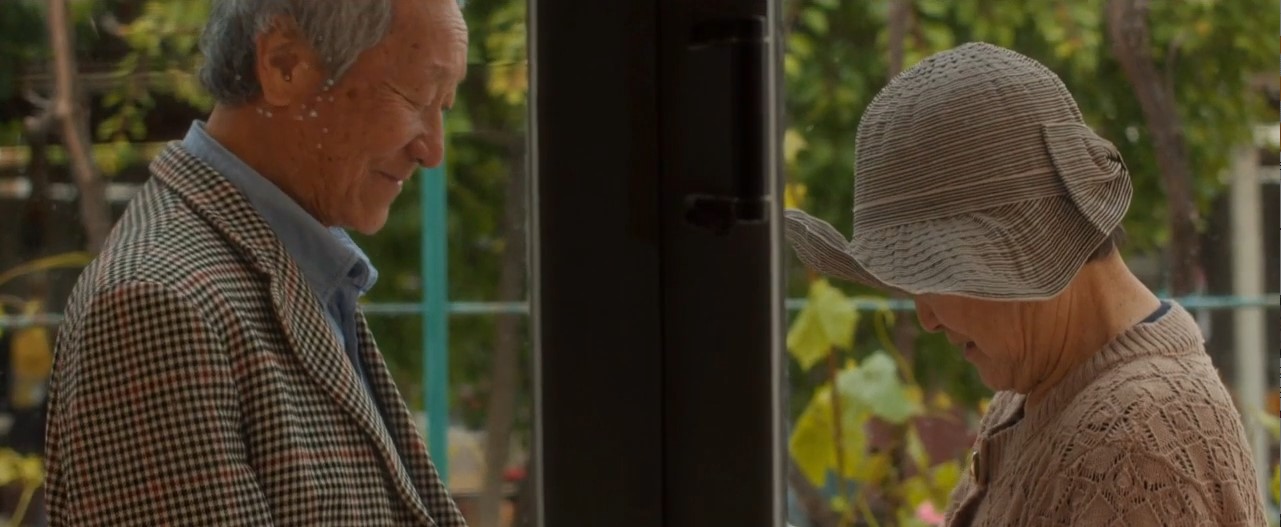 Larisa Ligai
The very act of capturing a “vanishing world”, particularly a generation of Koreans who still remember those times and cultural practices, is an achievement in itself. It serves both as a form of documentation and as a potential source of inspiration for further cinematic exploration of the subject.
Olga Khan
This is a very important observation. It underscores that Khan approaches cinema as a means of preserving a vanishing experience of Koryo-saram: language, daily life, and memory of the older generation. The article also pays particular attention to stereotypes about diasporas in general and about Koryo-saram in particular.
Films about Koryo-saram, like diasporic cinema in general, can reinforce the stereotype that members of a diaspora struggle to fully integrate into the societies in which they live. As for the challenging of stereotypes, the reality appears quite the opposite: not all migrants long for their historical homeland, nor are they necessarily lost or devoid of a sense of “home”.
Olga Khan
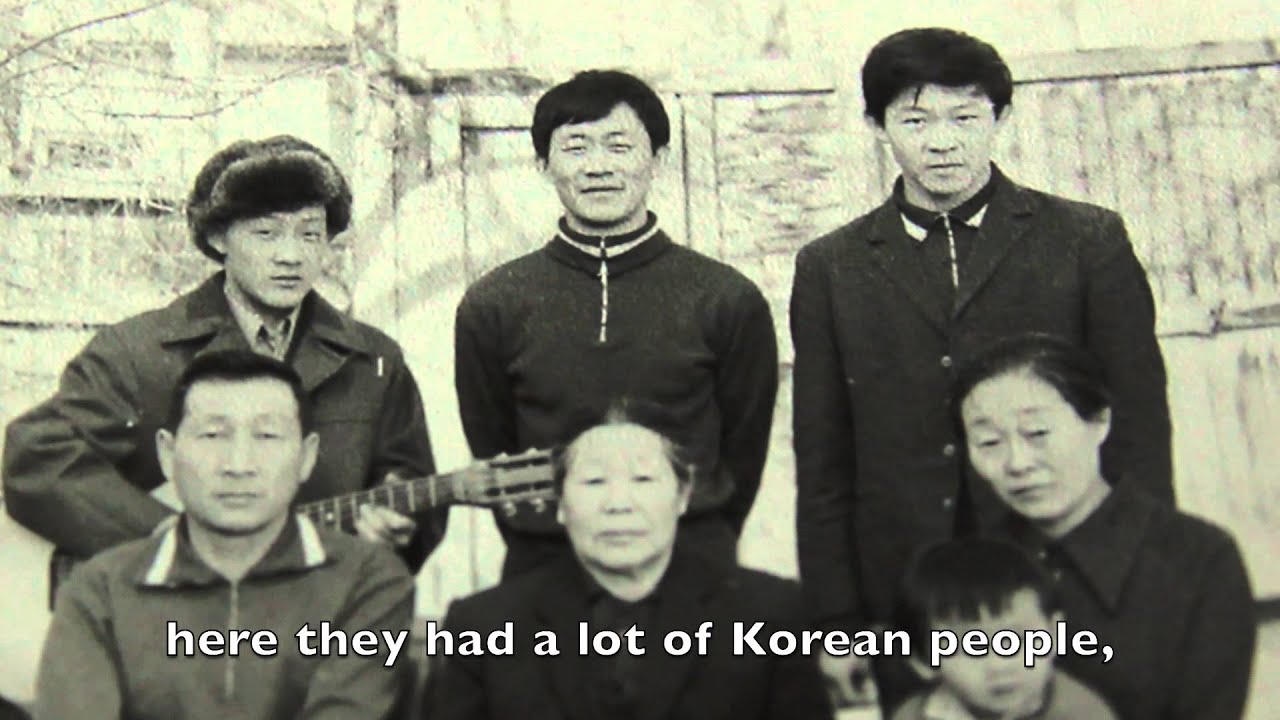
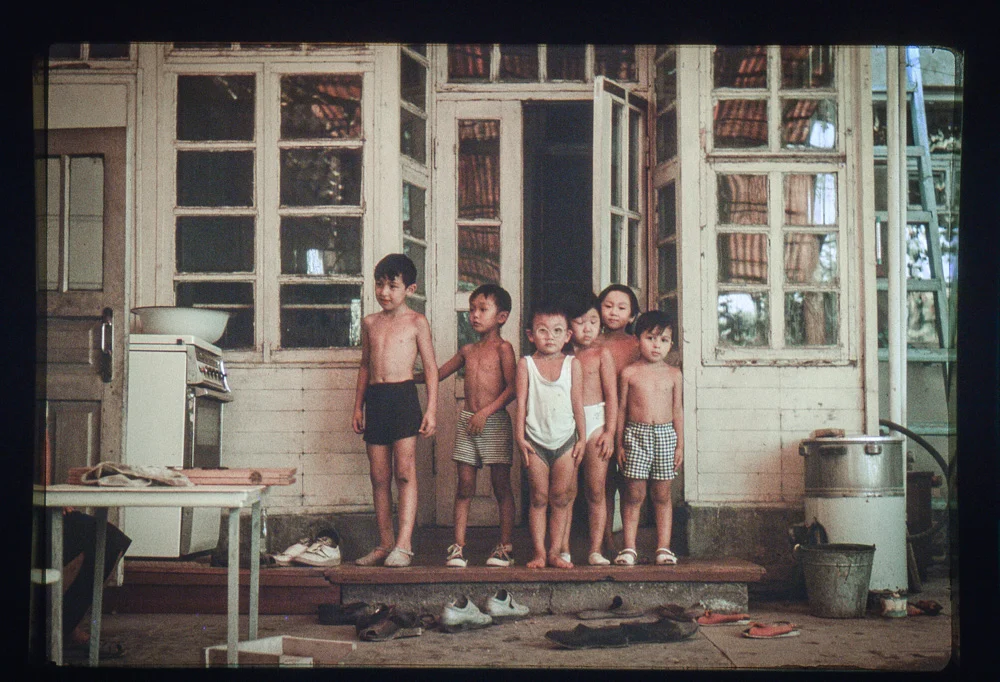 Soviet-korean-family // New East Digital Archive
In the conclusion of her article, Khan offers a broader insight: the experience of the Koryo-saram prompts a reconsideration of the very concept of diaspora. While the classical diasporic model is built around the idea of a lost homeland and the desire to return, in the case of the Koryo-saram, identity instead emerges from the experience of migration, adaptation, life in a new home, and the gradual formation of a distinct cultural wholeness. For this reason, according to the researcher, films about Uzbek Koryo-saram do not merely depict a particular minority but challenge the very nature of diasporic cinema, which is traditionally founded on nostalgia for an idealised homeland.


