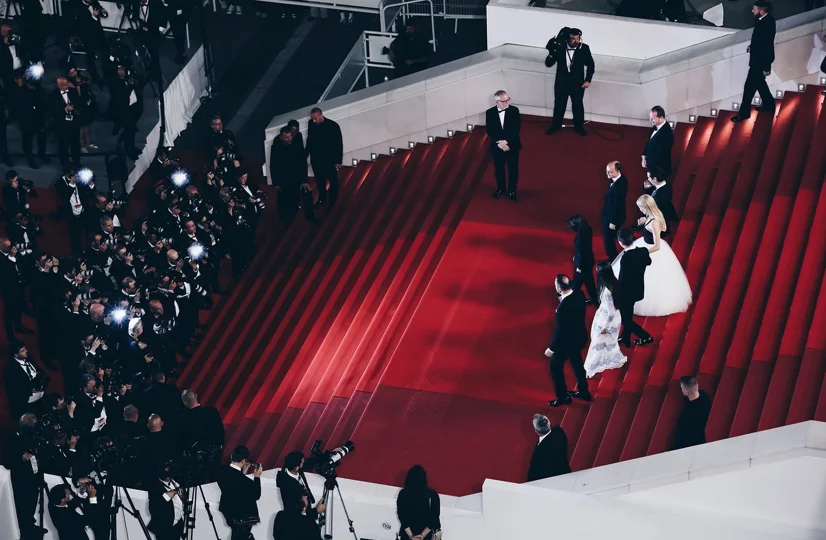
At the anniversary, thirtieth Busan International Film Festival (BIFF), films from Kazakhstan, Kyrgyzstan, and Tajikistan were included in the programs "Vision — Asia", the Main Competition, "A Window on Asian Cinema" and the Asian Short Film Competition.
«Kurak» (Kurak) by Kyrgyz directors Erke Jumakmatova and Emil Atageldiev begins with documentary footage of a march for women's rights in Bishkek in 2020, dispersed by security forces. From this episode, the film transitions to the stories of two heroines: Meerim, who secretly works as a webcam model, and Nargiza, experiencing romantic relationships for the first time.
The narrative is woven with archival recordings of exhibitions and actions, creating a mosaic of women's voices. "Different filming methods, editing rhythm, and music are stitched into a single pattern, like pieces of fabric in a kurak," says Jumakmatova. For the director, the film became a personal trial. — The hardest part was the loss of my friend and like-minded companion Emil Atageldiev. It was very difficult to make creative decisions alone—not because I didn't understand something, but because I didn't know how he would have envisioned it."
The director notes that the film's concept grew from social experience: "The main trigger was the numerous stories about violence against women. And then — Feminnale, the march in defense of women that was attacked. These events became a litmus test... We are talking about collective, cultural trauma."
In the short film section of Asian countries, they showed the film "Panic Button." This is the debut of Kyrgyz director Samara Sagynbayeva — a personal yet political story. In the opening scenes of the film, viewers see a road without markings, where cars and horses move. The scene on the verge of a collision creates a feeling of a vulnerable but existing order — a metaphor for a country where chaos and resilience coexist.
The film tells about the journalistic investigation of the director's husband, Ali Toktakunov: he examined corruption schemes for smuggling, involving high-ranking Kyrgyz officials. After the murder of an informant, the investigative journalist's family was forced to leave the country and move to the Czech Republic, where Toktakunov continued to work in his profession. Sagynbaeva's restrained voice-over transforms the more than five-year chronicle of exile into a document of the times about living with that very "panic button".
Tajikistan also presented two films at the film festival. The first of them — "Black Rabbit, White Rabbit" by Shahram Mokri — intertwines the fates of three characters and their stories: an illegal arms deal, the filming of a remake of a classic film, and the personal crises of the heroes. And in the debut film by Isabela Kalantar, "Another Birth," poetic shots and static frames transform the childhood question "can you die from sadness?" into a philosophical parable about hope.
Kazakh directors continue to explore the theme of coming of age. In Natalia Uvarova's film "Malika," a twelve-year-old girl faces the threat of losing her mother due to the norms of traditional life: in a second marriage, custody of the daughter passes to the father. The story shows how a child's personal anxiety is linked to the mother's helplessness within a system where key decisions are made by men.
In Zhannat Alshanova's film "Pobeditely vidno na starte" (Becoming), sport becomes a metaphor for growing up. Sisters Mila and Lina are left without their mother, and each searches for her own way to cope with loneliness. Mila strives to join the swim team, facing difficulties that only adults might handle. Alshanova's work has already been featured in the competition program of the Locarno Film Festival, cementing her status as one of the new voices of Kazakh cinema.
Why the Busan Film Festival is important for Central Asia
For Central Asian filmmakers, participating in the Busan International Film Festival is not only an opportunity to present their work to a wide audience but also a chance to enter the global film market. BIFF provides access to the Asian Project Market and the Asian Cinema Fund, where scripts and rough cuts find funding and support. For example, in 2019, the Asian Cinema Fund selected only 17 projects from thousands of submissions. Among them was "A Pair of Leather Clogs" by Kazakh director Olga Korotko. By 2020, this film was already included in the prestigious La Fabrique des Cinémas du Monde program of the Cannes Film Festival.
Amidst a lack of funding and infrastructure within the Central Asian region, BIFF becomes a window to the world, allowing directors to find partners and audiences beyond their own country.
For young filmmakers, participating in BIFF is a sign that their voice is heard and understood, which means it's worth continuing to work and find their own path.
"It is a great honor for us to be part of one of the most important festivals in Asia. The rest will depend on the audience, the jury, and cinephiles. I am not expecting anything — I am simply happy and want to feel the audience's reaction," says director Erke Jumakmatova.
In 2025, Uzbekistan was not represented in the festival program, but the country has already left a notable mark on BIFF's history. Director Yolkin Tuychiyev twice showcased his works here: "2000 Songs of Farida" (2020) and Evrilish ("Transformation", 2022). The latter was awarded the Kim Jiseok Award. In 2021, at the 26th festival, Mansur Abdulkhalikov's film Tengiz was also shown — a feminist realist drama filmed in Karakalpakstan. The film tells the story of the courage and resilience of a woman who lost an arm and a leg in an accident caused by her husband and was abandoned by him. These examples confirm that Uzbek cinema is capable of speaking a universal language while preserving local themes and color.
BIFF: what you need to know
- Busan International Film Festival was first held in October 1996. Its founder, film critic and cultural figure Kim Dong-ho, envisioned it as a platform for emerging directors.
- The New Currents competition section has served as a launchpad for the debuts of Asian directors. In 1998, it was joined by the Asian Project Market and the Asian Cinema Fund—programs that transform scripts and rough cuts into full-length films.
- Over three decades, BIFF has grown from a local event into one of Asia's most influential film forums. It has mirrored the rapid growth of the Korean film industry, which by the late 1990s had already secured a firm place in world cinema.