Architecture & Urban Environment
Cement of Power: Deconstructing the Architectural "Grand Style" of Central Asian "Stalinkas"
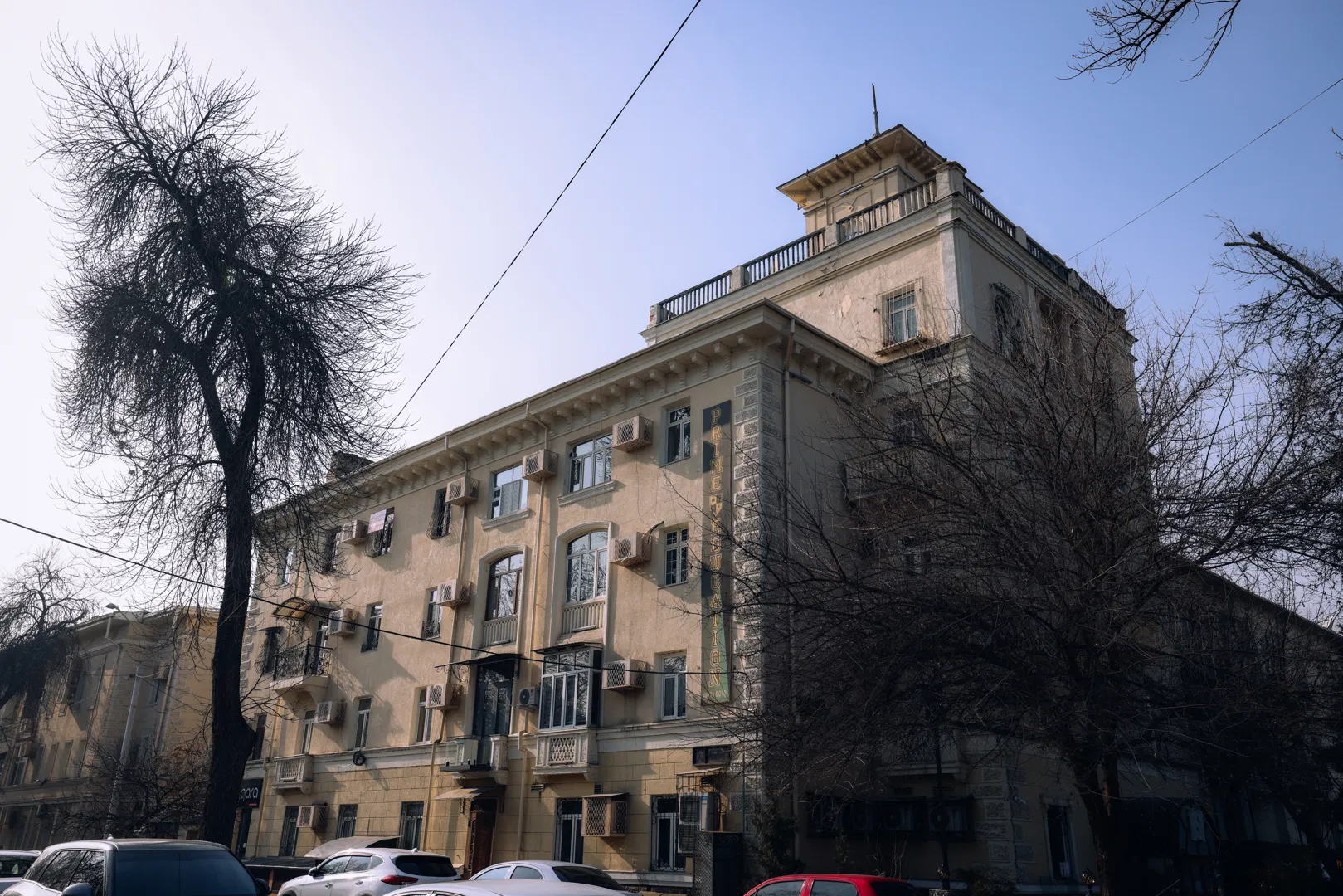
Stalinist Empire style, which continues to attract researchers of the urban environment, aesthetes, and realtors in the post-Soviet space, acquired its recognizable features in Central Asia. Architect Philipp Moizer and historian of Stalinist architecture Dmitry Khmelnitsky explain how the "grand style" tried to mimic the rich national traditions of architecture but failed to conceal its totalitarian origin.
This text is part of a larger study in which Philipp Meuser and Dmitry Khmelnitsky explore how the Stalinist regime was embodied in architectural forms. Published with the authors' permission in an abridged version.
While European colonial powers expanded their dominance in Africa and Asia in the second half of the 19th century, Russian expansionist policy was focused on the Caucasus and Central Asia. This trend did not change even after the formation of the Soviet Union. On the contrary, the new communist model of society envisaged an even greater concentration of power in Moscow than before the Bolshevik Revolution. Moscow controlled all aspects of life, even in the most remote regions of the empire.
In particular, the threat of losing individuality looms over Central Asian architecture as well, which for centuries has been shaped by Persian influence.
Fashion trends in architecture coming from the north were stronger than the influence of Islamic architecture coming from the south.
This was expressed in the spread of Russian architectural avant-garde in Central Asia, which prevailed until 1932.
It was then replaced by Stalinist neoclassicism, and another 25 years later—by the second wave of modern architecture—this time of the "Khrushchev" era, which later transitioned into the postmodernism of the mid-1980s. All key tasks for the regions were set in the center: from the radical transformation of peasant society into an industrial one to the construction of Stalinist residential palaces for the elite, and later mass standardized housing construction. On the other hand—it was precisely in Central Asian Tashkent that standardized housing construction once again reconnected with national ornamental traditions.
The Beginning of the "Grand Style"
[...] Stalin seized absolute power in the Politburo in 1927–1928 and immediately began his social and economic reforms. Lenin's "New Economic Policy" was eliminated, along with the right to private enterprise, trade, and crafts. All resources in the country were expropriated by the state, and all labor was turned into state labor. Stalin thereby gained the means to implement his plans for the rapid construction of heavy and military industry and the militarization of the country. Simultaneously, he took measures to create a new artistic image for the USSR. Architecture played the most important role as the backdrop against which the creation of the new Stalinist state unfolded.
Modern architecture, focused on purely functional tasks and heavily influenced by the West, was categorically unsuitable for these purposes. It was necessary to create a new unified imperial style, common to the USSR, based on historical models and completely isolated from Western architecture. On behalf of Stalin, the development of the new style in Moscow in the 1930s was overseen by Politburo member Lazar Kaganovich. All important projects underwent stylistic control at the highest level and became models for the entire country.
The Soviet government was not interested in architecture as such. It approved only facades that were visible from afar and faced the main streets. As a result, the professional level of design sharply declined.
Working on the functional tasks of architecture and independent volumetric and planning solutions lost its meaning; it was considered as insubordination to government directives.
The beginning of the Stalinist stylistic era in Soviet architecture dates back to the spring of 1932, when the results of the all-Union competition for the Palace of Soviets were announced. The competition for the enormous building, functionally meaningless but very important ideologically, was conceived by Stalin as an instrument of stylistic reform. Hundreds of architects were involved, essentially the entire architectural community of the country.
[...] Simultaneously, measures were taken to establish censorship control over the entire artistic life of the country. By the decree of the Central Committee of the All-Union Communist Party (Bolsheviks) dated April 23, 1932, "On the Restructuring of Literary and Artistic Organizations," all creative organizations that had existed in the USSR up to that point were liquidated. In their place, unified Unions were established, including the Union of Soviet Architects. At the same time, subordinate unions of architects were created in all Soviet republics.
If previous architectural associations (OSA, ASNOVA, ARU, etc.) were created based on the principle of affinity of their members' creative principles (which differed among different associations), then the new Unions were the unification of all people engaged in creative work into single organizations under party control.
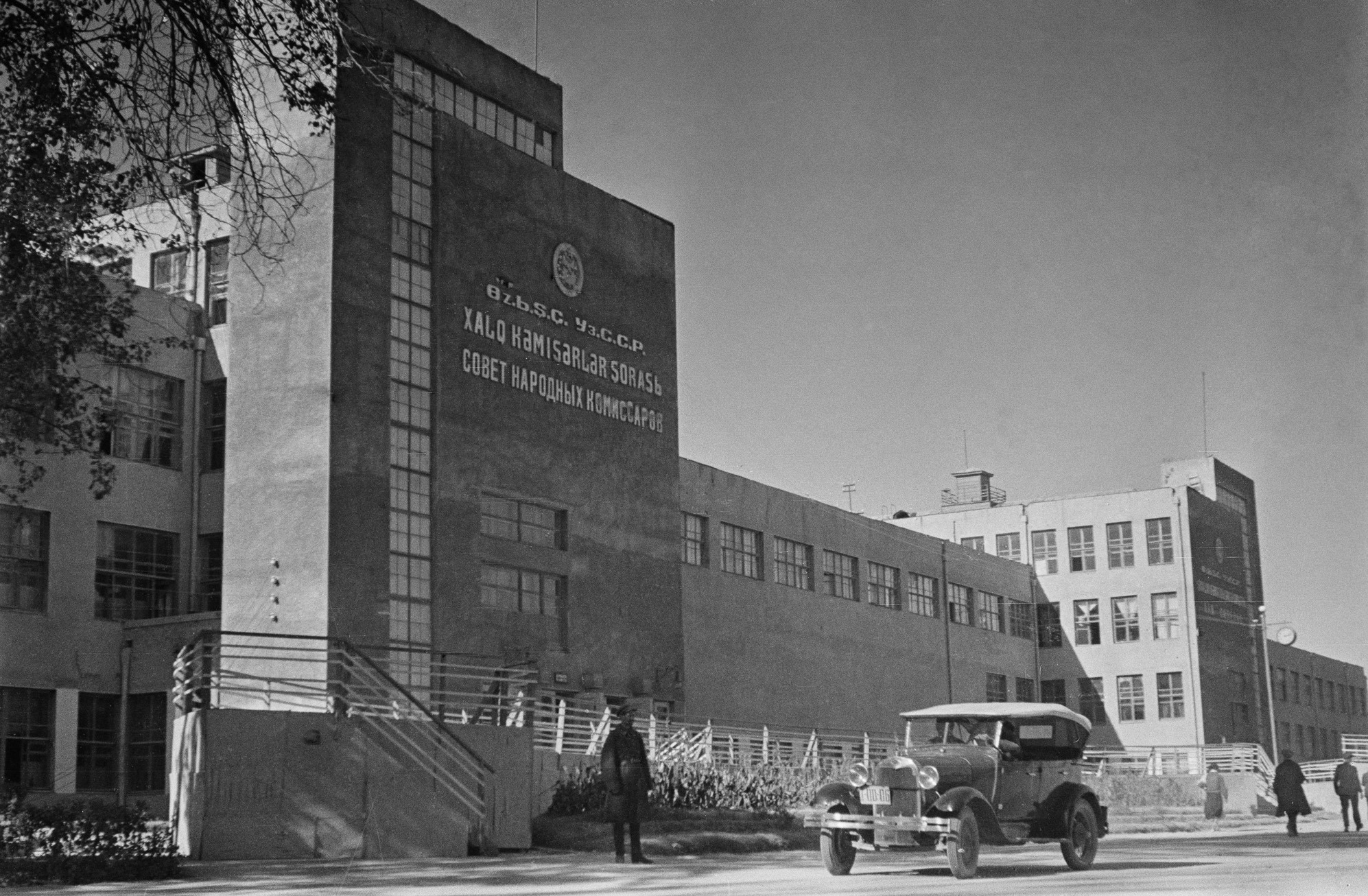
The Government House of the Uzbek SSR in 1931. Archive photo
From that point on, their creative principles also became common to all. What exactly they were was not yet entirely clear at that moment. Only one thing was clear: modern architecture in its pure form, without decoration in "historical styles," was no longer permitted. By the early 1930s, architecture in the USSR had already ceased to be a free profession. Private enterprise had been banned as early as 1928–29, and all architects became salaried employees of various state departments, which ensured the government's control over all architectural activity in the country and facilitated the solution to the problem of creating a unified state style.
The architecture of government and administrative buildings changed dramatically: it now acquired a palatial character. In many capital and major cities, ceremonial government ensembles were designed and built - symmetrical and monumental. The unpredictability of composition and freedom of form-making from the constructivist era completely disappeared from architecture. The endless reproduction of the same layout schemes and facade compositions began.
All stylistic transformations that occurred in Moscow were immediately reflected in provincial capitals and major cities, including those in Central Asia.
Government Houses and Theater Palaces
The most important place in the architecture of Soviet republican capitals in the thirties was occupied by government buildings and theaters, which also served as halls for party congresses and conferences. The competition for the Government Palace in Alma-Ata took place in 1937. It was won by high-ranking Leningrad architects Boris Rubanenko and Georgy Simonov. Before the war, they only managed to excavate the foundation pit. The project was revised many times and was only built in 1957. It is a typical Stalinist ceremonial neoclassical building with a deep six-column double-row portico and the mandatory national decorative elements of that time.
In 1947, Alexey Shchusev began designing the building for the Kazakhstan Academy of Sciences in Alma-Ata. The first version, resembling a caricatured madrasah with a dome over the main entrance, was rejected. The second version—a traditionally Stalinist building, but with elements of Eastern decor—was approved and constructed by 1957. In Frunze, the three-story government building of the Kirghiz SSR was completed in the same year, 1957 (architects R. Semerdzhiev, G. Nazaryan), and in 1965 a two-row, eight-column portico was added to it (architect E. Pisarskoy), making it resemble the Government House in Alma-Ata.
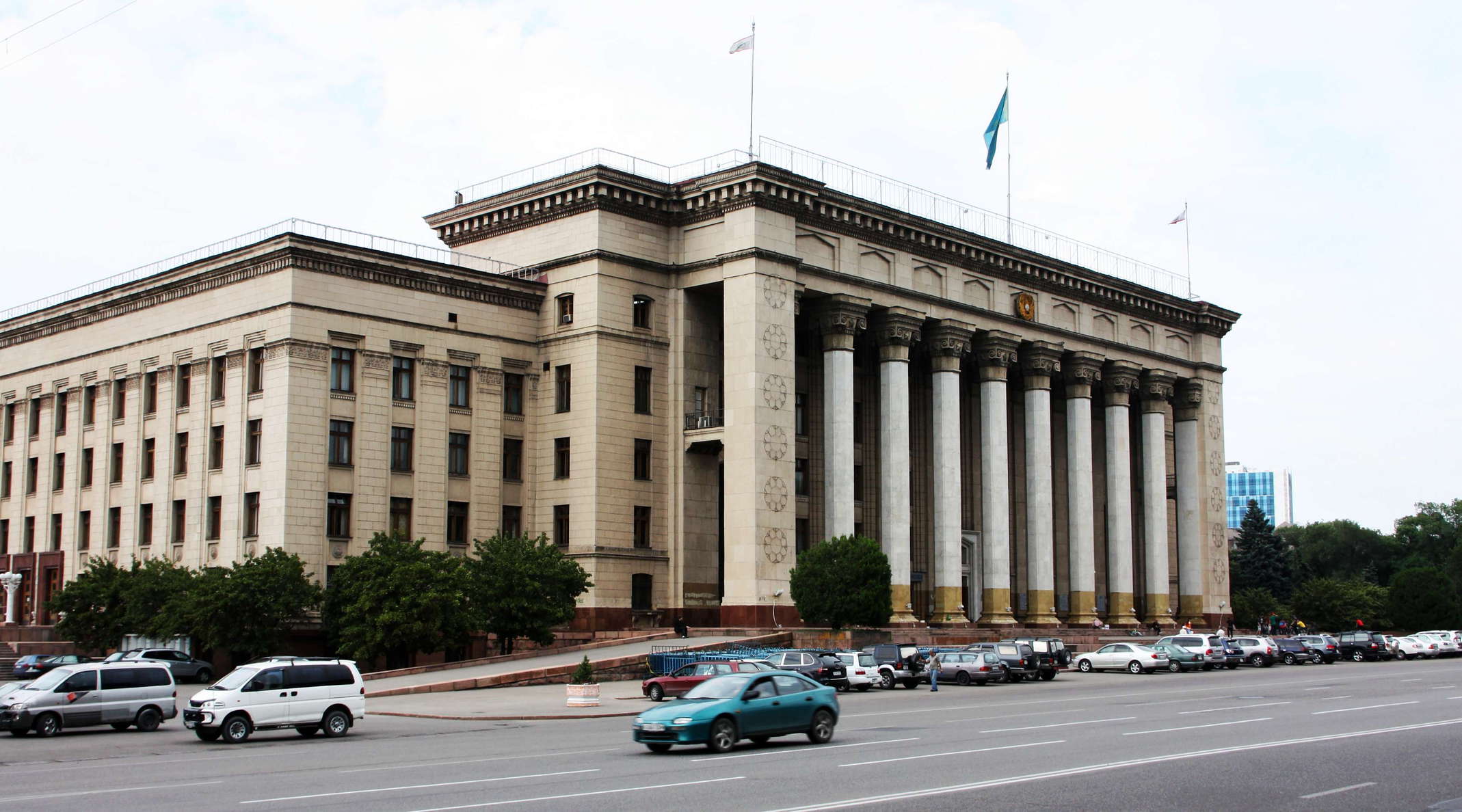
Government House of the Kazakh SSR in Alma-Ata. Archive photo
According to this scheme - in the form of palace buildings of various sizes with more or less identical floor plans, with facades decorated with real or applied porticos, many administrative buildings, educational institutes, and palaces of culture were designed in the 1930s-1950s across major and minor cities of the USSR. In the Central Asian republics, elements of national decoration were additionally applied to the facades.
Theaters. The government directive for the construction of large theaters in major industrial and capital cities of the USSR dates back to the late 1920s. Many of them were already nearly built when constructivism was banned. Therefore, after 1932, their facades were typically redesigned "in the classical style."
[...] In the 1930s, it became a matter of honor for republican capitals to build new opera houses, and they tried to commission projects from Moscow architects close to Stalin. One of the earliest and most famous examples of a purely Stalinist theater can be the theater in Tashkent. The high-ranking Moscow architect Alexey Shchusev received the Stalin Prize for it in 1948. Design began in 1934, but due to the war, the theater was only completed in 1947. Initially, the project was classical, with semi-circular arches and statues, but later, Eastern motifs were introduced into the facade decoration, and the arches were made pointed. In Soviet art history, such architecture was called "national in form and socialist in content."
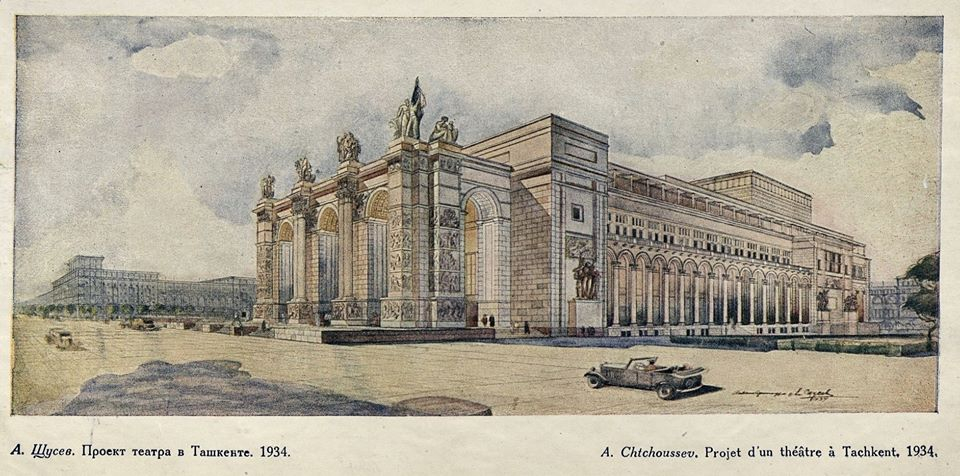
Alexey Shchusev's preliminary design, 1934. Source: the journal "Iskusstvo".
Around the same time (1935-1946), the opera and ballet theater in Dushanbe was built, adorned with a lush portico featuring Ionic order columns (architects D. Bilibin, V. Golli, A. Junger, artist S. Zakharov). Here, the architects managed with almost no Eastern elements. The prototype for a standard Stalinist theater or club was typically an ancient temple with a pediment and a columned portico. This is how the Kyrgyz Opera and Ballet Theater in the city of Frunze (architect A. Laburenko) looked as well. Its foundation was laid before the war, but it was only completed in 1955. The theater resembles an ancient temple with a lush multi-columned portico and sculptures above the pediment.
In 1934, the government of Turkmenistan organized a custom competition for an opera and drama theater in Ashgabat with the participation of several high-ranking Moscow architects (V. Shchuko and V. Gelfreikh, I. Fomin and A. Shchusev). The chosen project was the monumental design by Shchuko and Gelfreikh, featuring huge semicircular arches on the main facade and Renaissance decor. The foundations were laid immediately, but by 1935 it became clear that the government of Turkmenistan had no money for construction, and the project was halted. In 1947, a music school was built on the theater's foundations, which collapsed the following year due to a powerful earthquake.
Two years later, a new competition was announced, which was won by architect Alexander Tarasenko's project. His design featured arcades with pointed arches characteristic of the local medieval tradition and abundant stucco decoration on the main and two side facades. The project was realized from 1951 to 1958 on a different plot, but also in the historical center of Ashgabat. This pompous building now houses the Mollanepes Student Theater.
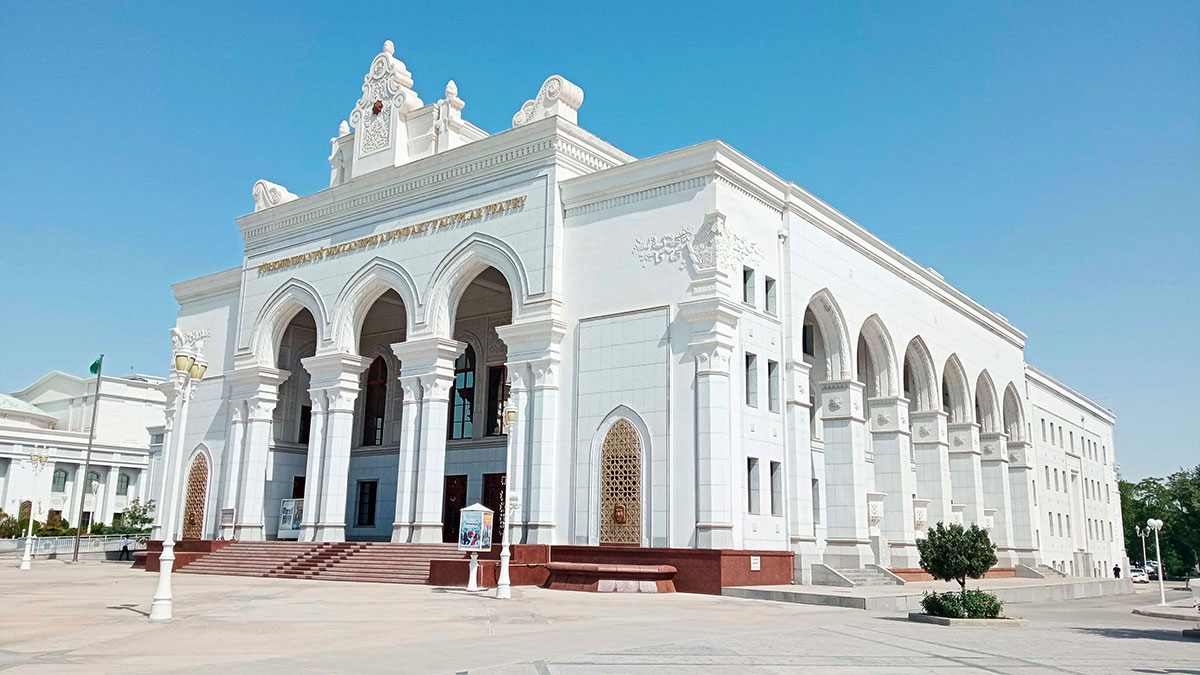
Mollanepes Student Theater in Ashgabat. Photo: turkmenportal.gov.tm
What kind of housing was built under Stalin?
The official design of housing in the 1930s completely changed its character compared to the era of the First Five-Year Plan (before 1932). Mass housing types disappeared from consideration, replaced by individual departmental residential buildings, with luxurious houses featuring "back staircases" and servants' rooms becoming the norm. Apartments in such buildings were published in architectural journals and were considered almost the only type of housing in the Soviet Union.
When designing the ceremonial centers of new cities, the most richly decorated houses were built along the main streets, forming a backdrop for festive processions and demonstrations. The central streets of Central Asian cities were formed according to the same principle.
[...] Large plants typically had two residential settlements - a workers' settlement consisting of communal barracks and dugouts, and an isolated settlement for management with various types of housing - from villas for plant managers to dormitories for lower-ranking employees. Such was, in its early years, the settlement (and later city) of Chirchik in Uzbekistan, which arose in connection with the construction of two hydroelectric power stations and a nitrogen fertilizer plant in the foothills of the Tien Shan.
An exceptionally interesting example of this type of settlement is the residential town for oil workers, located near the city of Guryev in Kazakhstan, designed by architects S. Vasilkovsky and A. Arefyev, the construction of which began in the autumn of 1943. The settlement was built for the Guryev Oil Refinery in a hot, waterless desert. The plant was American and received by the Soviet Union under Lend-Lease.
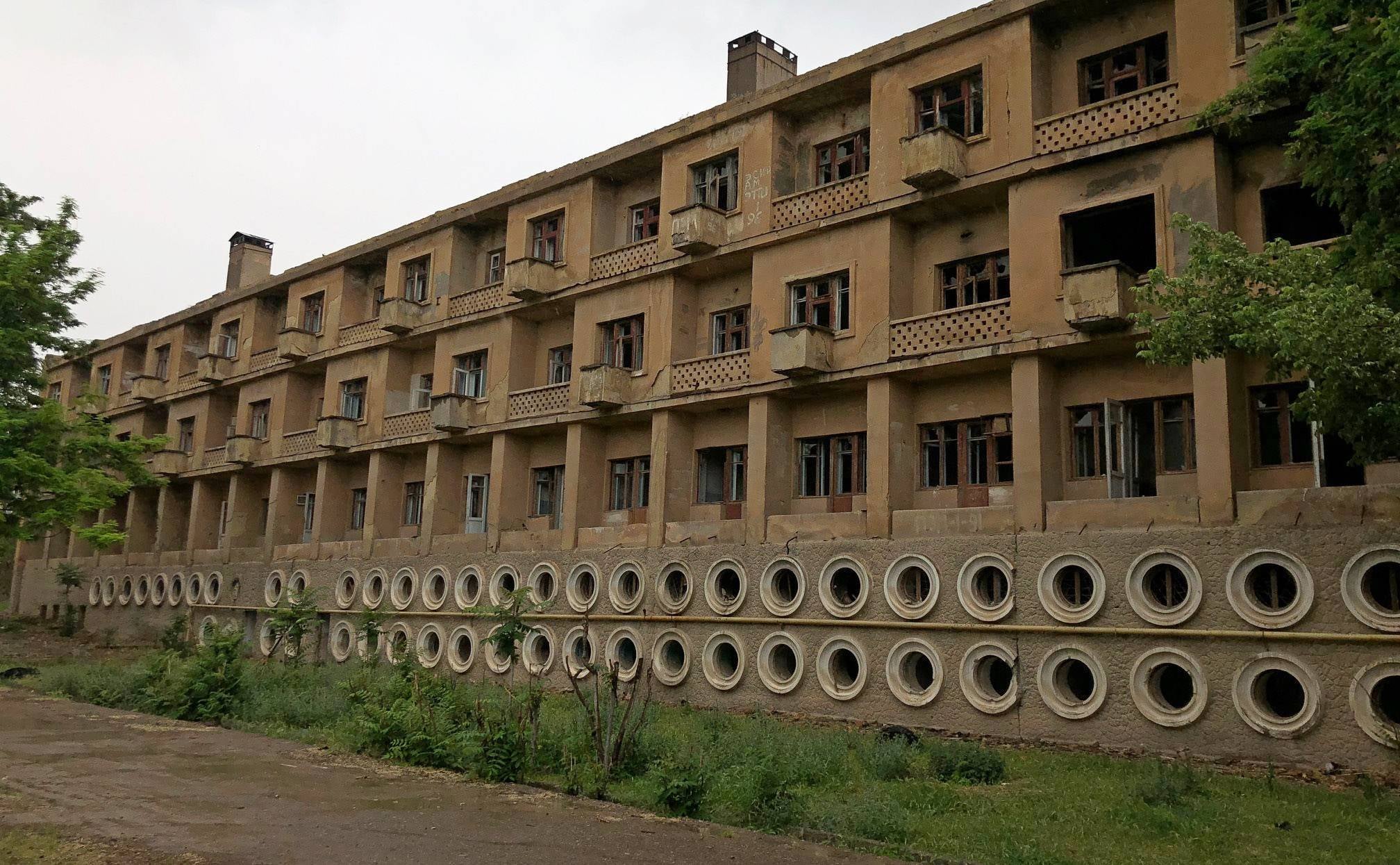
This is how the Chirkikstroi hotel looks now. Photo: Ildar Galeev / Alerte Heritage
A completely isolated and guarded settlement consisted of comfortable single-, double-, four-, and eight-apartment houses, adapted to the conditions of a hot climate and stylized to resemble Central Asian architecture. The settlement had water supply, sewage, a central swimming pool, and other amenities indicating the privileged nature of its residents. The plans and structure of the houses are extremely diverse and interesting, which is uncharacteristic of residential architecture of that time. Apparently, this is explained by the fact that construction was carried out by one of the departments of the NKVD, whose architects enjoyed relative intra-departmental artistic freedom. The plant and the settlement were built by prisoners and deportees; their camp for 12,000 people was located nearby. The settlement's project received the Stalin Prize in 1946.
[...] In 1985, with Mikhail Gorbachev's rise to power, a rejuvenation of the Politburo's top leadership occurred, and simultaneously, an impulse was given to economic development. However, the "perestroika" and policy of glasnost he initiated inevitably led to the exposure of economic abuses and then to the self-liquidation of the state and party dictatorship. Following the dissolution of the USSR at the end of 1991, so-called "turbo-capitalism" was established across the former territory of the Soviet superpower, reinforced by the growing importance of regional capitals and centers resulting from overall decentralization. A new type of Eurasian city emerged, based on the American model, heavily oriented towards automobile traffic and permeated by shopping centers, while Soviet traditions persisted in housing construction.
The full study by Moizer and Khmelnitsky can be read here.
Did you like the story? Follow us on Instagram and Telegram — there's even more interesting content there.
Read also
 Architecture & Urban Environment
The Architecture of Tomorrow: New Identities, Emerging Technologies and the Human Factor
Damir Ussenov
 Architecture & Urban Environment
Walking Almaty’s Modernism: Architecture Against the Mountains | A Photo Essay
Alfiya Kalmaganbetova, Amira Kassenova
 Architecture & Urban Environment
FLOW Park: A New Space for Active Recreation in Almaty | A Photo Essay
Amira Kassenova, Gulsara Kenbaeva
Newsletter
A letter from the HD editors
Once a week, we send the best stories, events, and cultural discoveries from Central Asia.