Cinema and Performing Arts
Between the "Palm Branch" and the Artistic Council: Why Uzbek Films Are Not Shown at Cannes

On May 13th, the 78th Cannes Film Festival begins. Uzbekistan has never participated in this main European cinema celebration. Why is this happening — and what does "spiritual examination" have to do with it?
From May 13 to 24, on the French Riviera, one of the main events in the world of cinema will take place — the Cannes Film Festival, which de jure is included in the list of 15 category "A" festivals. Throughout its history, the festival has been canceled five times: in 1939 — due to the start of World War II; in 1948 and 1950 — due to lack of funding; in 1968 — due to mass protests and strikes that swept France amid a social crisis; and in 2020 — due to the coronavirus pandemic.
For comparison, other prestigious international film festivals have also faced cancellations and format changes. The Venice Film Festival was not held during World War II (from 1943 to 1945), and also in 1973, 1977, and 1978 due to internal disagreements. The Berlin International Film Festival in 2021 was held in a hybrid format: first online, then with summer screenings for the general public. Sundance in 2022 went completely online due to the spread of the Omicron variant, and the Toronto International Film Festival (2020) also took place partially in a virtual format. These examples show that even the most resilient cultural institutions are forced to adapt to external circumstances—be it political conflicts, financial difficulties, or global pandemics.
New Year for filmmakers
The Cannes International Film Festival is a kind of New Year for the world of cinema.
The festival calendar begins in Europe with the arthouse glamour of Cannes and concludes in Hollywood under the spotlights of the Oscars. From May to March — a journey from world premieres on the Côte d'Azur to golden statuettes in Los Angeles. Cannes sets the artistic tone, Toronto shapes the predictions, and the Oscars sum up the film year.
A recent example is the film "Anora," which has been effectively banned in Uzbekistan (this is reported by the republic's media citing the Uzbekistan Cinematography Agency). The film received its first award precisely in Cannes and was later recognized in Los Angeles. There are many such cases.
For example, the South Korean film "Parasite" became the first film from South Korea to be awarded the Palme d'Or in 2019. This marked the beginning of its triumphant journey: the film won four Academy Awards, including Best Picture — the first time in history for a non-English language film. Another illustrative example is Roman Polanski's "The Pianist," awarded the Palme d'Or in 2002 and receiving three Academy Awards in 2003. Polanski himself did not attend either the Cannes Film Festival or the Oscar ceremony: due to criminal prosecution in the United States, he cannot enter the country. The awards on his behalf were received by producer Alain Sarde in Cannes and actor Harrison Ford in Los Angeles — it was he who later presented the director with the statuette for Best Director, outside the official ceremony.
And even Martin Scorsese's cult film "The Irishman," despite its powerful direction and star-studded cast, lost to "Parasite" in the battle for major film awards, leaving the Oscars in 2020 without a win despite ten nominations.
Dreams and Reality
In Tashkent, there is a cinema called Riviera Cinema — its waiting hall is decorated with official posters and advertisements for films that have received awards at Cannes. Among them are "Apocalypse Now" (1979) by Francis Ford Coppola, "Parasite" (2019) by Bong Joon-ho, "The Pianist" (2002) by Roman Polanski, and "Pulp Fiction" (1994) by Quentin Tarantino.
While waiting for the session, it's especially pleasant to dream that one day a poster for an Uzbekistani film will appear on this wall.
Uzbekistan first announced its presence on the French Riviera in 2018 — at that time, the Cinema Development Center and the Council of Young Cinematographers, represented by Oybek Abdushukurov and Mukhlisa Azizova, organized the national pavilion of Uzbekistan at the Marché du Film market as part of the 71st Cannes Film Festival. The PROlogue International Film Festival was presented in Cannes, and a presentation of Uzbekistan's filming locations for the international filmmaking community also took place.
By the way, there will be no Uzbek pavilion in Cannes this year: the Cinematography Agency, which acted as the organizer, was unable to secure the necessary funding.
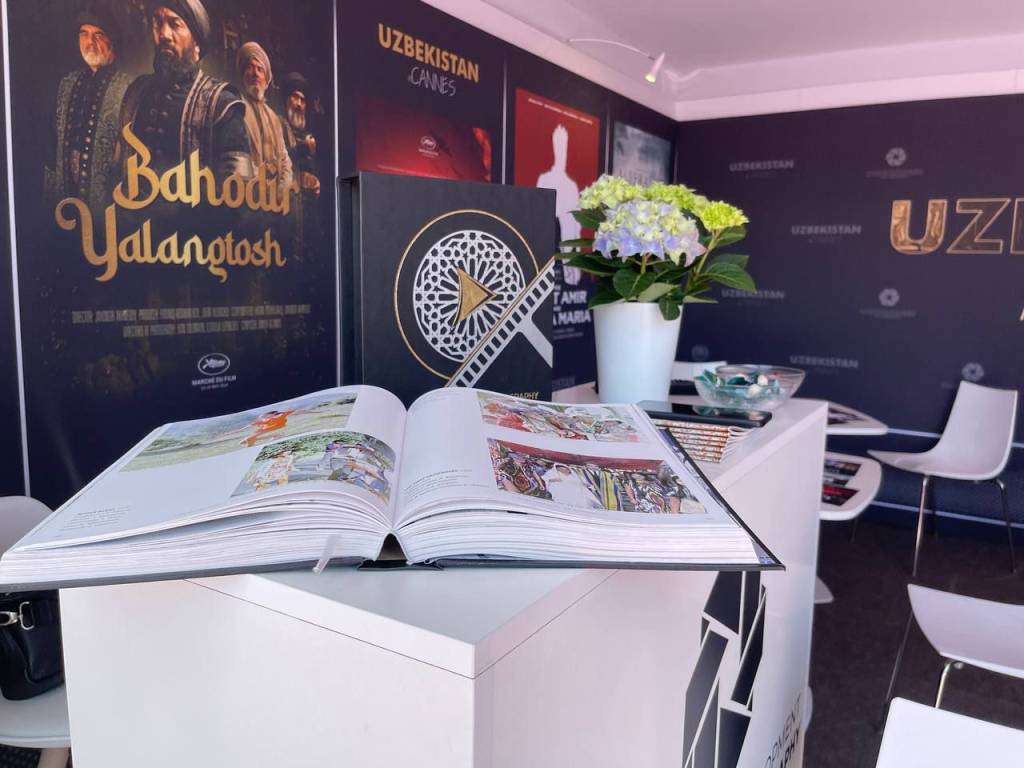
Uzbekistan Pavilion at the 2024 Cannes Film Festival. Photo: Ministry of Culture of Uzbekistan
In 2024, shortly before the opening of the Tashkent International Film Festival "Pearl of the Silk Road," Uzbekistan was visited by Joël Chapron — the official correspondent of the Cannes International Film Festival for the countries of the former USSR, a renowned film critic and specialist in promoting French-language cinema, and a translator for Russian-speaking members of the film festival jury. The festival, scheduled for September 15–19, was postponed by the decision of the organizers. Cited reasons included a scheduling conflict with other international events taking place in the republic, including the Futsal World Cup, as well as the ongoing acceptance of applications despite the official deadline having passed.
In the Uzbek media space, sensational headlines periodically appear claiming that a particular domestic film has "won at Cannes." For example, the documentary film "The Dreamers" (2024) by director Ruslan Saliev, dedicated to the history of Jadidism, received an award in the "Best Educational Film" category at the World Film Festival in Cannes. And the short film "Tea" (2019) by young Uzbek director Shakir Kholikov, which was his graduation project at the State Institute of Arts and Culture of Uzbekistan, was awarded the Grand Prix at the ENTRE 2 Marches festival, held as part of the 72nd Cannes International Film Festival.
Several nuances are important to understand here.
Firstly, besides the main Cannes International Film Festival, the city indeed hosts other film events — both parallel official sections and independent screenings. Secondly, within the festival itself, there are separate programs such as Short Film Corner, Cinéfondation, ACID, or Marché du Film, which formally operate under the auspices of Cannes but are not part of the main competition program and do not award the Palme d'Or. Some of them operate on an open participation model or serve as industry platforms for networking and project promotion.
Thus, participation in such sections is undoubtedly an important step for promoting Uzbek cinema on the international stage, but it does not mean winning the official competition of the Cannes Film Festival. Correct positioning of such news helps form a more accurate and respectful perception of national cinema both within the country and abroad.
The fact remains: throughout the entire history of the Cannes Film Festival, Uzbekistan has never been represented in the main competition, special screenings, or premiere sections.
The only exception — and even that is a stretch — could be considered Mikhail Borodin's film "Products 24." However, this project is de jure not Uzbek: it was fully financed by Russia. Moreover, the film's creative team chose a different platform for its premiere — the 72nd Berlin International Film Festival.
Neighbors' Success
In December 2022, film industry professionals had the opportunity to get to know the native of Shymkent, film director Sergey Dvortsevoy and actress Samal Yeslyamova on the sidelines of the XVI International Eurasia International Film Festival.
Kazakhstan has achieved significant success at this prestigious film festival. In 1998, Darejan Omirbaev's film "Killer" was presented in the "Un Certain Regard" program. In 2008, Dvortsevoy's film "Tulpan" won the main prize of the same section.
In 2018, Dvortsevoy's "Ayka" (2018) was included in the main competition of the 71st Cannes Film Festival, where Yeslyamova was awarded the prize for Best Actress. That same year, the festival's top prize, the Palme d'Or, went to Japanese director Hirokazu Kore-eda for his film "Shoplifters." Thus, Dvortsevoy was competing against a three-time Cannes Festival laureate.
In addition to excellent dramaturgy, direction, storyline development, cinematography, and acting, one of the secrets to the success of the film "Ayka" was its bold exploration of the acute and relevant issue of labor migration in our region.
For our filmmakers, such creative freedom remains an unattainable luxury for now.
Talent vs spirituality
According to established practice, film production in Uzbekistan is almost entirely carried out within the framework of state orders. All projects undergo not only artistic but also ideological examination — it is not advantageous for members of the artistic council, who essentially perform the function of ideologists, to raise sharp social issues. For such initiative, at best, there will be no reward; at worst, sanctions may follow.
The film "Products 24" (2022) serves as a telling example, which also touches on a painful topic for the region—labor slavery and the exploitation of migrants. However, despite its sharp plot, the film was state-funded—in this case, by Russia. According to Borodin, the project team approached the Cinematography Agency of Uzbekistan for permission to film in the country. Permission was granted only on the second attempt—due to scenes in cotton fields being present in the script.
Before his departure from the position of Director of the Cinematography Agency, Firdavs Abdukhalikov sanctioned work on two promising projects: one of them became the social drama "Vata" by Rashid Malikov, the second — a new film by the classic of Uzbek cinema, Honored Art Worker Ali Khamraev. However, only the first project was launched into production — the corresponding order was issued for it in time.
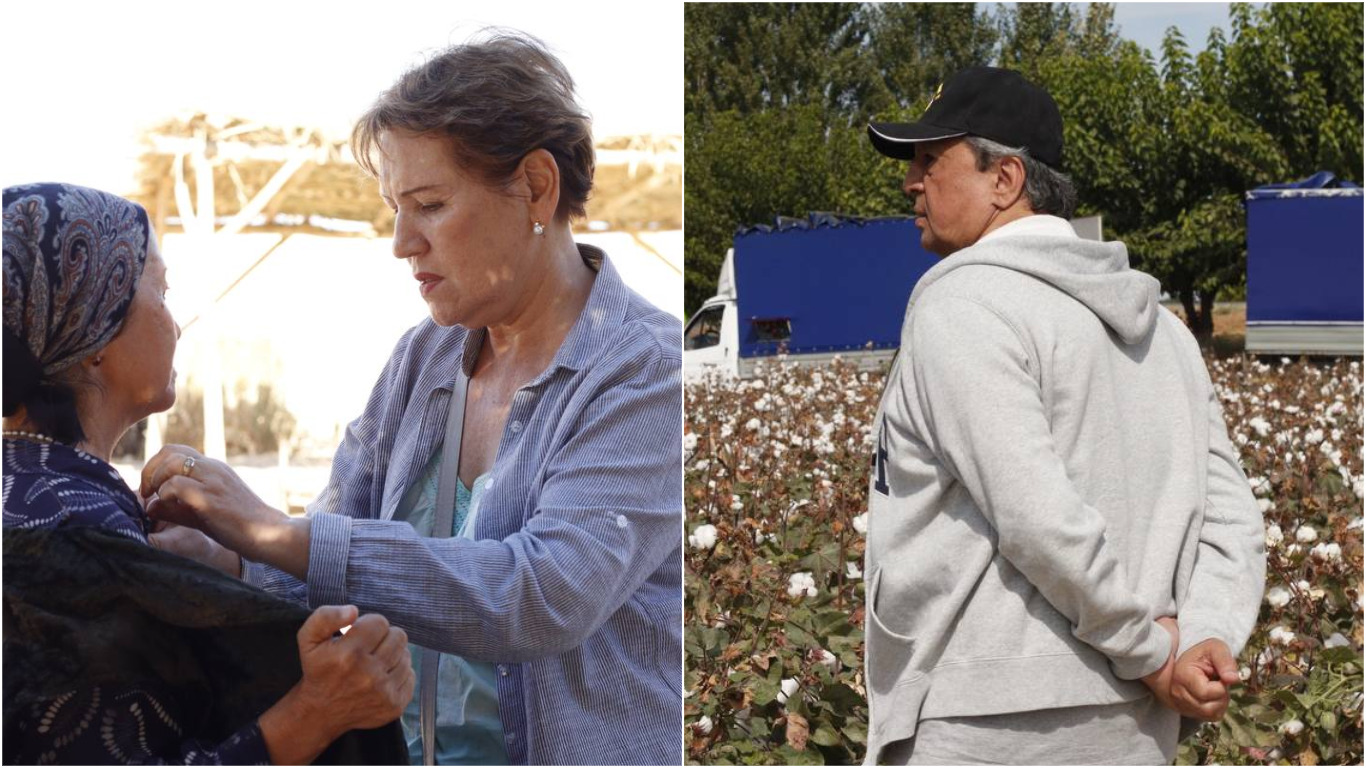
Filming of the movie "Vata". Photo: Tashkent branch of VGIK
The film "Vata" ("Cotton") could not get approval from the artistic council for a long time, a member of which, ironically, was the director Malikov himself. The reason for this was the traditionally inconvenient topics for local censorship: labor migration, cotton farming, family breakdown. The film lacks a conventional happy ending, and the finale is sustained in a heavy, minor tone—which in itself is a rarity for Uzbek feature films created under state order.
In November 2024, at a reporting meeting with media representatives attended by the Minister of Culture, the leadership of the Cinematography Agency stated the need to introduce "spiritual expertise" for all media products. In December 2024, the Ministry of Justice reported that media products could only be subject to examination for compliance with legislative, but not spiritual norms, adding that the project had been withdrawn by the initiator. Nevertheless, attempts to supplement or strengthen the powers of the artistic council with new ideological mechanisms are indicative.
Meanwhile, it is precisely auteur, festival cinema, free from administrative pressure, that today forms the basis of international recognition. What awaits young directors and screenwriters under such conditions is difficult to predict — but a trend of creative professionals emigrating abroad is already evident. Thus, Kholikov is developing his next project in Kazakhstan, and Timur Murodov planned to establish himself in South Korea—until he was forced to return to the country in a 'voluntary-compulsory' manner.
Liked the story? Subscribe to us on Instagram and Telegram — there's even more interesting content there.
Read also


Newsletter
A letter from the HD editors
Once a week, we send the best stories, events, and cultural discoveries from Central Asia.