Cinema and Performing Arts
Only hearing and memory, only hardcore: how Soviet films were taught to speak Uzbek in Tashkent
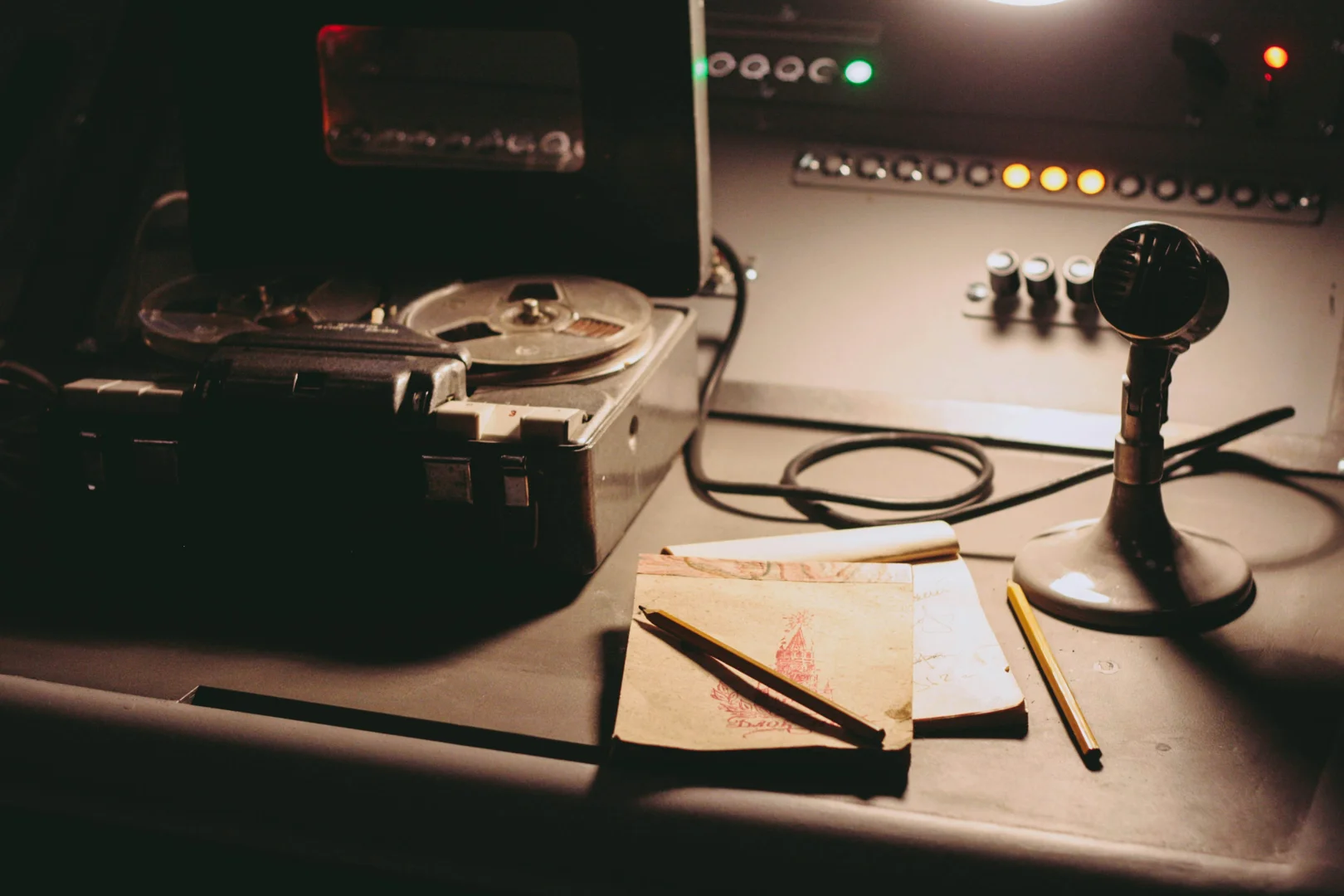
The first dubbing studio in Tashkent had no soundproofing or professional actors—but it had a passion for cinema and a bunch of dedicated enthusiasts ready to learn on the fly. We tell the story of how, under semi-amateur conditions, one of the most respected dubbing schools in the USSR was created.
The School of Film Dubbing was established in Uzbekistan in 1937 at the Tashkent film studio "Uzbekfilm". It was created on the initiative of Adil Sharapov — a writer, translator, and one of the founders of this profession in Soviet Central Asia.
A studio in a former madrasa
The working conditions were initially spartan — the pioneers of Uzbek dubbing were located in the Madrasah of Ishanqula Dadkho building in Shaykhantahur. From 1925 to 1928, this was the site of the Tashkent film studio and the filming of the first Uzbek films. The premises had no soundproofing, and a tram line ran right under the windows — recordings were made at night to improve quality.
At that time, there were no theater universities in the Uzbek SSR, so actors, directors, announcers, and editors were initially trained at the film studio. Gifted students were sent to study in Moscow and Leningrad, to courses at VGIK. The first notable graduates of the studio school were Nazira Aliyeva and Yulduz Rizayeva, and the founder of the national dubbing school is considered to be Bori Khaydarov. Working alongside him was Viktor Kutyukov, who participated in dubbing the first film dubbed into the Uzbek language, serving as the assistant director.
The film chosen was the 1937 Soviet musical comedy directed by Ivan Pyryev about collective farm life — "The Rich Bride". The choice was not accidental: in the late 1930s, the image of the new socialist way of life was actively being formed in Soviet Uzbekistan, and cinema was seen as an important tool of party propaganda aimed at mass perception of these transformations.
The process proved to be labor-intensive: there was no equipment for synchronizing sound with images in Tashkent, a shortage of microphones, editing consoles, and technical specialists. Songs and musical episodes were re-recorded from scratch: the vocal parts were performed by Khalima Nasirova, actors were invited from the opera theater. Writer Abdulla Qahhor checked the sound of the text against the characters' articulation, and poet Hamid Olimjon adapted the songs. The final sound editing was done in Moscow in a great hurry. Sharapov personally oversaw the entire process and delivered the finished film copy back to Tashkent. The screening took place before Yuldosh Akhunbabaev — the then head of Soviet Uzbekistan. He liked the film — he ordered it to be shown throughout the republic.
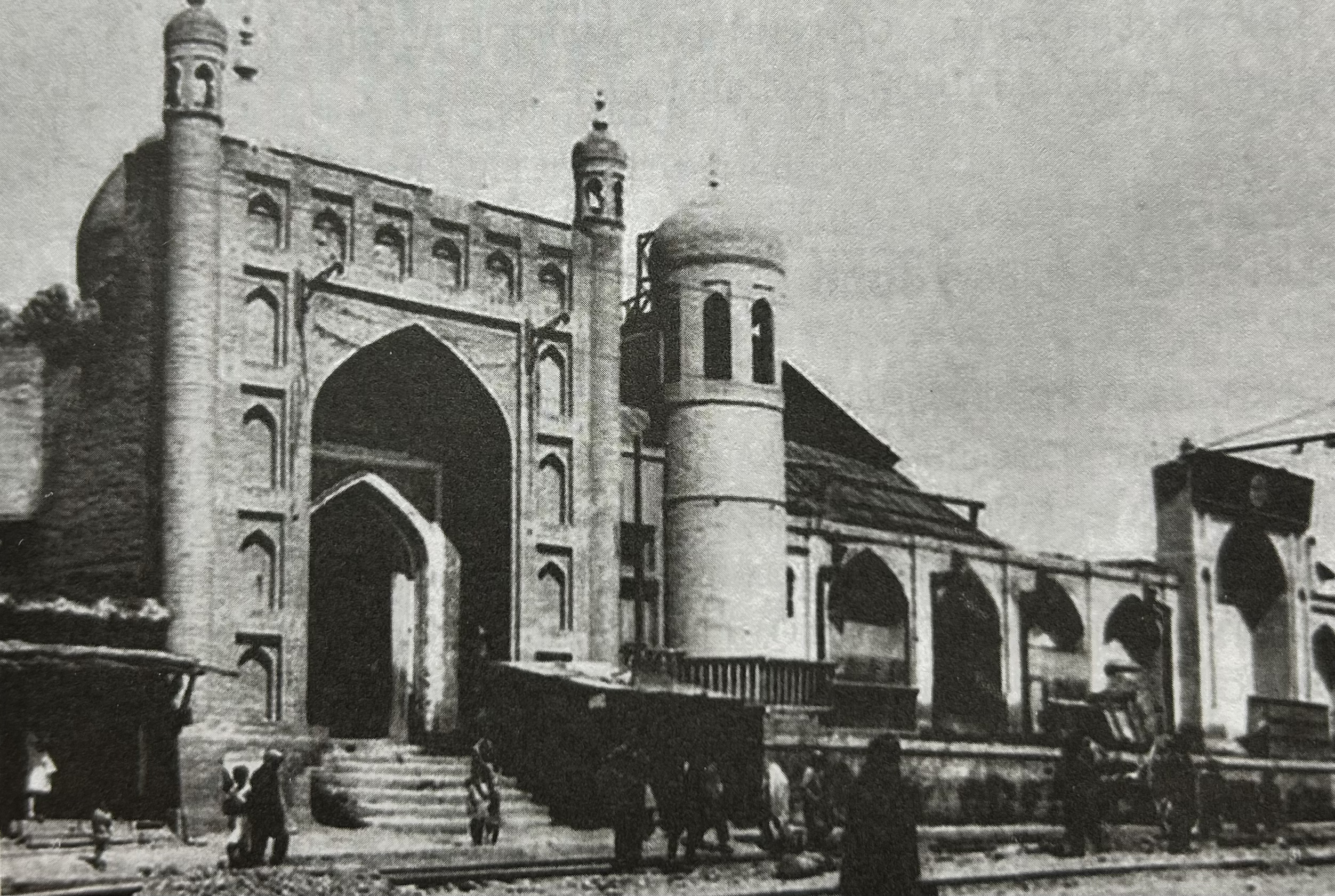
The first film studio "Shark Yulduzi" in the Tashkent district of Shaykhantakhur. Photo from the book "The History of Dubbing Art" (authors: Mukambar Rakhimova, Aibek Veysal-ogly Kapadze, Komiljon Tursunboyev).
How Soviet Film Characters Started Speaking Uzbek
During these same years, national cinematography was also developing. Although many films were made in Russian due to the requirements of USSR Goskino, a trend gradually emerged towards filming and dubbing in literary Uzbek. In 1939–1940, films were dubbed in Tashkent for Kyrgyzstan, Karakalpakstan, and partially for Kazakhstan. Uzbek directors did not merely dub films; they also trained colleagues from neighboring republics, shared their methodology, and set standards.
After the technical base for dubbing was established in Uzbekistan, a new phase began — the formation of an editorial and scriptwriting school.
Translating films from one language to another required subtle adaptation: it was important not only to preserve the meaning but also to convey the articulation, emotional weight, rhythm, and national flavor. Initially, this work was done by the directors themselves, but over time, professional literary figures were brought into the projects—among them were writer Abdullah Qahhor and poet Hamid Olimjon.
Their task was not merely to translate, but to bring the dialogues to life, weave in Uzbek idioms, folkloric turns of phrase, and make the speech organic and expressive. Sometimes the translation surpassed the original due to its vivid imagery, emotional depth, and careful handling of the source text.
Special attention was paid to dubbing synchronization — the precise alignment of speech with the characters' lip movements. The dubbing artists were trained by specialists from Moscow, studying syllable structure, rhythm, intonation, and phonetics. All of this required deep knowledge of both the original language and Uzbek speech culture. Screenwriters often participated in the dubbing process themselves to defend the meaning and preserve the artistic integrity. A compromise between artistic and technical quality was found through dialogue between the screenwriter, director, actor, and sound engineer.
From Voice to Image: How Actors Were Cast and Intonations Were Found
The day before the recording, actors were gathered in the studio or at the "Vatan" cinema to watch the film—with a rough sound mix or without it. The director gave instructions: which role each person should pay attention to. This shaped not only the understanding of the task but also the culture of film perception.
After viewing, voice tests were conducted. Several people were auditioned for one role — not only talent was considered, but also the timbral combination with partners. There were also cases of direct appointments, when the director clearly saw the future hero in the actor. For supporting roles, reliable actors were also chosen, such as Dias Rakhmatov and Tulkyn Tadzhiev. However, Khamza Umarov refused to dub King Lear in the 1970 Soviet film adaptation directed by Grigory Kozintsev. He yielded this role to Obid Yunusov, whose strained timbre more accurately conveyed the tragedy of Shakespeare's hero.
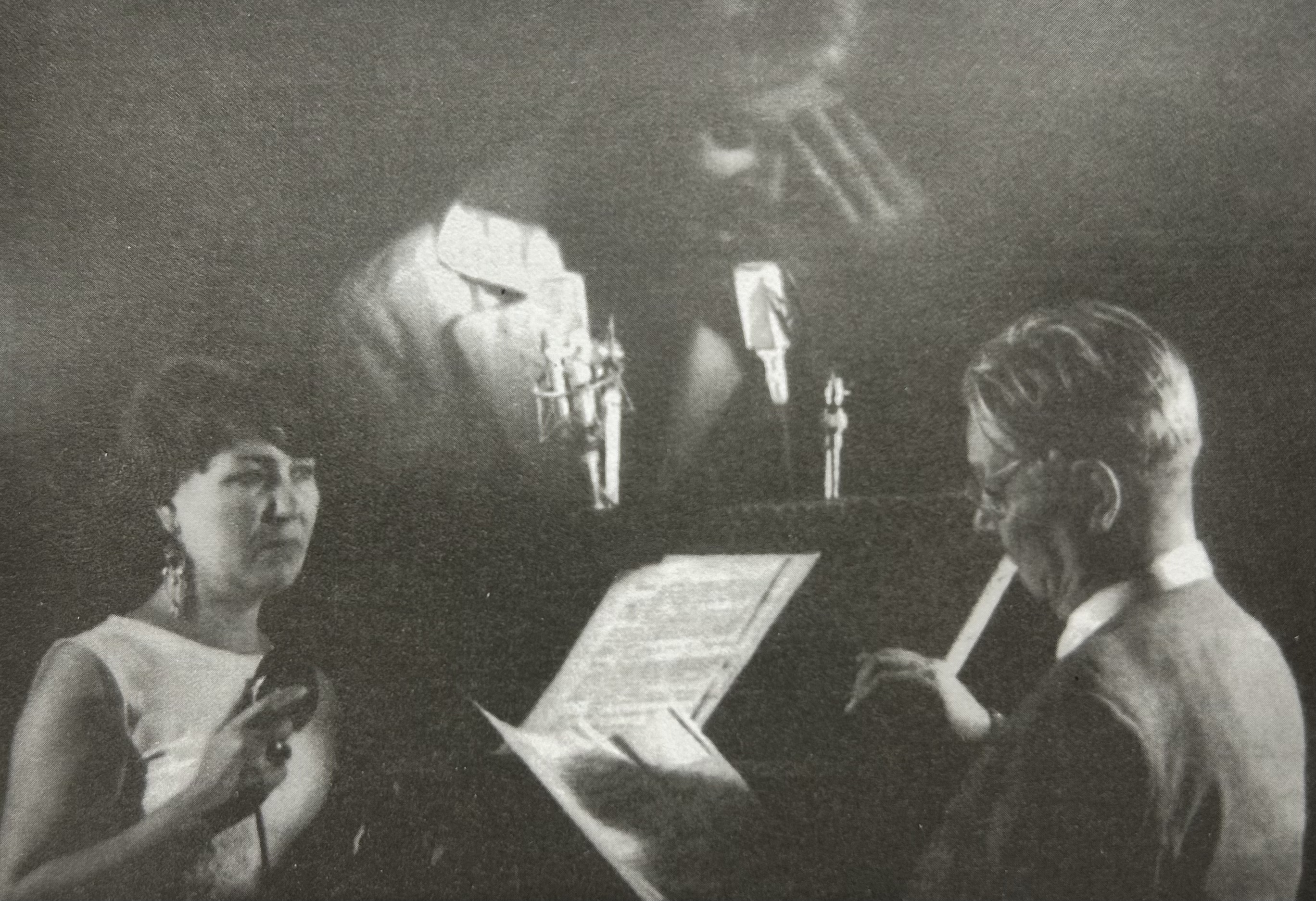
Dubbing director Boris Khaidarov and actress Valentina Gozieva. Photo from the book "The History of Dubbing Art."
The preparation for dubbing involved not only reading the text but also deeply immersing oneself in the character. Shukur Burkhanov, Sara Ishanturaeva, and their colleagues rewrote the dialogues by hand, sometimes in Arabic script—this helped them better feel the rhythm of the phrases and the nuances of intonation. Dubbing sessions lasted no more than six hours a day, taking into account the strain on vision and attention. Actors were called in for specific scenes depending on their schedules in theaters or on the radio. Per shift, 8–10 scenes were dubbed, and typically, the entire film took from 4 to 8 days.
After the voice recording came the sound assembly stage: voice, sound effects, and music were recorded separately, then mixed together. The sound engineer was tasked with achieving a perfect balance so that the dialogue was audible, the music didn't "overwhelm" the emotional moments, and the sound effects didn't distort the meaning. The sound editing was done manually, sometimes frame by frame. Each line had to smoothly and precisely integrate with the camera movement — abrupt entries created a sense of unnaturalness and disrupted the rhythm of perception.
The script adapted during the dubbing process. If a scene began with a quiet dawn, the director could ask the sound engineer to "bring the music closer" — to enhance the atmosphere. Such adjustments required a keen ear and genuine directorial instinct. Control encompassed everything: timbre, background noise, speech tempo, the final sounds of words, which had to precisely match the actor's articulation on screen.
The final re-recording (so-called "dubbing" or "additional recording") was of particular importance. If the sound in the finished film needed replacement, the actor had to return to a role played long ago. This was not easy—the emotion had already been lived through, the voice had changed, the intonation had slipped away. This is why, during the recording stage, maximum concentration was required from the actor, director, and sound engineer: "patches" could destroy the fabric of the scene.
When movies were dubbed better than they were filmed
Since the 1960s, dubbing in Uzbekistan has transitioned into a stage of stable professional production. The dubbing system became centralized and regulated: the plan, which came down from Goskino USSR, included 65-70 films per year. This pace allowed not only for the fulfillment of the state order but also for accumulating funding for their own initiatives, bonuses, and internal cultural events. When a new studio with three professionally equipped halls was built in Tashkent, dubbing finally transformed from a craft into an industry.
In the 1960s–1970s, the school of Uzbek film dubbing became known beyond the Uzbek SSR. At inter-republican competitions, films dubbed at "Uzbekfilm" won prizes, and the quality and accuracy of the work of the Tashkent studio were highly praised by the Union of Cinematographers of the USSR.
However, the development of the national dubbing school was hindered by ideological restrictions. For instance, with rare exceptions, Western films almost never made it into the republican distribution, so it was mainly Soviet films arriving from Moscow that were dubbed. This limited the thematic and artistic diversity of the film distribution.
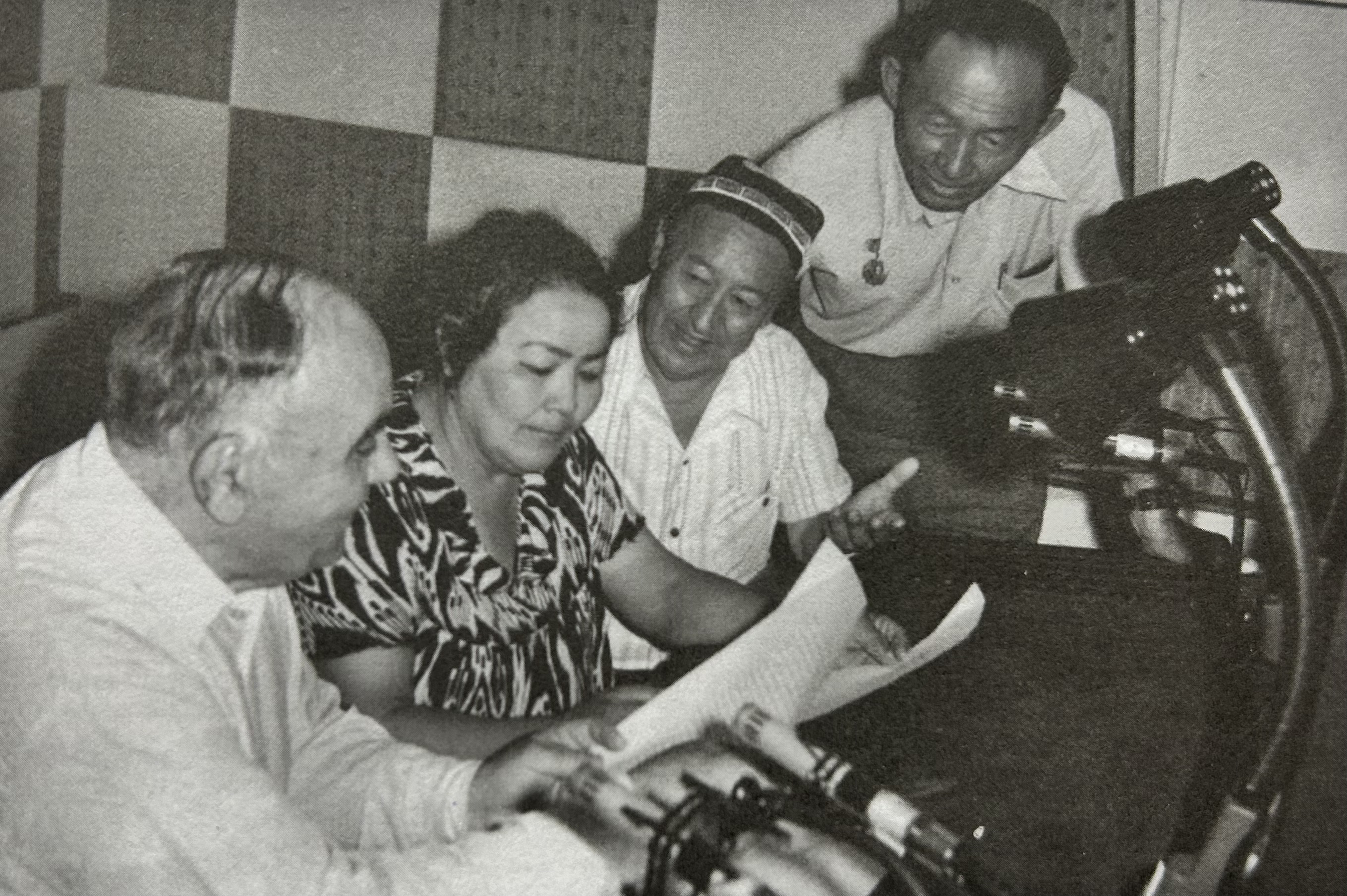
Working on the text. Photo from the book "The History of the Art of Dubbing".
The entire film production cycle at the studio—from script to dubbing—underwent multi-level censorship: approval from Moscow and Tashkent leadership, control by the Central Committee, cultural departments, and repeated viewings after editing.
How Uzbek dubbing began to lose its voice
During the perestroika years, the dubbing industry in Uzbekistan began to decline. The reduction in funding and the drop in box office revenues inevitably affected the work of the studios: whereas they used to dub 3-4 films per week, they were now releasing 1-2 films per month.
At the studio, they began using the so-called four-voice dubbing, where one actor voiced several roles at once. This was most often used for Iranian, Indian, and Pakistani films and series. Despite attempts to preserve the quality of the voiceover, this had already become a necessary measure due to the emerging shortage of personnel. It was precisely in those years that dubbing began to turn into a mechanical reading of the text, and by the end of the 1980s, technical voiceover had completely replaced artistic voiceover.
Modern technologies, as noted by the veterans of "Uzbekfilm," have simplified the process — now actors read the text from a monitor, but this disrupts the rhythm and complicates intonation. Old dubbing actors usually held the entire text in memory, processed it through themselves, and paused only as a last resort to catch the necessary emotional wave.
Despite the collapse of the Soviet film industry, veterans of the Uzbek dubbing school managed to preserve this legacy and pass on their experience to new generations.
Recently, the first dubbing museum in the country was opened at Uzbekfilm. Its initiator was the People's Artist of Uzbekistan Mukambar Rakhimova, who also published memoirs in 2023 for the 85th anniversary of Uzbek dubbing. The book brings to life the studio atmosphere of past years, conveying the voices and personalities of the key figures of the era. The museum occupies two floors: downstairs—examples of equipment and materials about the pioneers of Uzbek film dubbing, upstairs—archives, scripts, and personal notes of the actors and their mentors.
Did you like the story? Follow us on Instagram and Telegram — there's even more interesting content there.
Read also
Newsletter
A letter from the HD editors
Once a week, we send the best stories, events, and cultural discoveries from Central Asia.