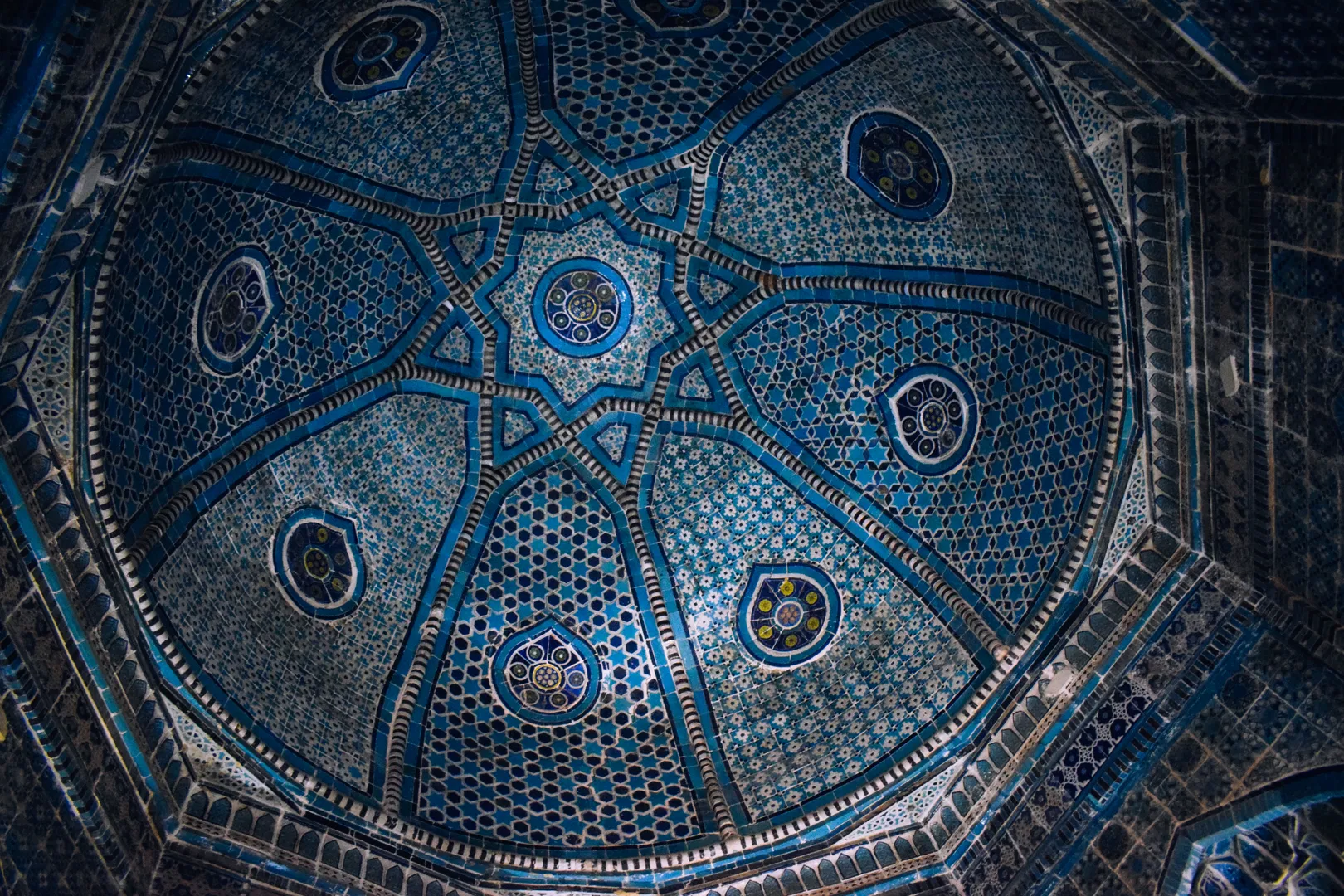
Following the advice of several experts, and having discarded seven introductory paragraphs explaining why this article is so important and necessary, let us get straight to the point and dive into Tashkent's ornamentation.
You can find the introduction to this article here:
The pattern of civilization from ornamentsEvgeny Sklyarevsky’s Guide to the Ornamental Heritage of Tashkent.mag.humodoc.com
Whenever he turned his brush to ornament, he created Paradise anew
From the article by Elmira Gyul "Ornament impersonates the World and Sky". SANAT, 2005. Issue No. 3-4
Let us begin with a reminder: ornament is Tashkent's greatest decoration and, to the discerning eye, one of its greatest attractions. To fully appreciate it, it helps to understand at least a little about how it works, or at the very least to know what to point at in order to impress your friends with your apparent expertise.
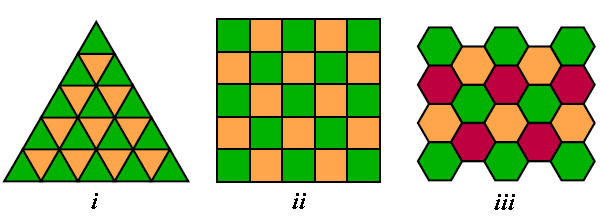
It is also worth noting that, beyond its historical, sacred, aesthetic and cultural significance, Islamic ornament is extraordinarily rewarding for us [crossed out] lovers of geometry and can provoke more than a few cries of astonishment and admiration when contemplating its finest examples, of which there is certainly no shortage in Uzbekistan and Tashkent. On one hand, the creators of these ornaments found themselves in the grip of a rather unforgiving rule: a plane can only be tiled with regular triangles, squares and hexagons. On the other hand, limitations like these often stimulate creativity. They compel artists to produce masterpiece after masterpiece, drawing on star polygons, irregular shapes and all sorts of auxiliary elements.
Beyond these geometric marvels, there are plenty of other things worth knowing, the sort of knowledge that will greatly increase your enjoyment of ornamentation and raise your standing to near legendary levels among classmates, fellow soldiers, colleagues and the rest of your tour group.
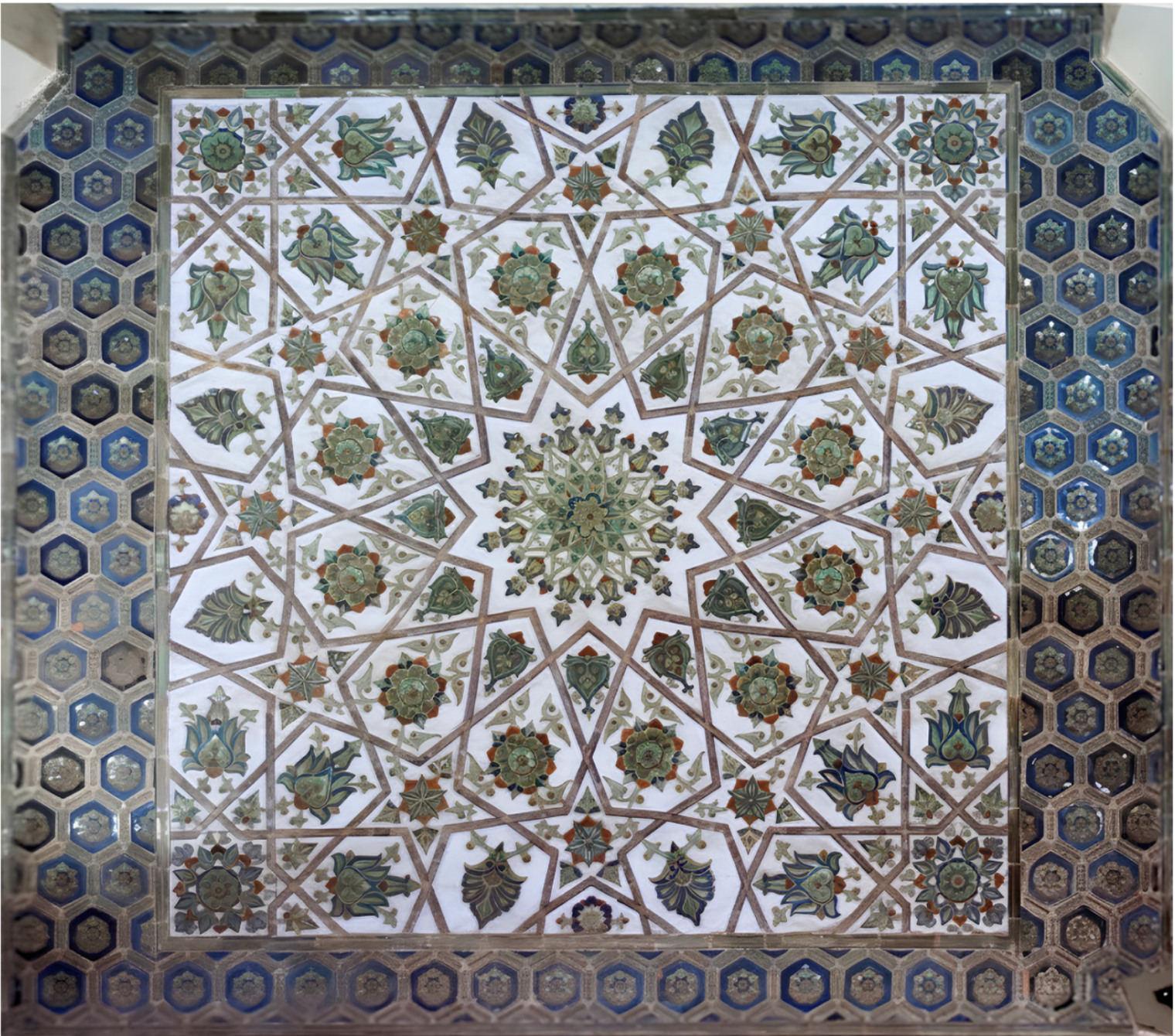
It is always convenient when nearly all the features of an ornament can be studied through a single example, and here we are in luck: such an example exists. It is Tashkent's finest ornament, located on the transfer between Navoi and Pakhtakor metro stations: the most thrilling and the most encyclopaedic of them all.
Let us begin. There are three things to note here.
First, it can be photographed accurately only from the centre line of the escalator. Any attempt from either side introduces distortion, turning the quest for the perfect photograph into a performance piece of its own.
Second, the panel is visible only while the escalator is moving, and only for a few fleeting seconds. In this respect, it resembles an immersive theatre production.
Third, almost every important feature worth observing in Islamic ornament appears here in one form or another.
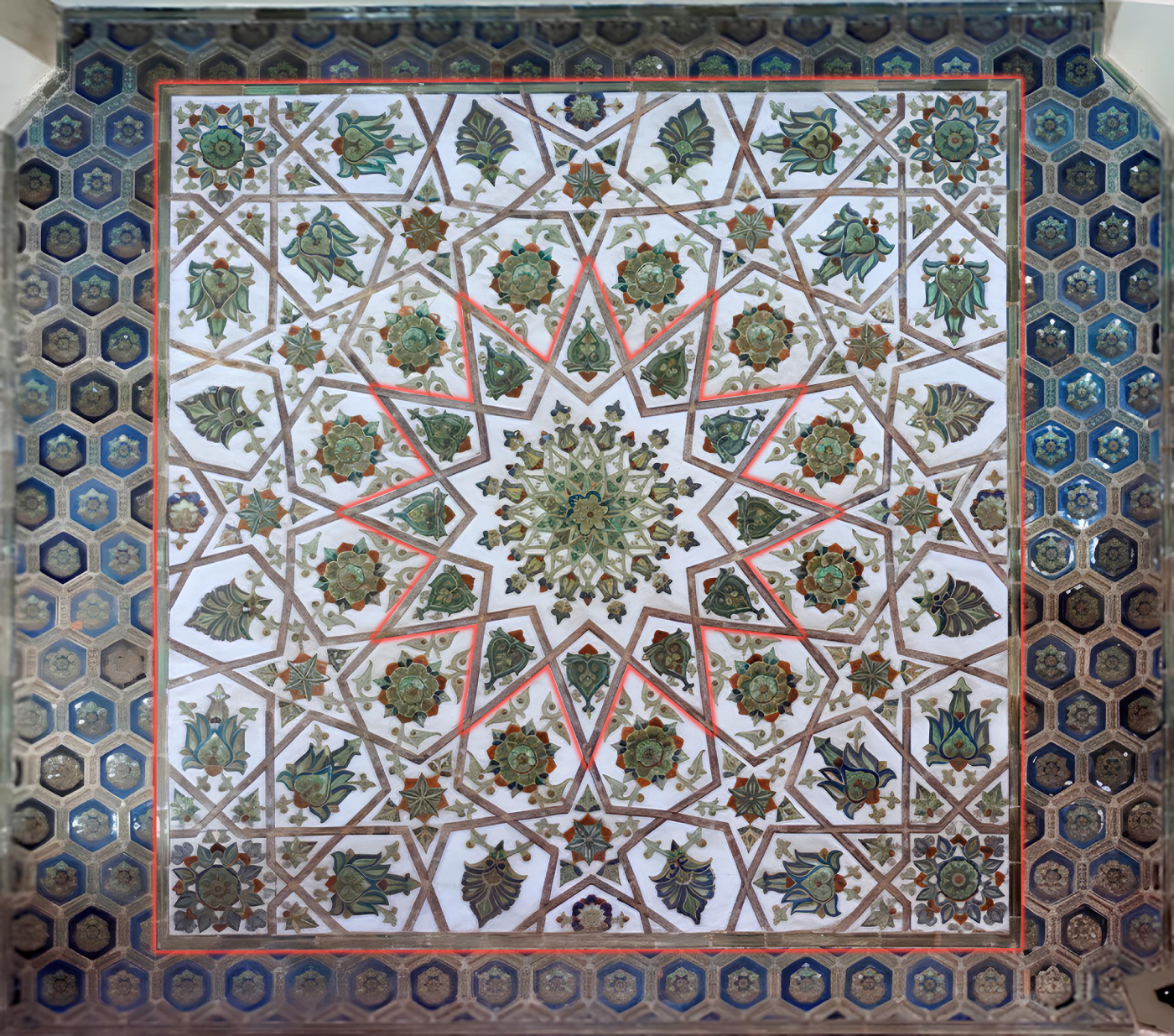
Let's go through them one by one.
- 01The number of points on the central star. The most common are eight-, ten-, and twelve-pointed stars, while other star polygons are less common. We will devote a separate article to square-based designs, while seven-pointed stars are so rare that they deserve an article of their own. Nine-pointed stars appear only occasionally and require ingenious geometric constructions to fit naturally into the overall pattern. Star polygons with a larger number of points, such as eighteen or twenty-four, also occur, but they tend to resemble hedgehogs or thorny burrs, making them less visually appealing and losing much of the geometric magic.
- 02The size of the stars. Here, the central star, framed by five-pointed stars, fits perfectly within the enclosing square. Had the central star been either larger or smaller, the composition would not have achieved the same sense of harmony.
- 03Connections. At the point where the stars meet, both between the central twelve-pointed star and the surrounding five-pointed stars, and between the five-pointed stars themselves, the angles are vertically opposite. In other words, the lines continue seamlessly without changing direction. This creates an additional visual effect: the lines seem to come alive, inviting the eye to follow them as independent elements of the design.
- 04Lines. Always pay attention to the width of the lines, as it varies according to the artist's intention. Sometimes they are broad, outlined with a contrasting border, and where they intersect they pass over or under one another, giving the ornament a striking sense of depth. In other cases, the ornament has no visible lines at all; they are implied rather than drawn. In this example, the lines are clearly defined and contrasting, yet relatively slender. They define the geometric forms without dominating them, creating a harmonious overall composition.
- 05Background. The background is important because it determines the overall mood of the ornament, whether light or dark. Here, the background is white, an uncommon choice that gives the composition a particularly festive appearance.
- 06Colour. Most ornaments are turquoise, offset by contrasting dark or white elements. More recently, however, beige-toned designs have begun to appear, for example at the Suzuk-Ota complex. In this ornament, by contrast, green is paired with a reddish-brown hue that may have developed during firing. Set against the white background, this combination gives the design a particularly rich and celebratory character.
- 07The combination of girih and islimi. This design brings together girih, the geometric ornament, and islimi, the vegetal ornament. Here, elements of the vegetal pattern are used to fill the spaces within the geometric composition, allowing the two ornamental traditions to complement one another perfectly.
- 08The use of space. Notice how evenly the design fills the available space. There are no empty patches of background, yet neither is there any overcrowding of motifs.This is the result of craftsmanship refined over centuries and passed down from one generation to the next. It is what makes the entire composition so pleasing and, once again, so harmonious. Our thanks go to the masters who created it.
- 09Seamless Continuity. The ornament is fitted into its enclosing square with such precision that each corner contains a quarter of the central star. If an identical square were placed above, below, to the left or to the right, the pattern would continue seamlessly, with the boundary between the two becoming virtually invisible. More remarkably still, the square can also be reflected horizontally or vertically, allowing the ornament to extend infinitely in every direction.
A philosophical insert from Rustam Batyr's article is particularly apt here:
The frame outlining the girih does not, in fact, define its boundaries. Rather, it is like a window cut into our world, revealing before us the prospect of eternity. And that eternity is revealed through the fundamental unity of its infinite diversity.
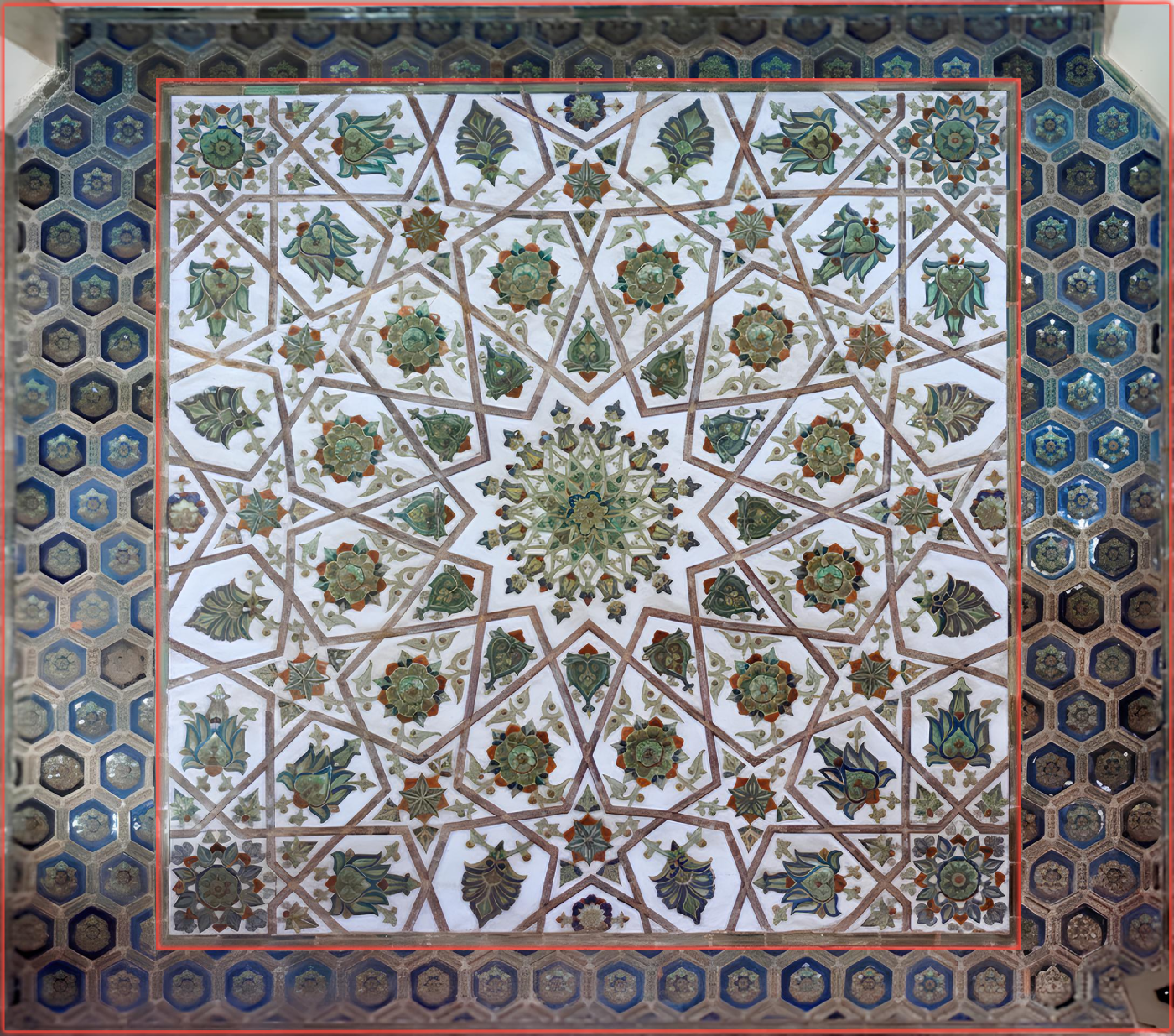
- 10The border. Notice that the ornament is often enclosed by a border featuring geometric elements that contrast with the polygons of the main pattern, in this case hexagons. The width of the border is carefully proportioned, giving the composition a harmonious visual balance. Imagine it either wider or narrower, and the composition would no longer feel quite so harmonious.
- 11Distortions. The greatest secret of this ornament is that it is not, in fact, a dodecagon!
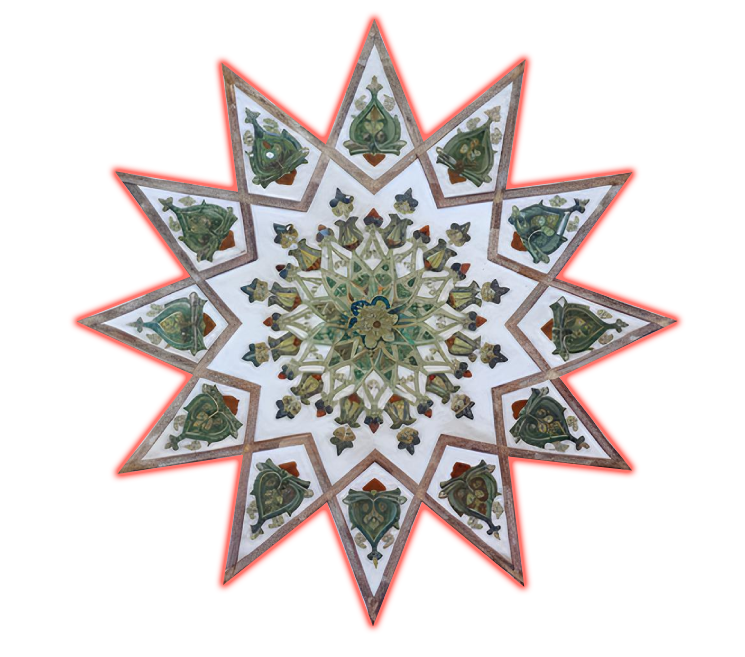
It has twelve vertices, but its sides do not actually run from one vertex to the next, as you can easily verify by placing a ruler against the photograph. The reason is that the vertices of the dodecagon merge seamlessly into those of the five-pointed star (pentagram), even though their vertex angles are different. To make this possible, the dodecagon has been subtly "broken". Because its sides are interrupted by the central star rather than drawn as continuous lines, the distortion remains virtually imperceptible. What can one say? Every detail was conceived, calculated and executed by master craftsmen.
There is a well-known rule of thumb: every formula or numerical argument reduces the readership by a third. So let us avoid too many technicalities and instead admire once again the remarkable craftsmanship behind this metro ornament, created by the ceramic artists and master craftsmen Riskat Mukhamedzhanov and Abdujalil Rakhimov.
The only thing this ornament cannot teach us is the answer to one intriguing question: what lies between the stars? How, exactly, has the problem of filling the plane been solved?
Ideally, the space between the principal stars is filled with convex or star polygons, and it is in this infill that the artist's mastery truly reveals itself. The greater the number of secondary regular stars and regular (or only slightly distorted) polygons that can be fitted between the principal stars, the finer the ornament. If, however, the space cannot be filled using regular stars and polygons alone, and the craftsman has to resort to auxiliary motifs such as "birds", "spools", or other decorative shapes, the ornament is considered less accomplished and less harmonious. After all, anyone can scatter an assortment of irregular polygons across a surface and arrange them into a pattern. But what has that to do with the truly sublime geometric perfection of Islamic ornament?
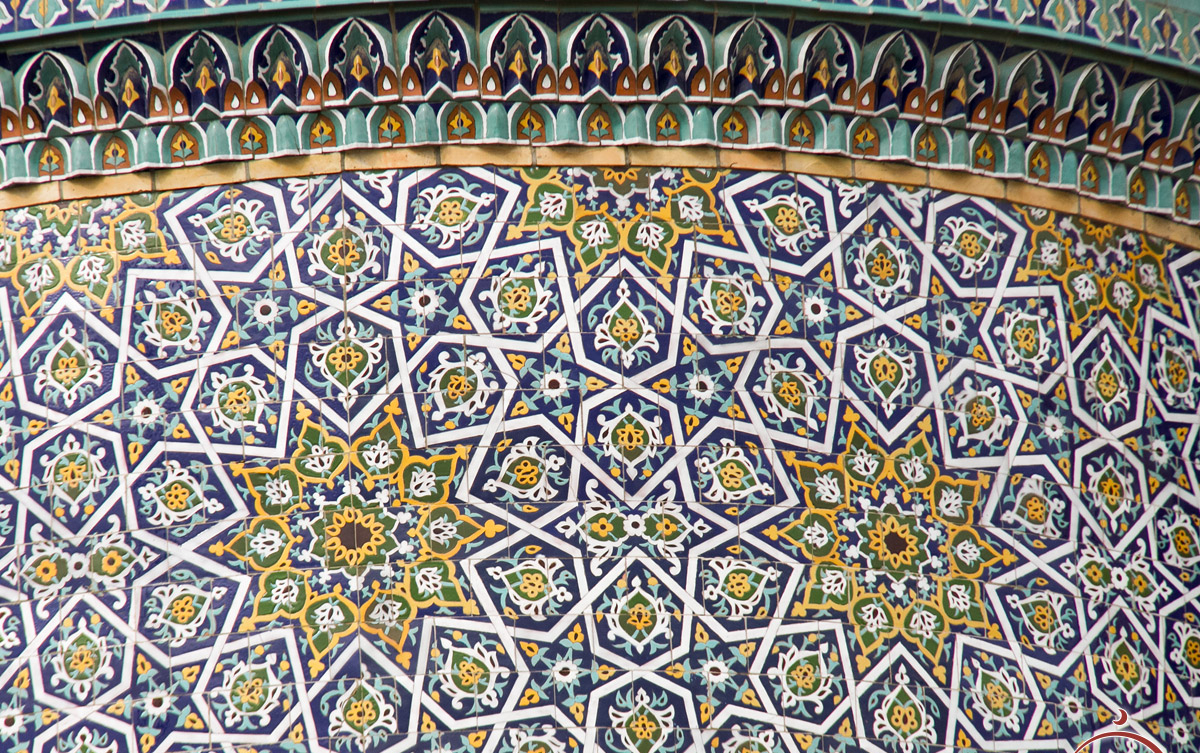
You are now equipped to explore such ornaments on your own. All that remains is to suggest how you can put this newly acquired knowledge into practice.



Newsletter
A letter from the HD editors
Once a week, we send the best stories, events, and cultural discoveries from Central Asia.